Comparison
Weak vs strong satisficing
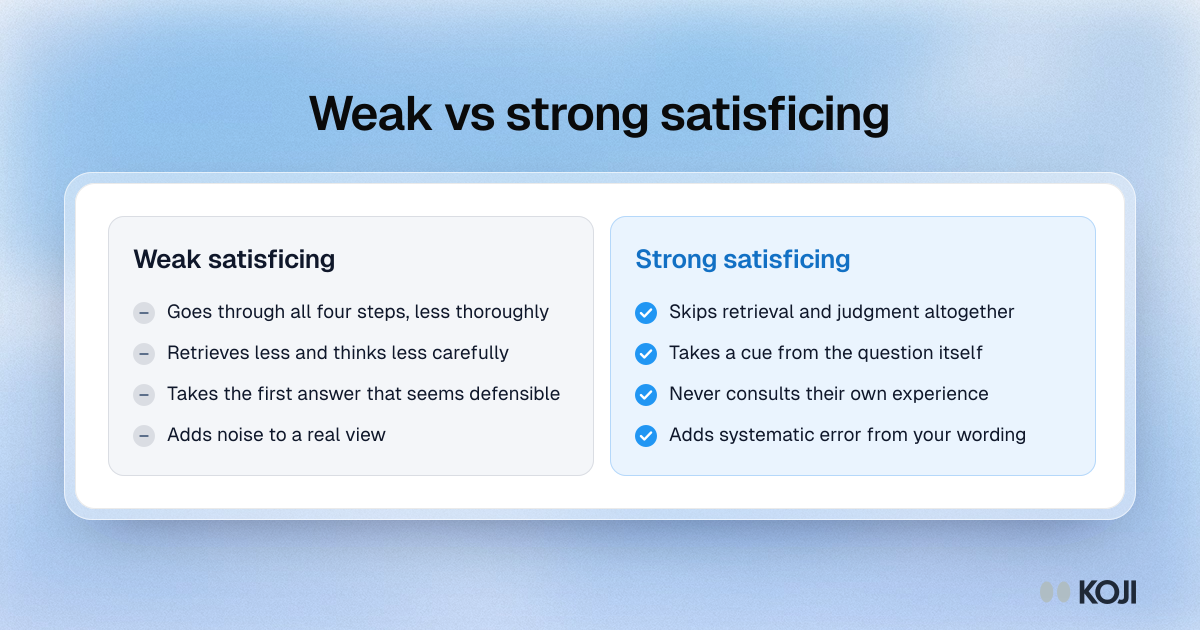
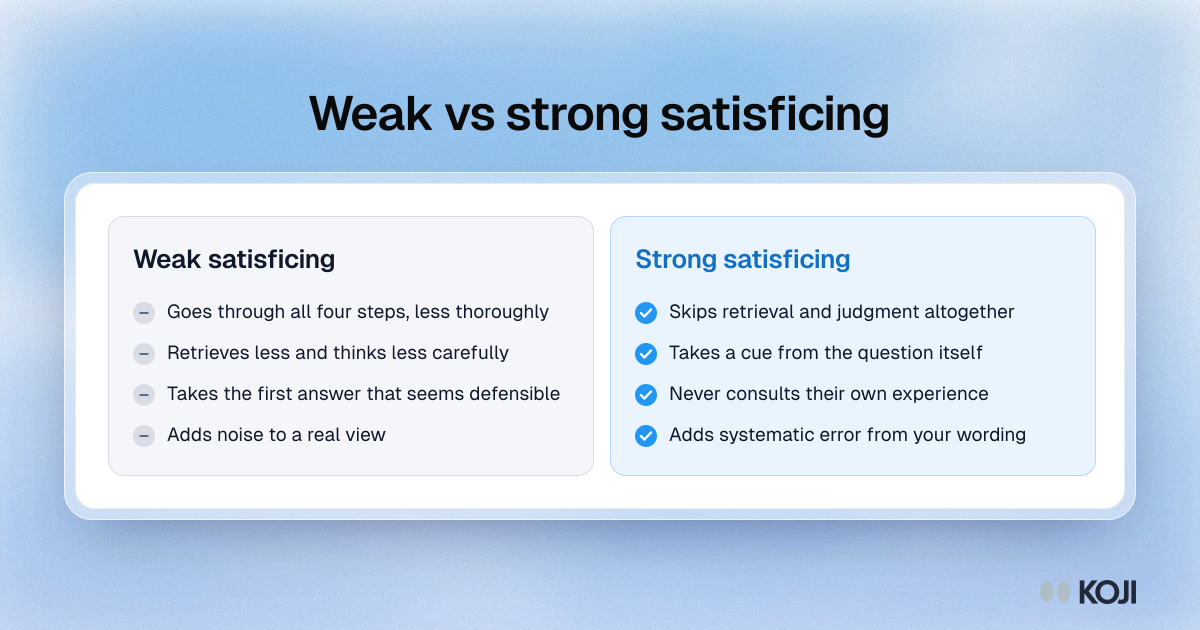
The two degrees of satisficing in Jon Krosnick's framework, side by side. In weak satisficing a respondent goes through every step less carefully and settles for the first defensible answer, so the result is a noisier version of their real view. In strong satisficing they skip retrieval and judgment and build an answer from cues in the question, which adds systematic error. Use it to explain why cleaning noise does not fix biased questions.
Where this appears
What's in this comparison
Weak satisficing
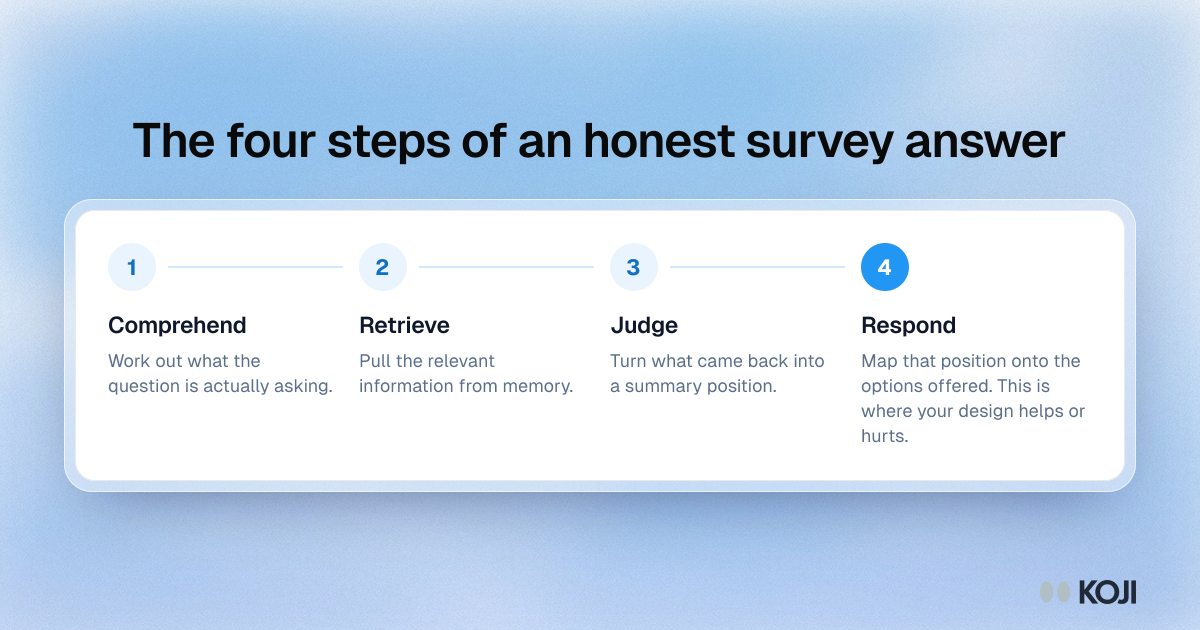
- Goes through all four steps, less thoroughly
- Retrieves less and thinks less carefully
- Takes the first answer that seems defensible
- Adds noise to a real view
Strong satisficing
- Skips retrieval and judgment altogether
- Takes a cue from the question itself
- Never consults their own experience
- Adds systematic error from your wording
Use this image
Free to use in your docs, decks and posts under CC BY 4.0, as long as you credit Koji with a link to this page. To embed it, paste this into your page:
html
<a href="https://www.koji.so/visuals/weak-vs-strong-satisficing"><img src="https://www.koji.so/visuals/weak-vs-strong-satisficing/weak-vs-strong-satisficing.png" alt="Comparison of weak satisficing, a noisier version of a real view, with strong satisficing, where the answer comes from a cue in the question." width="1200" height="630" /></a>
<p>Source: <a href="https://www.koji.so/visuals/weak-vs-strong-satisficing">Weak vs strong satisficing</a>, Koji</p>