Benchmark range
How many Americans are unique on ZIP, gender and birth date
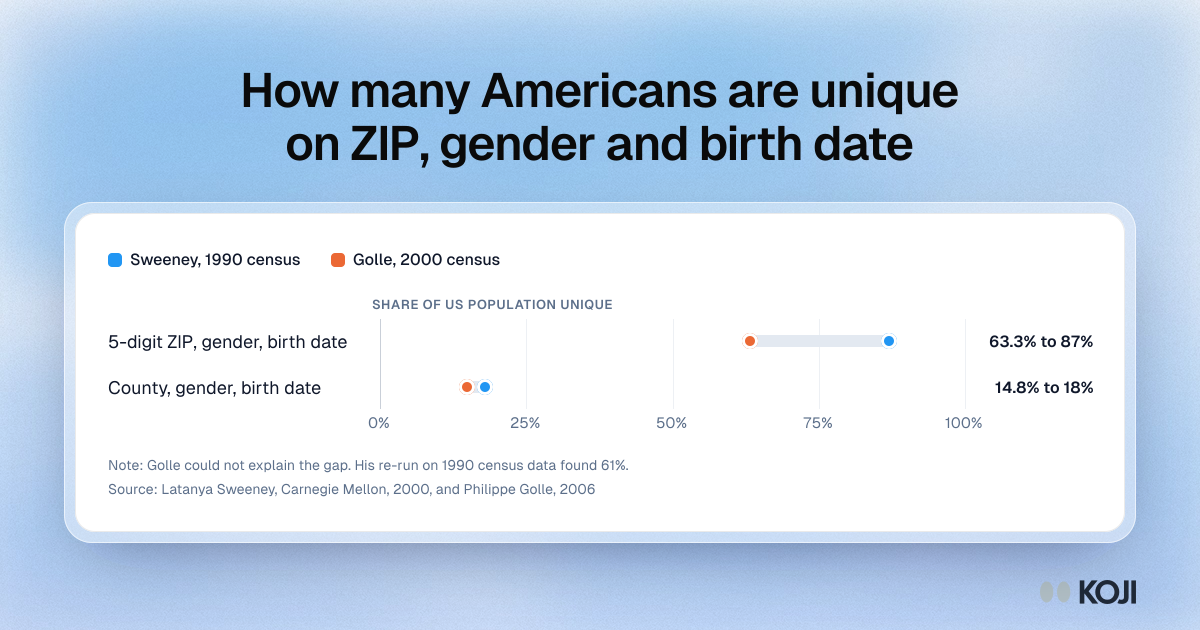
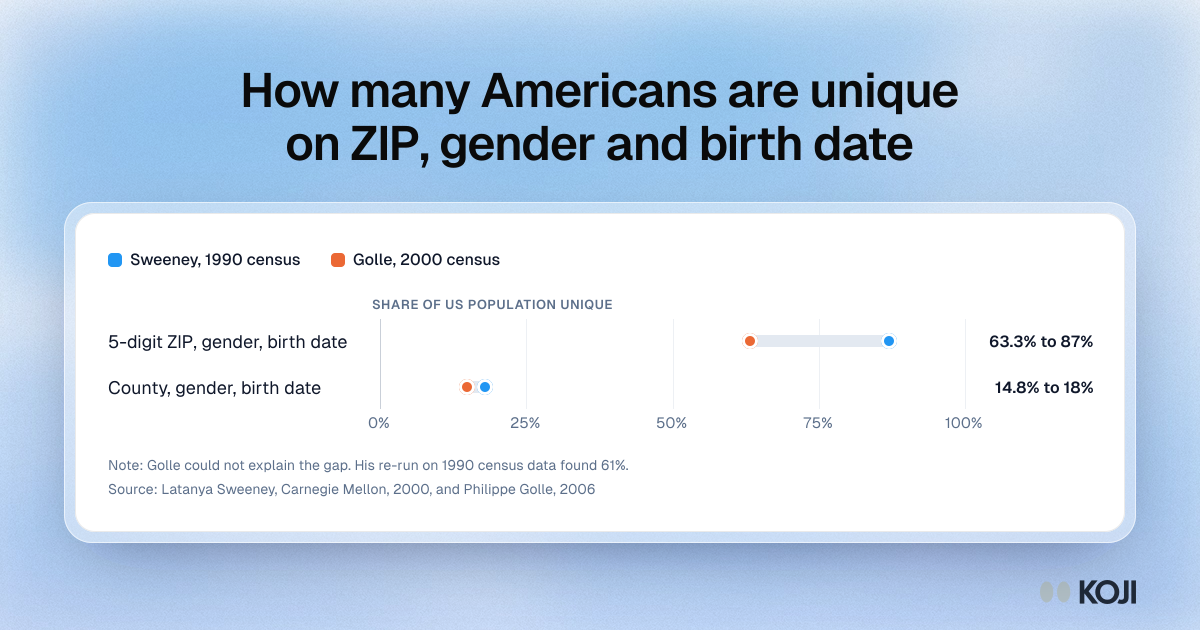
Two studies measured how many people in the US could be singled out by gender, location and full date of birth alone. Latanya Sweeney found 87% on 1990 census data at 5-digit ZIP level and 18% at county level. Philippe Golle, working with the 2000 census, found 63.3% and 14.8%. The gap is unexplained, so cite the smaller number, which still shows how three ordinary fields can identify most people.
Where this appears
What's in this benchmark range
| Sweeney, 1990 census | Golle, 2000 census | Range | |
|---|---|---|---|
| 5-digit ZIP, gender, birth date | 87% | 63.3% | 63.3% to 87% |
| County, gender, birth date | 18% | 14.8% | 14.8% to 18% |
Golle could not explain the gap. His re-run on 1990 census data found 61%.
Use this image
Free to use in your docs, decks and posts under CC BY 4.0, as long as you credit Koji with a link to this page. To embed it, paste this into your page:
html
<a href="https://www.koji.so/visuals/zip-gender-birth-date-uniqueness-sweeney-vs-golle"><img src="https://www.koji.so/visuals/zip-gender-birth-date-uniqueness-sweeney-vs-golle/zip-gender-birth-date-uniqueness-sweeney-vs-golle.png" alt="Range chart comparing two census studies: 87% vs 63.3% of Americans unique on ZIP, gender and birth date, and 18% vs 14.8% at county level." width="1200" height="630" /></a>
<p>Source: <a href="https://www.koji.so/visuals/zip-gender-birth-date-uniqueness-sweeney-vs-golle">How many Americans are unique on ZIP, gender and birth date</a>, Koji</p>