In short: Divide the number of interviews you need by the share of people on your list who are likely to finish one, then round up. For 10 interviews, that is roughly 40 to 67 invitations to active users, 67 to 125 to recent signups, 125 to 334 to churned customers and 200 to 1,000 to cold contacts. Those rates are planning assumptions, not benchmarks: send a small first batch, add one reminder, and re-plan from your own numbers after a few days. In one founder's experiment, a single follow-up to people who had not replied more than doubled the interviews booked (Customer Dev Labs, 2012).
"How many people should I email to get 10 interviews?" is one of the first questions founders and researchers ask, and most answers are either a single number with no source or "it depends". It does depend, but on things you can name: who is on the list, how well they know you, how personal the ask is and whether you follow up. This guide turns those into a calculation you can run this afternoon, with a worked example and the honest caveats.
If you are still deciding how many interviews you need, start with how many user interviews are enough. If you have no list at all, read how to find people to interview with no audience first.
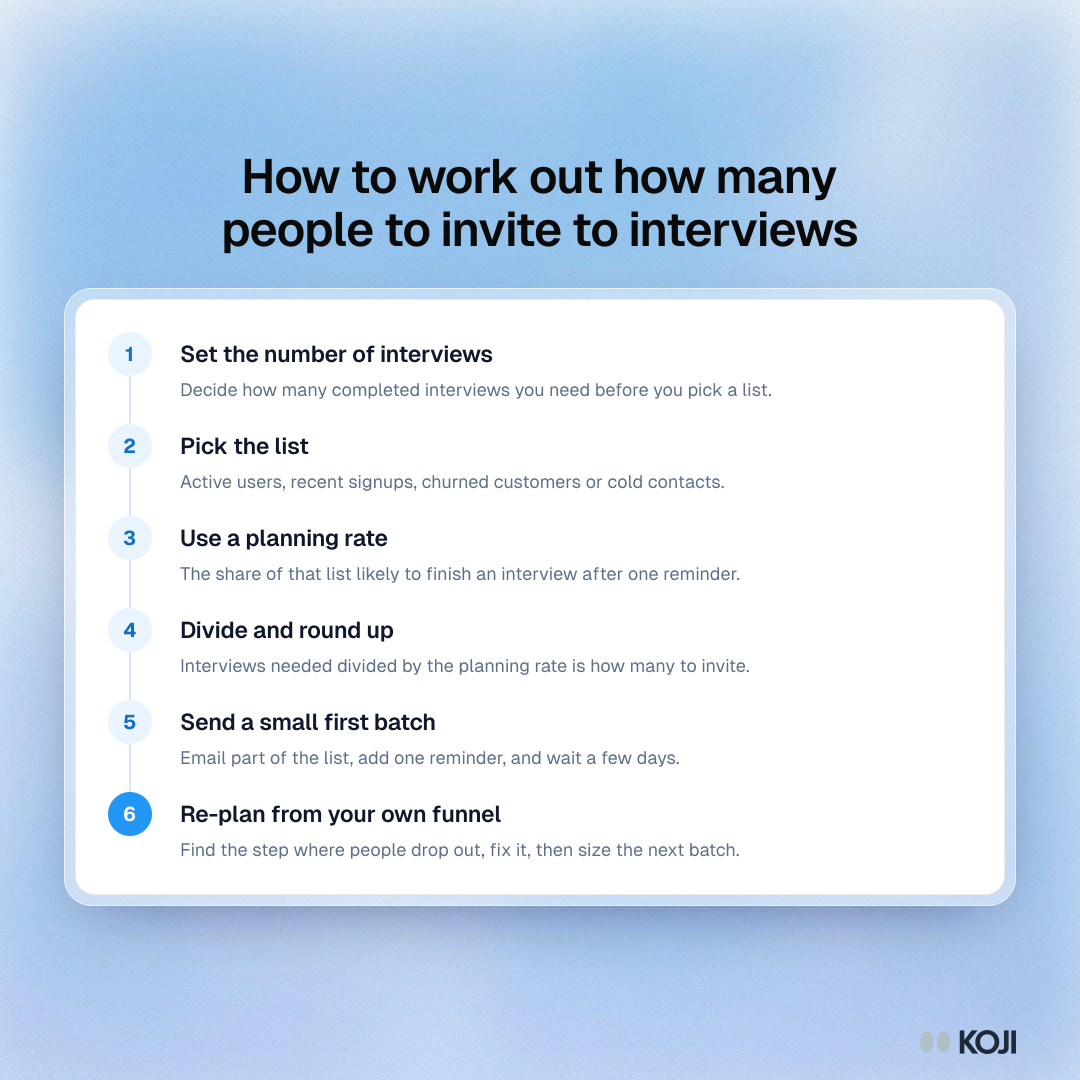
The formula
Invitations to send = interviews you need ÷ expected completion rate
The completion rate is the share of people you email who finish the interview, not the share who open or reply. It is the product of every step in the funnel:
- Delivered: the email reached an inbox and did not bounce.
- Opened: they saw it.
- Clicked: they followed the link.
- Started: they began the interview.
- Completed: they finished it.
Each step loses people. A list with 98% delivery, a good open rate and a weak ask can still end up at a few percent. That is why you plan on completion, and then watch each step to find where people drop out.
What the evidence says about response
There is no large, published benchmark for interview invitations specifically. What exists is a mix of practitioner reports and email marketing data, and it is worth knowing what each one says:
- Email opens. Mailchimp's published benchmarks put the average open rate across all its users at 35.63% and the click rate at 2.62% (Mailchimp, email marketing benchmarks, last updated December 2023). Marketing emails are not research invitations, but the number is a useful ceiling check: if fewer than a third of people open, the rest of the funnel cannot save you.
- Interview requests. Justin Wilcox of Customer Dev Labs tested several interview request emails and reported an average interview conversion of 7%, with the best email converting at 12%. He added that sending one follow-up to everyone who had not replied, a couple of days later, more than doubled the number of interviews (Customer Dev Labs, 2012). He also noted the sample was too small to be scientific.
- Research operations. GitLab's public UX research handbook tells researchers to allow two weeks for responses and to expect three to four email sends to reach their target number, and notes that replies typically take 24 to 48 hours to start arriving (GitLab Handbook, recruitment methods).
- Contact design. In a randomised experiment with more than 24,000 people, personalising contacts raised the odds of responding by as much as 48% (Sauermann and Roach, Research Policy, 2013).
Three lessons come out of these. Rates vary several-fold with the list and the email. A follow-up is the cheapest lever you have. And personal beats generic.
Planning rates by list
Use these as a starting assumption for the share of people who will complete an interview after an invitation and one reminder. They are Koji's planning ranges, built from the reports above and from how warm each list is. They are not measured benchmarks, and your own first batch will beat them as a guide.
| List | Why it behaves this way | Plan for (completed ÷ emailed) | Invite for 10 interviews |
|---|---|---|---|
| Active users | Know you, use the product, have opinions | 15% to 25% | 40 to 67 |
| Recent signups | Remember you, but less invested | 8% to 15% | 67 to 125 |
| Churned customers | Know you, but have moved on | 3% to 8% | 125 to 334 |
| Cold contacts | Never heard of you | 1% to 5% | 200 to 1,000 |
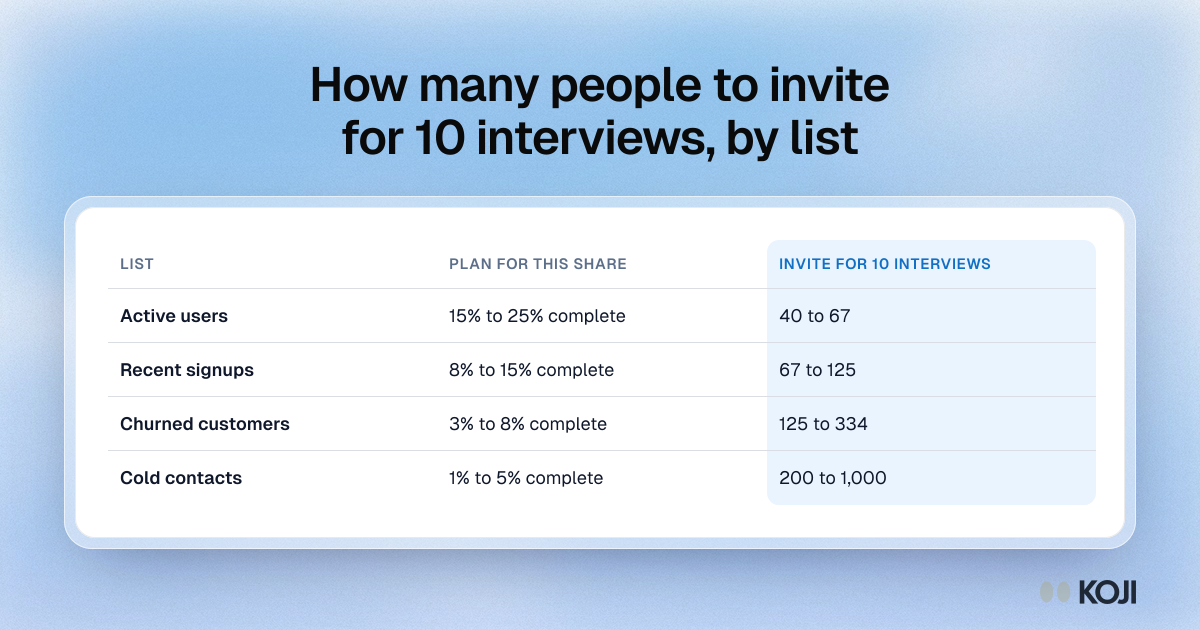
Read the table from the right column back. If you only have 50 churned customers, you are unlikely to get 10 interviews from them by email alone. You either need an incentive, a more personal ask (a note from the founder or their account manager) or a second source of people.
A worked example
Say you are a seed-stage founder with 600 signups in the last 60 days, and you want 10 interviews with people who signed up but never finished setup. Your list of non-activated signups has 240 people.
Using the recent signups range (8% to 15%), you need 67 to 125 invitations. Do not email all 240 at once. Send 80 first.
Here is how that first batch might look three days later. The numbers are illustrative, to show how to read a funnel, not a prediction:
| Step | People | Share of emailed |
|---|---|---|
| Emailed | 80 | 100% |
| Delivered | 78 | 98% |
| Opened | 30 | 38% |
| Clicked | 9 | 11% |
| Started | 8 | 10% |
| Completed | 6 | 8% |
Six completed from 80 is 7.5%, at the bottom of the range. Now look for the step that leaks. Opens are healthy, so people are seeing it. Clicks are low: 9 of 30 openers. That points at the ask, not the inbox. So the reminder (to the 72 who have not started) gets a new subject line, a shorter body and a clearer reason. If the reminder brings in four more, you have your 10 from 80, and 160 people you never had to email.
If clicks were fine but starts were low, the problem would be the landing page or the interview format. If opens were low, it would be the subject line, the sender or deliverability.
Six things that move the rate
- Who sends it. A named person with a real reply-to address, not a no-reply address. Personalisation had the largest effect in the Sauermann and Roach experiment.
- A follow-up. One reminder to people who have not started. See research invitation reminders for timing and templates.
- The size of the ask. "10 minutes, whenever suits you" is easier to say yes to than "book a 45-minute call".
- The format. People can answer an async interview by voice or text at 11pm. A scheduled call needs a free slot in two calendars, and some people do not show up.
- An incentive. A gift card or a donation helps most with cold and churned lists. It matters less with active users who want to be heard.
- Relevance. "You signed up three weeks ago and stopped at the import step. What happened?" beats "We would love your feedback".
When email is not enough
If the table says you need 1,000 cold contacts, email is the wrong tool. Better routes for cold or hard-to-reach groups:

Photo by Dennis Zhang on Unsplash
- A research panel with screening questions, where you pay per completed interview.
- Communities where your audience already talks, with permission from the moderators.
- Warm introductions from customers, investors or advisors.
- In-product prompts for active users, which skip the inbox entirely.
Before you email anyone, check that you have a basis to contact them for research. Our guide to the laws on emailing people for research covers the main rules. It is not legal advice.
How Koji helps you plan and track it
Koji turns the funnel above into something you can see per person. Add the people you want to interview to Participants, by CSV import or one at a time, and group them into audiences such as "Signed up, not activated". From a study's Self-recruit tab, email an audience an invitation in your study's branding, with merge tags for each person's name, and send yourself a free test first. Set one reminder for 2, 3, 5 or 7 days later and Koji sends it, with the same personal link, only to the people who have not started.
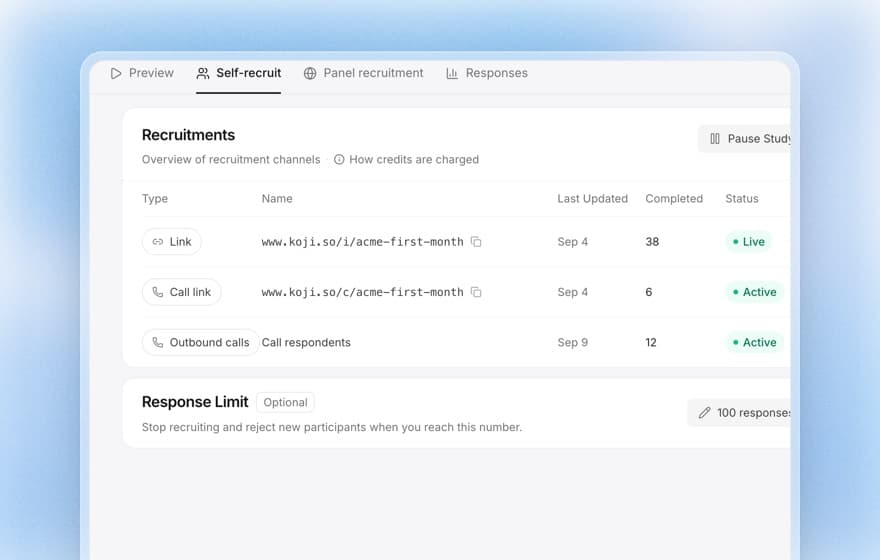
For every send, the study shows emailed, delivered, opened, clicked, started and completed, and who is at which step. That is exactly the table in the worked example, filled in for you, so you can see whether to fix the subject, the ask or the interview before you send the next batch. Each person gets their own link, so nobody is reminded after they have taken part.
Interviews run by voice or text, at any hour, so the format itself removes the scheduling step where many calls are lost. Recruitment email is included on paid plans: Insights includes 20 emails a month, Interviews 50 and Enterprise 1,000, and each invitation and each reminder uses one. If your list is cold, Koji can also recruit from its panel with screening questions instead. For the setup, see managing research participants and importing participants from a CSV.
The short version
- Plan on completion, not on opens or replies.
- Invitations = interviews needed ÷ planning rate, rounded up.
- Warm lists need tens of invitations for 10 interviews. Cold lists need hundreds, sometimes a thousand.
- Send a small first batch, add one reminder, and re-plan from your own funnel.
- If the math needs more people than you have, change the source, not just the email.
Next step: create a free Koji account, set up the study and write your invitation, then send your first batch from a paid plan and watch the funnel tell you how many more you need. When the interviews are in, why new users stall shows what to do with them.