To pay research participants in other countries fairly, set one home amount, then scale consumer incentives by local price levels with a floor, and pay professionals the same everywhere. Let each person choose how to receive the reward (gift card, prepaid card or donation), because gift-card brands and bank options vary by country. And check before you invite anyone that you can legally pay them at all: sanctions rules apply to the person receiving the reward, not just to you.
Try it in Koji: turn on Offer an incentive in your study's settings and set one amount in euros. After you approve an interview, the participant gets a claim link where they pick a gift card, a prepaid Visa card or a donation to charity, so you do not have to source codes market by market. Koji does not offer rewards in countries that banking rules exclude. Incentives are on the Insights, Interviews and Enterprise plans.
The rest of this guide is the working: how to set the amount per market, a worked example across six countries, how to handle currency and form, where you cannot pay, and what to tell participants about tax.
Start from a home rate you can defend
Most teams already have a sense of what an hour of a participant's time costs at home. User Interviews' analysis of about 25,000 sessions found 74% of researchers offered between $60 and $100 an hour for consumer participants, and the single most common rate, offered by 25%, was $100 an hour. Our guide to research participant incentives has amounts by audience and session length.
Pick your home rate for the session length you are running, and write it down. Every other market is then a decision relative to that number, which makes it easy to explain to finance, to a client or to an ethics reviewer.
Consumers: scale by price level, with a floor
The same €60 buys very different things in Munich and in Mumbai. The cleanest public measure of that is the World Bank's price level ratio, which compares what a dollar buys in each country with what it buys in the United States (the US is 1.0 by construction).
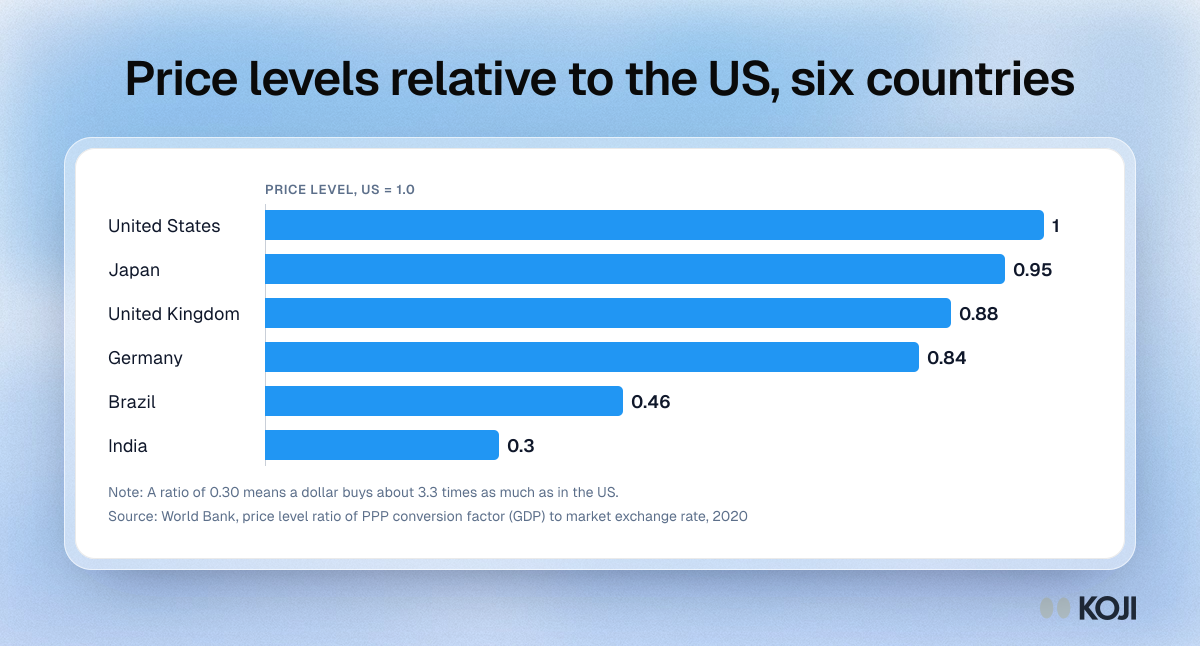
In the World Bank's 2020 figures, Japan sits at 0.95, the United Kingdom at 0.88, Germany at 0.84, Brazil at 0.46 and India at 0.30. A ratio of 0.30 means a dollar buys about 3.3 times as much in India as in the US. Ratios move every year with exchange rates and inflation, so check the current figure before you set amounts, but the order of magnitude rarely changes.
Two reasons not to scale all the way down:
- Online participants are not average. People who join a video or voice interview from a city are usually better off than their national average, and their alternatives (freelance work, other studies) pay more than the national price level suggests.
- A very low amount reads as an insult. If the scaled number looks tiny next to what you are paying elsewhere, participants notice, and the people you most want will not reply.
So use a floor. A simple rule of thumb: scale by the price level ratio, then never go below half your home rate. Round to the nearest €5 so the numbers look deliberate.
Worked example: a 45-minute consumer interview
A team based in Germany pays €60 at home. Scaling by each country's ratio relative to Germany, rounding to €5 and applying the half-rate floor of €30:
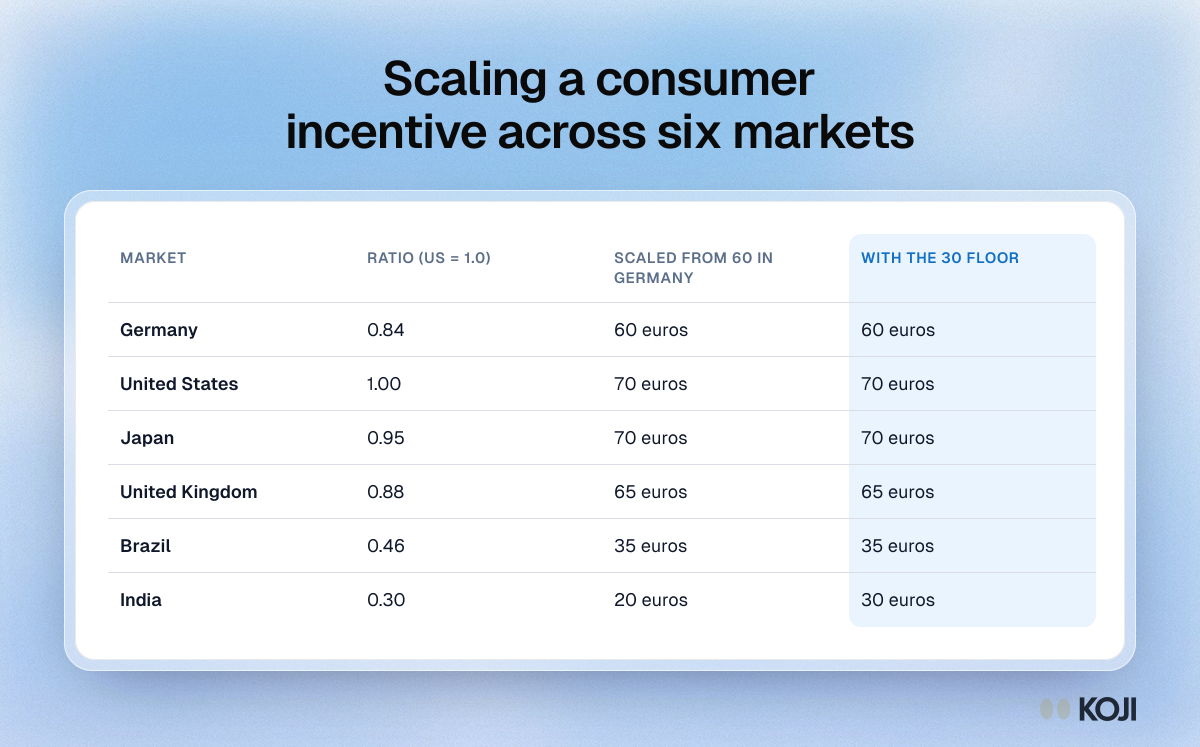
| Market | Ratio (US = 1.0) | Scaled from €60 in Germany | With the €30 floor |
|---|---|---|---|
| Germany | 0.84 | €60 | €60 |
| United States | 1.00 | €70 | €70 |
| Japan | 0.95 | €70 | €70 |
| United Kingdom | 0.88 | €65 | €65 |
| Brazil | 0.46 | €35 | €35 |
| India | 0.30 | €20 | €30 |
The working for India: 60 × 0.30 ÷ 0.84 is about €21, rounded to €20, which is under the €30 floor, so you pay €30.
Because a Koji study has one incentive amount, run one study per market when the amounts differ: duplicate the first study from its card menu, then turn the incentive back on (a copy starts with rewards switched off) and set that market's amount. Keep the same amounts for every later wave, so rounds stay comparable.
Professionals: pay the same in every market
For B2B participants (product managers, engineers, finance leads, clinicians), do not scale by price level. Their time is priced in a global market, their employers often pay in dollars or euros, and a senior engineer in Bangalore who is offered a third of what the London participant got will feel it, and may tell colleagues.

Photo by Vitaly Gariev on Unsplash
Use one global rate per role and session length. If a market has very different seniority norms, adjust the screener rather than the amount: recruit the same level of responsibility everywhere.
And remember the participants who cannot take a reward at all. Civil servants and staff under strict vendor-gift policies exist in every country, and the rules differ. Our guide to charity donations as research incentives covers that case.
Currency and form: let the recipient choose
The amount is only half of the problem. The other half is what the participant actually receives.
- Gift-card brands are national. A card that is a fair thank-you in the US may not exist in Brazil, and a local brand may not be available through your provider.
- Bank transfers across borders lose money. Fees and exchange spreads can eat a large share of a small payment, and you have to collect bank details you would rather not hold.
- Some people cannot take personal gifts. A donation option keeps them in the study.
The answer that scales is to let each person choose the form when they claim. In Koji, you set one amount in euros and the participant picks a gift card, a prepaid Visa card or a donation to charity on the claim page. You pay from one rewards balance and do not source anything per country.
Where you cannot pay
Sanctions apply to the recipient. If a reward reaches someone in a sanctioned country, the sender can be liable, even when the sender is an ordinary company paying for a survey.
The clearest warning is a rewards company, not a research team. In 2022 the US Treasury's Office of Foreign Assets Control (OFAC) settled with Tango Card, a digital rewards provider, for $116,048.60 over 27,720 apparent violations: between 2016 and 2021 it had sent gift cards and promotional debit cards to recipients in sanctioned jurisdictions, including Cuba, Iran, Syria, North Korea and the Crimea region of Ukraine. It had screened its business customers, not the people receiving the rewards, even though it held their IP and email addresses.
What that means for a research team:
- Check the participant's country before you invite, not after the interview. Screen by country in your recruitment, and say in the invitation which countries the reward is available in.
- Use a payout route that screens recipients. Koji checks where the participant is when the reward is offered and again when it is claimed, and does not offer rewards in countries that banking rules exclude. Someone claiming from one of those countries sees a message that rewards are not available there.
- Do not promise what you cannot pay. If you recruit through a panel that covers a country your payout route cannot reach, use the panel's own incentive.
Tax and reporting: tell people, do not advise them
In most countries an incentive can count as taxable income for the participant. You are not their tax adviser, but you should tell them it may count as income where they live. Koji's claim page says exactly that.
On your side, keep a record of who was paid what and when. Koji's rewards statement in Usage lists every approved reward and exports to CSV, which is what your finance team or client will ask for. Our guide to incentives and taxes covers US reporting rules and thresholds, and international privacy laws covers the data you collect to pay people.
How it works in Koji
- Turn on incentives in the study's settings and set one amount per participant, from €10 to €500.
- Top up the rewards balance for the workspace, from the study page or Usage. Only approved rewards are paid.
- The participant gives an email on the thank-you screen at the end of a text or voice interview (phone calls are not included).
- Approve or decline each reward on the Interviews page, with the interview's quality score beside it.
- The participant claims it through a personal link, valid for 30 days, and chooses a gift card, a prepaid Visa card or a donation to charity.
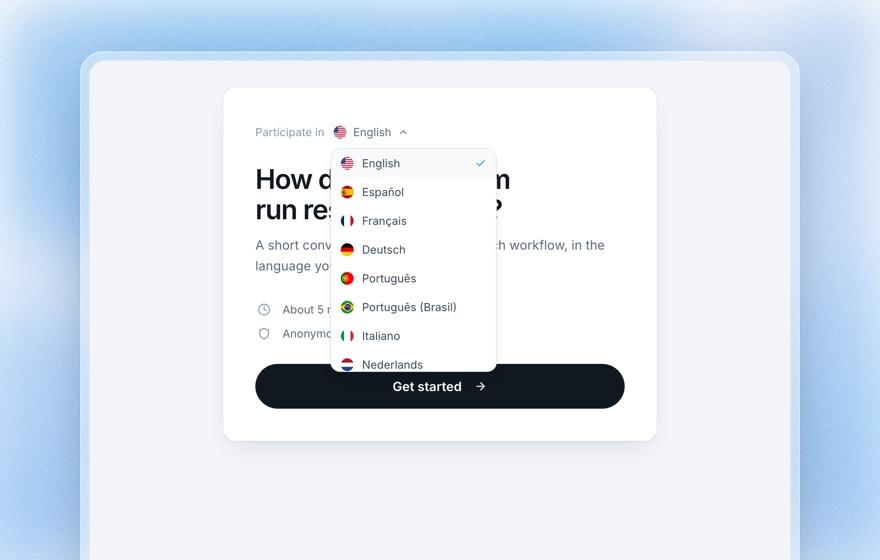
A person can receive up to €1,500 in rewards a year. People recruited through Koji's panel are paid by the panel, so this is for participants you bring yourself: your own customers, users or contacts in each market. For running the interviews themselves in several languages, see our multilingual research guide.
Common mistakes
- One flat amount everywhere. It overpays in some markets and insults people in others. Scale consumers, keep professionals flat.
- Scaling with no floor. The cheapest markets end up with amounts nobody takes seriously.
- Finding out about sanctions at payout. Screen country before you invite, and say where rewards are available.
- Bank transfers for small amounts. Fees eat the reward, and you hold bank details you did not need.
- Changing amounts between waves. If you rerun the study, keep the same amounts, or you change who answers.
Start with your next market
Before you invite anyone in a new country, write down your home rate, look up that country's current price level ratio, apply the floor, and decide whether your participants are consumers or professionals. Then add one line to the invitation saying what the thank-you is and how they can receive it. If you run the study in Koji, set the amount once and let participants choose their reward on the claim page. Start a study, or read research incentive management to compare Koji with separate incentive tools.
Sources: User Interviews, research incentives analysis of about 25,000 sessions (Research Incentives Report). World Bank, World Development Indicators, price level ratio of PPP conversion factor (GDP) to market exchange rate, 2020. US Department of the Treasury, Office of Foreign Assets Control, settlement with Tango Card, Inc., 30 September 2022.