Framework
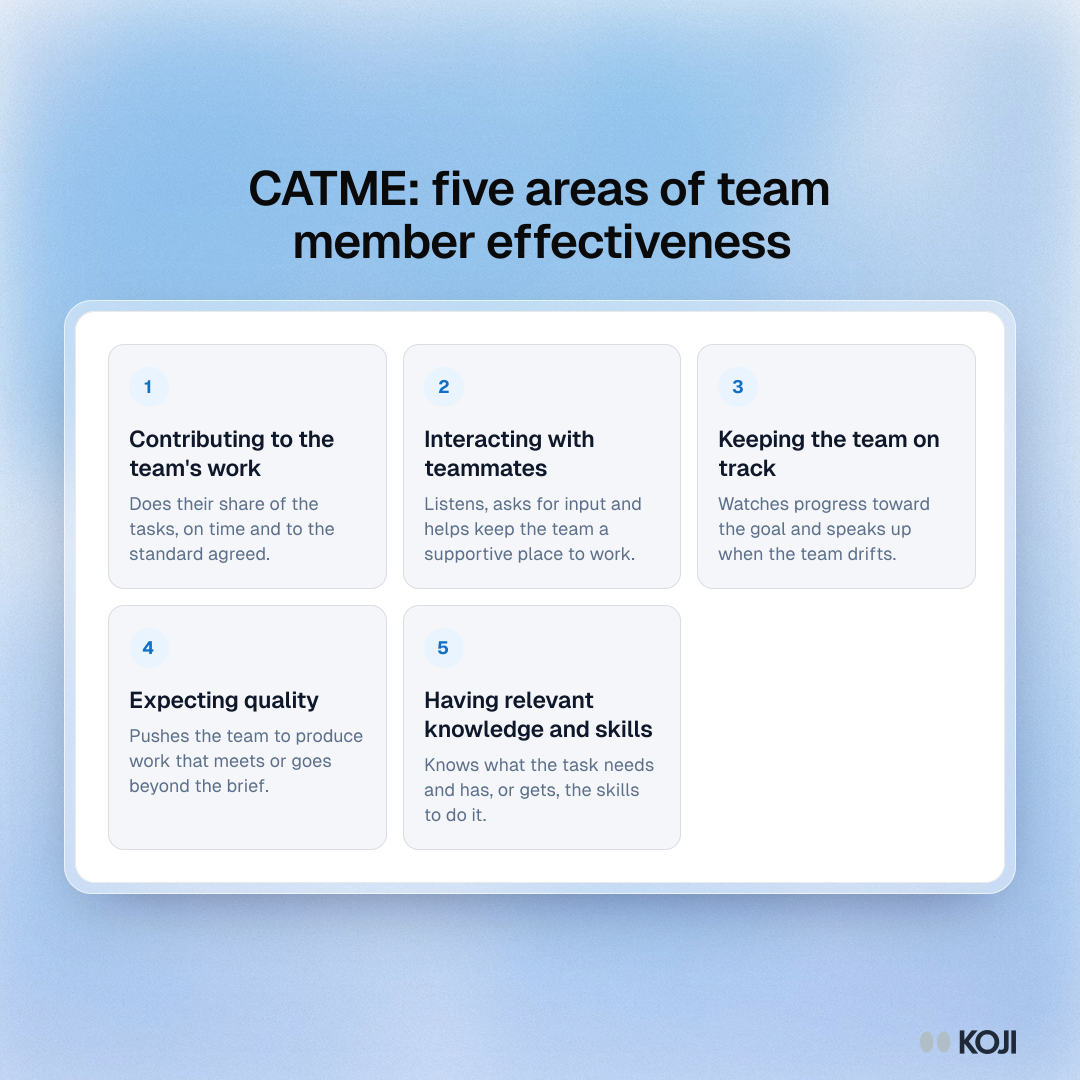
CATME: five areas of team member effectiveness
The five areas in the CATME behaviourally anchored scale for self and peer evaluation of team members
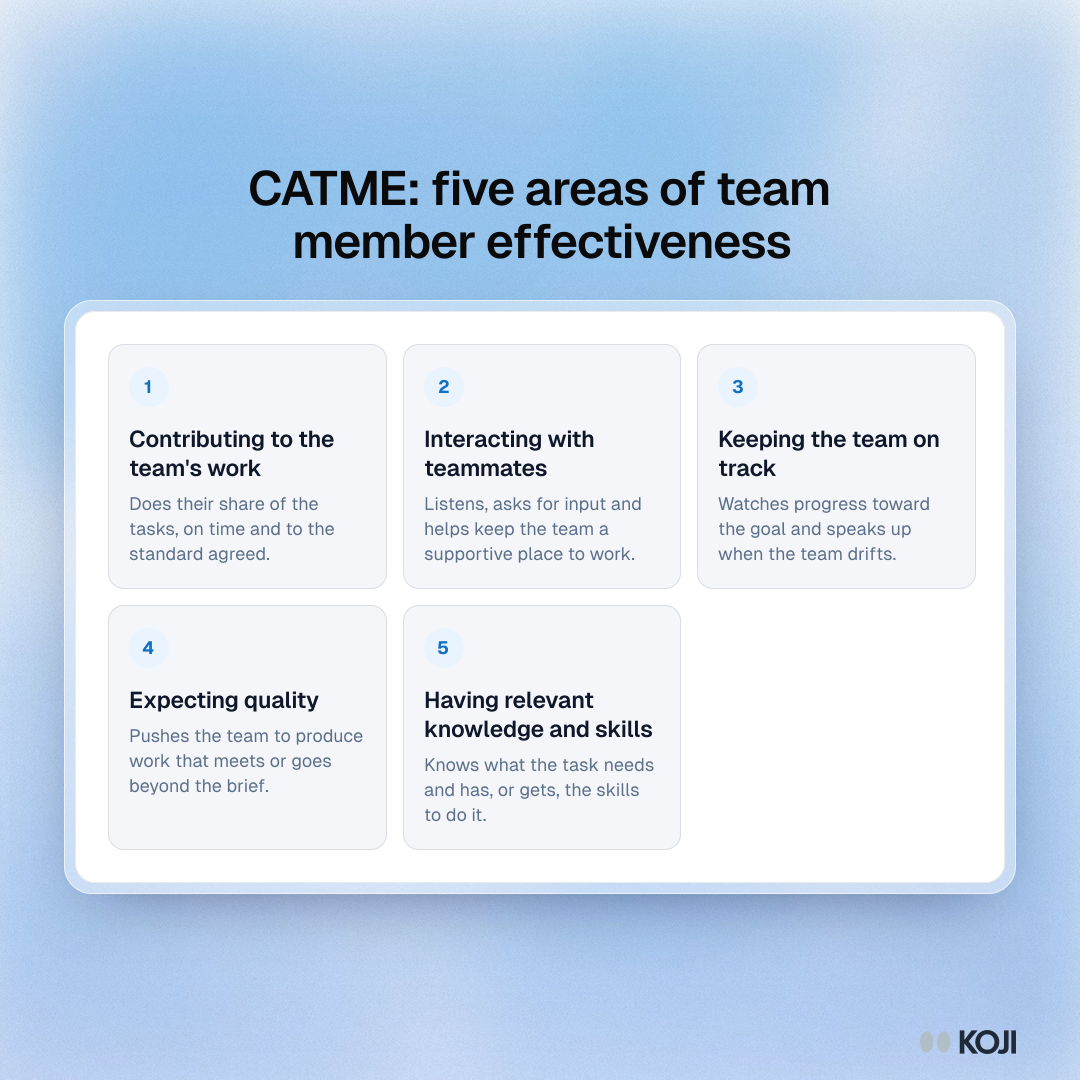
The five areas of the Comprehensive Assessment of Team Member Effectiveness (CATME), the behaviourally anchored rating scale for self and peer evaluation developed by Ohland and colleagues (2012). Lecturers and programme teams can use it to structure peer evaluation of group work, and to write course evaluation questions on team process that line up with it. In Koji, open or rated questions on each area can be asked in a course evaluation interview.
What's in this framework
- Contributing to the team's work: Does their share of the tasks, on time and to the standard agreed.
- Interacting with teammates: Listens, asks for input and helps keep the team a supportive place to work.
- Keeping the team on track: Watches progress toward the goal and speaks up when the team drifts.
- Expecting quality: Pushes the team to produce work that meets or goes beyond the brief.
- Having relevant knowledge and skills: Knows what the task needs and has, or gets, the skills to do it.
Use this image
Free to use in your docs, decks and posts under CC BY 4.0, as long as you credit Koji with a link to this page. To embed it, paste this into your page:
html
<a href="https://www.koji.so/visuals/catme-five-dimensions-team-member-effectiveness"><img src="https://www.koji.so/visuals/catme-five-dimensions-team-member-effectiveness/catme-five-dimensions-team-member-effectiveness.png" alt="Framework showing the five CATME areas for rating team members: contributing, interacting, keeping on track, expecting quality and relevant skills." width="1080" height="1080" /></a>
<p>Source: <a href="https://www.koji.so/visuals/catme-five-dimensions-team-member-effectiveness">CATME: five areas of team member effectiveness</a>, Koji</p>