Process
The riskiest assumption test for a Lean Canvas
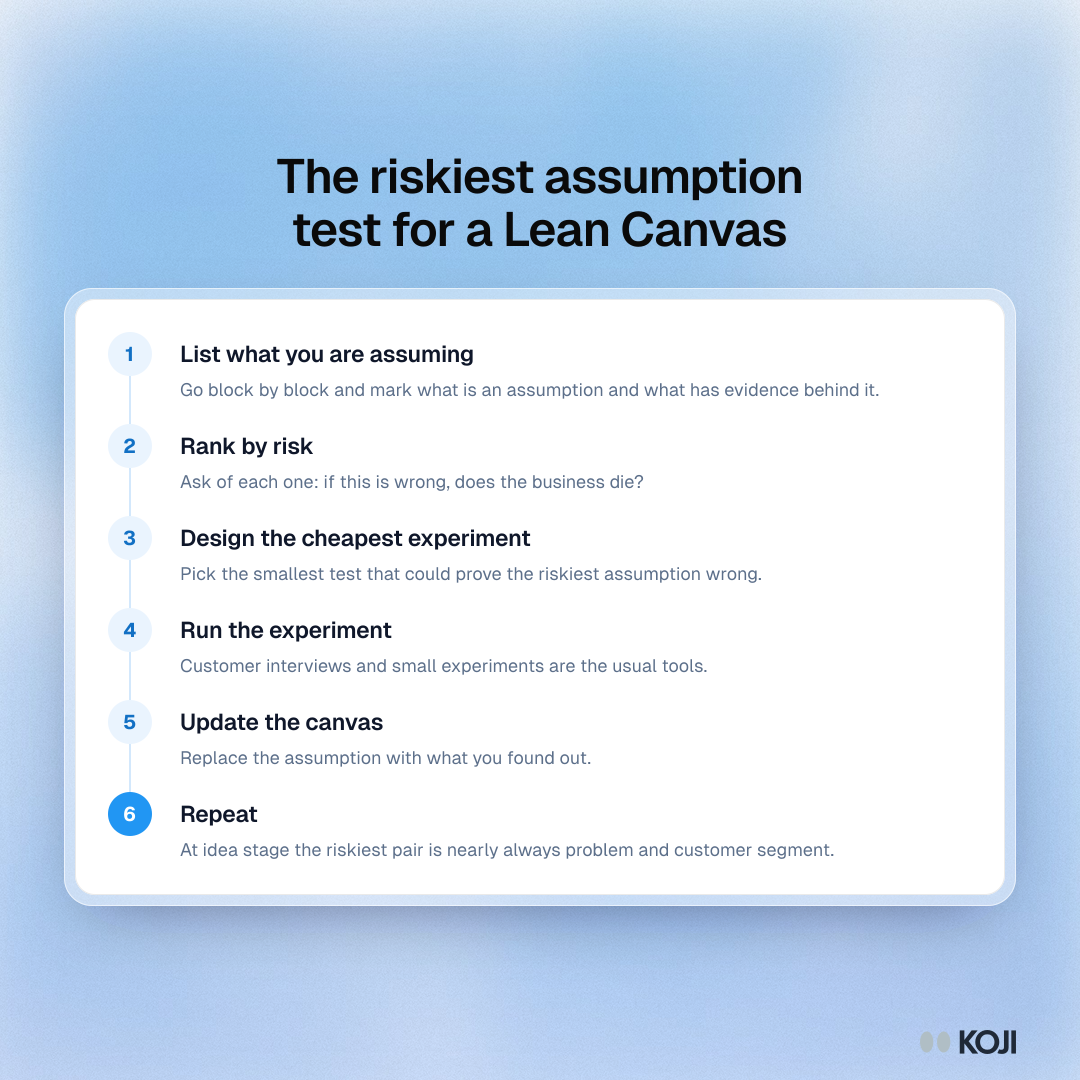
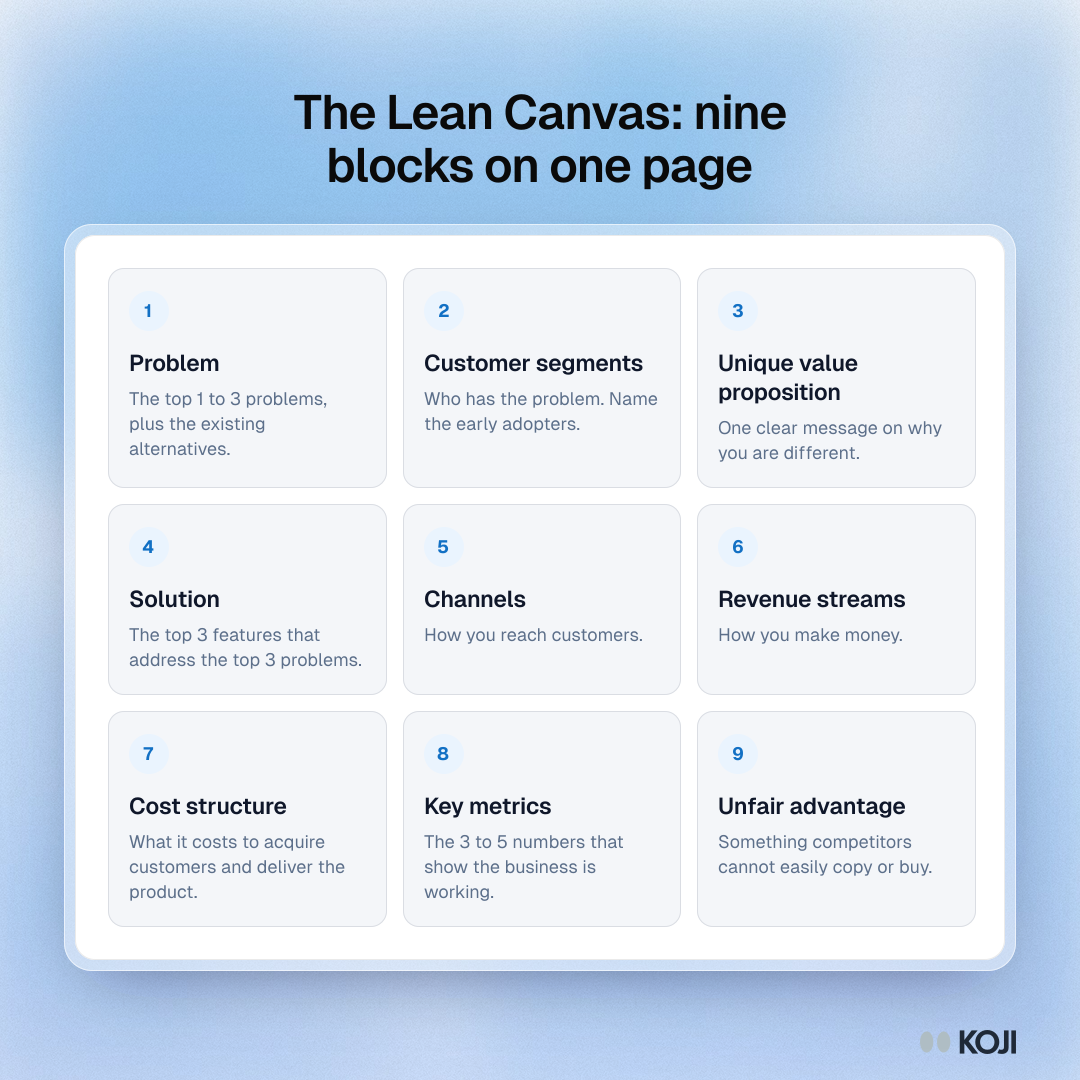
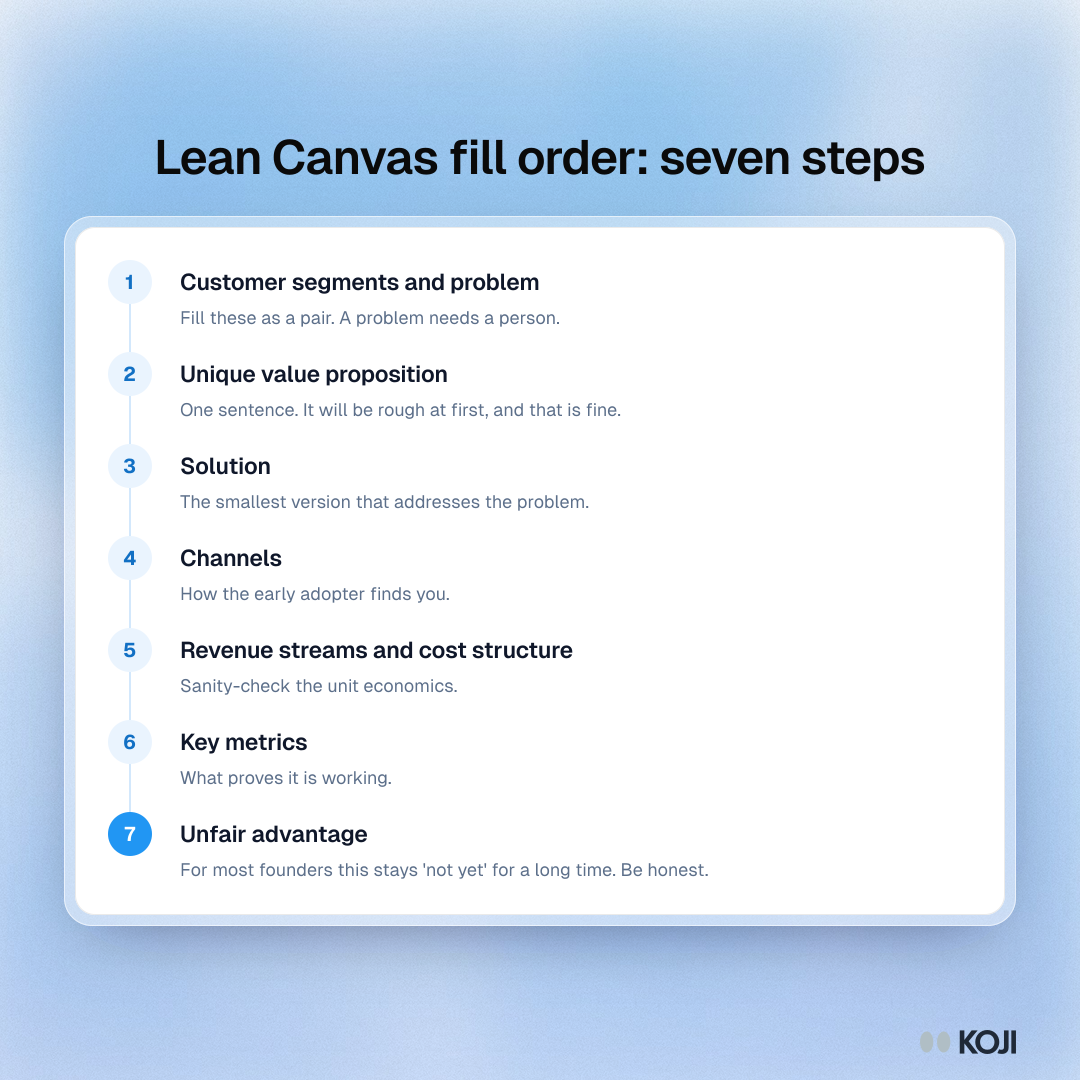
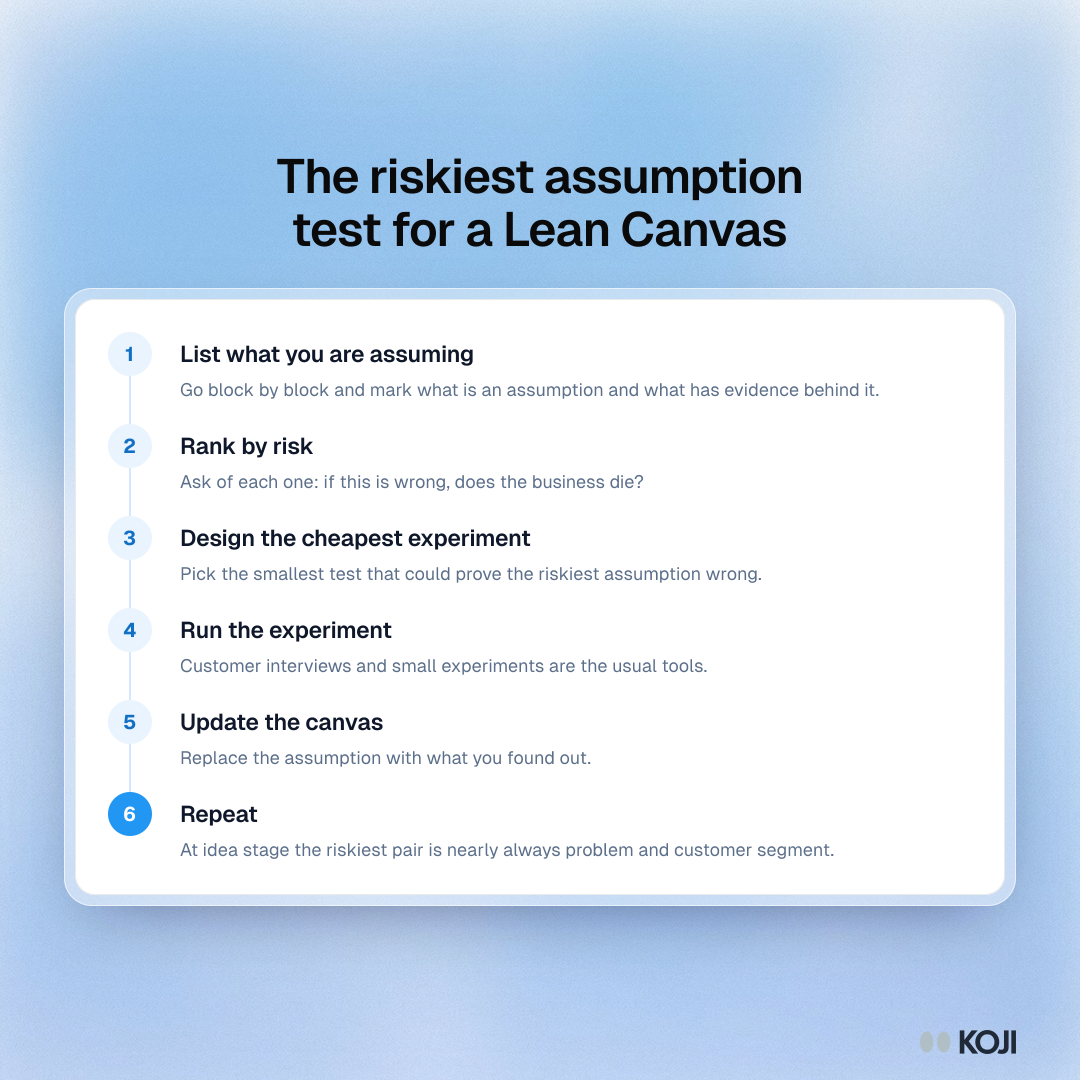
Ash Maurya's loop for treating a Lean Canvas as a list of hypotheses rather than a plan. You mark each block as assumption or evidence, rank the assumptions by whether being wrong would kill the business, test the riskiest one as cheaply as you can, update the canvas and go again. For most founders the first test is a round of customer interviews, which Koji can run and summarize in an afternoon.
Where this appears
What's in this process
- List what you are assuming: Go block by block and mark what is an assumption and what has evidence behind it.
- Rank by risk: Ask of each one: if this is wrong, does the business die?
- Design the cheapest experiment: Pick the smallest test that could prove the riskiest assumption wrong.
- Run the experiment: Customer interviews and small experiments are the usual tools.
- Update the canvas: Replace the assumption with what you found out.
- Repeat: At idea stage the riskiest pair is nearly always problem and customer segment.
Use this image
Free to use in your docs, decks and posts under CC BY 4.0, as long as you credit Koji with a link to this page. To embed it, paste this into your page:
html
<a href="https://www.koji.so/visuals/lean-canvas-riskiest-assumption-test-steps"><img src="https://www.koji.so/visuals/lean-canvas-riskiest-assumption-test-steps/lean-canvas-riskiest-assumption-test-steps.png" alt="Process in six steps for the Lean Canvas riskiest assumption test: list assumptions, rank by risk, design and run a cheap experiment, update, repeat" width="1080" height="1080" /></a>
<p>Source: <a href="https://www.koji.so/visuals/lean-canvas-riskiest-assumption-test-steps">The riskiest assumption test for a Lean Canvas</a>, Koji</p>