Framework
The six scales of the User Experience Questionnaire
Attractiveness, three pragmatic scales and two hedonic scales
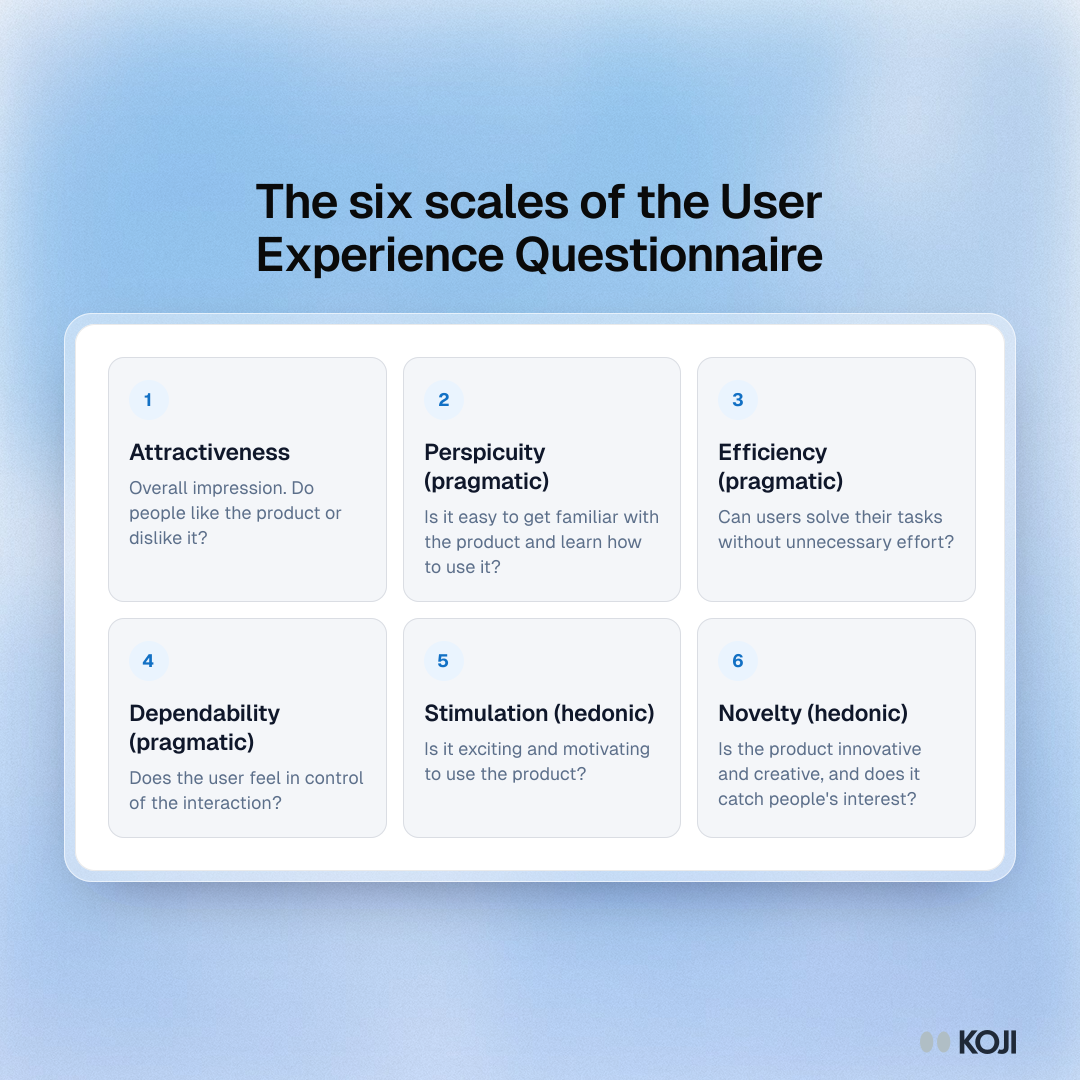
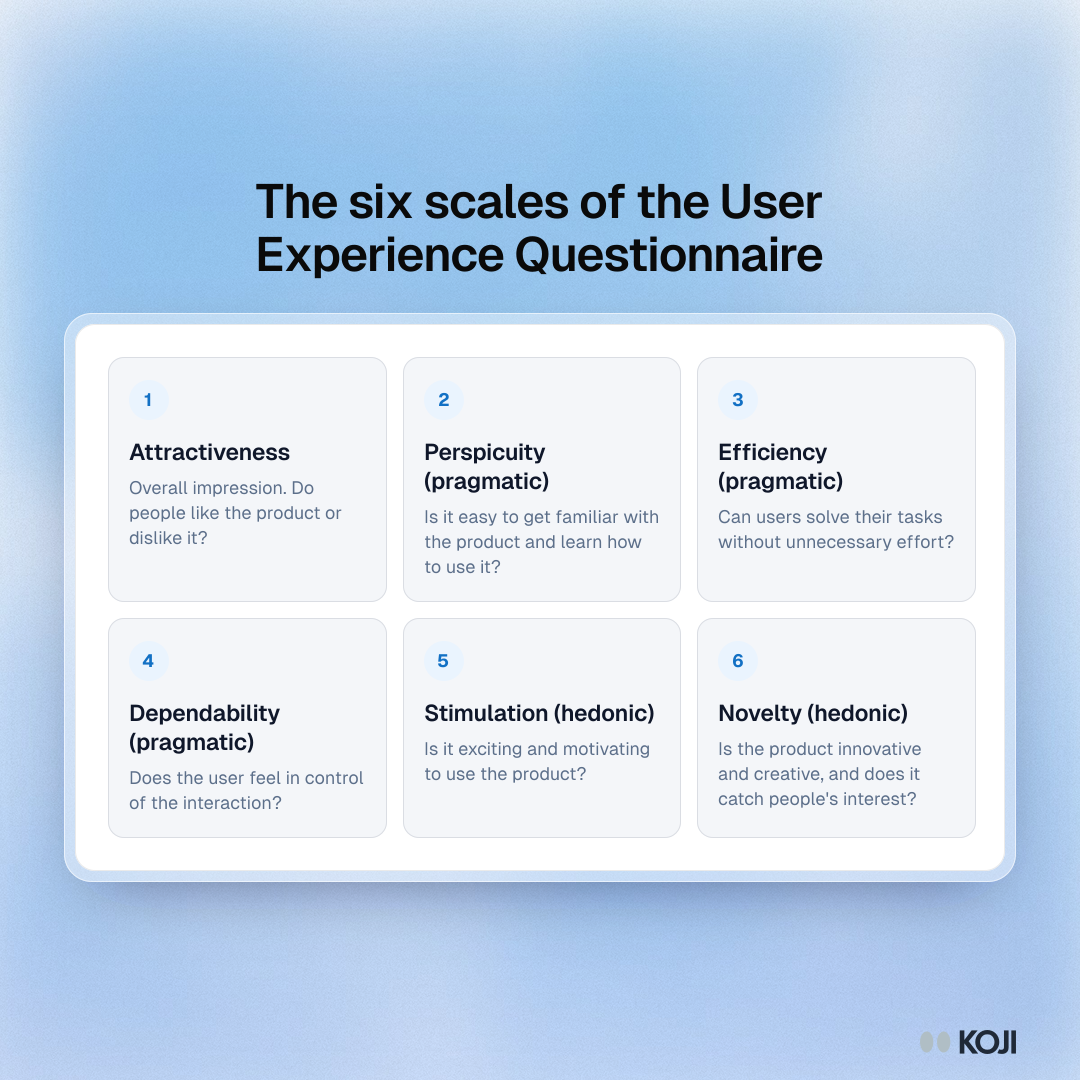
The six scales of the User Experience Questionnaire (UEQ), each with the question it answers. Perspicuity, efficiency and dependability describe pragmatic, goal-directed quality. Stimulation and novelty describe hedonic quality, and attractiveness is the overall impression. Use it to explain a UEQ profile to a team or to plan which scales a redesign should move. Koji can run the UEQ as scale questions inside an AI-moderated interview.
Where this appears
What's in this framework
- Attractiveness: Overall impression. Do people like the product or dislike it?
- Perspicuity (pragmatic): Is it easy to get familiar with the product and learn how to use it?
- Efficiency (pragmatic): Can users solve their tasks without unnecessary effort?
- Dependability (pragmatic): Does the user feel in control of the interaction?
- Stimulation (hedonic): Is it exciting and motivating to use the product?
- Novelty (hedonic): Is the product innovative and creative, and does it catch people's interest?
Use this image
Free to use in your docs, decks and posts under CC BY 4.0, as long as you credit Koji with a link to this page. To embed it, paste this into your page:
html
<a href="https://www.koji.so/visuals/user-experience-questionnaire-six-scales"><img src="https://www.koji.so/visuals/user-experience-questionnaire-six-scales/user-experience-questionnaire-six-scales.png" alt="Framework of the six UEQ scales: attractiveness, three pragmatic scales (perspicuity, efficiency, dependability) and two hedonic (stimulation, novelty)." width="1080" height="1080" /></a>
<p>Source: <a href="https://www.koji.so/visuals/user-experience-questionnaire-six-scales">The six scales of the User Experience Questionnaire</a>, Koji</p>