Reference table
Two schools of Jobs to Be Done
Jobs as progress versus jobs as activities
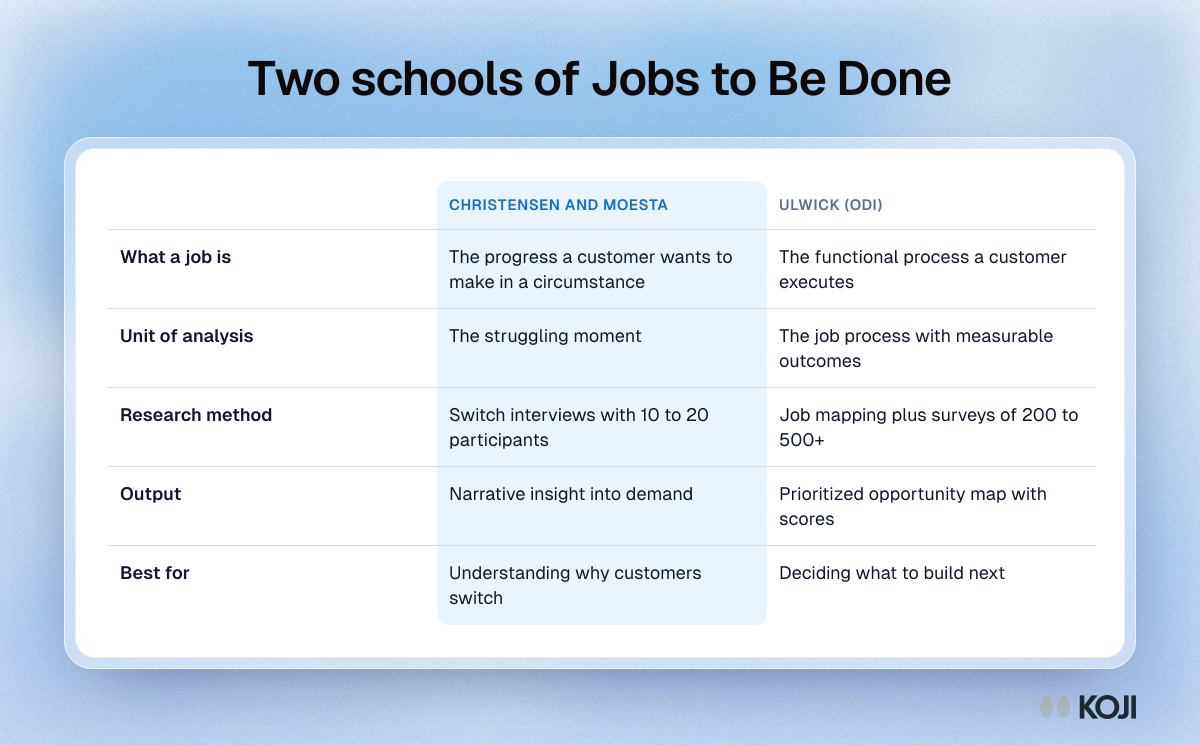
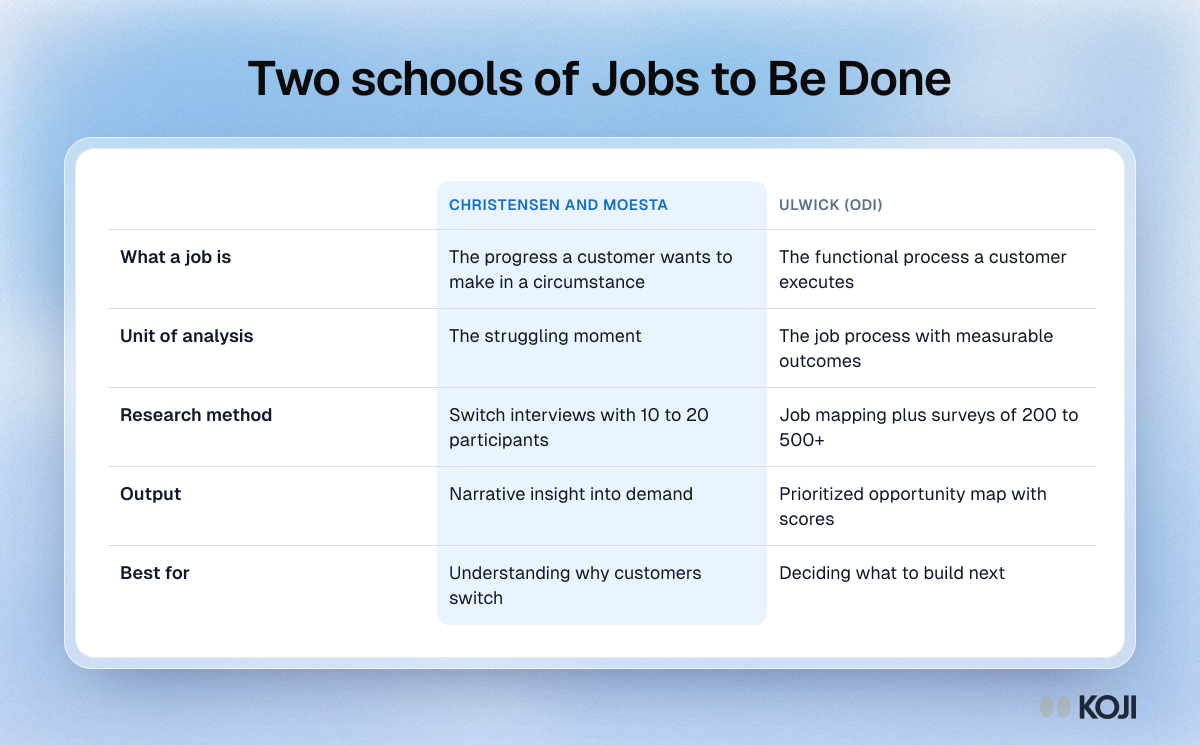
Jobs to Be Done has two main interpretations that people often mix up. Christensen and Moesta treat a job as progress in a circumstance and study it with switch interviews. Ulwick's Outcome-Driven Innovation treats it as a process with measurable outcomes and adds large surveys. This table helps you choose which school fits the question you are asking.
Where this appears
What's in this reference table
| Christensen and Moesta | Ulwick (ODI) | |
|---|---|---|
| What a job is | The progress a customer wants to make in a circumstance | The functional process a customer executes |
| Unit of analysis | The struggling moment | The job process with measurable outcomes |
| Research method | Switch interviews with 10 to 20 participants | Job mapping plus surveys of 200 to 500+ |
| Output | Narrative insight into demand | Prioritized opportunity map with scores |
| Best for | Understanding why customers switch | Deciding what to build next |
Use this image
Free to use in your docs, decks and posts under CC BY 4.0, as long as you credit Koji with a link to this page. To embed it, paste this into your page:
html
<a href="https://www.koji.so/visuals/jobs-to-be-done-two-schools-comparison"><img src="https://www.koji.so/visuals/jobs-to-be-done-two-schools-comparison/jobs-to-be-done-two-schools-comparison.png" alt="Table comparing the two schools of Jobs to Be Done, Christensen and Moesta against Ulwick's ODI, on definition, method, output and best use." width="1200" height="745" /></a>
<p>Source: <a href="https://www.koji.so/visuals/jobs-to-be-done-two-schools-comparison">Two schools of Jobs to Be Done</a>, Koji</p>