Customer research after raising a seed round should answer four questions in your first 90 days: who your best customers really are, why new users stall or leave, whether your price is right, and what evidence you will show at the next round. Run it as four short sprints of interviews, about two to three weeks each, and finish with a one-page summary you can drop straight into your investor update.
You raised money on a story. The next 90 days are when you check that the story holds before you spend the round on it. Here is the week-by-week plan, the questions to ask, how many people to talk to, and where it goes wrong.
Try it now: start a free Koji study from the churn interview template or a blank study. You get 10 credits at signup, enough for 10 text interviews, so you can run the first sprint this week.
Why the 90 days after a seed round matter
The gap to the next round is long, and the money you just raised has to cover it. Carta's data shows the median time from seed to Series A was about 1.9 years in the second half of 2025, after several years of getting longer. And only 12.9% of companies that raised a seed round in Q3 2024 had raised a Series A one year later (Carta, 2025).
That is a long time to build on a guess. When CB Insights went through 111 startup post-mortems, founders most often blamed running out of cash or failing to raise (38%), with no market need close behind at 35%. Those two are often the same story: the team spent the money building for a market that was smaller or different than they thought.
Pricing is the other place a fresh round leaks. McKinsey's classic analysis of 2,463 companies found that a 1% price increase, with volume held steady, lifted operating profit by about 11% (Marn and Rosiello, Harvard Business Review, 1992). Most seed-stage companies set their price once, early, and never test it again.
So the first quarter after the round is the cheapest moment to find out what is true. You have cash, you have some customers, and no one has yet built a team around the wrong idea.
The 90-day plan at a glance
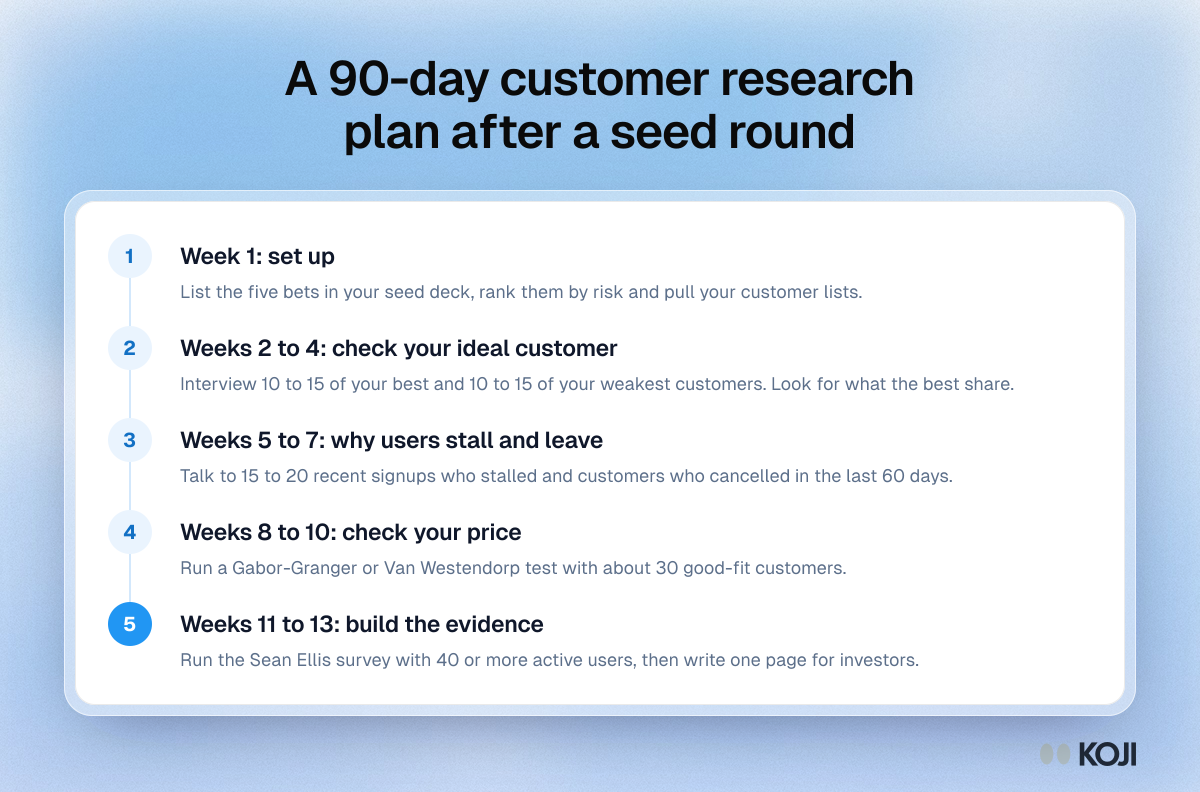
| Weeks | Sprint | The question | Who to talk to | How many |
|---|---|---|---|---|
| 1 | Set up | What do we most need to know? | Your own team and board | No interviews yet |
| 2 to 4 | ICP check | Who gets the most value, and why? | Your best and your weakest customers | 10 to 15 of each |
| 5 to 7 | Activation and churn | Where do new users stall, and why do people leave? | Recent signups who stalled, and recent cancellations | 15 to 20 |
| 8 to 10 | Pricing check | Is the price right for the customers we want? | Current customers and good-fit prospects | About 30 |
| 11 to 13 | Investor evidence | What can we prove now that we couldn't at seed? | Active users | 40 or more for a fit survey |
Each sprint ends with a short write-up: what you heard, what you are changing, and what you still don't know. That habit is worth more than any single study.
Week 1: set up before you interview anyone
Spend the first week deciding what you need to learn, not booking calls.

Photo by Tool., Inc on Unsplash
- Write down the bets in your seed deck. Every slide makes a claim: "mid-market finance teams", "they switch from spreadsheets", "they'll pay €200 a month". List the five claims the plan depends on most.
- Rank them by risk. Which one, if it's wrong, wastes the most of the round? That ranking sets the order of your sprints. The default order below works for most B2B and B2C products, but swap sprints if pricing is your biggest open question.
- Pull your lists. Export customers with plan, signup date, usage and, if you have it, revenue. You'll need four groups: your best customers, your weakest active customers, signups from the last 30 days who never got going, and anyone who cancelled in the last 60 days.
- Pick one owner. At seed stage that is usually a founder. Research that belongs to everyone happens to no one.
Weeks 2 to 4: check your ideal customer profile
Your seed deck named an ideal customer. Now check it against who actually pays and stays.

Interview 10 to 15 of your best customers (high usage, renewed, expanded or referred others) and 10 to 15 of your weakest active ones. The contrast is the point. Ask both groups the same things:
- What were you using before, and what made you look for something else?
- Walk me through the last time you used the product. What were you trying to get done?
- Who else on your team uses it, and who decided to buy?
- If it disappeared tomorrow, what would you do instead?
Then look for what the best group shares that the weak group doesn't: a role, a company size, a trigger event, a tool they left. That is your real ICP. It is often narrower than the deck, and that's good news, because a narrow target makes the rest of the round cheaper to spend.
For a deeper method, see find your ideal customer profile in three rounds of interviews. If you are still choosing between segments, find your first customer segment before you build covers how to compare two.
Weeks 5 to 7: find out why users stall and why they leave
Most seed companies hire engineers first, and the roadmap fills up fast. Before it does, find out where new users get stuck and why paying customers leave. Fixing one activation step often does more for growth than a new feature.
Talk to two groups:
- Signups from the last 30 days who never reached the moment the product proves itself. Ask what they were hoping to do, what they tried, and where they stopped. Our playbook on why new users stall has a full script.
- Customers who cancelled in the last 60 days. Ask what changed in the 90 days before they left, what they moved to, and what would have kept them. Memory fades fast, so invite them within a few days of cancelling. The churn interview questions guide has a ready list.
Around 15 to 20 interviews across the two groups usually shows the main reasons. Stop when the last five add nothing new. How many user interviews you need explains the stopping rule.
Weeks 8 to 10: check your price
You probably set your price before you had many customers. Now you have some, and you can test it properly.
Two methods work at this stage:
- Gabor-Granger. Show each person the product at one price at a time and ask how likely they are to buy. Move up or down until you find the highest price they would still pay. You get a demand curve and the price that earns the most. Plan for about 30 interviews.
- Van Westendorp. Ask four questions about when the product feels too cheap, a bargain, getting expensive and too expensive. You get an acceptable price range rather than one number. See the Van Westendorp guide.
Run the test on the customers your ICP sprint said you want more of, not on everyone. A price that suits your weakest customers can quietly cap the business.
In Koji, a price test is a question type: enter 3 to 10 prices, and the AI interviewer moves each person up or down the ladder, then asks why they stopped where they did. The report shows the share who would buy at each price and the revenue each price implies. Treat it as directional: people overstate what they would buy, and the best price is always one of the prices you tested. How to set up a price test walks through it, and price your first product with 30 conversations covers the founder version.
Weeks 11 to 13: build the evidence for your next update
By now you have three sprints of findings. The last sprint turns them into proof.
- Run a product-market fit survey. Ask active users the Sean Ellis question: how would you feel if you could no longer use the product? Very disappointed, somewhat disappointed or not disappointed. Ellis's benchmark is that 40% or more "very disappointed" signals fit. You need about 40 responses before the number means much. See the Sean Ellis test guide.
- Ask the "very disappointed" group why. Their answers tell you what to protect and how to describe the product to people like them.
- Write one page. What you believed at seed, what you learned, what you changed, and the numbers behind each. Investors remember a founder who says "we thought it was mid-market finance teams; it's actually controllers at 50 to 200 person companies, and here's why".
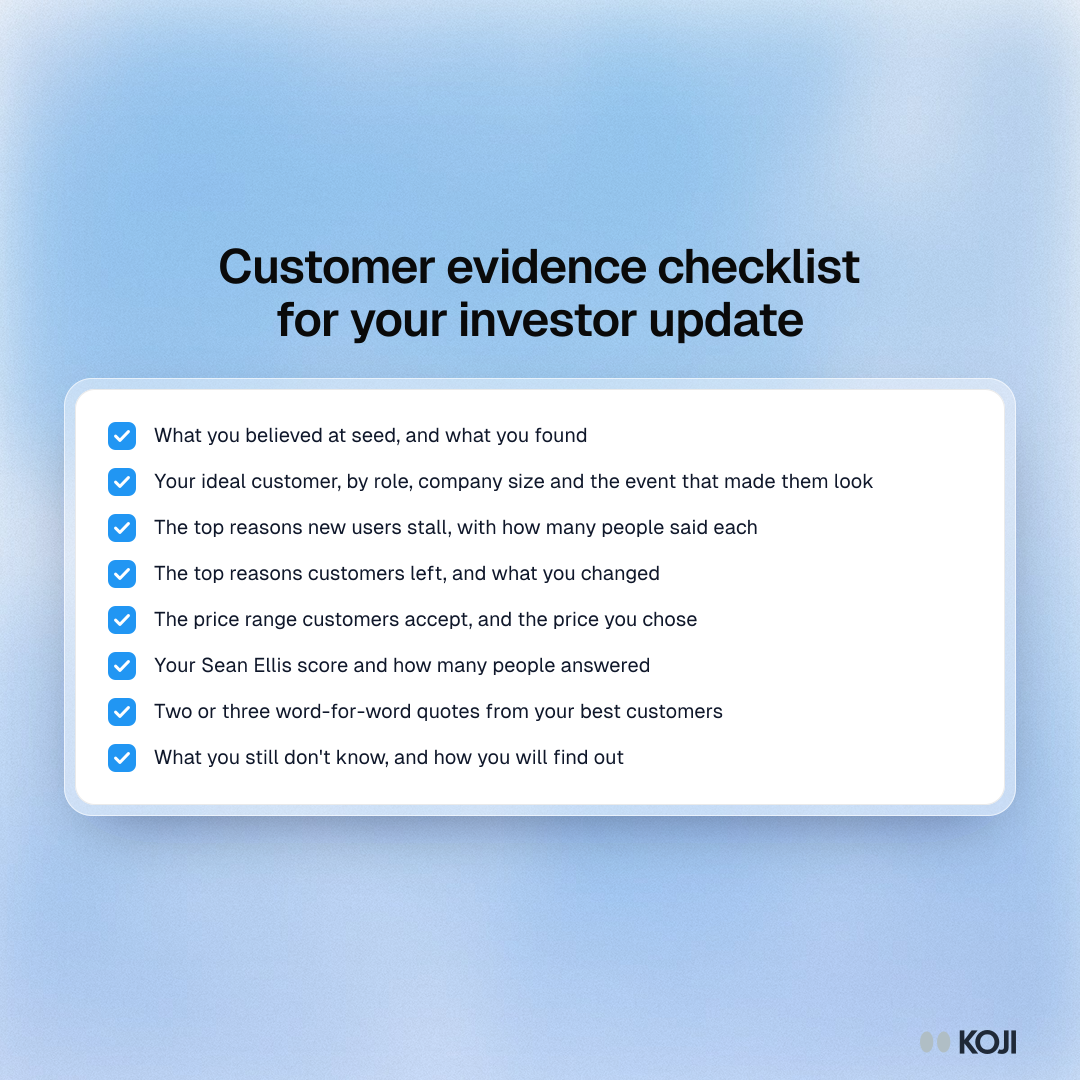
Koji reports download as an editable PowerPoint deck or a PDF, so the slides for the update or board meeting come straight from the study. For the full method, customer research for investors covers what investors look for in customer evidence.
Where this goes wrong
Interviews are good at the "why" and bad at some other things. Be honest with yourself about the limits:
- People are kind about your product. Ask about past behaviour, not opinions about the future. "What did you do last time?" beats "Would you use this?"
- What people say they'd pay is not what they pay. Treat price test results as a range to try, then confirm with real offers, prepayment or a price change on new signups.
- Your loudest customers aren't your typical ones. Sample from your lists on purpose, not just from people who reply to emails.
- Usage data beats memory for "what". Use interviews to explain the patterns your analytics show, not to replace them.
How to run this plan in Koji
Koji runs each sprint as an AI-moderated interview study, so a founder can run the whole plan without a researcher:
- Invite your own customers. Import your lists as audiences and email each group a personal interview link with reminders, then see who opened and took part. Recruitment emails need a paid plan.
- No customers in a group yet? Recruit from Koji's research panel by role, country and screening questions, or find B2B professionals by job title and company size. Both need a paid plan.
- Mix questions. Combine open questions with scales, choices, a price test or the Sean Ellis question in one study.
- Voice or text. Participants answer when it suits them, in their own language. A text interview uses 1 credit and a voice interview 3.
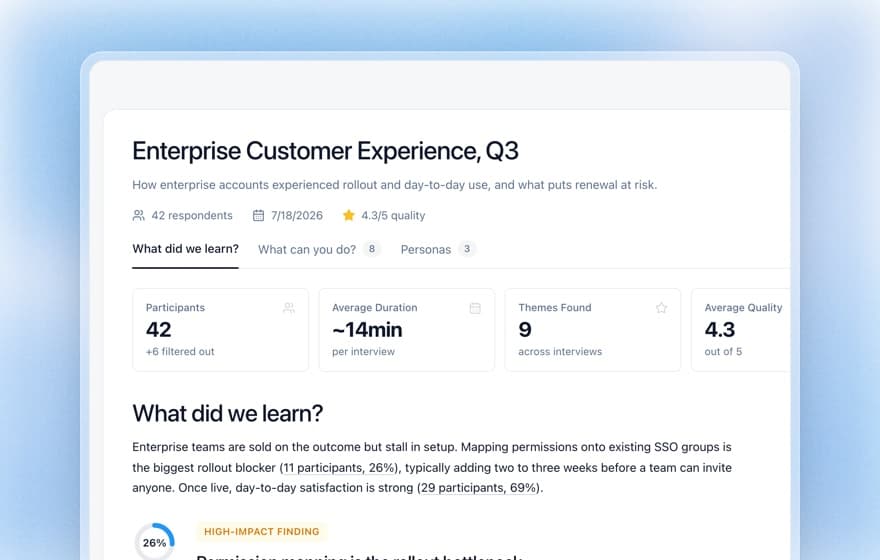
- Read and share. Every study gets a report with themes and quotes, and downloads as slides or a PDF.
Run your first sprint this week. Start free with Koji: 10 credits at signup, no card, and your ICP study can be live in minutes.
Sources: Carta, seed to Series A data, 2025 and March 2026; CB Insights, analysis of 111 startup post-mortems; Michael Marn and Robert Rosiello, "Managing Price, Gaining Profit", Harvard Business Review, 1992; Sean Ellis, product-market fit survey benchmark.