You have an idea and no customers, and everyone you describe it to says they might use it. The short answer: don't pick your customer by thinking harder. Pick three or four candidate groups, ask five people in each the same questions about the last time the problem hit them, and choose the group with a recent story, a paid workaround and a way for you to reach more of them. By the end of this guide you can run that comparison in about two weeks and walk away with one segment to build for.
When you need this
You are here when "who is it for?" gets the answer "small businesses, mostly", or "anyone who ...". Founders ask the question in plain words: how can I find the ICP for my product or service [7], and how specific should my target customer be when I am just starting [8]. The honest answer to the second one is: specific enough that you could write down a list of fifty of them and know where to find each.

Photo by Will H McMahan on Unsplash
The cost of guessing is concrete. If you build for "everyone", you can't build a list, so every channel you try feels like it half works. Camuffo and colleagues ran randomised trials with entrepreneurs who were taught to treat their customer and their idea as hypotheses to test. In the first trial, with 116 Italian startups, the group that tested its hypotheses closed unpromising ideas more often and pivoted in a more focused way [1]. A larger replication across four trials and 759 firms found the same improvement in deciding when to drop an idea [2]. Deciding who your customer is belongs on that list of hypotheses.
The method in brief
You are running a small comparison, not a survey. Interview a handful of people in each candidate segment with identical questions, then score the segments on three signals. This sits between two jobs Koji already has guides for: problem validation, which asks whether a problem is real, and the three-round ICP process, which suits you once you have users to learn from. Here you have neither, so the unit of analysis is the segment.
Why five per segment? In a study of 60 interviews, Guest, Bunce and Johnson found that most of the themes they coded appeared within the first twelve interviews, and the building blocks of the main themes were visible by about six, in a fairly uniform group [3]. Five interviews will not prove anything about a segment. They will show you whether a story is there at all, which is all this round needs to decide. The proof comes in the second round, with 15 to 20 people from the one segment that wins.
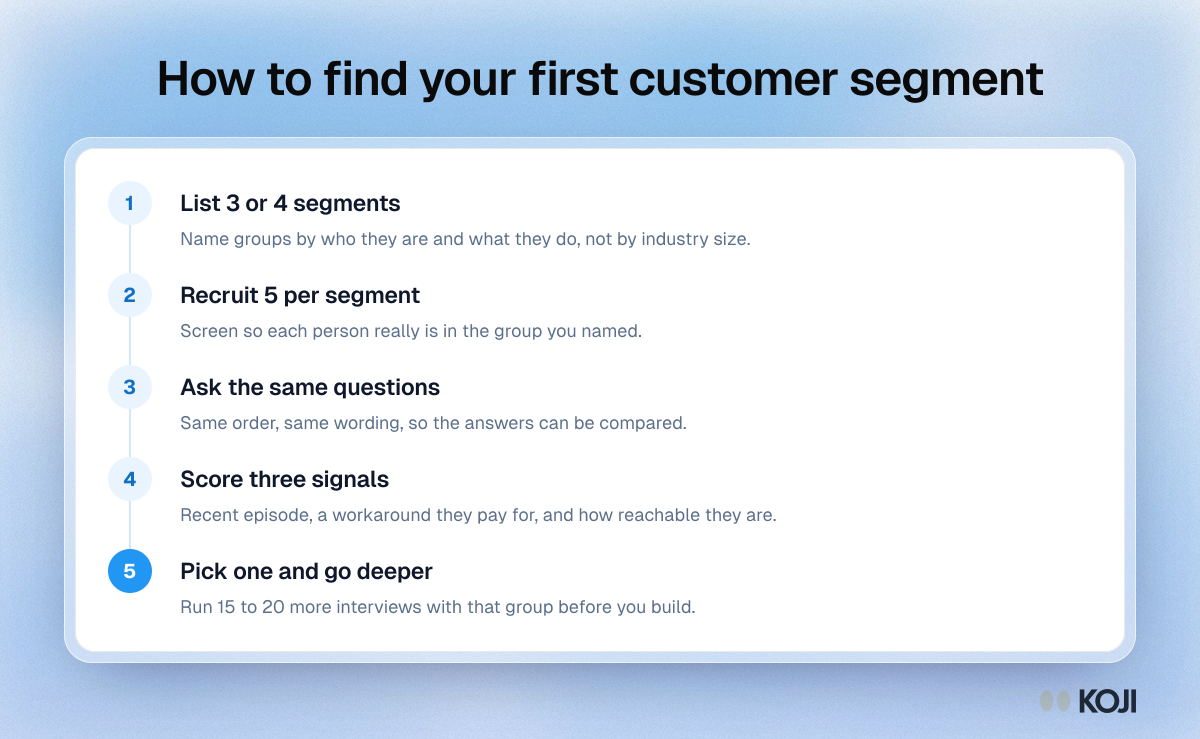
The three signals come from the question every founder path asks here: who feels the problem most, and who already pays to work around it? Your founder's research playbook puts it as that comparison, and I would add a third: can you reach them? A group that hurts and pays but that you can't talk to is somebody else's customer.
Step by step
1. List three or four segments
Write each segment as a person doing something, not as a market size. "Independent home inspectors who write their own reports" is a segment. "Real estate" is a market. If you can't think of three, split the one you have by what they do today: by the tool they use, the team size, or the trigger that makes the problem show up. If you want to size the market, TAM, SAM and SOM comes later. Don't let it decide this.
2. Find five people per segment
You need 15 to 20 conversations from people who really are in the groups you named. Start with introductions from people you know, add the communities where each group posts, and use cold messages for the rest. Find 20 people to interview when you have no audience has the full 14-day plan. The only extra rule here is balance: don't let the easiest segment to reach fill the sample.
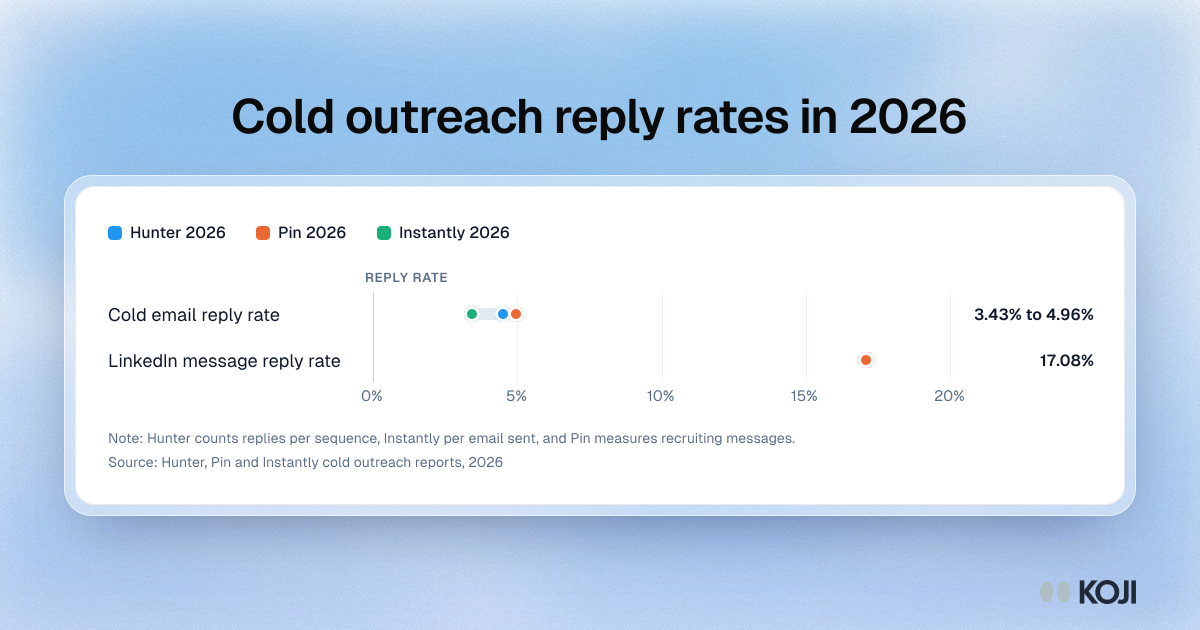
Plan for few replies. Hunter's 2026 report puts the average cold email sequence reply rate at 4.5% [4]. Pin's analysis of more than four million recruiting messages found 4.96% for email and 17.08% for LinkedIn [5], and Instantly reports 3.43% on its own definition [6]. All three measure sales and hiring outreach, not research invitations, so treat them as a floor you may beat by being honest about what you want, which is a conversation and not a purchase. At 4% you need to contact roughly 25 people to get one yes, so a target of 15 interviews means a list closer to 400 names than 40.
Screen every person before the call. One question is enough: "When did you last deal with [the problem]?" Someone who says "never" is not in the segment, however friendly they are.
3. Ask the same questions in every segment
Same order, same wording. That is what lets you compare. Anchor everything on the last real episode and not on your idea, which is the core of the Mom Test: people are poor at predicting what they will do and decent at remembering what they did. Don't mention your product in this round.
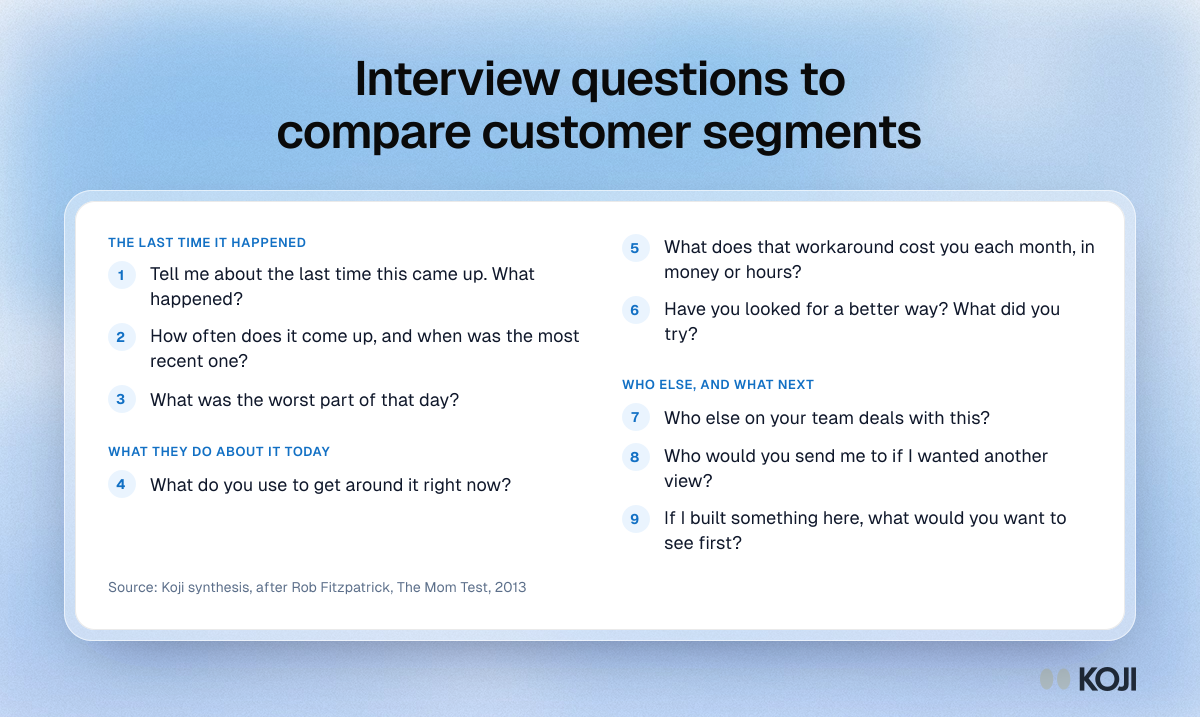
The first block gives you the story. The second block is the one that separates segments: what do they do today, and what does it cost them? The third block gives you referrals, which is how the second round fills up without more cold outreach. For a deeper treatment of the job people are hiring a workaround to do, see jobs-to-be-done interviews.
4. Write down the same four things after each call
Keep a row per person with the segment and:
- The episode: a date and what happened, or "no specific story".
- The workaround: what they use now, and what it costs in money or hours.
- The effort: whether they tried to fix it before you called.
- The reach: who they would send you to.
At the end you have 15 to 20 rows grouped by segment, and the comparison is a read down three columns.
A worked example
Say you're a two-person team that wants to turn photos from a site inspection into a finished report. Your four candidate segments, written as people: independent home inspectors, property managers who commission inspections, small construction firms that document progress, and insurance adjusters who work for themselves. This is an invented scenario to show the mechanics. The numbers are made up for the example.
You get five calls in each. The inspectors all tell you about last Tuesday: three hours of typing up a report after a day on site, done at night. Four pay for report software today and two have tried a second tool. The property managers describe the problem second-hand ("our inspector takes a few days"), and none pays for anything; they just wait. The construction firms have a story, but a different one each time, and only one workaround in common, a shared folder. The adjusters are the hardest to reach: two replied out of forty messages, and neither wanted to talk again.
Run the three questions. Inspectors have a recent, specific episode, a paid workaround and have already named three people to call next. The property managers fail the second question and go in the parking lot. The construction firms are close, but there is no single workaround you could beat. The adjusters fail the third. You pick the inspectors and schedule 15 to 20 more calls with them, starting with the three names you were given.
Reading the results and deciding
For each segment, ask three yes or no questions. A single answer isn't a verdict: you are comparing groups, so the question is which one has the strongest answers on all three.
- Did most of them tell you a recent, specific story? A date, a place, a person involved. If you mostly got opinions ("it's a pain, in general"), the problem is not frequent enough in their lives to drive a purchase. Go back and ask about the last time before you decide.
- Do they already spend time or money on a workaround? This is the strongest signal in the round. Spending money or hours on a bad fix tells you the problem already costs them something. No workaround usually means no purchase.
- Can you reach ten more of them this month? A segment that fits the first two but that you can't get to is a note for later, or a reason to look for someone who already sells to them.
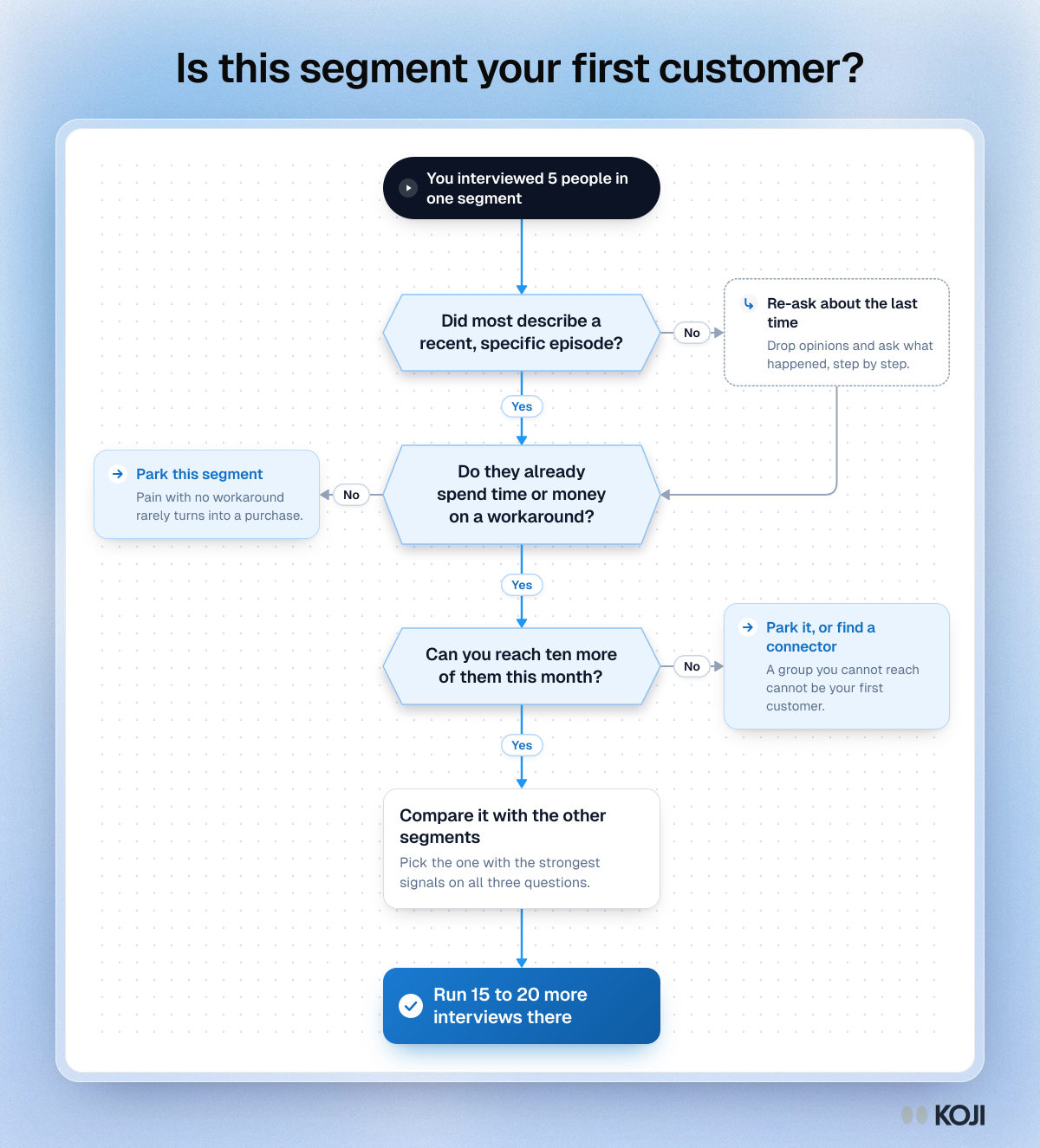
If two segments pass, take the one where the workaround costs more, then run the second round with 15 to 20 people from it. If none pass, don't pick the least bad. Go back to your list, split the segments differently, and ask again. That outcome is cheap compared with six months of building for the wrong group. If one segment passes and you also want to know what it would pay, move to pricing before you have customers once you have talked to enough of them.
Run it this week with Koji
You can do all of this by hand, with a spreadsheet and a calendar. Koji removes the scheduling, the note-taking and the transcribing, and keeps each answer next to the quote behind it.
- Write the brief. Describe your problem and the segments in the research assistant, and ask for an interview built around the nine questions above. It builds the study and can change any part of it when you ask.
- Screen on the way in. Add a screening question such as "When did you last deal with [the problem]?" and mark which answers qualify. Everyone answers it before the interview starts, whatever link they came through, and people who don't qualify are turned away.
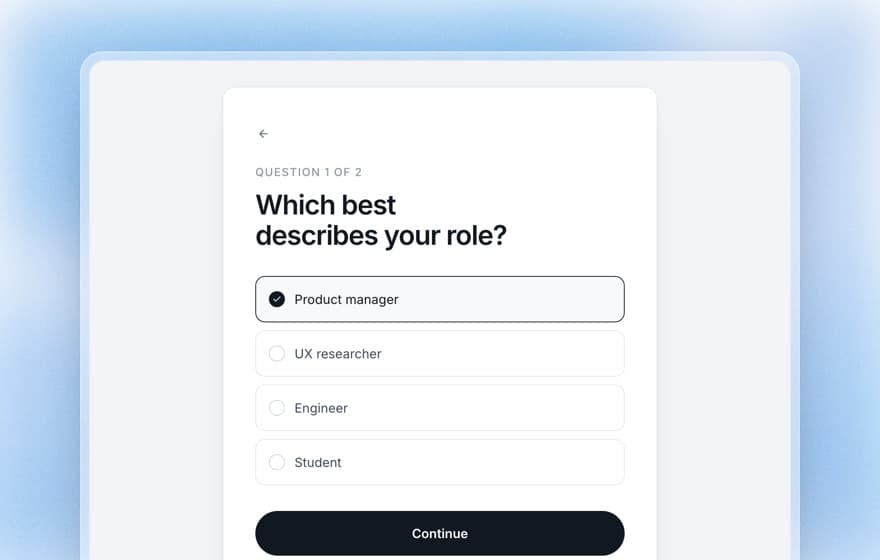
- Ask which segment they are in. Add a single-choice question near the start ("Which best describes your work?") with the segment names as options. Shuffle the option order so the first option isn't favoured, and read each person's answer next to their transcript.
- Send it to people. Share one link in the communities where each segment gathers. If you have a list, import it as a CSV and Koji gives each person their own link (Interviews plan and above); the exported file keeps your own columns, such as the segment, next to each person's status. Emailing a list from Koji, with reminders, is on the paid plans.
- Read across segments. The report shows each question's answers with the quotes behind them. Check the three signals per segment, then pick.
Later, once you have chosen a segment, Koji's price test can put the same product description in front of 30 or so people and show how many would buy at each price, with the reasons in their own words. It is directional, since people overstate what they would buy, so treat the result as a range to test and not a price to publish.
An AI interviewer won't judge your segment list for you, and it can't replace the first few calls where you hear the story in someone's voice. Do the first two or three yourself.
Common mistakes
- Choosing by who is easiest to reach. Friends and colleagues are easy and polite. Balance the sample across segments.
- Mentioning your idea. The moment you pitch, the answers turn into opinions about the idea.
- Treating a big market as a segment. If you can't list fifty of them, it isn't one yet.
- Counting enthusiasm as signal. "I would definitely use that" costs nothing to say. A workaround that costs money is a fact.
- Changing the questions between segments. Then the groups can't be compared.
- Stopping at five. Five tells you where to look. It doesn't tell you the segment is large or willing to pay.
When research will mislead you
Five interviews per group is a small sample, and the groups won't be random: the people who answer a cold message are the ones who like talking about their problem. The result is evidence about where to dig, not a measurement of a market. Pair it with a commitment: a deposit, a signed letter of intent, or a waitlist that asks for a real next step. Where you have only conversations with friendly people, discount the whole result.
Don't expect a clean winner every time. Sometimes two segments tie, or the best one is too small to matter. Say so, and pick on the one signal the others lack: reach, or the size of the workaround.
Where this fits
Before this, you need to know there is a problem and where to find people: rank the pains you heard and find people to interview with no audience. After it, take your chosen segment into the three rounds of ICP interviews, then to testing a landing page and pricing. The whole path is in the founder's research playbook, and more for your stage is at /for/founders.
FAQ
How many interviews do I need to find my ICP?
Start with five per candidate segment, so 15 to 20 across three or four segments. That's enough to see whether a story exists. Then run 15 to 20 with the segment that wins. Research on interview saturation finds that themes in a fairly uniform group appear within about a dozen interviews [3], which is why the second round should stay inside one segment.
Can I find my ICP before I have a single customer?
Yes, as a hypothesis. You are looking for the group with a recent story, a paid workaround and a way to reach them. Your first ten customers will then tell you whether the guess was right, and you should expect to adjust it.
What if everyone I talk to is a possible customer?
Then your segment is too wide to use. Split it by what people do today: the tool they use, their team size, or the event that triggers the problem. Pick the cut you can write a list for.
Should I use a survey instead?
Not for this round. A survey is good at counting a thing you already understand. You don't yet know what the segments are or how they describe the problem, and a survey can't ask a follow-up. Use interviews first and a survey to size what you learn.
Can I use AI or synthetic users to pick my segment?
An AI can help you draft segments and questions, and an AI interviewer can run real conversations with real people. Synthetic personas only reflect what a model already knows, so they can't tell you who has a problem right now. Use real people for the comparison.
References
- Camuffo, A., Cordova, A., Gambardella, A. and Spina, C. "A Scientific Approach to Entrepreneurial Decision Making: Evidence from a Randomized Control Trial." Management Science, 2020. Bocconi repository.
- Camuffo, A., Gambardella, A., Messinese, D., Novelli, E., Paolucci, E. and Spina, C. "A scientific approach to entrepreneurial decision-making: Large-scale replication and extension." Strategic Management Journal, 45(6), 1209 to 1237, 2024. Record.
- Guest, G., Bunce, A. and Johnson, L. "How Many Interviews Are Enough? An Experiment with Data Saturation and Variability." Field Methods, 18(1), 59 to 82, 2006. Record.
- Hunter. "The State of Cold Email." 2026. hunter.io.
- Pin. "Recruiting Outreach Benchmarks 2026: The Full Data Report." Pin blog, 2026. pin.com.
- Instantly. "Cold Email Benchmark Report 2026." 2026. instantly.ai.
- Product Hunt discussion. "How can I find the ICP (ideal customer profile) for my product/service?" 2026. Product Hunt.
- Echai Ventures. "How specific should my target customer be when I am just starting?" 2026. echai.ventures.
Further reading
- The Mom Test, as summarised by Koji: Rob Fitzpatrick's rules for asking about the past and not the idea, which every question in this guide follows.
- Find your ideal customer profile in three rounds of interviews: the next step once you have users and want to narrow further.
- How to find early adopters: where the first people to try something new gather.
- Guest, Bunce and Johnson on saturation: the paper behind the "about a dozen interviews" rule and its limits.
One next step: write three candidate segments as people doing something, then book your first five calls this week. Koji can turn that list into a screened interview study in a few minutes.