You have an idea, maybe a prototype, and no customers. The price box on your landing page is empty and every answer you find says "it depends." The short answer: build a price range from three things you can find this week (what your buyers spend today, what the alternatives cost, what the problem costs them), test five to seven prices inside that range with about 30 target buyers, then ask a few of them for a deposit. By the end of this guide you can run all of it before you write the billing code.
When you need this
You are at this point if any of these is true:
- You are about to put up a waitlist or landing page and cannot say what the product costs.
- You are about to talk to buyers and know that "how much would you pay?" gets you polite, round, low answers.
- A first prospect asked "what's the price?" and you improvised.
- You are tempted to copy the nearest competitor so you do not have to decide.
Skipping the question is not neutral. A price that is too low is a cost on every sale, and it attracts buyers who leave at the first bump. A price that is too high hides itself: you never hear from the people who closed the tab. And pricing does not stay put once you pick it. PricingSaaS counted more than 1,800 pricing and packaging changes across about 500 SaaS and AI companies in 2025, roughly 3.6 per company [1]. Your first number is a hypothesis. The aim now is a defensible one and a cheap way to check it.
That is also how the better-studied founders work. In a randomised trial of 116 Italian startups, those taught to form hypotheses and test them performed better than those who got general training [2], and a replication across four trials and 759 firms found a similar pattern [3]. Price is one of the easiest hypotheses to test early.
The method in brief
Before you have customers, no single method works. People are poor at predicting what they would pay, and the way you ask matters less than you might hope. Schmidt and Bijmolt pooled 115 effect sizes from 77 studies and found that stated willingness to pay ran about 21% above what people really paid. Surprisingly, indirect methods overstated it more than simply asking directly [4]. So the plan is to stack methods, each one covering the weakness of the last:
- Anchors, no one to talk to. Work out your cost floor and what buyers spend today on the workaround or the nearest alternative. This gives you a rough band.
- Conversations, about 15 to 20 people. Ask about their current spend and the cost of the problem in the Mom Test way: about their past, not your idea. Then ask four range questions (too cheap, a bargain, getting expensive, too expensive). That is the Van Westendorp price sensitivity meter, introduced in 1976 [5], and it is built for the situation where you have no starting number.
- A price test, about 30 people. Now that you have a range, show 5 to 7 prices inside it, one at a time, and ask how likely they are to buy at each. That is the Gabor-Granger price test. The two methods are compared in Gabor-Granger vs Van Westendorp.
- Real money. A deposit, a pre-order, a paid pilot or a signed letter of intent. This is the only step that measures what people do. Smoke tests and fake doors are cheaper versions of it.
If you already have customers and a live product, you want Price Your First Product With 30 Customer Conversations or the comparison of price-testing methods instead. This playbook is for the stage before that.
Step by step
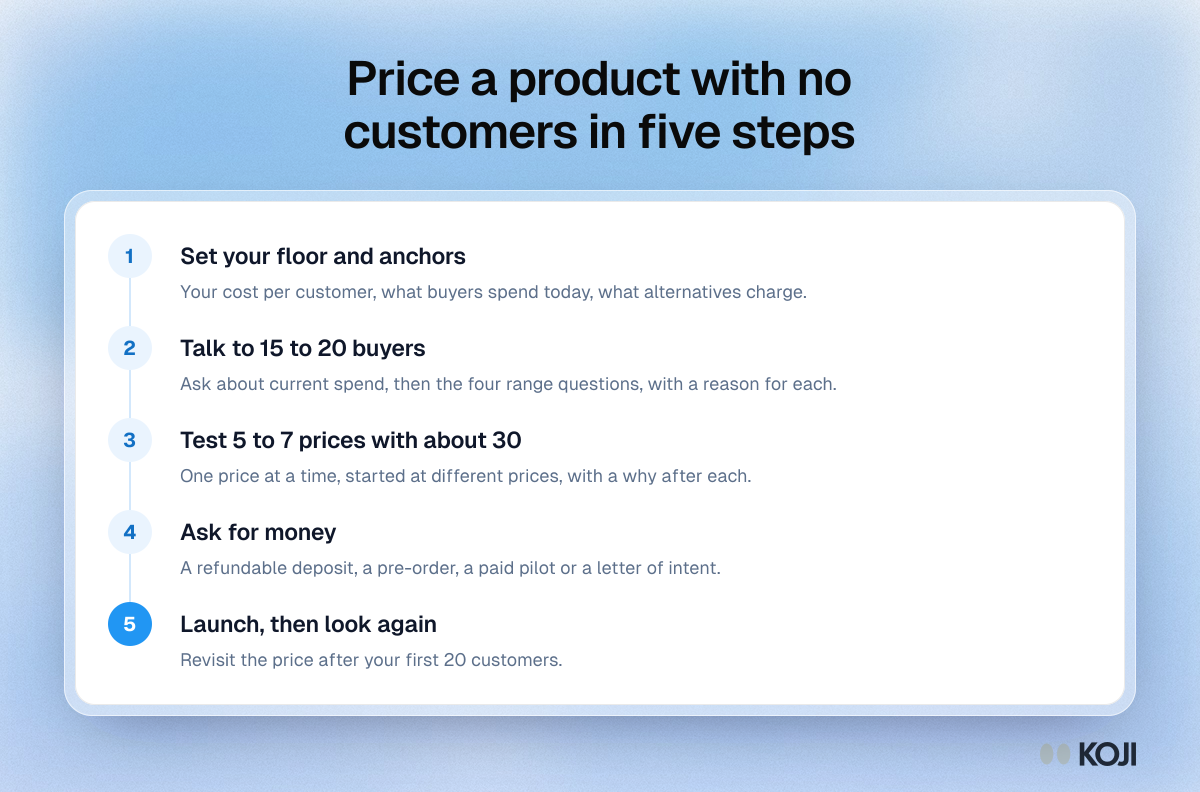
Step 1: set your floor and your anchors (a day, no conversations). Write down what one customer costs you to serve, including your time if the first customers will be hand-held. That is your floor. Then list what your buyer spends today on the problem: the tool, the freelancer, the staff hours, the lost sales. If your product saves a team six hours a week, six hours is the number to compare, not the price of other software. Add the two or three closest alternatives and what they charge, including the "do nothing" one. You now have a band, and nothing in it is proven yet.
Step 2: find 15 to 20 people who buy this kind of thing. Pick the person who signs the cheque, not the person who is easiest to reach. If you have no audience, find 20 people to interview lists the places to look, and early adopters covers who to look for. Ask each person you speak to for two introductions. A small thank-you shows you value their time; see participant incentives.
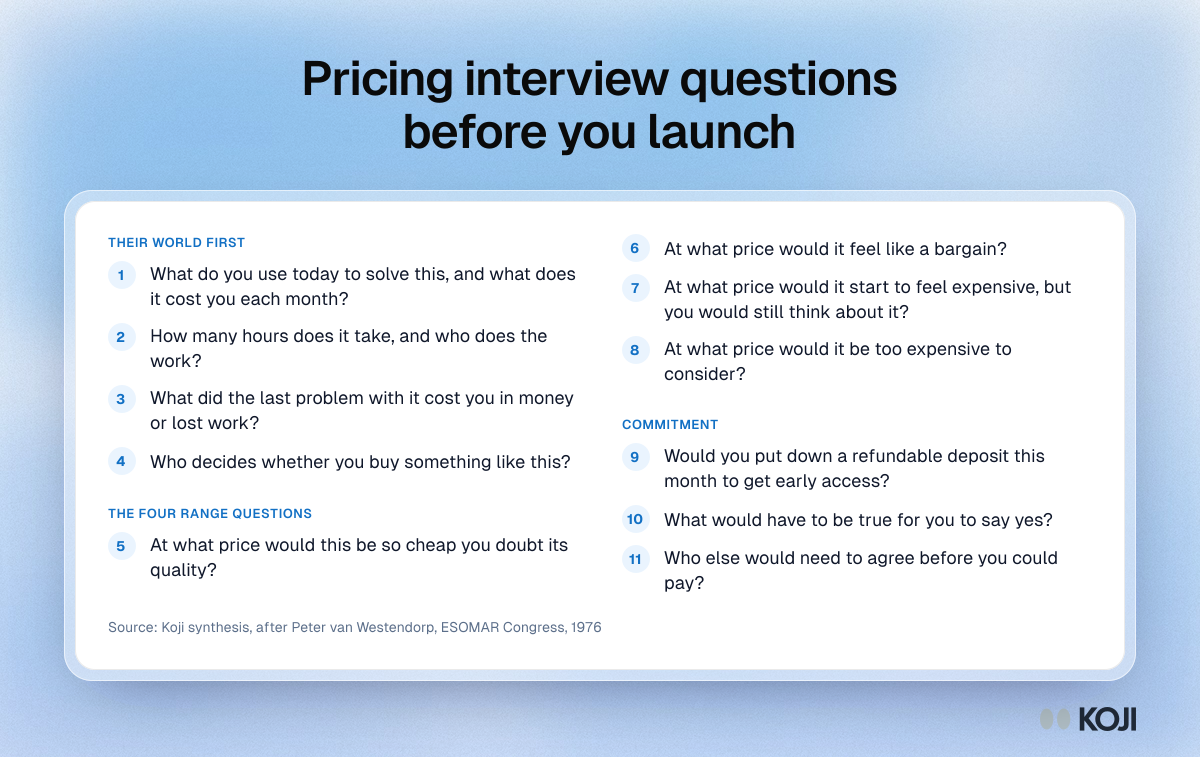
Step 3: run the range conversation (12 to 15 minutes each). Start with their world: what they use now, what it costs in money and hours, who decides. Describe what the product does in a sentence or two, without a price. Then ask the four range questions and write down each number, with a reason for each. Reasons matter more than the numbers: "too cheap" at $9 because "I would assume it breaks" tells you something a spreadsheet cannot.
Step 4: run the price test (about 30 people). Take the range the conversations gave you, split it into five to seven evenly spaced prices, and show them one at a time, never as a menu. A menu invites people to pick the middle. Start different people at different prices so none is anchored on the cheapest, and ask why after each answer. If you can show a sketch, mockup or landing page, show it with the price question, so people price the thing and not your description.
Thirty is where the curve starts to mean something, not where it becomes proof. A price curve counts people, so it needs more than a theme interview does. Say so in your notes: this is a directional read, and comparing two customer types would need far more people.
Step 5: ask for money. Pick the one or two prices the curve and the reasons favour, and put them in front of the people who said yes. The ask should cost them something and be small enough that a serious buyer says yes: a refundable deposit, a pre-order, a paid pilot, or a letter of intent from a company that can sign one. A clean test: of ten people who said "probably would buy" at your price, how many put down something?
A worked example
Say you are a solo founder building a tool that turns site-visit photos into quotes for small roofing firms. You have a clickable prototype and no customers. The numbers below are made up to show how to read a result. They are not from a real study.

Photo by Raze Solar on Unsplash
Anchors. Your floor is low, since each quote costs you a few cents of compute and some support time. What matters is the buyer side. A roofing firm owner tells you quoting takes him about four hours on a Sunday, and he loses jobs to the firm that quotes first. A competing estimating tool costs a few hundred dollars a month and is built for big contractors. The band you take into the calls is $40 to $300 a month, wide on purpose.
Range calls. You speak to 17 owners. Their "too cheap" answers cluster around $20 to $40, "a bargain" around $60 to $90, "getting expensive" around $150, "too expensive" around $250. Crossing the four lines in a spreadsheet gives an acceptable range of roughly $60 to $200. The reasons split into two groups: owners with one crew say $100 is already a lot, owners with three or more crews say they would pay $200 without thinking if it saved a Sunday.
Price test. You take seven prices, $59, $79, $99, $129, $159, $199 and $249 a month, and run 31 more owners through them with a photo of the prototype. A third of them cap out at $99, and say the same thing: "I'd need to see it win one job first." Another third go to $199 and mention hours saved. The revenue per person asked peaks near $129, but $99 is within a few percent of it.
Decision. You do not set "$129." You decide: launch with two plans, one near $99 for single-crew firms and one near $199 for multi-crew firms, and ask the first ten who said yes at those prices for a refundable $50 deposit. Seven pay. Now you have something stronger than a curve.
Notice what you did not conclude: that a third of roofers will pay $199. You learned where the steepest drop-off is, who is on each side of it, and what makes them pay.
Reading the results and deciding
Treat a stated price as a ceiling. Take the 21% average gap [4] as a rough guide: a price people say they would pay at $100 behaves more like $83 when it is real money. Then use these rules:
- The revenue peak sits inside your ladder, not at its top or bottom edge.
- The reasons at the peak come from the buyer you want, not from people who were never going to buy.
- Most people do not reject your lowest price.
- A second price sits within about 10% of the peak revenue, so you have something to test against.
- You can say what would make your highest price work.
- At least some of the people who said yes will back it with a deposit or a letter.
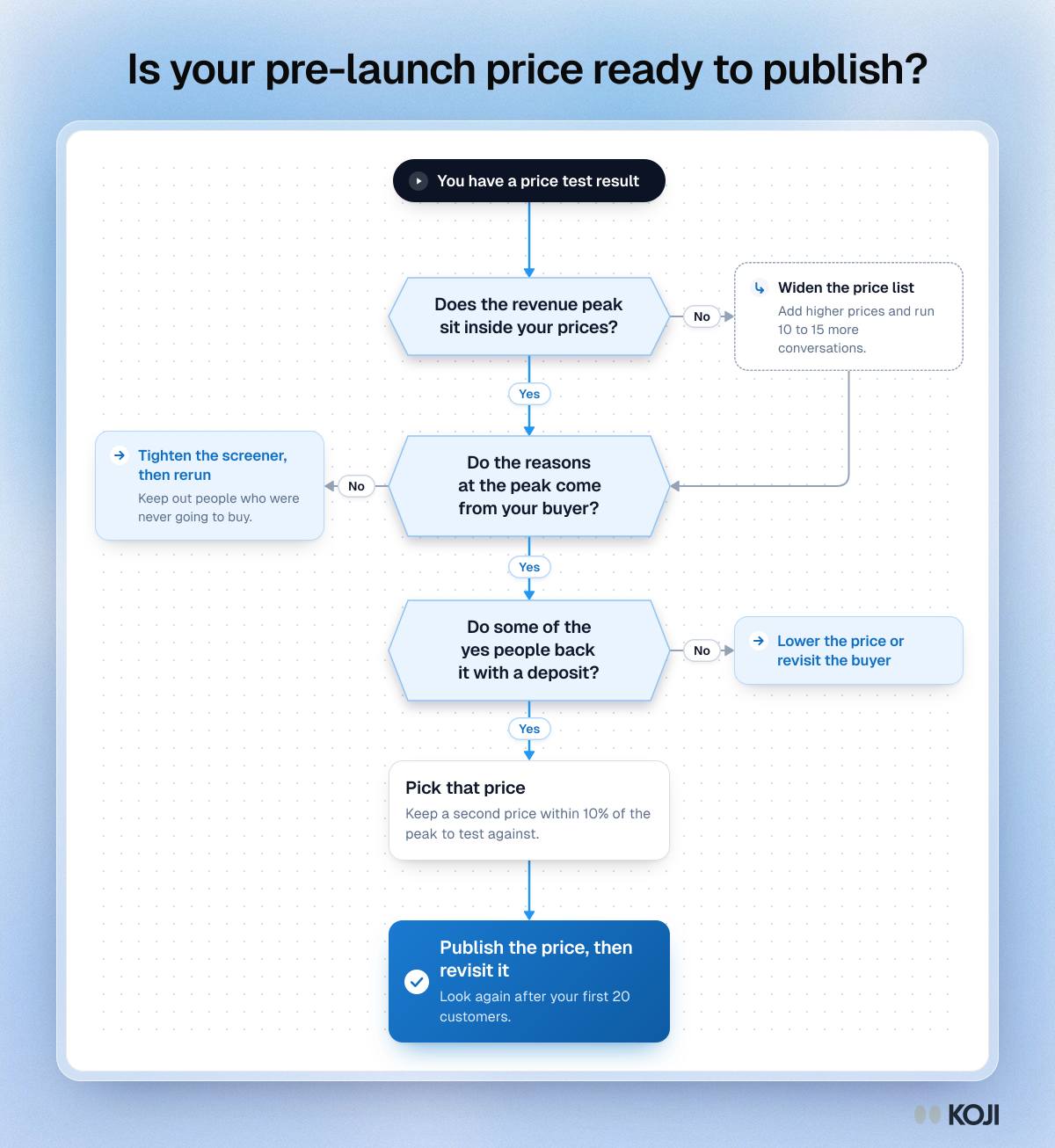
What to do next, by outcome:
- The peak is in the middle and buyers back it with money. Launch at that price, and plan to look again after your first 20 customers.
- The peak is at the top of your ladder. The range was too low. Add higher prices and run another 10 to 15 conversations.
- Most people turn down even the cheapest price. This is rarely a pricing problem. They do not see the value, so go back to the problem and who has it worst.
- Two peaks with different reasons. You have two buyers. Price them separately or choose one.
- People say yes and then will not pay a deposit. The curve was too kind. Lower the price you launch with, or return to the buyer.
Run it this week with Koji
You can do every step above with a spreadsheet and a calendar. Koji takes out the scheduling, the walk up and down the prices and the arithmetic. The price test is a question type you can add yourself from a free account, next to every other question type.
- Start a study and describe the goal ("what should we charge for a quoting tool for roofing firms?"). The research assistant drafts the brief, or you can write the questions yourself.
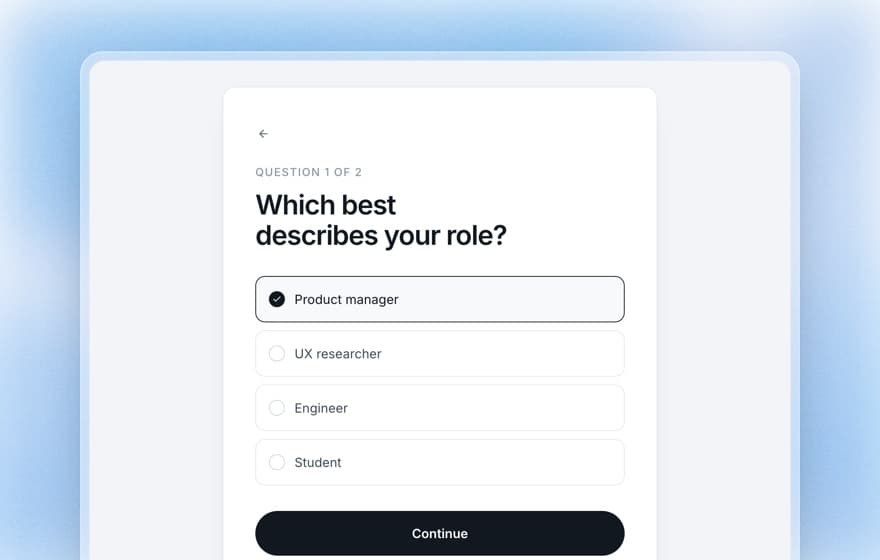
- Add a screener so only people who buy this kind of product get through. A screener is a question that qualifies or disqualifies on the answer, for example "Which best describes your role?"
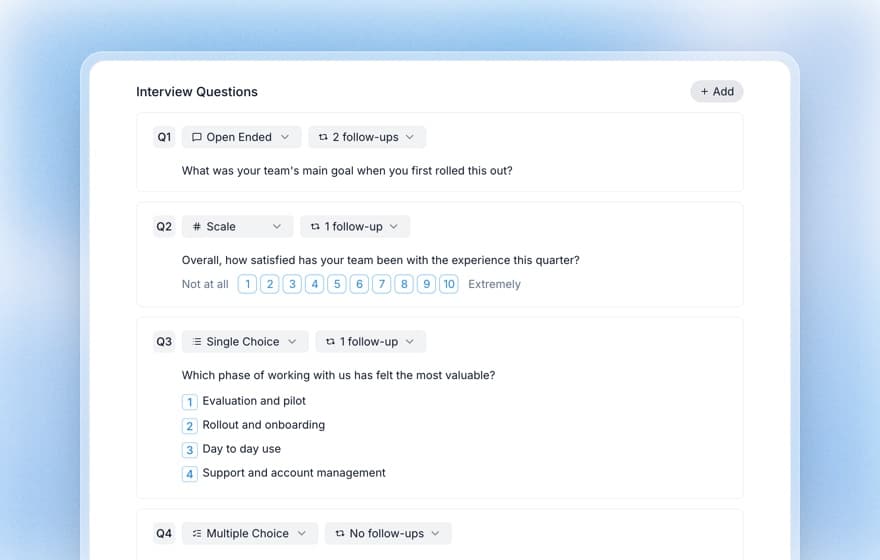
- Put the context questions first as open-ended questions: current spend, the hours the problem costs, who signs. Then add the four range questions as open-ended questions too. Koji follows up on each answer, so you get the reason beside the number. You note the four numbers per person and cross them in a spreadsheet; the Van Westendorp guide shows how.
- Add a Price Test question. The question text names the product and what the price buys, not a price. Attach your mockup or landing page as the question's image. Enter 3 to 10 prices (five to seven, evenly spaced, works best), the currency and a unit such as "per month", and pick which answer counts as a buy. The default is "Probably would buy" or higher. Setting up a price test explains every setting, and how many prices to test helps you choose them.
- Share the link. Use personal invite links or email your own contacts and waitlist. Each person starts at a random price in the middle of your list, and Koji moves up or down until it finds the highest price they would still buy at, usually in about three steps. Then it asks why, in their own words. It works in text and voice interviews, not on phone calls, and prices lock once responses come in, so check them before you share.
- Read the report. It shows the share who would buy at each price, the revenue each price implies and the price that earns the most, with the quotes behind each point. It is labelled directional on purpose, and the best price is always one of the prices you tested. Reports read best from about 30 interviews. Download the report as slides or a PDF to send to a co-founder, an advisor or an angel.
Koji does not take the deposit. That step is yours, with a payment link or an invoice, and it is the step that tells you whether the report was right.
Common mistakes
- Asking "what would you pay?" People anchor on round numbers and round down. Give them specific prices.
- Pricing a feature list. Describe the outcome, what is included and who it is for.
- Asking friends and family. They want to be kind.
- Starting the ladder at your own guess. Build the range from their numbers, not yours.
- Reading the curve as a forecast. It is a ceiling.
- Mixing two buyers in one curve. Owners and employees want different things; screen for one.
- Treating the launch price as permanent. The market keeps moving. Poyar's 2026 survey of more than 230 B2B software and AI companies found hybrid pricing the most common model at 37%, up from 25% a year earlier, while early-stage startups held on to flat-fee subscriptions [6]. A simple first price is fine. A first price you never revisit is not.
When research will mislead you
- Stated prices run high. About a fifth on average [4], and more for expensive or specialist goods.
- Thirty people is a directional sample. If you need to compare two customer types, plan for well over 30 each.
- Early fans pay more than the rest. In the 2022 account of how Scrintal priced a pre-launch product, more than 1,400 people completed a pricing survey, and people who had tried the product were willing to pay 60% more than people who had not [7]. Your first respondents are probably your warmest ones, so do not assume the next thousand match them.
- Politeness. "Probably would buy" does not open a budget line. Pair every curve with a deposit or a letter.
- A price you tested is not a price you proved. Interviews and price tests are a way to narrow the range and start well, and live sales are the real test.
Where this fits
Pricing sits after you know who the customer is and before you put money into acquisition. Before it, rank the problems your customers have and test your landing page. After it, price your first product with 30 customer conversations once real customers arrive. The whole sequence is in the founder's research playbook, and Koji for founders shows how founders run it.
FAQ
How do I price a product when I have no customers? Build a range from your cost floor, what buyers spend today and what alternatives charge. Then ask 15 to 20 target buyers the four Van Westendorp questions, test five to seven prices with about 30, and ask a few for a deposit.
How many people do I need to talk to? About 15 to 20 for the range, and about 30 for a price test curve. Both are directional. For firm numbers or to compare segments you need many more.
Should I just copy my competitor's price? Use it as one anchor, not the answer. Their cost structure, buyers and plan limits are different from yours, and you do not know whether their price is working.
Can I trust what people say they would pay? Partly. A meta-analysis found stated willingness to pay about 21% above real payment on average [4]. Confirm with a deposit, a pre-order or a paid pilot.
Is Van Westendorp or Gabor-Granger better for a first price? Van Westendorp finds an acceptable range when you have no starting number. Gabor-Granger gives a demand curve at prices you choose. With no number, use the first and then the second.
What if I cannot find 30 buyers? Run the range conversations with 15 to 20, make the best two-price decision you can, and let the first deposits do the rest of the work. A small, honest sample is better than a made-up one.
Next step: write your one-line offer and your anchor band, then start a free study and run the range conversations this week.
References
- Kyle Poyar, "The good, bad and ugly of SaaS pricing changes" (analysis of PricingSaaS tracking of 2025 changes), Growth Unhinged, 2025. growthunhinged.com
- Camuffo, Cordova, Gambardella and Spina, "A Scientific Approach to Entrepreneurial Decision Making: Evidence from a Randomized Control Trial", Management Science, 2020. City Research Online
- Camuffo et al., "A scientific approach to entrepreneurial decision-making: Large-scale replication and extension", Strategic Management Journal, 2024. IE repository
- Schmidt and Bijmolt, "Accurately measuring willingness to pay for consumer goods: a meta-analysis of the hypothetical bias", Journal of the Academy of Marketing Science 48(3), 2020. University of Münster research portal
- Peter van Westendorp, "NSS-Price Sensitivity Meter (PSM): a new approach to study consumer perception of price", ESOMAR Congress Proceedings, 1976. Cited via Wikipedia
- Kyle Poyar, "The State of B2B Monetization in 2026" (survey run April to May 2026, 230+ companies), Growth Unhinged, 2026. growthunhinged.com
- Scrintal team, "How we got 1400 people to help us price a pre-launch product, step by step", Indie Hackers, 2022. indiehackers.com
Further reading
- Van Westendorp price sensitivity meter: the four questions and how to cross the lines.
- Gabor-Granger pricing method: the method behind the price test, with the arithmetic.
- The Mom Test: how to ask about money without being flattered.
- Price testing methods for startups, compared: the seven routes once you have a live product.