How do you pre-sell a product before you build it? Pick the commitment that fits your buyer (a refundable deposit or pre-order for consumers and small businesses, a paid pilot or a letter of intent for bigger companies), offer it to 10 to 20 people who already told you they have the problem, and count who pays, not who says yes. By the end of this playbook you will have the offer, the script, the decision rules and the follow-up questions for everyone who said no.
This is the step after the price. If you don't have a number yet, start with how to price a product before you have customers, then come back here.
When you need this
You are at this point if any of these is true:
- Your problem interviews went well and everyone said they would "definitely use it".
- You have a waitlist and no idea how many of those people would pay.
- You are about to spend two or three months building, or to quit a job to do it.
- An investor or co-founder asked "has anyone paid?" and you changed the subject.
Here's why guessing costs so much. People say they will pay more often, and more, than they actually do. A meta-analysis of 77 studies found that stated willingness to pay runs about 21% above what people really pay for the same goods [1], and an older review of 28 studies put the median ratio of stated to real value at 1.35 [2]. A 2025 study of German mobile customers found the same pattern: what people said they would pay sat above what they already spent [3]. Founders feel it as the waitlist that looked busy and didn't convert on launch day.
So the interview tells you the problem is real. Only money tells you the solution is wanted at your price. Asking for it before you build is the cheapest way to find out, and the founder's research playbook puts it exactly here: show the idea only after the problem interviews, and look for a signup or a deposit, not compliments.
The method in brief
Pre-selling is a commitment test. You describe what you will deliver, by when and for how much, and ask for something that costs the buyer: money, a signature, time or reputation. It sits next to three tests you may already know:
- A smoke test or fake door measures clicks from strangers. It is cheap and fast but a click costs nothing.
- A waitlist measures email addresses. Also cheap, and also weak on its own.
- A concierge MVP delivers the result by hand. It is the strongest evidence and the most work.
A pre-sale sits between the waitlist and the concierge: real money, little build. If you are unsure which test should come first, which validation test to run first walks through the order. This playbook is about doing the pre-sale well.
There is one good reason to trust the method. In randomised trials with 759 early-stage firms in Italy, founders taught to treat their ideas as hypotheses and test them were more likely to drop ideas that didn't hold up [4]. A pre-sale is that kind of test. It gives you a clear chance to be wrong before the expensive part.
Step 1: pick the commitment that fits your buyer
Not every buyer can hand you money before a product exists. A clinic owner can pay a €150 deposit on a card today. A procurement team at a 2,000-person company cannot, but a manager there can sign a letter or agree to a paid pilot. Pick the strongest ask your buyer can realistically say yes to.
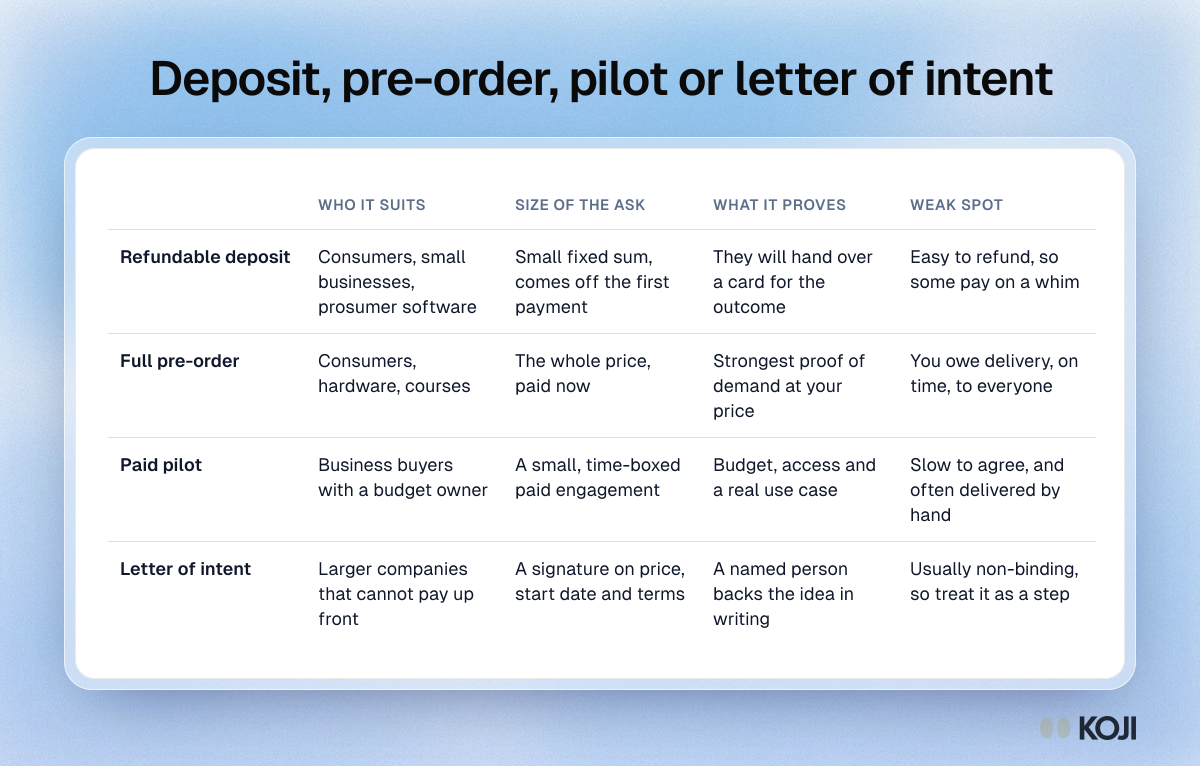
A few notes on each:
Refundable deposit. A small, fixed amount that reserves a founding spot and comes off the first payment. It works for consumers, small businesses and prosumer software. Make the refund promise plain and keep it. The deposit proves people will hand over a card for the outcome you described, which is most of what you need to know.
Full pre-order. The whole price, paid now, delivered later. Strongest evidence, and the most obligations. Crowdfunding is the public version, and it's a reminder that delivering is its own job: in a survey of 47,188 Kickstarter backers, about 9% of funded projects failed to deliver, and only 65% of backers said their reward arrived on time [5].
Paid pilot. A small, time-boxed engagement with a business buyer, often delivered partly by hand. It proves budget and access, which a deposit can't.
Letter of intent. A signed, usually non-binding note that the company intends to buy on stated terms if you deliver. It is the weakest of the four. Treat it as a step toward a paid pilot, not as revenue. The best LOIs name a price, a start date, a person who owns the budget and what "delivered" means.
Step 2: write an offer you can keep
The offer is one short page, or one card you can show on a call. It has five parts:
- The outcome, in the words your interviewees used. Not features.
- What they get and when, with a date you can hit even if things go wrong. Under-promise.
- The price after launch, and what the founding customer pays.
- The ask, in money: "€150 refundable deposit, comes off your first invoice."
- The refund rule. "If we don't deliver by 30 April, or you change your mind before we start, you get it all back."
Two practical checks. First, don't rely on a card hold. A card authorisation usually lasts about seven days before it expires (Visa allows five for online charges the merchant starts) [6], which is far shorter than your build. Take a real, refundable payment through any normal checkout or payment link instead. Second, know the rules for selling ahead of delivery. In the US, the FTC's Mail, Internet or Telephone Order rule says you must ship within the time you state, or 30 days if you state none, and if you can't you must tell buyers and offer a refund [7]. In the EU, consumers who buy online have 14 days to withdraw [8]. A deposit that is refundable at any time keeps you well inside both. If in doubt, ask a lawyer before you take money.
Step 3: ask the right people, live
Only ask people who passed the problem test: they described the problem happening recently, and they already spend time or money working around it. A pre-sale offered to strangers who never had the pain measures your copywriting, not demand. If you don't have those people yet, find 20 people to interview with no audience first.

Photo by Heng Chiu on Unsplash
How many? Aim for 10 to 20 qualified people. That is too few for a percentage you can quote, but it is enough to see whether money moves at all, and to hear the reasons when it doesn't. Ask on a call or face to face, at the end of a problem conversation or in a short follow-up. A pre-order page sent cold to a list is useful later, as a second test with more volume.
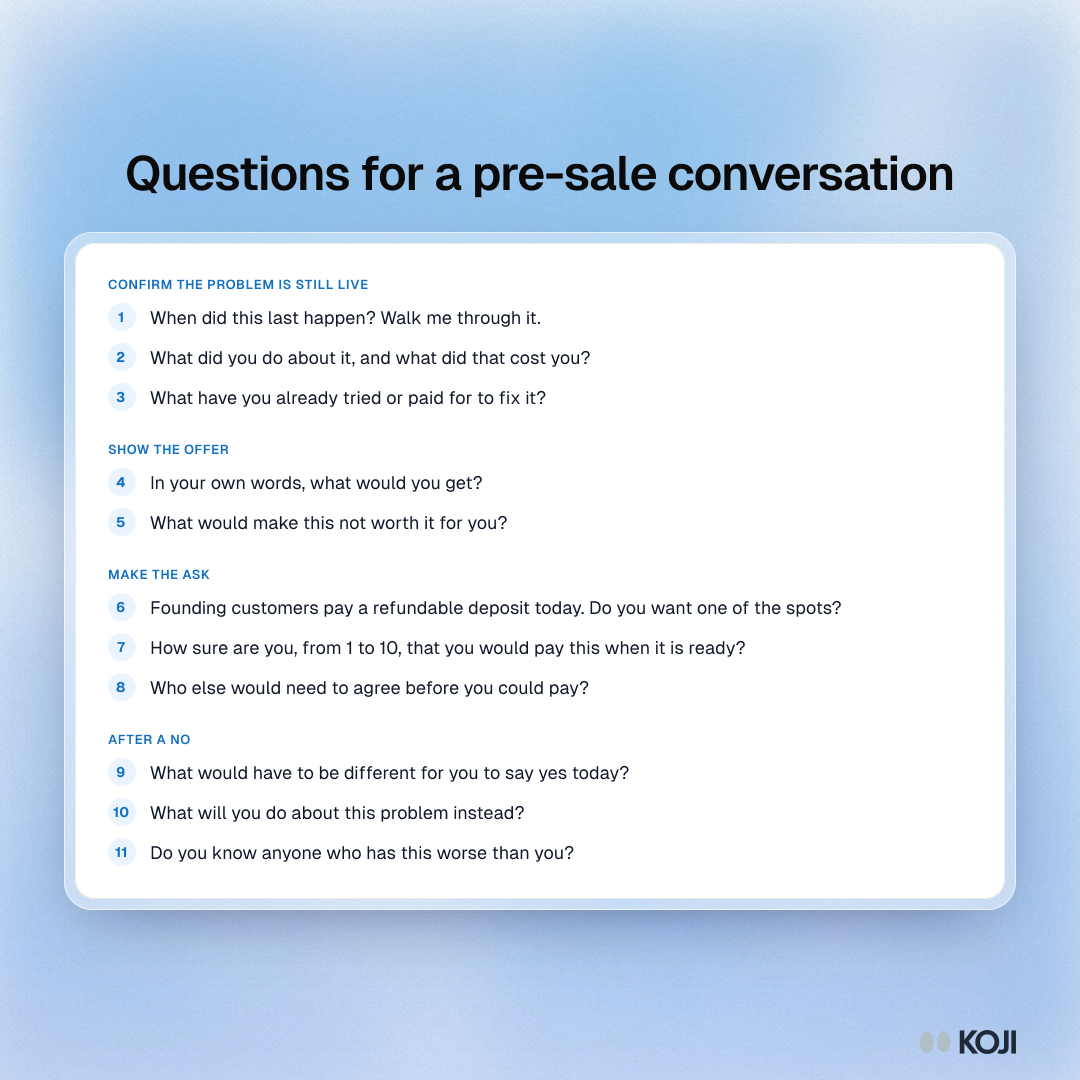
Use the same arc every time: their problem, your offer, the ask, then silence. Here is the question bank I'd use:
Confirm the problem is still live
- When did this last happen? Walk me through it.
- What did you do about it, and what did that cost you?
- What have you already tried or paid for to fix it?
Show the offer
- (Show the offer card.) In your own words, what would you get?
- What would make this not worth it for you?
Make the ask
- Founding customers pay a €150 refundable deposit today, and it comes off the first invoice. Do you want one of the spots?
- How sure are you, from 1 to 10, that you'd pay this when it's ready?
- Who else would need to agree before you could pay?
After a no
- What would have to be different for you to say yes today?
- What will you do about this problem instead?
- Do you know anyone who has this worse than you?
The hardest part is the moment after the ask. Say the price, say the refund rule, then stop. If they say yes, send the payment link while you are still on the call. "I'll do it later" is not a yes. Write down that answer word for word, because it's often the most useful thing you hear.
The 1 to 10 certainty question earns its place when someone hesitates. In a field experiment, plain hypothetical yeses overstated real buying, but counting only the people who said they were definitely sure they would pay removed the gap [9]. A 7 is not a yes.
A worked example
Say you're two founders building a tool that fills last-minute cancellations at independent physiotherapy clinics. It texts patients on a short-notice list when a slot opens. In problem interviews, 14 of the 20 clinic owners you spoke to described an empty slot in the past week, and most of them fill gaps today by phoning patients from the front desk.
The offer. "We fill short-notice cancellations by text, set up for you in two weeks. After launch it's €79 a month. Founding clinics pay a €150 refundable deposit now, which comes off your first two invoices, and we do the setup by hand. If we haven't gone live for you by 31 March, or you change your mind before setup, we refund the deposit in full."
The ask. You go back to the 14 owners with the pain. You show the offer card on a call, ask the money question, and wait.
What you hear. Five pay on the call. Three say they need to check with a partner or practice manager. Six say no. Of the six, four give the same reason: their booking system already sends a waitlist text, they just don't use it.
What you decide. Five of fourteen is a real signal from people who are hard to sell to, so you build the smallest version that delivers what you sold to those five. You follow up with the three "need to check" owners within a week, with a one-page note for the partner. And you take the four "we already have it" answers seriously: you interview two of them about why the built-in feature goes unused, because that is either your best pitch or your biggest risk.
Reading the results and deciding
The numbers are small, so read reasons as carefully as counts. These are rules of thumb I'd use, not benchmarks:
- Strong: around a third or more of qualified people pay. Build the smallest thing that delivers what you sold, to the people who paid, by the date you promised.
- Mixed: a few pay, many say "not yet" or "check with someone". Look at what blocks them. If it's timing or approval, keep selling the same offer. If it's price or scope, change one thing and ask a fresh group.
- Weak: almost nobody pays, even though the interviews were warm. The problem is real but not urgent at this price, or for this segment. Go back to which problem to solve first or narrow the segment before you change the product.
- Nobody to ask: if you can't find 10 qualified people to ask, that's a finding about reach, and you'll face it again after launch.
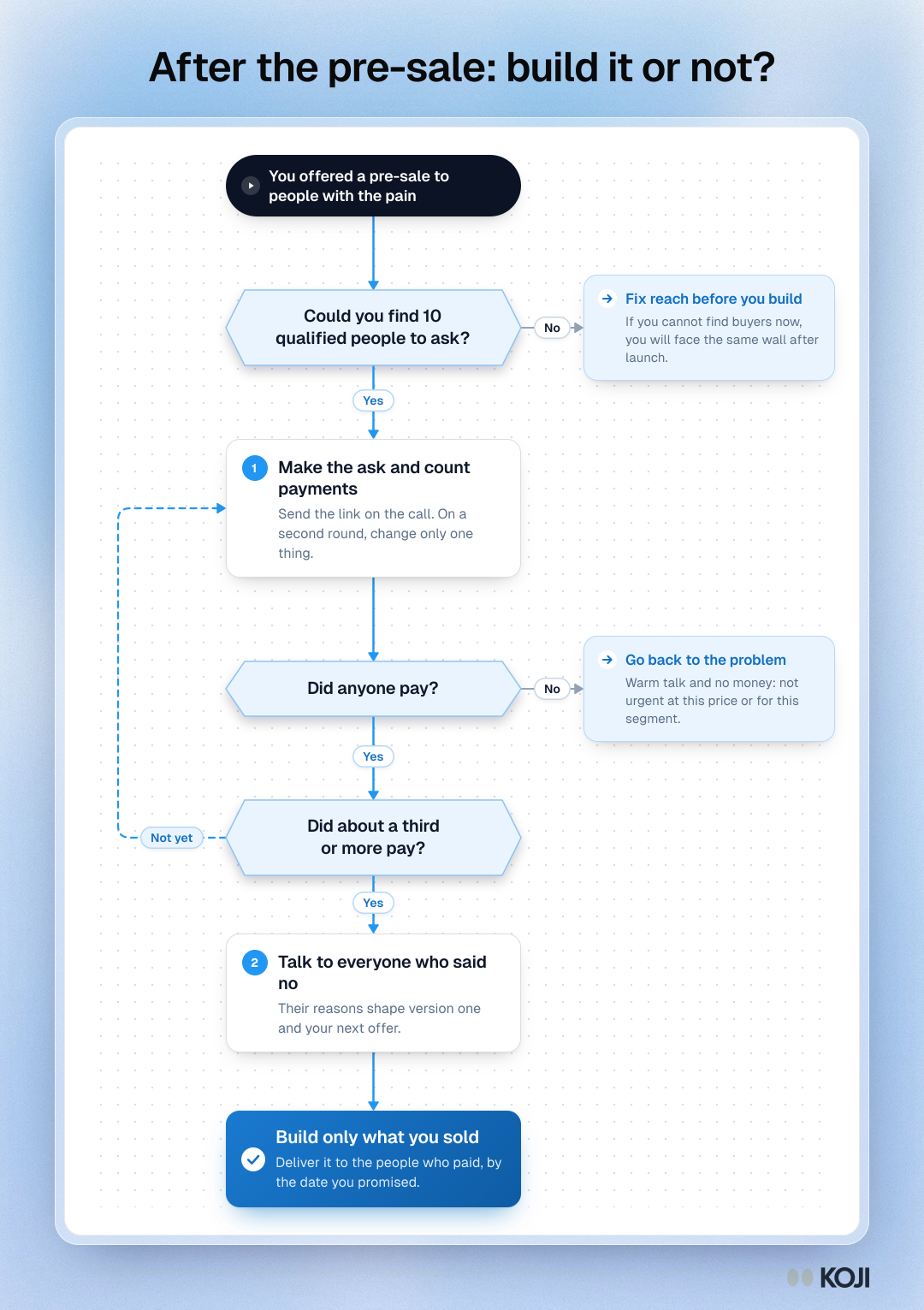
Whatever happens, talk to the people who said no. They tell you what the offer got wrong, and they are far more honest about it after they have declined.
Run it this week with Koji
Koji doesn't take payments, so the ask itself happens in your own checkout. Where it helps is before the ask and after it.
Before the ask: pick the founding price and the offer. Create a study and add a Price test question. Enter five to seven prices around your planned founding price, set the currency and the unit ("per month"), and leave the buy answer at "Probably would buy" or higher. Attach your offer card to the question as an image, so each person sees exactly what you plan to sell. Koji starts each person at a price in the middle of the ladder, moves up or down until it finds the highest price they would still buy at, usually in about three steps, then asks why in their own words. The report shows the share who would buy at each price, the revenue each price implies and the quotes behind each point. It reads best from about 30 interviews and is labelled directional, because people overstate what they'd buy. That's why the pre-sale comes next: the price test tells you what to ask for, and the deposit tells you whether they meant it.
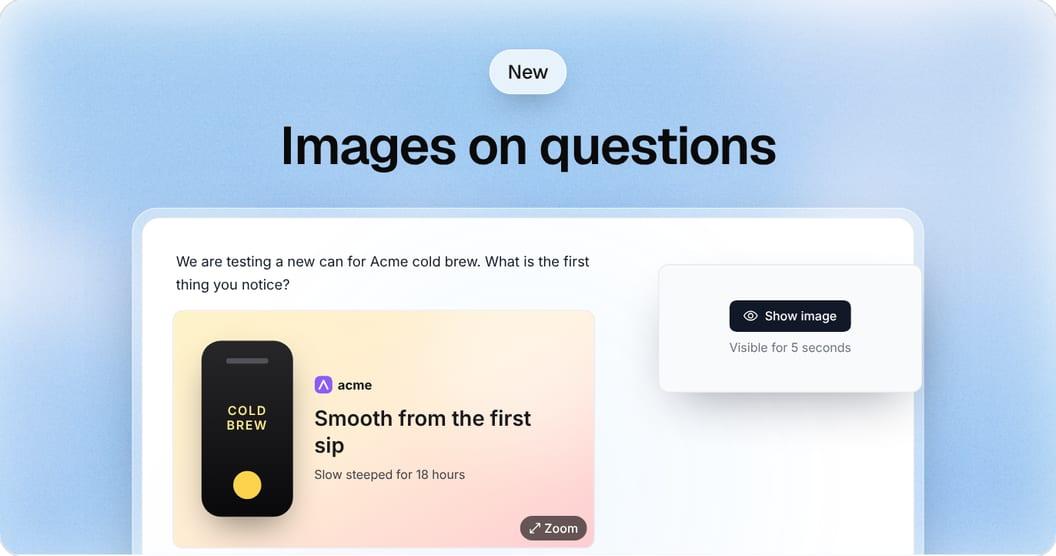
If you want a first-impression read on the offer card, set the image to show once for 5 or 10 seconds, then ask what they remember. That catches an offer whose main promise nobody notices.
After the ask: interview the people who said no. Duplicate the study, swap in the after-a-no questions from the bank above, and send each person who declined your interview link. They can answer by text or voice, when it suits them, which gets you more honest answers than a second sales call. Koji asks the follow-ups, and the report groups the reasons with the quotes behind them.
Show the result. Download the report as editable slides or a PDF for your co-founder, an advisor or your next investor update.
A free account comes with 10 interviews, which is enough to run the after-a-no follow-ups for a first round. The price test works in text and voice interviews.
Common mistakes
- Asking people who never had the problem. You learn how persuasive your page is, not whether the problem is worth paying to solve.
- Accepting "I'd pay" as a yes. Send the link while you're still talking. Count payments.
- Promising features instead of an outcome by a date. Buyers can't judge a feature list. They can judge "your empty slots filled by text, live by 31 March".
- A deposit so small it proves nothing. A €1 reservation is a click with extra steps. The ask should hurt a little.
- Hiding the refund rule. A plain refund promise lowers the risk of saying yes, and it keeps you honest.
- Treating LOIs like revenue. Use them to get to a paid pilot.
- Building more than you sold. The pre-sale defines version one.
When pre-selling will mislead you
Early buyers are not the market. People who pay before a product exists are your most motivated customers. A study of crowdfunded products published in late 2025 found that backers and later mainstream buyers behave like two separate markets [10]. Five deposits say five clinics want it badly. They don't say every clinic will.
Your network pays out of kindness. Friends, former colleagues and people who like you will pre-order to help. Count them separately, or leave them out.
A no can be about you, not the problem. Some buyers won't pay an unknown two-person company up front, however much they want the result. If the reasons say "trust", a paid pilot with a refund guarantee may work where a deposit didn't.
Money proves intent, not retention. A deposit says they want to start. Whether they stay is a question for after launch.
Where this fits
Before this: price a product before you have customers, which gets you the number you ask for, and test your landing page before you launch, which gets you an offer people understand in a few seconds. After this, the next decisions are building the smallest version you sold and learning why new users stall. The whole path is in the founder's research playbook, and Koji for founders shows the setups in one place.
FAQ
Did anyone actually pay before you built it? Yes, plenty of founders do, often a handful of buyers rather than hundreds. That's normal. You're looking for whether money moves at all from people with the problem, not for a launch.
How big should a deposit be? Big enough that someone would only pay it if they wanted the result, small enough to fit on a card without a meeting. For small-business software, one or two months of the planned price is a common shape. Always refundable.
Is a letter of intent worth anything? Some. It shows a named person will put their name to the idea. It's weak on its own because it is usually non-binding, so use it to get to a paid pilot with a price and a start date.
Is it legal to take money for something that doesn't exist yet? Generally yes, if you're honest about what and when, and you refund on request. In the US, the FTC's order rule covers shipping times and refunds, and in the EU online buyers have a 14-day withdrawal right. Check the rules where you sell.
What if nobody pays? Then the pre-sale did its job cheaply. Talk to the people who said no, find the reason, and go back to the problem, the segment or the offer before you build.
Should I pre-sell on a landing page or on calls? Calls first, with 10 to 20 qualified people, because you hear the reasons. A page comes second, when you want volume and want to see if strangers behave like the people you spoke to.
Next step: write your offer card today, list the people from your problem interviews who described the pain recently, and book the first five calls this week.
References
- Jonas Schmidt and Tammo H. A. Bijmolt, "Accurately measuring willingness to pay for consumer goods: a meta-analysis of the hypothetical bias", Journal of the Academy of Marketing Science 48(3), 2020. University of Münster research portal
- James J. Murphy, P. Geoffrey Allen, Thomas H. Stevens and Darryl Weatherhead, "A meta-analysis of hypothetical bias in stated preference valuation", Environmental and Resource Economics 30(3), 2005. EconPapers
- Jasmin Ebert, Peter Winzer and Carina Müller, "Reducing the hypothetical bias in measuring willingness to pay for mobile communication products", Journal of Theoretical and Applied Electronic Commerce Research 20(2), 2025. doi.org/10.3390/jtaer20020122
- Arnaldo Camuffo, Alfonso Gambardella, Danilo Messinese, Elena Novelli, Emilio Paolucci and Chiara Spina, "A scientific approach to entrepreneurial decision-making: Large-scale replication and extension", Strategic Management Journal 45(6), 2024. EconPapers
- Ethan Mollick, "Delivery Rates on Kickstarter", University of Pennsylvania, 2015. Penn repository
- Stripe, "Place a hold on a payment method", Stripe documentation, 2026. docs.stripe.com
- Federal Trade Commission, "Business Guide to the FTC's Mail, Internet, or Telephone Order Merchandise Rule". ftc.gov
- European Parliament and Council, "Directive 2011/83/EU on consumer rights", Official Journal of the European Union, 2011. EUR-Lex
- Karen Blumenschein, Glenn C. Blomquist, Magnus Johannesson, Nancy Horn and Patricia Freeman, "Eliciting willingness to pay without bias: evidence from a field experiment", The Economic Journal 118(525), 2008. EconPapers
- Haisu Zhang, "Navigating post-crowdfunding commercialization: Launch decision, market sales, and product survival", Journal of the Academy of Marketing Science 54, 2026 (online November 2025). link.springer.com
Further reading
- The Mom Test: the classic on why compliments mislead and commitments don't, with the questions to get past politeness.
- Stated vs revealed preferences: why what people say and what they do drift apart, and how to design around it.
- Which validation test to run first: where a pre-sale fits next to interviews, fake doors and a concierge MVP.
- Gabor-Granger pricing method: the method behind the price test, if you want the arithmetic before you choose your founding price.