If a customer is reducing seats at renewal because they are rolling out AI, you find out why in the 120 days before the renewal, not on the renewal call. The way to do that is to interview four to six people at the account: the champion, the budget owner, the leads of the biggest seat groups and whoever runs the AI rollout. AI-moderated interviews let you hear everyone across every exposed account in parallel, instead of one call at a time, and you get each person's reasons in their own words.
By the end of this playbook you will have a 120-day timeline, a rule for which accounts go first, a nine-question interview guide you can copy into any tool, and the exact setup in Koji.
Why seat reductions matter now
Seat counts used to fall when a customer lost headcount. Now they also fall when a customer finds that an AI agent does part of the work a seat used to do, and buyers have noticed.
- Buyers see seats as the lever. In BCG's IT buyer research, 40% of buyers cite seat reduction as their primary lever to decrease software spending, a shift BCG says agentic AI makes easier. BCG names the leading indicators to watch: more agentic AI use, purchases of fewer seat licences and workforce reductions inside customer organisations (BCG, August 2025).
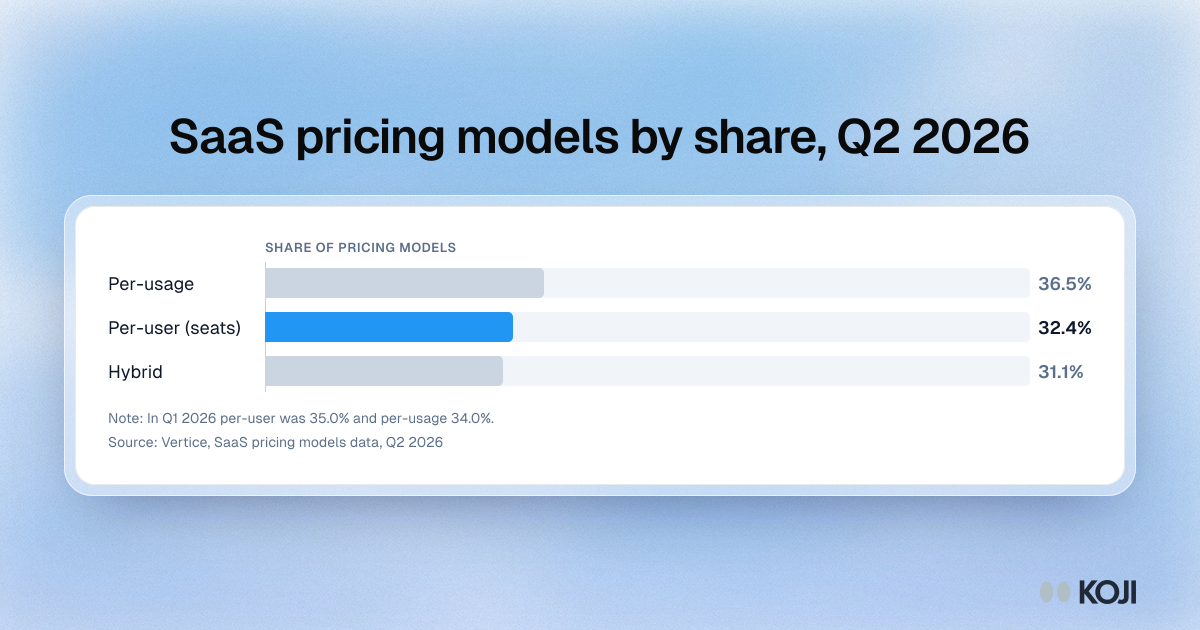
- Seats are no longer the default contract. In Vertice's purchasing data, per-usage pricing rose from 34.0% in Q1 2026 to 36.5% in Q2 2026, while per-user pricing fell from 35.0% to 32.4%. Hybrid pricing stood at 31.1% (Vertice, 2026).
- Analysts are putting a number on it. Gartner estimates that up to $234 billion of enterprise application software spending is exposed to agentic AI between now and 2030, roughly 20% of enterprise application SaaS spending by 2030 (Gartner, July 2026).
- Your buyers are already under cost pressure. Zylo's 2026 SaaS Management Index found that 78% of IT leaders faced unexpected charges tied to AI features or consumption pricing in the past year, and 61% cut projects because of unplanned SaaS cost increases (Zylo, 2026). The easiest place for them to find the money is your seat count.
- Retention is already slipping. The Aleph and Benchmarkit 2026 benchmarks put median gross revenue retention at 84%, down from 88% (Aleph, 2026).
Be fair to the other side of this. Oliver Wyman's 2026 SaaS Pricing Outlook, based on more than 150 North American software buyers, found that few enterprise buyers expect seat counts in most categories to fall more sharply over the next three years than over the past three (Oliver Wyman, October 2026). So the cut is not coming for every account. That is exactly why you interview: the average tells you nothing about the account in front of you.
The cost of guessing is a contraction you could have shaped. If you hear about the cut from procurement at T-30, the customer has already decided the number. If you hear it from the team leads at T-120, you can still propose the right-sized renewal yourself, move seats to the teams that grow, or price the AI work instead of losing it.
What good looks like
We call this the Seat Story review: for every group of seats in the account, find out what work those people do today, what the AI rollout will take over, and what is left. Then build the renewal around the answer, not around last year's number.

Photo by Vitaly Gariev on Unsplash
The rules that make it work:
- Start at T-120 days. That leaves a month to interview, a month to rework the proposal and a month for the customer's own approval. Most seat decisions are made in the customer's budget cycle, before anyone calls you.
- Interview four to six people per account. The champion, the economic buyer, the leads of the two or three biggest seat groups and the person running the AI rollout, who is often in IT, operations or a new "AI lead" role. The champion alone will tell you the relationship is fine. The team leads tell you which seats are idle.
- Ask about work, not about your product. "What does your team spend its week on?" gets you the seat story. "Do you still need all your licences?" gets you a negotiation.
- Separate the AI story from the budget story. Some accounts cut seats because the work moved to an agent. Others cut because the budget was cut and AI is the explanation they give. The fix for each is different.
- Have the AE in the loop before the interviews, not after. Agree who owns the renewal proposal, so the findings land in a plan rather than a slide.
Which accounts to interview first
You can't run a full review for every account. Use this to sort the book.
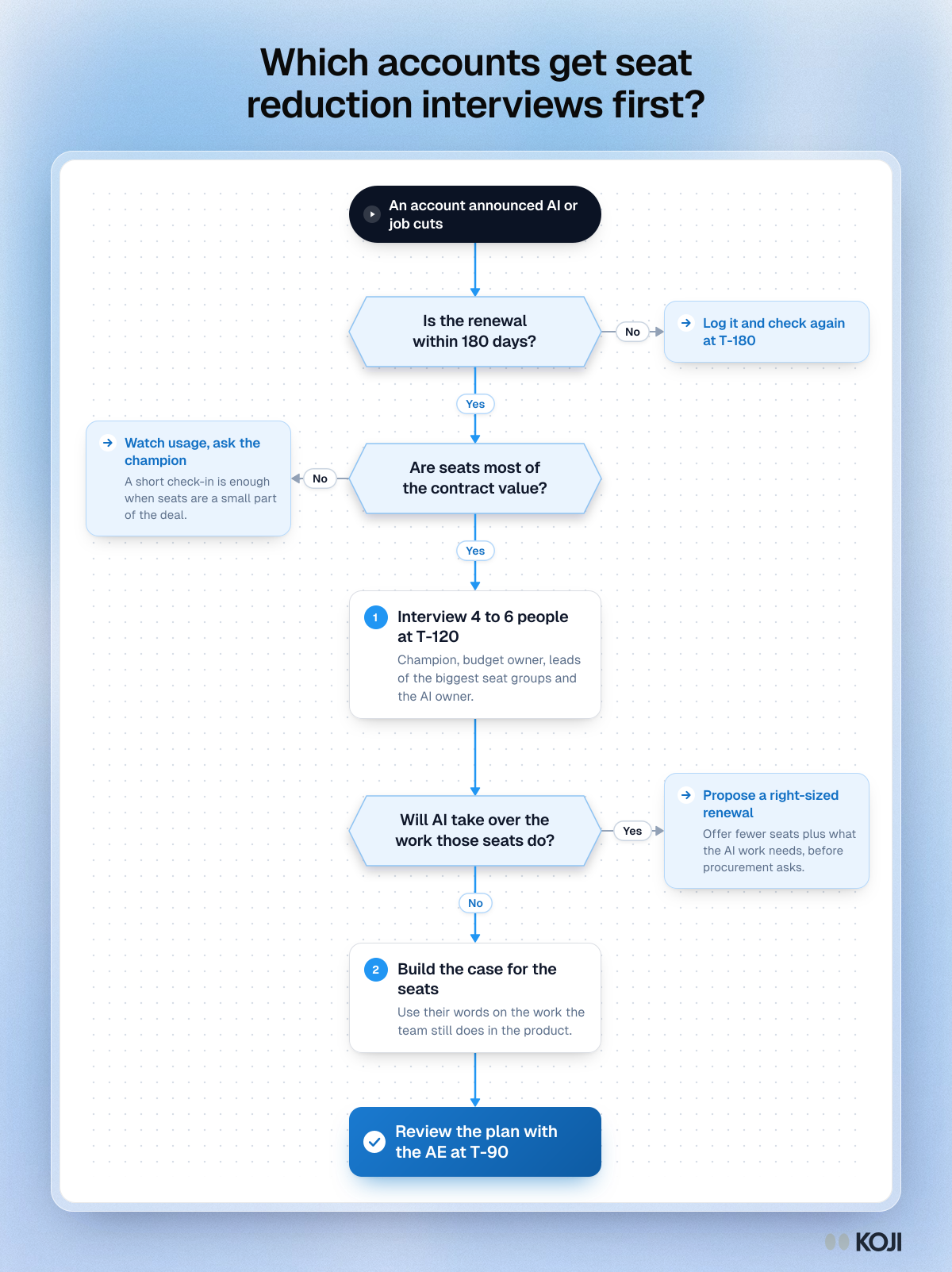
In practice, the accounts that rise to the top are the ones whose seats sit in the teams AI is reaching first: support, operations, sales development and back-office work. Check your own usage data for those seat groups before you pick.
Common mistakes
- Waiting for the renewal call. By then the customer has a number, and you are negotiating against it.
- Only talking to the champion. Champions protect the relationship. They rarely know which of 40 seats have gone quiet.
- Treating every seat cut as churn. A customer that right-sizes and stays is a win. Forcing them to keep idle seats makes the next renewal worse.
- Pitching during the interview. The moment it sounds like a save attempt, people stop telling you what is going on.
- Ignoring the AI owner. The person running the rollout knows which teams are next. They are often not in your CRM at all.
How to set it up in Koji, step by step
You need a paid plan to import your contacts from a CSV, email them from Koji and run voice interviews. A text interview uses 1 credit and a voice interview 3, so 30 voice interviews across six accounts use 90 credits. The Free plan includes 10 credits, enough to test the guide on a couple of friendly champions through a shared link first.
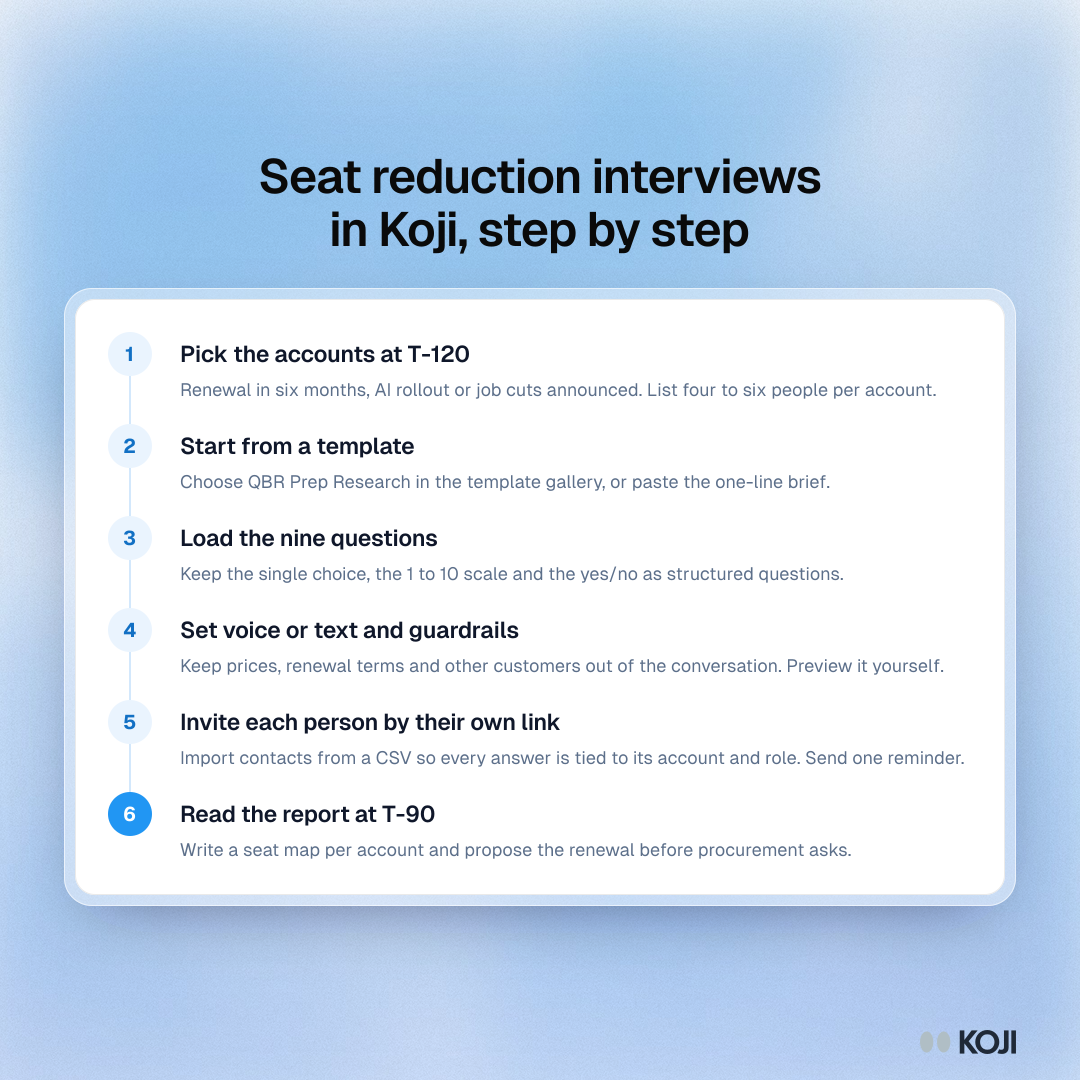
- Pick the accounts at T-120. Run the flowchart above on every account with a renewal in the next six months that has announced an AI rollout or headcount cuts. List four to six people per account.
- Start a study from a template. Open the template gallery in the dashboard, filter by Customer Success and choose QBR Prep Research. It already frames the conversation as a listening exercise about the customer's priorities and warns the interviewer off upselling. Or paste the one-line brief below into the "What do you want to research?" box and let the research assistant draft it.
- Load the questions. Replace the template questions with the guide below. Keep the structured ones as they are typed: a single choice for the main driver, a 1 to 10 scale for how much of the work AI will take over, and a yes/no for whether a seat decision has been made. Koji's other structured types include multiple choice and ranking (structured questions guide).
- Choose voice or text, and set guardrails. Voice suits team leads who would rather talk for ten minutes than type. Text suits busy budget owners. A participant who starts in voice can switch to text, and text participants can dictate an answer and edit it before sending. Add guardrails so the interviewer never quotes prices, never discusses the renewal terms and never names other customers (interview guardrails). Run a free preview interview yourself before anyone else sees it.
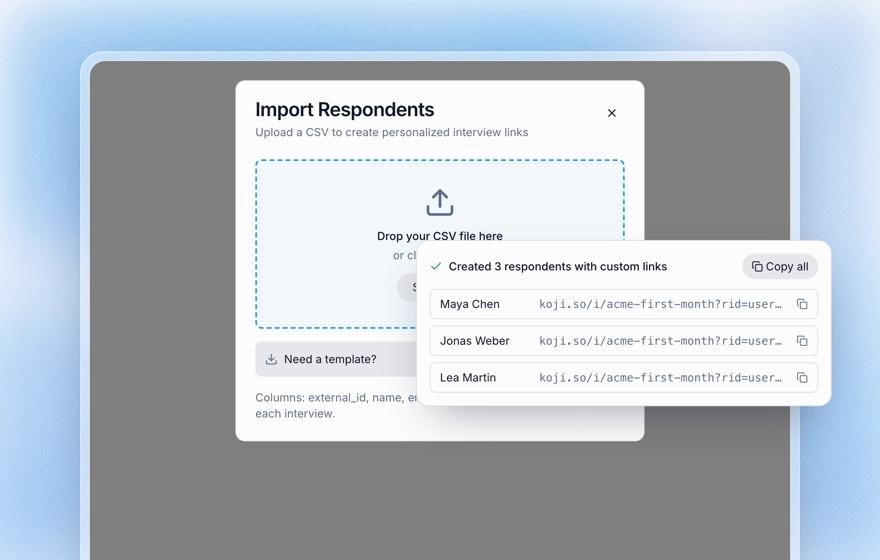
- Invite each person with their own link. Import your contacts from a CSV and each person gets a personal link, so you know which account and role every answer came from without asking (personalized interview links). Email them from Koji with a reminder, or paste each link into the CSM's own email.
- Read the report at T-90 and plan the renewal. Koji groups the interviews into themes and findings, with the quotes behind each one. Turn on the setting that removes personal details from transcripts if your team prefers not to keep names in research data.
Sending the invitations
Keep the note short and honest: "We're planning your renewal and want to make sure it matches how your team actually works now, including the AI tools you're rolling out. It's a ten-minute conversation with an AI interviewer, by voice or text, whenever suits you. I'll read every answer."
Copy this interview guide
One-line brief to paste into Koji: "Before renewal, find out how each team at this account works today, what their AI rollout will take over, which seats they plan to keep or cut and why, so we can propose a renewal that fits."
Opening line: "Thanks for making time. We're planning your renewal and want it to match how your team works now. There are no right answers, and nothing you say here commits you to anything."
- (Open) What does your team spend most of its week on right now? Probe: What has changed in the last six months?
- (Open) Which parts of that work is your company moving to AI tools or agents, and when? Probe: Who decides what moves?
- (Scale, 1 to 10) How much of the work your team does in our product do you expect AI to take over in the next year? Probe: Which tasks in particular?
- (Single choice) What is driving the seat count for next year: AI taking over work, a budget cut, a team change, low use, or nothing is changing? Probe: Tell me how that came up.
- (Open) Who on your team uses our product every week, and who has stopped? Probe: What did the people who stopped switch to?
- (Yes/no) Has a decision about the number of seats already been made? Probe: Who made it, and what would change it?
- (Open) If the AI takes over that work, what will your people do instead, and does any of it happen in our product? Probe: What would make that easier?
- (Open) What would a renewal that fits your plans look like to you? Probe: What would you need to show your finance team?
- (Closing, open) What should we have asked you that we didn't?
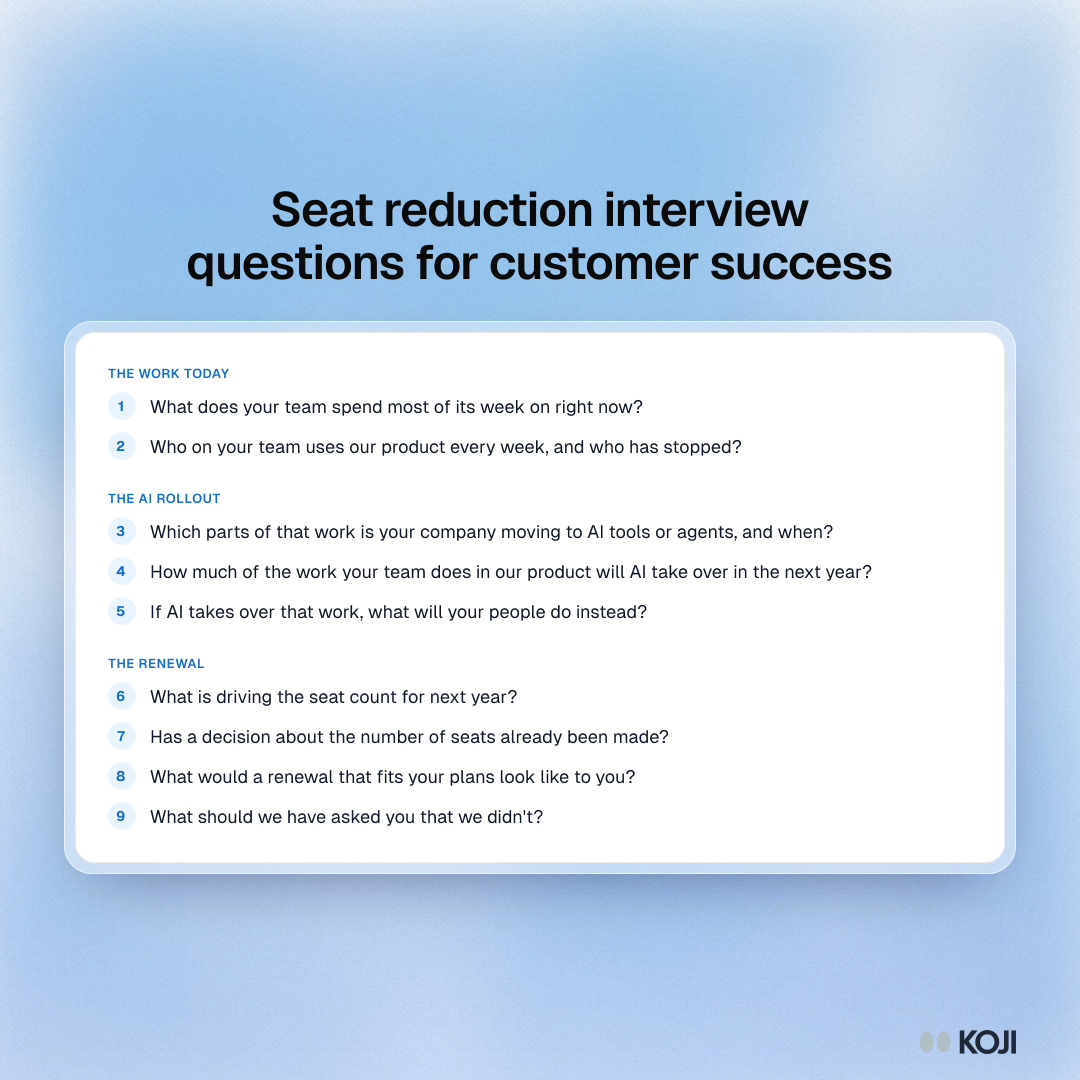
Question 4 is the one that sorts the book. The "AI taking over work" accounts need a renewal priced on what the AI work needs. The "budget cut" accounts need proof of value. The "low use" accounts need adoption help first.
What you get
The report gives you themes, ranked findings and the quotes behind each, plus the scale, choice and yes/no answers as charts. Because every person came in on their own link, you can read the answers account by account.
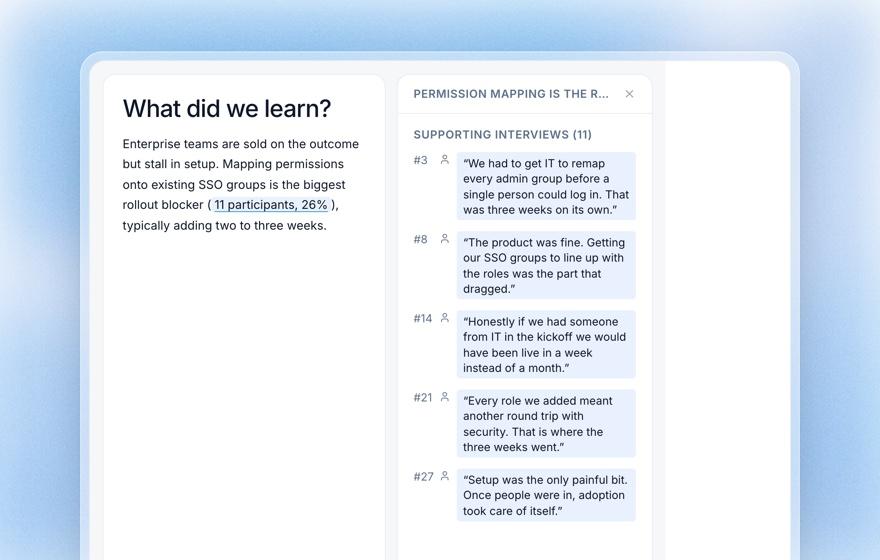
What you do with it the next day:
- A seat map per account. For each seat group: the work today, what AI takes over, the seats they need, in their words. This is the page the AE and CSM plan the renewal from.
- A right-sized proposal before they ask. If a team will shrink from 30 seats to 18, propose it, along with whatever the AI work needs. You keep the account and the credibility.
- An expansion list. The same interviews find the teams that are growing because of the AI rollout. Move seats there.
- A product signal. When several accounts say "the agent does this now", your product team needs to hear it this quarter. Download the report as slides or a PDF for the review, or share it with read-only viewers in your workspace (publishing and sharing reports).
The 120-day timeline
- T-120: pick accounts, list contacts, agree the plan with the AE.
- T-115: preview the study, then send invitations.
- T-115 to T-100: interviews come in. Send one reminder.
- T-100 to T-90: read the report, write the seat map for each account.
- T-90 to T-60: propose the renewal, including any right-sizing.
- T-60 to T-0: the customer's approval runs on your proposal, not on a number procurement made up.
The same playbook elsewhere
Seat reduction interviews share their shape with other Koji playbooks. CS teams run the same pre-renewal conversation for renewal risk and before a price increase. Private equity operating partners ask the investor's version of the question in AI substitution interviews: will customers replace this product with AI? Product managers run AI feature adoption research from the other side. What CS can borrow from all of them: talk to several roles, anchor on real work, and decide what you will do with each answer before you ask. See every Customer Success playbook at /use-cases/customer-success.
Why Koji for seat reduction interviews
There are four realistic ways to learn why an account is cutting seats. Each has a job.
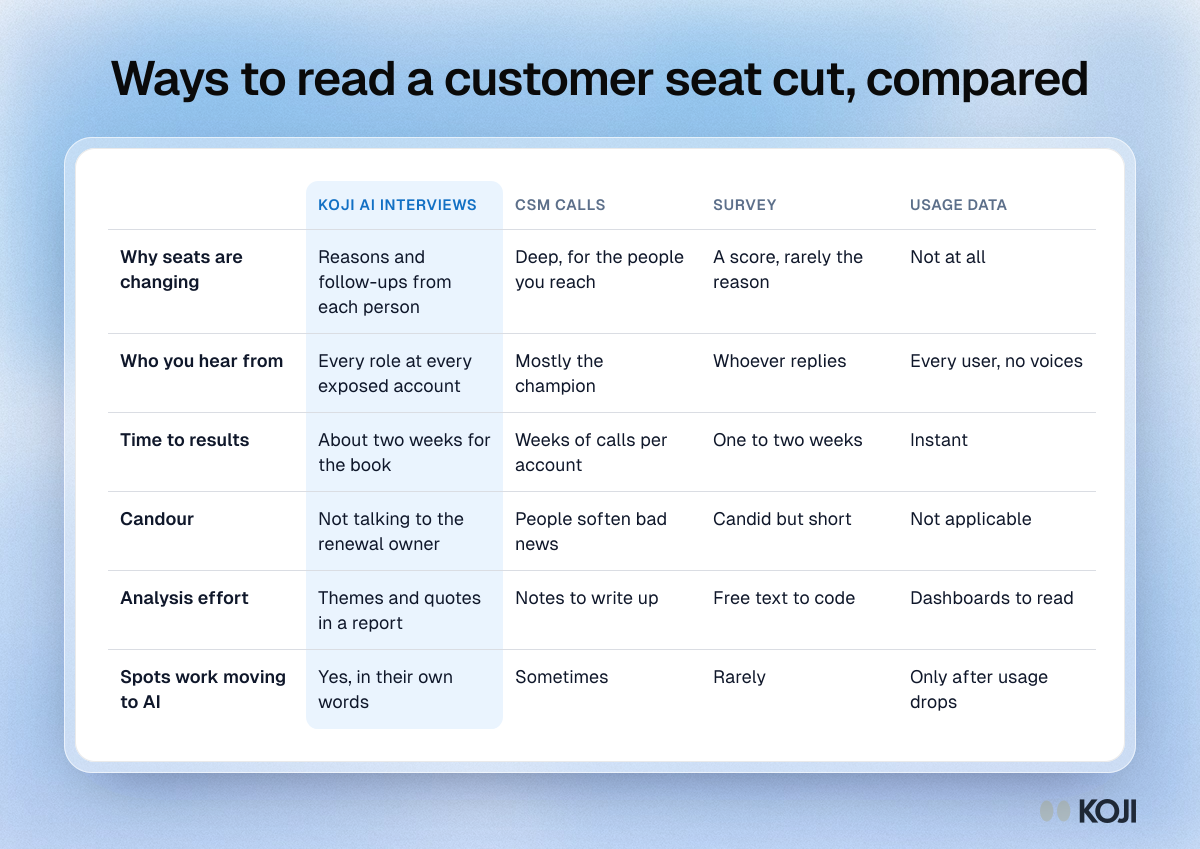
CSM calls are the best relationship tool you have, but a CSM can run only so many in a week, and people soften bad news for the person who owns the renewal. Surveys reach everyone and miss the reasons. Usage data shows who logged in, not why they stopped or what replaced them. Koji covers the gap between them:
- Every role, in parallel. Thirty people across six accounts can answer in the same week, by voice or text, on their own time.
- Follow-ups on every answer. The interviewer probes each open answer, which is where "we're moving tier-one tickets to an agent in March" comes out.
- Answers you can trace. Each person's own link ties their answers to their account and role, and every finding links to the quotes behind it.
- Quality you can see. Each interview gets a quality score from 1 to 5, and only those scoring 3 or more enter the report or use credits.
- Control over what the interviewer says. Guardrails keep prices and renewal terms out of the conversation.
Questions you might have about AI interviews
"Will my customer's team leads talk to an AI instead of their CSM?" They see a welcome page with how long it takes and that answers are confidential, and they answer when it suits them. A ten-minute link is an easier ask for a team lead or an AI owner than a calendar invite from someone they have never met. Say plainly in the invitation that it is an AI interviewer.
"Won't it feel like a save attempt?" Only if you write it as one. Use the guardrails to keep pricing and renewal terms out, open with the line above, and ask about work, not licences.
"Where does account data go?" Interviews are kept in your Koji workspace, visible to the people you share them with. You can turn on the setting that strips names, emails, phone numbers and employers from transcripts when each interview finishes. Enterprise plans add more control, including bringing your own AI keys (bring your own key).
"Does this replace the CSM?" No. It gives the CSM the account's seat story before the conversation that matters, so the call is about the plan, not about discovery.
When Koji may not be the right fit
If your account has three users and one decision maker, call them. If the customer has already signed a replacement contract, an interview will tell you why but won't change the outcome; use the exit interview guide instead. And if your contracts are already priced on usage, the seat question matters less than whether the work is growing, which is a different study.
Metrics to track
- Exposed ARR interviewed: the share of seat-based ARR at accounts with an AI rollout that you reviewed by T-90.
- People per account: aim for four or more, across at least two seat groups.
- Driver mix: the share of accounts citing AI, budget, team changes or low use (question 4).
- Proposals sent before procurement asks: the share of right-sized renewals you proposed first.
- Seat retention at renewal, and gross revenue retention, against the accounts you did not interview.
FAQ
When should customer success start talking to an account about seat reductions? About 120 days before renewal. That leaves a month to interview, a month to rework the proposal and a month for the customer's approval.
Who should I interview when a customer is cutting seats because of AI? Four to six people: the champion, the budget owner, the leads of the two or three biggest seat groups and whoever runs the AI rollout.
Should I try to stop every seat reduction? No. If the work behind the seats has moved to AI, propose a right-sized renewal yourself. Forcing a customer to keep idle seats makes the next renewal harder.
How do I tell an AI-driven seat cut from a budget cut? Ask directly what is driving next year's seat count and probe the answer. AI-driven cuts point to specific tasks moving to an agent. Budget cuts point to a finance decision.
Which Koji plan do I need? Any paid plan, for CSV import, email invitations and voice interviews. The Free plan includes 10 credits for text interviews to test the guide.
Start this week
Open Koji, pick the QBR Prep Research template or paste the one-line brief, load the nine questions and invite your first exposed account. For more on running research across your book, see koji.so/for/customer-success.