Which customers should you interview? If you run a small business, the answer is almost never "everyone on the list". Your customer list holds regulars, one-time buyers, lapsed customers, trade accounts and people who signed up and never bought, and each group answers a different question. Pick the one decision you're making, use two to four screening questions to let in only the group that can answer it, and talk to about 10 to 12 of them. By the end of this playbook you'll have ready-to-copy screening questions for an online shop, a service business and a local store, a rule for who to interview for each kind of decision, and a way to run it this week.
When you need this
You need this the moment you're about to ask customers anything and the list in front of you is a mix. Some signs:
- You exported your customers from Shopify, Square, your booking tool or your email list, and it has a few thousand rows with no labels beyond "ordered" and "subscribed".
- You sent a feedback survey before and got answers that pulled in every direction: the regulars loved it, someone who bought a gift once had no opinion, a café that buys wholesale wanted invoices.
- You want to know one specific thing (why people don't reorder, what to charge for a new package, which offer to run) and you can't afford twenty calls that miss it.
The cost of skipping this is quiet. You hear a blur of opinions, average them in your head and make a decision that fits nobody. Research teams with budgets struggle here too: in User Interviews' 2025 State of User Research survey, finding the right participants and time to recruit were the two biggest recruiting struggles, with participant quality third, named by 54% of respondents [1]. You just have less room to get it wrong.
Why your customer list is several lists
Before you screen anyone, split the list on paper. Most small businesses have five groups, and each one knows something the others don't:

Photo by Umar Al Farouq on Unsplash
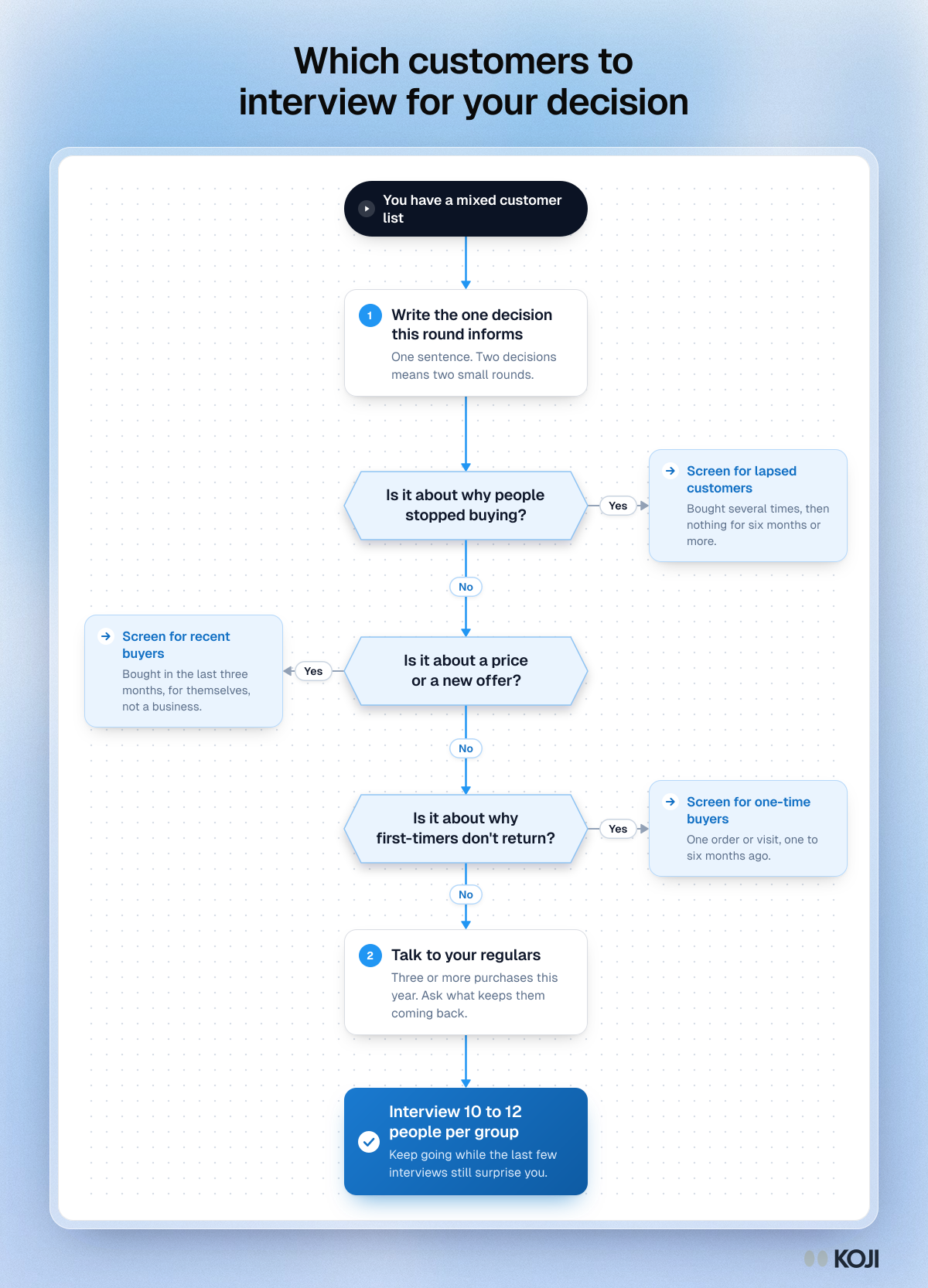
- Regulars (bought three or more times this year) know why people stay. They're the best source for what to protect and what to build on, and the worst source for why others leave.
- One-time buyers (one order or visit, one to six months ago) know what didn't pull them back. This is often the most useful group nobody talks to.
- Lapsed customers (bought several times, then nothing for six months or more) know what changed: a competitor, a move, a bad experience, a price rise.
- Trade or business accounts (wholesale, corporate gifting, the clinic that buys in bulk) buy for different reasons and on different terms. Mix them with retail customers and both sets of answers get muddier.
- Browsers (on the newsletter, never bought) know what stopped the first purchase. They can't tell you anything about the product itself.
Teresa Torres, who writes about continuous discovery, puts the general principle simply: "Don't just talk to super engaged customers if you also have customers that are not that engaged. We're looking at variation in behavior." [2] The point isn't to avoid regulars. It's to choose the group on purpose, for the question you have.
Here's a quick way to pick:
The method in brief
Screening is a short set of multiple-choice questions people answer before the interview starts. Each answer either lets them in or turns them away. The research version of this is called a screener, and Koji's guide to research screener questions covers the craft in depth. For a small business it comes down to three rules.
Screen on behaviour, not identity. "When did you last order from us?" works. "Are you a loyal customer?" doesn't, because everyone says yes. Ask about the last time something happened, with answer options in time bands.
Hide what you're looking for. If the only way in is to pick "I've ordered more than five times", some people will pick it. Give a full spread of honest options so no answer looks like the right one, and add a plausible decoy where it helps.
Keep it to two to four questions. Each extra question narrows the group and adds a step where people drop off. Koji's note on why tightening a screener can make findings worse explains the trade-off.
Why the second rule matters: people do bend their answers to qualify, especially when there's a reward. In a randomised study of 2,275 survey respondents, Fernandez Lynch and colleagues told some people they'd be eligible for a paid task only if they'd had a recent flu shot. In the control group, where eligibility didn't depend on the shot, 52.2% reported one. When a shot meant getting in, 63.1%, 62.8% and 62.1% reported one at $5, $10 and $20 [3]. The authors estimated that 10.5% to 22.8% of the people who weren't eligible lied to get in, and paying more didn't make it worse [3].
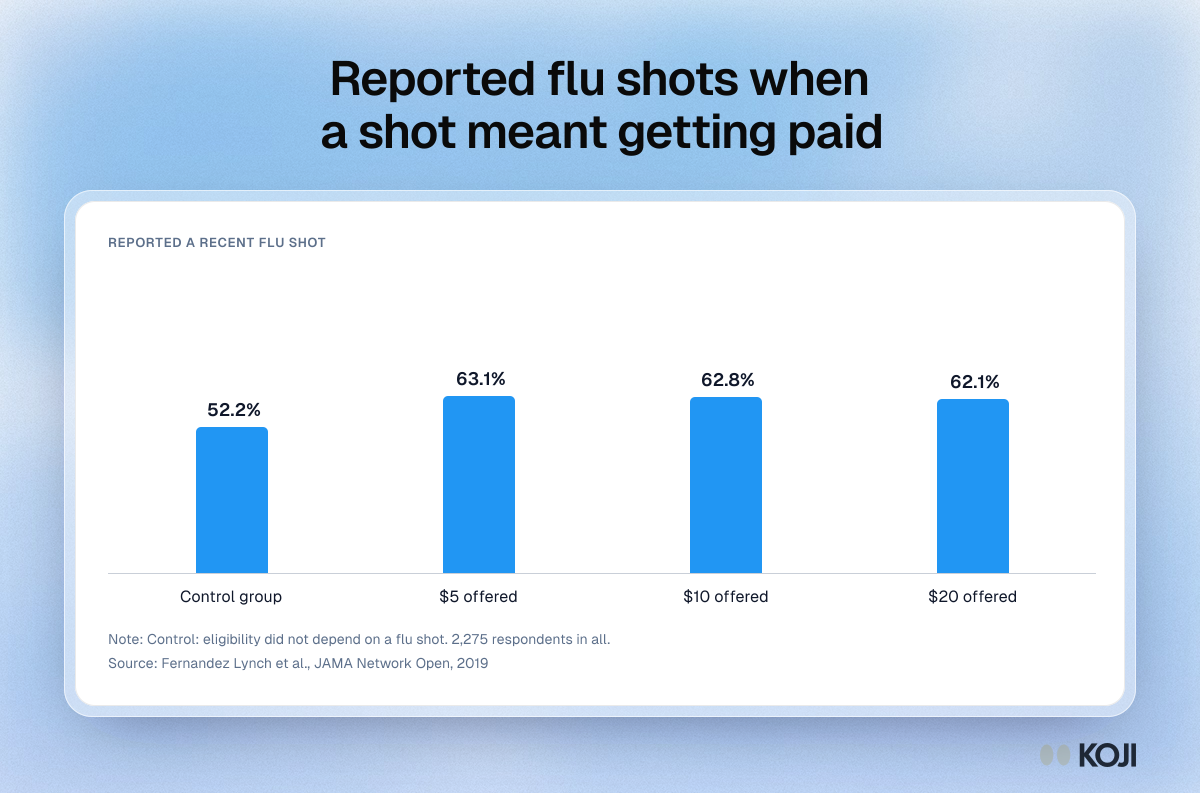
Chandler and Paolacci found the same pattern on an online research platform, summed up in the title of their 2017 paper: most prescreening responses are honest, but most "eligible" respondents can be impostors when the group you want is rare [4]. A small lie rate turns into a big problem when only a few people truly qualify. That's not a reason to give up on screening. It's a reason to ask questions where the qualifying answer isn't obvious, and to check what you can against your own records.
Your own customers have less reason to lie than strangers, and you can check their order history. Open online studies see the opposite: a 2026 content analysis in the Journal of Medical Internet Research documented fraudulent participants across recruitment, enrolment, survey distribution, data collection and focus groups in two multisite qualitative studies [5]. Screening your own list is the easy case. Do it well anyway.
Step by step
1. Write the one decision
One sentence: "Should we add a 1kg bag?", "Why don't first-time buyers reorder?", "Can we charge more for Saturday appointments?" If you have two decisions, run two small rounds. The decision tells you the group.
2. Pick the group, then the bands
Use the flowchart above. Then turn the group into answer options with time bands your records can back up. "Ordered once, between one and six months ago" is a group. "Occasional customer" isn't.
3. Write two to four screening questions
Start from the bank below and adjust the bands to your buying cycle. A coffee roaster's "regular" orders monthly; a furniture maker's might order twice in five years.
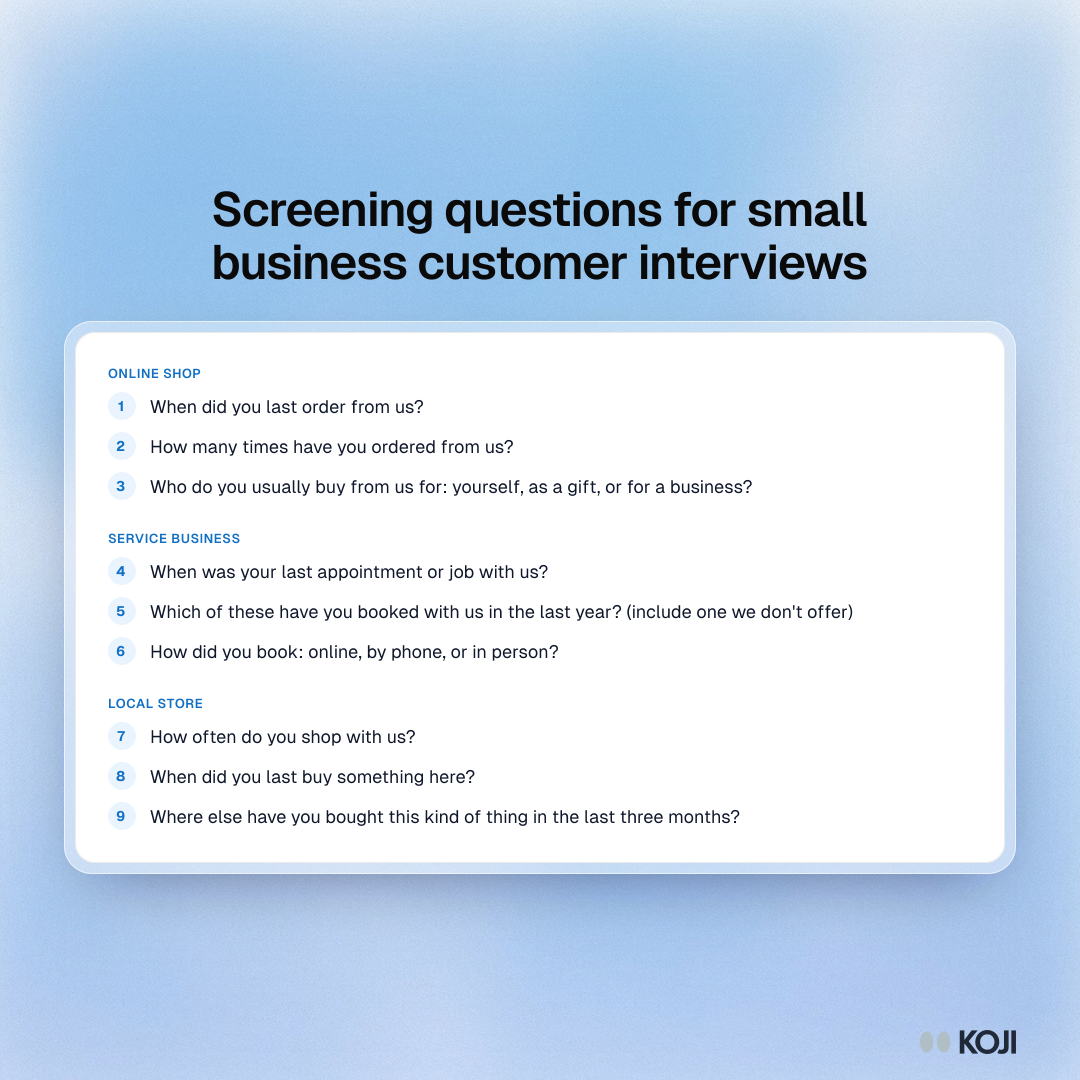
The options matter as much as the questions. For "When did you last order from us?" give: "In the last month", "1 to 3 months ago", "3 to 6 months ago", "6 to 12 months ago", "Over a year ago", "I haven't ordered yet". Then decide what each option does. Interviewing lapsed customers? Only "6 to 12 months ago" and "Over a year ago" qualify. Testing a price on recent buyers? Only the first two.
For questions where people can pick several answers ("Which of these have you bought from us in the last year?"), decide which options someone must pick to get in, which are fine either way, and which rule them out. Put one decoy in the list, something you don't sell, and turn away anyone who picks it.
4. Decide how many to talk to
Aim for 10 to 12 completed interviews per group. A systematic review of empirical saturation studies by Hennink and Kaiser found that interview studies reached saturation within 9 to 17 interviews, at the lower end when the group was homogeneous and the question narrow [6]. Screening is what makes your group homogeneous, so a tight screen and one decision put you near the low end. If the last three interviews still surprise you, keep going. Koji's guide on how many user interviews you need goes deeper.
To get 12 interviews you'll need to invite more people than that, and some who start will be screened out. Invite generously and watch how many fall at each step.
5. Invite with a plain, honest ask
Say who you are, why you're asking and how long it takes. Don't say which answers you're looking for. Our playbook on how to get customers to talk to you has scripts for checkout, receipts and text messages, and the recruitment email templates cover email. A small thank-you helps with one-time and lapsed customers, who owe you nothing; see whether to pay for interviews.
6. Run it, and ask about the last time
Once someone is in, the interview asks about real events: the last order, the last time they needed you and went elsewhere, what they compared. Then read who got turned away. If lots of people you'd have wanted are being rejected, a screening rule is too strict.
A worked example
Say you run a small online coffee roaster. Your shop export has about 1,400 customers: subscribers, people who bought a bag once, a dozen cafés on wholesale terms and a few hundred newsletter signups who never ordered. You're thinking about a 1kg bag at a lower price per gram, and you want to know whether your home customers would buy it and what's stopping one-time buyers from coming back.
That's two decisions, so it's two groups.
Group A, recent repeat buyers, for the 1kg bag. Two screening questions. "When did you last order from us?" qualifies "In the last month" and "1 to 3 months ago". "Who do you usually buy our coffee for?" qualifies "Myself or my household" and turns away "A café, office or business I work for", because the cafés buy on different terms and would skew the answer on price. You'd invite about 60 people by email and aim for 12 interviews.
Group B, one-time buyers. "How many times have you ordered from us?" qualifies only "Once". "When was that?" qualifies "1 to 3 months ago" and "3 to 6 months ago", recent enough to remember.
What you might hear: Group A says the 1kg bag is interesting but several worry about freshness once it's open, and two mention they'd only switch if it came on a subscription. Group B mostly bought as a gift or tried you once from an ad, and a few say they simply forgot, because nothing reminded them to reorder.
What you'd decide: test the 1kg bag only as a subscription option, and set up a reorder reminder for first-time buyers before spending anything on win-back discounts. Interview all 1,400 as one group and both findings drown under regulars saying they love the coffee.
Reading the results and deciding
A few rules for what you see:
- If 8 or more of 12 in a group give the same reason, act on it. Make one change and watch the numbers that should move (reorders, bookings, conversion on the new offer).
- If answers split across three or more reasons with no clear lead, your group may still be too broad. Look at who said what. Often one sub-group (gift buyers, say, or one location) explains the split. Screen tighter on that next round.
- If people you screened in don't match your records (says monthly, your shop shows one order), set those interviews aside and look for an obvious "right" answer in your screen.
- If too few people get through, loosen one rule before you send more invites. A wider time band is usually the cheapest fix.
Then decide what comes next. A price question goes on to a price test with the same screened group; see what to charge as a small business. A "why do they stop" question goes on to why customers leave a small business. An offer question goes to testing two offers with 20 customers.
Run it this week with Koji
You can do this with a form tool and a calendar link. Koji puts the screening, the interview and the analysis behind one link, so nobody books a call and nobody who doesn't fit uses up an interview.
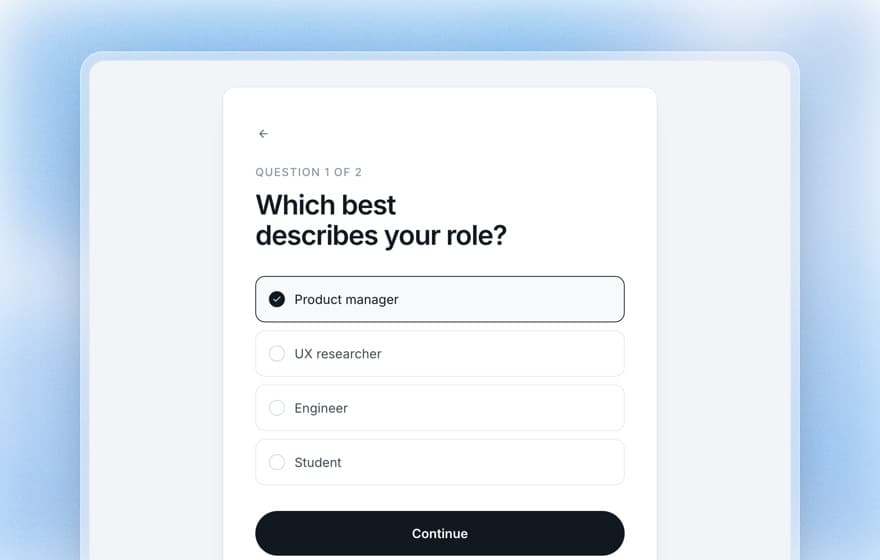
- Start a study and add screening questions. In your study's brief, open the Questions tab and find Screening Questions. Add single choice or multiple choice questions. Only those two types can screen. You can also ask the study assistant to write them ("add a screening question so only people who bought in the last three months get in").
- Set what each answer does. On a single choice question, each option either qualifies or disqualifies. On a multiple choice question, each option is may select, must select or disqualify. Koji won't let you publish while any option has no rule, so a half-finished screen can't go live. Turn on shuffled option order so the first answer isn't favoured.
- Add the interview questions. Ask about the last purchase and what they did instead. If you're testing a price, add a price test question; if you're testing a package or a photo, attach the image to the question.
- Invite your list. Share one link at checkout or on receipts, or email a saved audience from Participants with an invitation and a reminder. On the Interviews and Enterprise plans you can import a CSV and give each customer a personal link, so you can match answers to your order records later.
- Read who got in and who didn't. Everyone answers the screening questions on the study's page before the interview starts, whichever way they arrived. People who don't qualify are turned away, and they show as Screened out in your responses, so you can see whether a rule is too strict. A returning visitor isn't asked again, and someone screened out can't retry on the same personal link.
Screening questions work on every Koji plan, Free included. Recruitment emails come with the Insights, Interviews and Enterprise plans, as do thank-you rewards paid through Koji (gift cards, a prepaid Visa card or a charity donation). The screening section is available on studies created since screening launched in September 2026; if an older study doesn't show it, start a new one. The setup doc on adding screening questions to your study walks through each screen.
When the interviews are in, the report groups the reasons with the quotes behind each, and you can download it as slides or a PDF to share with a business partner or your staff.
Common mistakes
- Interviewing the people who reply first. They're your fans. Fine for some questions, wrong for "why don't people come back?"
- One study for two decisions. You end up with six interviews per question and no answer to either.
- A screening question with an obvious right answer. "Do you love great coffee?" lets everyone in.
- Mixing trade and retail customers. Their reasons, prices and volumes are different. Interview them separately or not at all.
- Screening so tightly that nobody gets through, then concluding customers won't talk. Check the screened-out count first.
When research will mislead you
Screening gets you the right people. It doesn't make what they say true. People say they'd buy more than they do: a meta-analysis by Schmidt and Bijmolt found that across 77 studies, stated willingness to pay ran about 21% higher on average than what people really paid [7]. So treat a price answer as a direction and confirm it with a real offer. Lapsed customers also tidy up their reasons ("it was the price") when the real story is messier, so ask what happened, step by step, the last time they needed you. And screening answers are self-reported. Where you can, check them against your order or booking history.
Where this fits
This is the "who do I talk to?" step on the small business path in the founder's research playbook. Before it: how to get customers to talk to you, which gets people to say yes. After it, depending on your decision: why customers leave a small business or what to charge. If you're a founder rather than a shop owner, see Koji for founders.
FAQ
How many screening questions should I use? Two to four. Each one narrows the group and adds a step where people can drop off. If you need more than four, you probably have two decisions.
Should I tell customers what I'm screening for? Tell them what the conversation is about and how long it takes. Don't say which answers get them in, or some will pick those answers.
Can I just interview my best customers? For "what should we keep doing?", yes. For "why don't people come back?" or "what would make a first-timer buy again?", no. Pick the group from the decision.
How many people should I invite to get 10 to 12 interviews? It depends on how warm the list is and whether you offer a thank-you. Invite several times more than you need, watch the first day's numbers and send more if the pace is slow.
What if someone lies to get in? Some will, especially with a reward. Use behaviour questions with time bands, add one decoy option, and set aside interviews that don't match your records.
One next step: write your decision in one sentence, choose the group with the flowchart, and copy the two screening questions for your kind of business from the bank above.
References
- User Interviews. The State of User Research 2025. User Interviews, 2025. https://www.userinterviews.com/state-of-user-research-2025-report
- Torres, T. Ask Teresa: How Do You Select Customers for Customer Interviews? Product Talk, 2022. https://www.producttalk.org/selecting-customers-for-customer-interviews/
- Fernandez Lynch, H., Joffe, S., Thirumurthy, H., Xie, D. and Largent, E. A. Association Between Financial Incentives and Participant Deception About Study Eligibility. JAMA Network Open, vol. 2, no. 1, 2019, e187355. https://pmc.ncbi.nlm.nih.gov/articles/PMC6484547
- Chandler, J. and Paolacci, G. Lie for a Dime: When Most Prescreening Responses Are Honest but Most Study Participants Are Impostors. Social Psychological and Personality Science, vol. 8, no. 5, 2017, pp. 500-508. https://repub.eur.nl/pub/108256
- Harden, D., Warner, E. T. and colleagues. Detecting and Preventing Fraudulent Participation in Qualitative Research: Content Analysis of Two Multisite Studies. Journal of Medical Internet Research, vol. 28, 2026, e87037. https://www.jmir.org/2026/1/e87037
- Hennink, M. and Kaiser, B. N. Sample sizes for saturation in qualitative research: A systematic review of empirical tests. Social Science and Medicine, vol. 292, 2022, 114523. https://pubmed.ncbi.nlm.nih.gov/34785096/
- Schmidt, J. and Bijmolt, T. H. A. Accurately measuring willingness to pay for consumer goods: a meta-analysis of the hypothetical bias. Journal of the Academy of Marketing Science, vol. 48, 2020, pp. 499-518. https://link.springer.com/article/10.1007/s11747-019-00666-6
Further reading
- Research screener questions: the full craft of writing screeners, with examples beyond small business.
- Screener accuracy: why a small lie rate matters more when the group you want is rare.
- Ask Teresa: How Do You Select Customers for Customer Interviews?: Teresa Torres on choosing interviewees by variation in behaviour, written for product teams but easy to apply to a shop.
- Data saturation in qualitative research: how to tell when you've heard enough.