Should you pay for customer interviews? Pay strangers, busy professionals and people who have left you, and pay them after the call at roughly the going rate for their time. Don't pay friends, design partners or prospects in a live deal, because cash turns a favour or a relationship into a transaction. By the end of this guide you'll know who to pay, how much, how to keep paid interviews honest, and what to ask for at the end instead of more money.
If you already use Koji, incentives are a setting on the study. Skip to Run it this week with Koji for the setup.
When you need to decide this
You need an answer the moment your warm network runs dry. The first ten conversations usually come from friends of friends, a former colleague, a founder group. Then you send twenty cold messages to people who actually have the problem, and two reply. That's when the question shows up on Indie Hackers and in founder Slack groups: do I just offer them $50?

The cost of guessing wrong runs both ways. Pay nobody and you end up interviewing only people who like you, which is the fastest route to polite, useless answers. Pay everybody, and pay too much, and you attract people who want the money more than they have the problem. Both mistakes feel like progress. Both give you evidence you can't trust.
There's a second moment too: when you want to talk to people who already left. Churned users and lost prospects owe you nothing, and they're the ones whose reasons you most need to hear.
What the evidence says about paying people
Most of what's known about incentives comes from surveys, not interviews, but the findings carry over well enough to set a few rules.
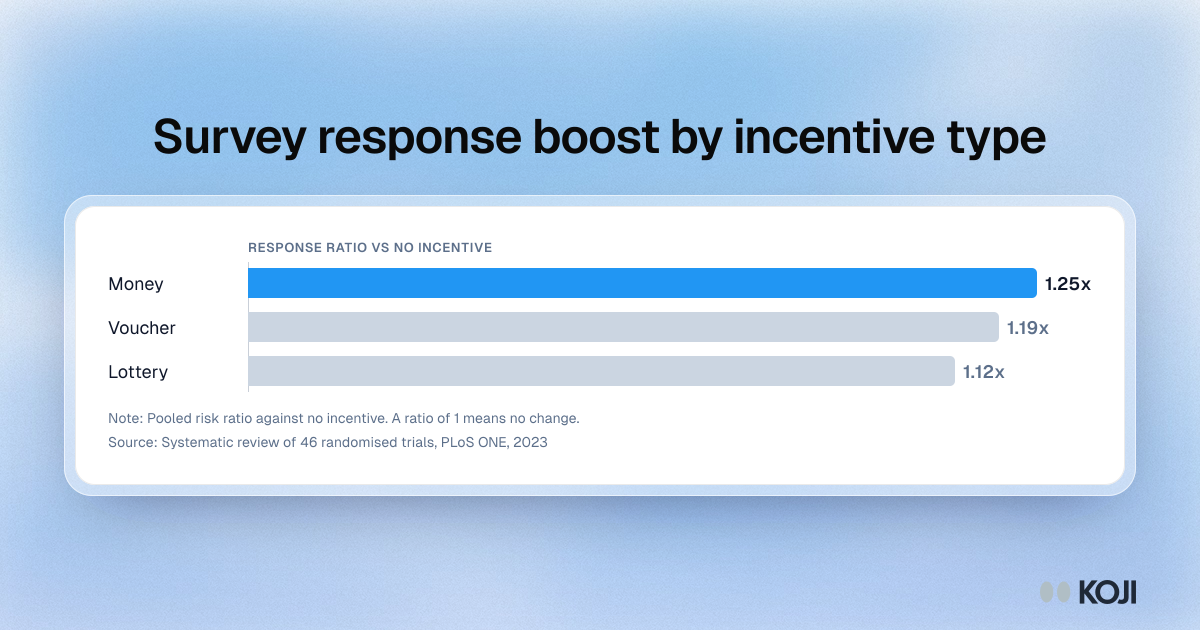
A reward raises participation, and cash beats prizes. A 2023 meta-analysis of 46 randomised trials, covering about 109,648 people in 14 countries, found every kind of incentive lifted response compared with none. Money did best, with a pooled response ratio of 1.25 against no incentive, then vouchers at 1.19 and lotteries at 1.12 [1]. A prize draw is the weakest thank-you you can offer.
Paying mostly changes who shows up, not what they say. Eleanor Singer and Cong Ye's review of the incentive research for the Annals of the American Academy of Political and Social Science found incentives raise response across survey modes, with only weak signs of any effect on the quality of answers, and small or inconclusive effects on who ends up in the sample [2]. That is reassuring, with one catch: the risk moves to your screener. If money brings in the wrong people, no amount of good questioning fixes it.
The going rate is higher than founders expect. Great Question's January 2026 guide puts consumer participants at about $60 to $100 an hour and professionals at about $100 to $200 an hour, and suggests adding 20 to 30% when you need people the same week [4]. User Interviews, a recruiting vendor, reported from nearly 20,000 projects that B2B studies paid around $80 to $100 an hour, and that consumer no-shows fell from about 10% at $60 an hour to about 8% at $100 [3]. Both are vendors with a stake in the answer, and the User Interviews figures are from 2022, so read them as a ceiling for strangers recruited through a platform. A founder reaching people directly can usually pay less.
Money attracts people who will lie to get it. A 2025 paper in the Journal of Medical Internet Research describes three studies where participants misrepresented themselves to collect the incentive, and sets out red flags (clear signs of an inauthentic participant) and yellow flags (ambiguous behaviour fraudulent participants often show) for screening [5]. These were health studies with public adverts, but the pattern is the same one founders hit when they post "$50 for a 20-minute chat" in a big subreddit.
Who to pay, and who not to
The decision isn't really "should I pay?" It's "should I pay this person?" The answer depends on what they already have at stake.
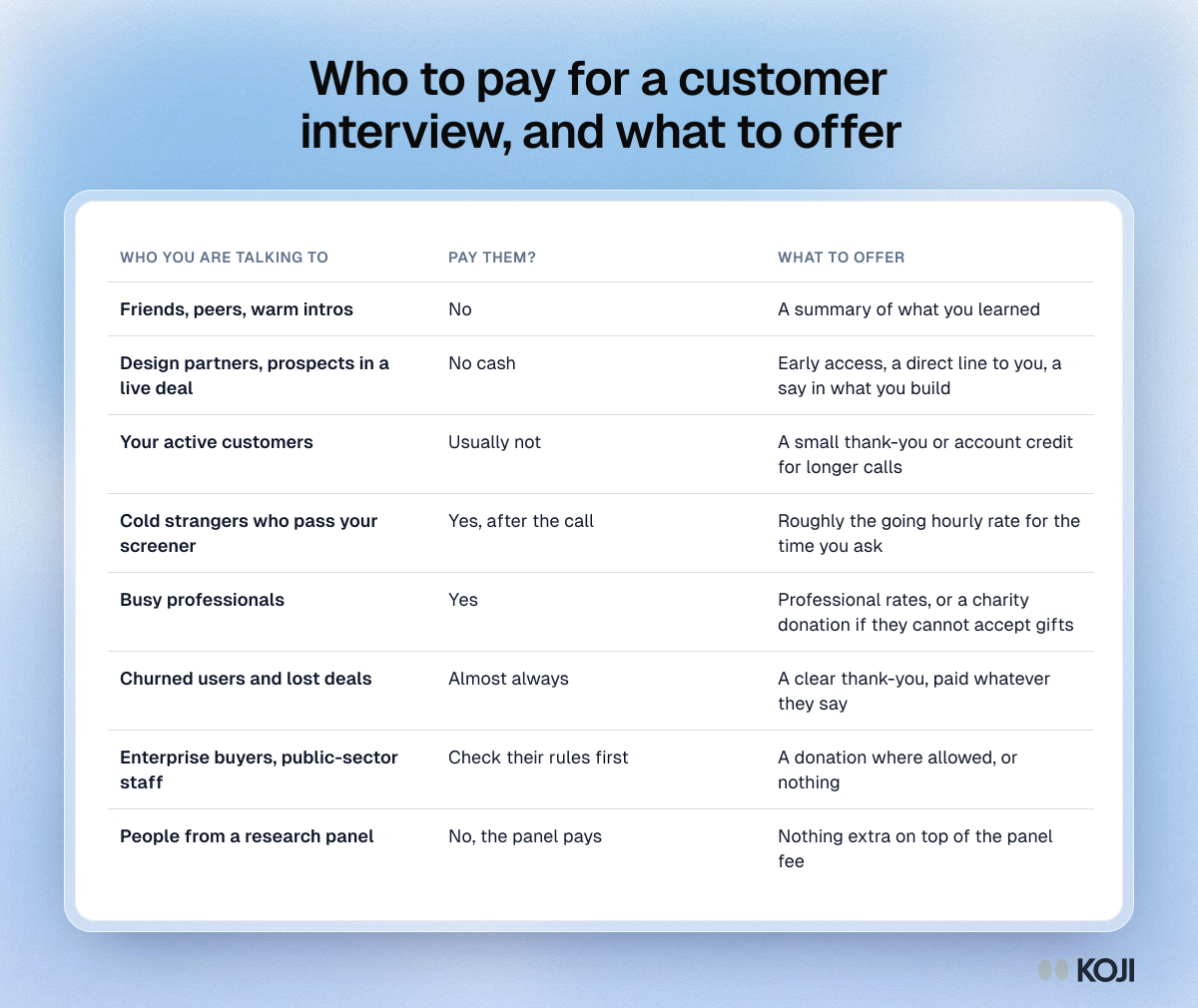
Friends, peers and warm intros: don't pay. They're doing you a favour, and money cheapens it. Offer to send them what you learned. If they're so far from the problem that they'd only talk for cash, they're the wrong people to interview.
Design partners and prospects in a live deal: no cash. These people are already invested. Paying them blurs whether they're a customer, a consultant or a research subject. Give them early access, a direct line to you and a say in what you build next. That's worth more to them than $50.
Your active customers: usually no, sometimes a small thank-you. For a 15-minute call, their stake in the product is enough. For 45 minutes with a busy customer, a modest gift card or a credit on their account is a fair thank-you. Account credit works well too, because it keeps the thank-you inside the relationship. Be careful with discounts as rewards, though: you'll hear more from people who care about price.
Cold strangers who match your screener: pay, after the call. These people have no reason to give you their time. Pay roughly in line with the hourly rates above for the time you ask for. For a 30-minute consumer call, that is $30 to $50 at the published rates [4]. Name the amount and how they'll receive it in the very first message.
Busy professionals: pay at professional rates, or offer a donation. A clinic owner, a finance lead or a senior engineer gets the $100 to $200 an hour range [4]. Some can't accept a personal gift at all. For them, offer a donation to a charity, after checking that their employer's rules allow it. Koji's guide to charity donations as research incentives covers who is barred and how to word the offer.
Churned users and lost deals: almost always pay. They left. The call has no upside for them, and the conversation can be awkward. A clear, decent thank-you (paid whatever they say) is what gets you a fair share of leavers rather than only the ones still angry enough to talk.
Enterprise buyers and public-sector staff: check the policy first. Gift rules are common. Ask what they can accept before you invite them, and fall back to a donation or nothing.
People from a research panel: the panel pays them. If you recruit through a panel, the fee covers their reward. Don't add your own on top.
Step by step: running paid interviews that stay honest
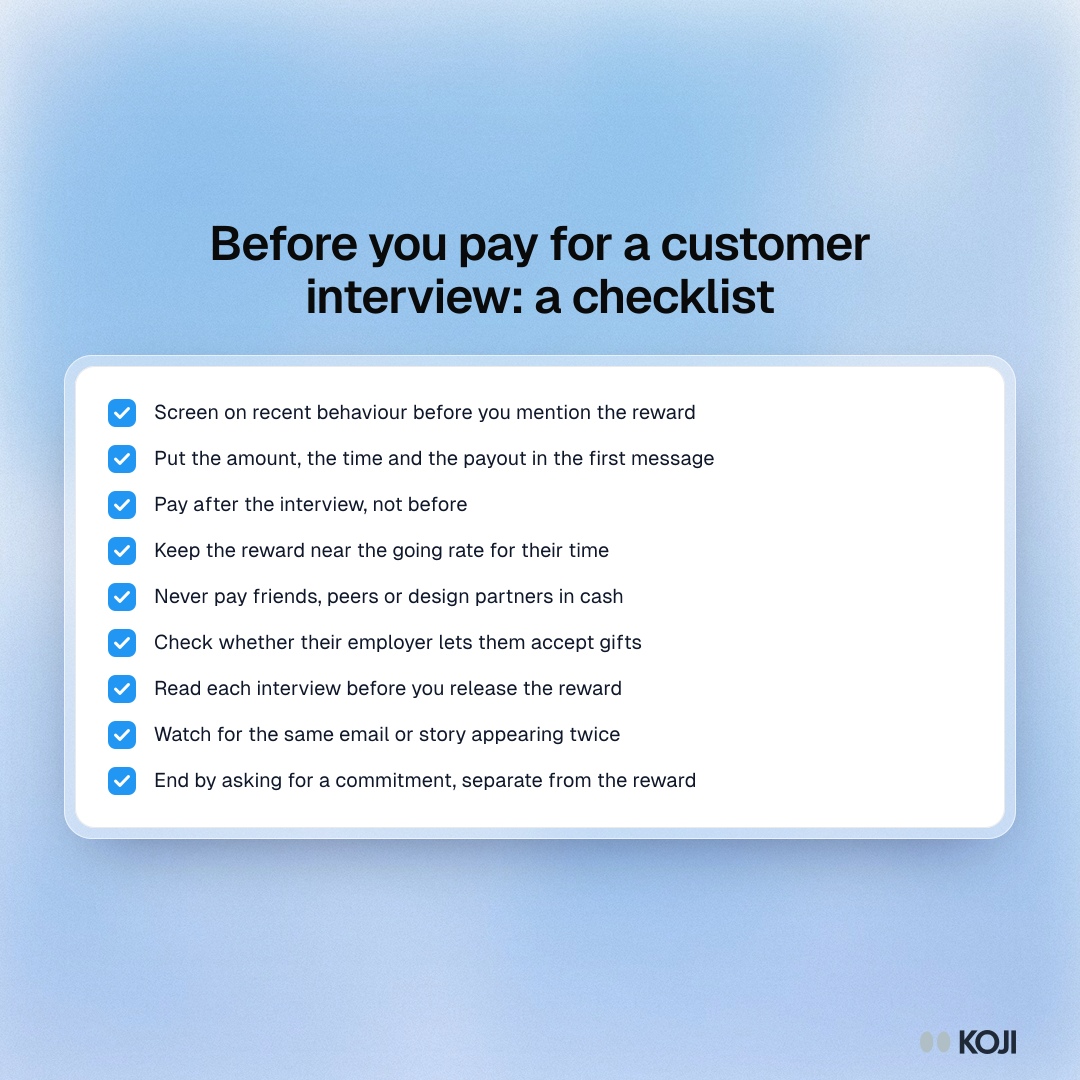
1. Screen for the problem before you mention money
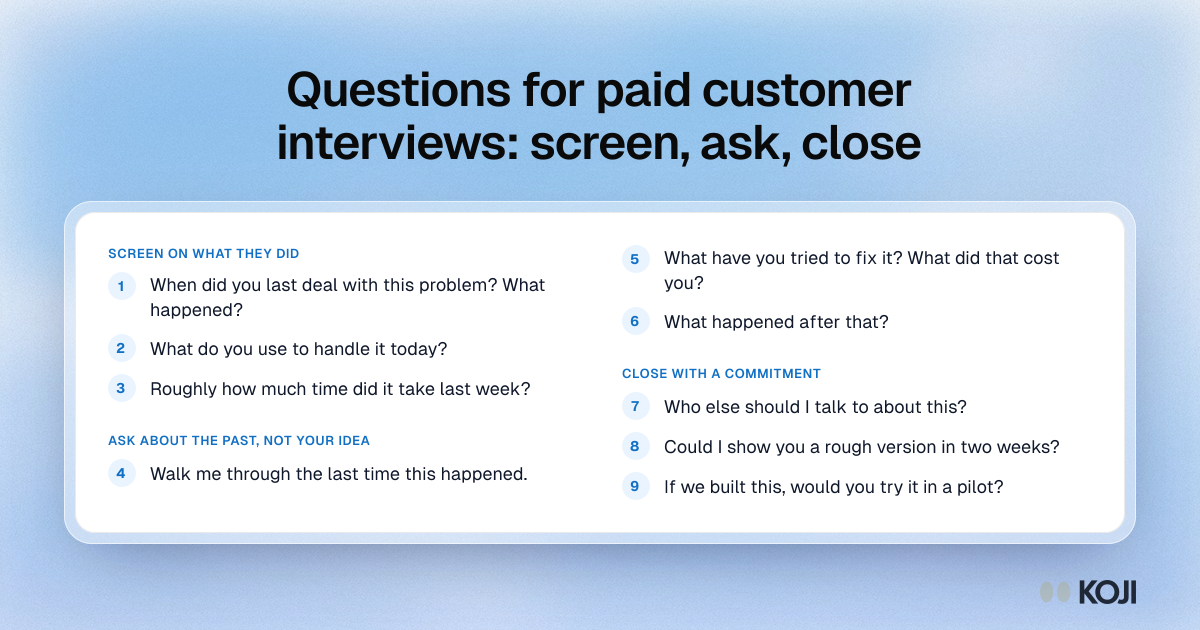
Put two or three screening questions in front of anyone you'd pay, and make them about behaviour, not identity. "Are you a clinic owner?" invites a yes. "When did you last chase an unpaid insurance claim, and how long did it take?" is hard to fake, and the answer is useful on its own. Ask open questions where you can; a multiple-choice screener tells people which answer gets them in.
2. Say the amount, the time and the payout in the first message
"20 minutes, a $40 gift card after we talk, about how you handle X today." Vague offers ("we'll send a small thank-you") get fewer replies and more arguments later. If you can't pay people in some countries, say so up front.
3. Pay after the interview, not before
Survey research has long found that paying in advance lifts response more than a promise [2]. For interviews with strangers, paying afterwards is the norm, and for good reason. It's your only check that the person turned up, was who they claimed, and actually took part.
4. Read every interview before the reward goes out
Look for the yellow flags [5]: answers that are generic in a way no real practitioner would be, a story that changes halfway through, the same email or phrasing showing up twice. Decline politely and give a reason when someone clearly didn't qualify. Don't decline someone just because they were nervous, quiet or disagreed with you.
5. End with a commitment that has nothing to do with the reward
The incentive pays for the time. It isn't evidence. The evidence is what they'll do next: introduce a colleague, look at a mockup in two weeks, join a pilot, put down a deposit. Ask for one of those at the end of every call, and write down who said yes. The Mom Test calls this the only real measure of interest, and a paid interviewee who agrees to a pilot is a much stronger signal than one who said nice things.
A worked example
Say you're two founders building invoice-chasing software for independent physiotherapy clinics. You have six warm intros from a co-founder's sister who runs a clinic, and you want 20 conversations in two weeks.
The six warm intros get no money. You offer to share a short summary of what you hear, and all six say yes.
For strangers, you join two clinic-owner groups on LinkedIn and Facebook, and pull 40 names from a regional directory. Your message says: "20 minutes about how you handle unpaid insurance claims. I'll send a €50 gift card after we talk. No sales pitch." The screener asks when they last chased a claim and how long it took. Twelve people book. One answers the screener with "every day, it's awful" and, ten minutes into the call, turns out to be a receptionist at a large chain. You thank them and pay anyway, because your screener let them in. Then you add a question about clinic size.
You also message eight clinics that tried your waitlist beta and dropped off. You offer €25 for 15 minutes, paid however they answer. Five agree.
What you hear: the warm group loves the idea. The paid strangers are cooler about the idea and much more specific about the problem: most of them lose a morning a week to insurer follow-ups, and three already pay a part-time bookkeeper to do it. The churned five tell you the beta asked them to connect their practice software on day one, and they gave up.
What you decide: the problem is real for clinics that already pay someone to chase invoices, so that's your first segment. You ask the twelve paid strangers if they'd try a pilot. Four say yes and two put down a deposit. You also fix onboarding, because five out of five leavers named it. You spent about €725 on rewards. Two deposits are worth more than all the enthusiasm from the warm group.
Reading the results and deciding
Paid and unpaid interviews answer different questions, so read them separately before you combine them.
- If paid strangers describe the problem the way your warm group does, the problem probably isn't a product of politeness. Move on to who has it worst.
- If the paid group is much cooler, your warm group was being kind. Trust the strangers.
- If paid interviews are vague and unspecific, your screener is too loose or your reward too high. Tighten the screener before you raise the amount.
- If you can't get replies even with a fair reward, you're probably in the wrong place, or the problem isn't painful enough to talk about. Go back to where you're finding people.
- If nobody paid takes the commitment you ask for at the end, you have a real problem and no pull for your solution. That's still a finding.
Run it this week with Koji
Koji runs interviews as AI-moderated text or voice conversations, so a stranger can take part at 11pm without you booking a call. You can pay them through Koji, on any paid plan.
- Write the study and the screener. Start from a template or describe what you want to learn, then add screening questions to the brief and mark which answers qualify. Anyone who doesn't qualify is turned away before the interview starts, whatever link they came in on. Screening questions work on every plan, including Free. See adding screening questions.
- Turn on incentives in the study's settings and set one amount per participant, from €10 to €500. Top up the workspace's rewards balance on the study page or in Usage. Rewards come out of it at face value, and a 7.5% handling fee and VAT are added when you top up. Only rewards you approve are paid.
- Invite people. Share the interview link in the communities where you found them, or, on paid plans, email a list of your own users or churned customers from the Participants page with an invitation and a reminder.
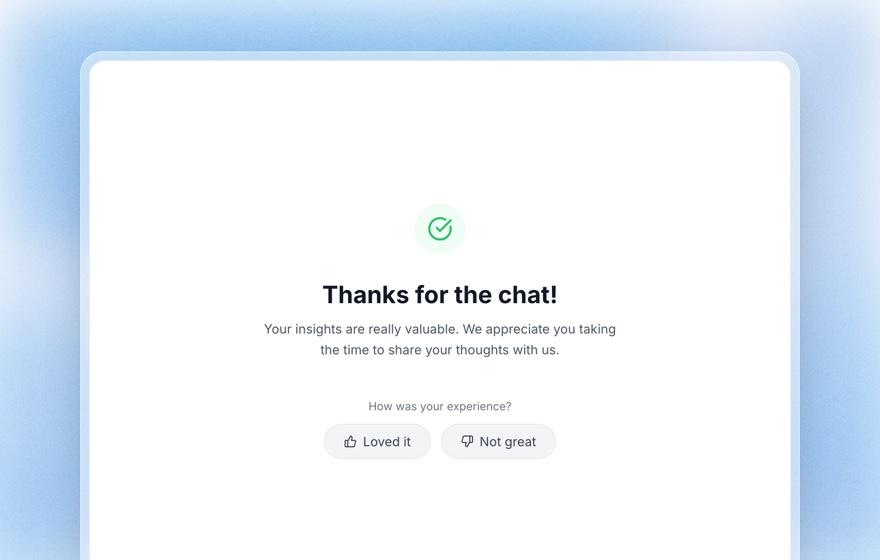
- The thank-you screen asks where to send the reward. Incentives are offered at the end of text and voice interviews.
Approve rewards with the interview in front of you
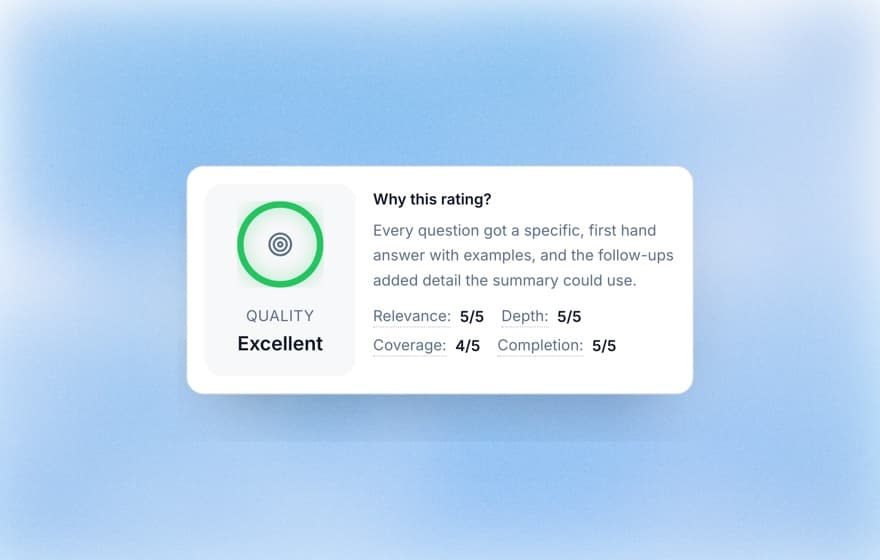
On the study's Interviews page, each reward waits for you to approve or decline it, with the interview's quality score beside it (or Approve all when you've read them). Koji warns you when the same reward email shows up more than once in a study, which is usually one person taking part twice. Interviews too short or too low in quality aren't put forward automatically, but you can still approve them.
When you approve, the participant gets an email with a personal link to claim the reward as a gift card, a prepaid Visa card or a donation to charity. The link is valid for 30 days. Each person can receive up to €1,500 a year, and rewards aren't offered in a few countries where banking rules prevent payouts. A rewards statement with a CSV export sits in Usage, which helps if your accountant asks.
If you recruit from Koji's research panel instead, the panel pays its participants, so leave incentives off for those people.
Common mistakes
- Paying friends. It doesn't make them more honest. It makes it awkward.
- Leading with the money. "$100 for 20 minutes!" in a public post is an invitation to people who'll say anything. Lead with the problem.
- Overpaying to make up for a bad screener. More money brings more of the wrong people.
- Paying with a discount on your own product. You'll hear mostly from people who care about price.
- Not paying churned users. You'll only hear from the angriest ones.
- Forgetting taxes and rules. Incentives can be taxable income for participants in some countries, and some employers bar gifts. See incentives and taxes and check before you promise anything.
When research will mislead you
Paying someone buys their time and attention. It doesn't buy accurate predictions. A 2020 meta-analysis found people state willingness to pay about 21% higher than they actually pay [6], and a reward doesn't change that. Paid or not, what people say they'll do is a weak signal. Pair interviews with something that costs them: a deposit, a letter of intent, a pilot with a start date, a week of real usage. If paid interviewees love your idea and none of them takes the next step, believe the step.
The other trap is the professional participant. Someone who does studies for income learns what researchers want to hear [5]. Behavioural screeners, reading interviews before you pay, and recruiting where your actual customers gather rather than on broad "paid study" boards keep their share small.
Where this fits
This is the second step on the founder path for idea-stage founders, the founder's research playbook. Before it: how to find 20 people to interview when you have no audience. After it: find your first customer segment before you build, which uses the same screening questions to compare groups. If you're already past launch, the same rules apply to interviewing customers who left after Series A and why new users stall. For amounts in more depth, see research participant incentives and incentive strategies. More for founders at /for/founders.
FAQ
Should I pay for customer interviews? Pay strangers, busy professionals and churned users, after the call, at roughly the going rate for their time. Don't pay friends, design partners or prospects in a live deal.
How much should I pay for a 30-minute customer interview? Published 2026 rates are about $60 to $100 an hour for consumers and $100 to $200 an hour for professionals, so $30 to $50 for a consumer and $50 to $100 for a professional for half an hour [4]. Founders recruiting directly can often pay less.
Does paying people bias what they tell you? The evidence says incentives mostly change who takes part, not the quality of what they say [2]. The real risk is attracting people who don't have the problem, so screen on recent behaviour before you pay.
Should I pay before or after the interview? After. It's your only check that the person showed up, qualified and took part.
What if someone can't accept a gift card? Offer a donation to a charity, but check their employer's rules first. Some public-sector and enterprise policies treat a directed donation as a gift too.
Is a discount on my product a good incentive? Only for existing customers, and with care. It pulls in people who care most about price, which skews what you hear.
Your next step: pick the five people you most want to hear from this week, find their row in the table above, and write the invitation with the amount, the time and the payout in the first line.
References
- Abdelazeem B. et al. "Does usage of monetary incentive impact the involvement in surveys? A systematic review and meta-analysis of 46 randomized controlled trials." PLOS ONE, 2023. https://pubmed.ncbi.nlm.nih.gov/36649255/
- Singer E., Ye C. "The Use and Effects of Incentives in Surveys." The Annals of the American Academy of Political and Social Science, vol. 645, 2013. https://doi.org/10.1177/0002716212458082
- User Interviews. "The UX Research Incentives Report." User Interviews blog, 2022. https://www.userinterviews.com/blog/research-incentives-report
- Great Question. "Research incentives: what to pay participants in 2026." Great Question blog, January 2026. https://greatquestion.co/blog/customer-research-incentives-guide
- Hill J.R. et al. "Flagged for Fraud: Lessons From 3 Case Studies on Detecting Inauthentic Participants in Online Research." Journal of Medical Internet Research, vol. 27, 2025. https://www.jmir.org/2025/1/e78554
- Schmidt J., Bijmolt T.H.A. "Accurately measuring willingness to pay for consumer goods: a meta-analysis of the hypothetical bias." Journal of the Academy of Marketing Science, 2020. https://doi.org/10.1007/s11747-019-00666-6
Further reading
- Jason Cohen, "When you have nothing: How to find potential customers to interview," A Smart Bear. A founder's practical guide to getting the first conversations, with or without paying. https://longform.asmartbear.com/find-customers-to-interview/
- American Statistical Association and AAPOR, "Joint statement on the use of incentives in survey participation." The research bodies' own position on why paying people is fair and ethical. https://aapor.org/statements/joint-american-statistical-association-aapor-statement-on-use-of-incentives-in-survey-participation/
- Koji, Research participant incentives: how much to pay and what to offer. Amounts by session type and length, for when you're past the first few calls.
- Koji, Scoring answers you cannot verify. For when you want to pay in a way that rewards honest answers, not just any answers.