If your customers buy once and quietly stop coming back, you can't fix it by guessing. The short answer: call 10 to 12 people who lapsed, ask what they did instead the last time they needed you, and count the reasons. By the end of this page you'll know who to call, what to say, how to read what you hear and what to change first.
This is written for the owner of a small business with no research team: a shop, an agency, a service business or a bootstrapped product. You don't need a subscription base or a dashboard. You need a list of people who stopped and an afternoon.
When you need this
You need it when the sales you counted on in March didn't repeat in June. The signs are easy to spot:
- First orders look fine, repeat orders don't.
- A regular you liked stopped booking and you never found out why.
- You've started a discount or a newsletter "to bring people back" without knowing what they left over.
- Reviews are fine, so it isn't obvious what's wrong.
Guessing is expensive because a wrong guess feels like progress. Cut prices when the real problem was slow replies and you've given away margin and fixed nothing. Most small businesses also have no system for this. In a SumUp survey of 617 US micro and small business owners (November 2025), 73.2% said they run no formal loyalty program, and the most common reason was that they felt their customer base was too small to justify one [2]. That's a fair feeling and a useful one: with a small base, you can simply call people.
The cost of staying quiet is real too. Zendesk's 2025 customer experience report found 63% of consumers said they'd be willing to switch to a competitor after one bad experience [3]. That's stated willingness, not measured behaviour, so don't treat it as a churn rate. It does tell you why a lapsed customer rarely complains first: leaving is easier than telling you.
The method in brief
For a small business the right method is a short, anchored conversation with people who have already stopped. It's the same family as a churned customer interview and a switch interview, adapted for a business that has no cancel button. You aren't asking "why did you cancel?" because nobody cancelled. You ask what happened the last time they needed what you sell.
Why this and not a survey? A fixed list of reasons can only return the reasons you thought of. A discontinued product, a staff member who left or a confusing booking page never makes the list. A conversation lets the customer name the reason you didn't expect. If you want the longer reasoning on methods, Mom Test style questions are the discipline underneath: ask about what really happened, not what people might do.
Here is how the options compare for a small business:
| Option | Good for | Weakness |
|---|---|---|
| Phone or video call by you | The first 8 to 12 conversations, best depth | Takes your time, people can soften answers to your face |
| AI interview sent by link | More people, any hour, nobody to be polite to | Less rapport on emotional topics |
| One-question text or email | A quick count once you know the reasons | Only returns what you already thought of |
| Looking at the order data | Seeing who lapsed and when | Says who left, never why |
Do them in that order: data to find the list, conversations to learn the reasons, a one-question follow-up to count them.
Step by step
1. Pull the list
Take everyone who bought at least once and has not come back in a window that's 1.5 to 2 times your normal gap between purchases. A coffee roaster whose customers usually reorder every five weeks looks at nobody-in-90-days. A wedding photographer looks at a different clock entirely. Include people who spent a lot and people who spent little: they leave for different reasons.
2. Split your list into two groups
Call a mix of high-spend and low-spend lapsed customers. If you only talk to your best customers, you learn why the people you were already losing were annoyed, and you miss why the first-timers never returned.
3. How many
Twelve is a good first target. Guest, Bunce and Johnson coded 60 in-depth interviews and found that saturation, the point where new interviews stop producing new themes, arrived within the first twelve, and the basic elements of the main themes were visible by six [4]. That was a fairly uniform group. Hagaman and Wutich later found that 16 or fewer interviews were enough to identify common themes within relatively uniform groups, but that themes shared across several different sites needed 20 to 40 [5]. For you that means: if your lapsed customers are one kind of person, 12 is plenty. If you serve two quite different kinds (homeowners and landlords, say), do 10 to 12 for each.
4. Invite them without selling
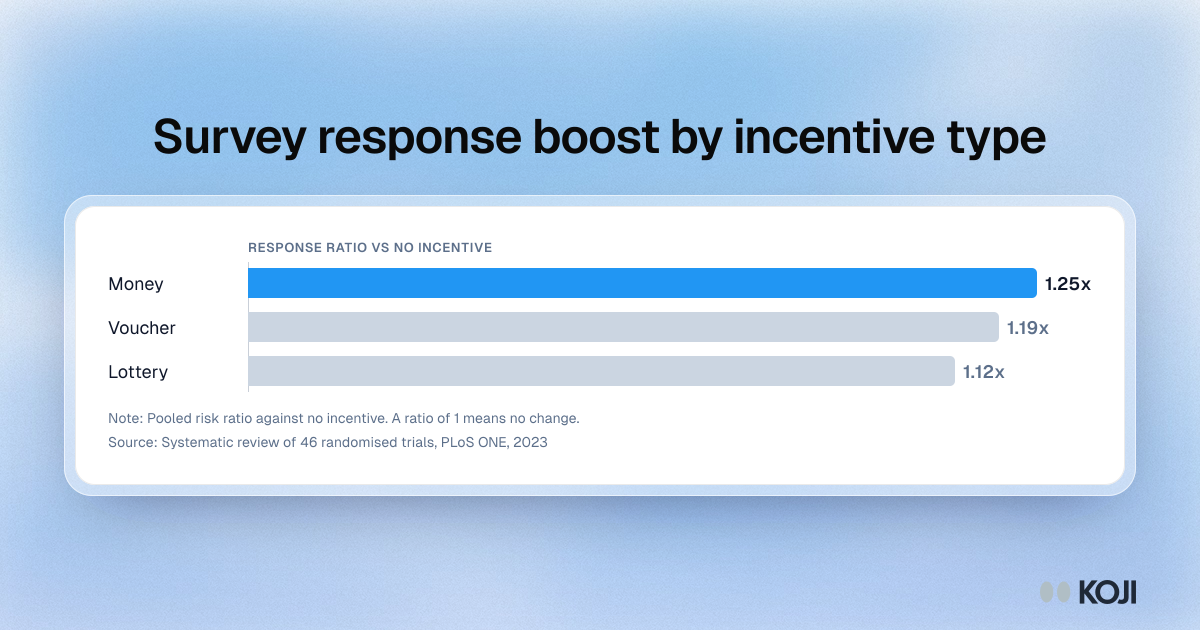
Say who you are, that you aren't calling to win them back and that you want ten minutes about what happened. Practitioner guidance on lost-customer research makes the same point: don't mix the research call with a win-back offer, because people who feel pressed to return are less open about why they left [7]. Offer a small thank-you. A systematic review of 46 randomised trials (PLoS ONE, 2023) found that money raised survey response more than vouchers or lotteries, with pooled response ratios of 1.25, 1.19 and 1.12 against no incentive [6]. Those are surveys, and your list is small, so treat it as a direction: a modest cash-like thank-you helps a little, and a lottery helps least.
5. Ask what happened, in this order
Anchor on the last time, not on opinions. Start wide, then narrow to a concrete event, then ask what they did instead. Keep your questions neutral, because "was it our slow delivery?" teaches them what to say.
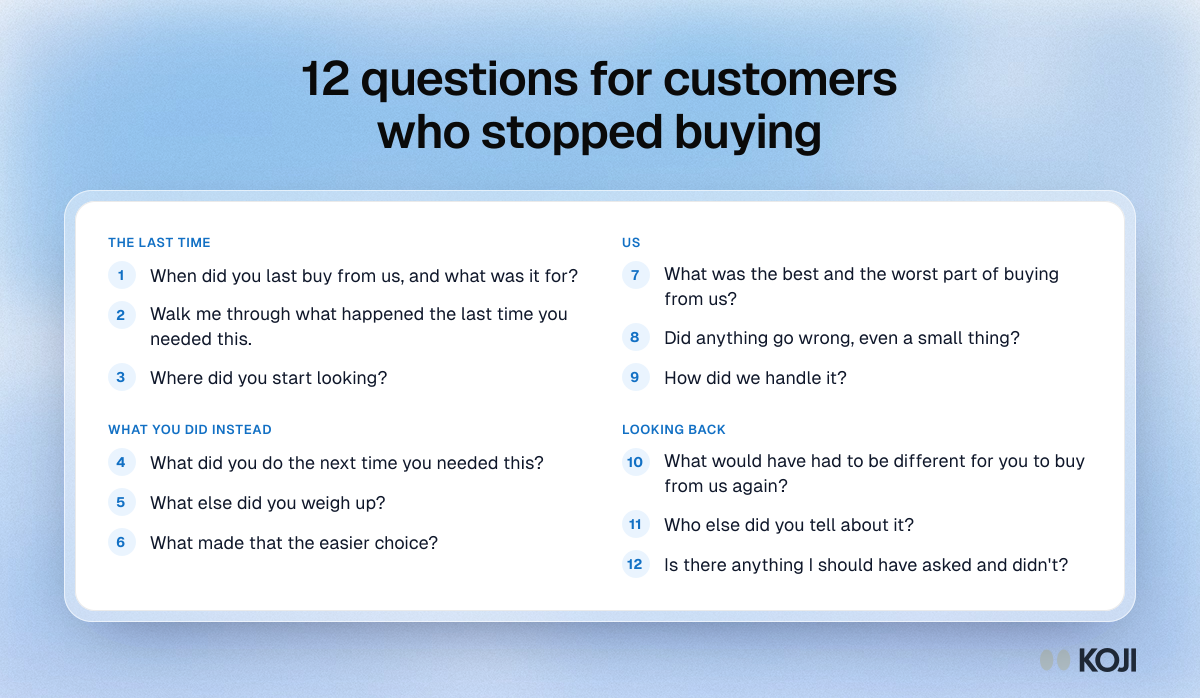
Two questions do most of the work. "What did you do the next time you needed this?" tells you who your real competitor is, which is often a rival, a do-it-yourself fix or nothing at all. "What would have had to be different?" turns a vague complaint into something you can build. When you hear "price", ask "compared with what?" and "what else did you weigh up?" Price is a common polite answer; Koji's piece on why price is rarely the real reason goes through how to dig under it.
6. Run it in a week
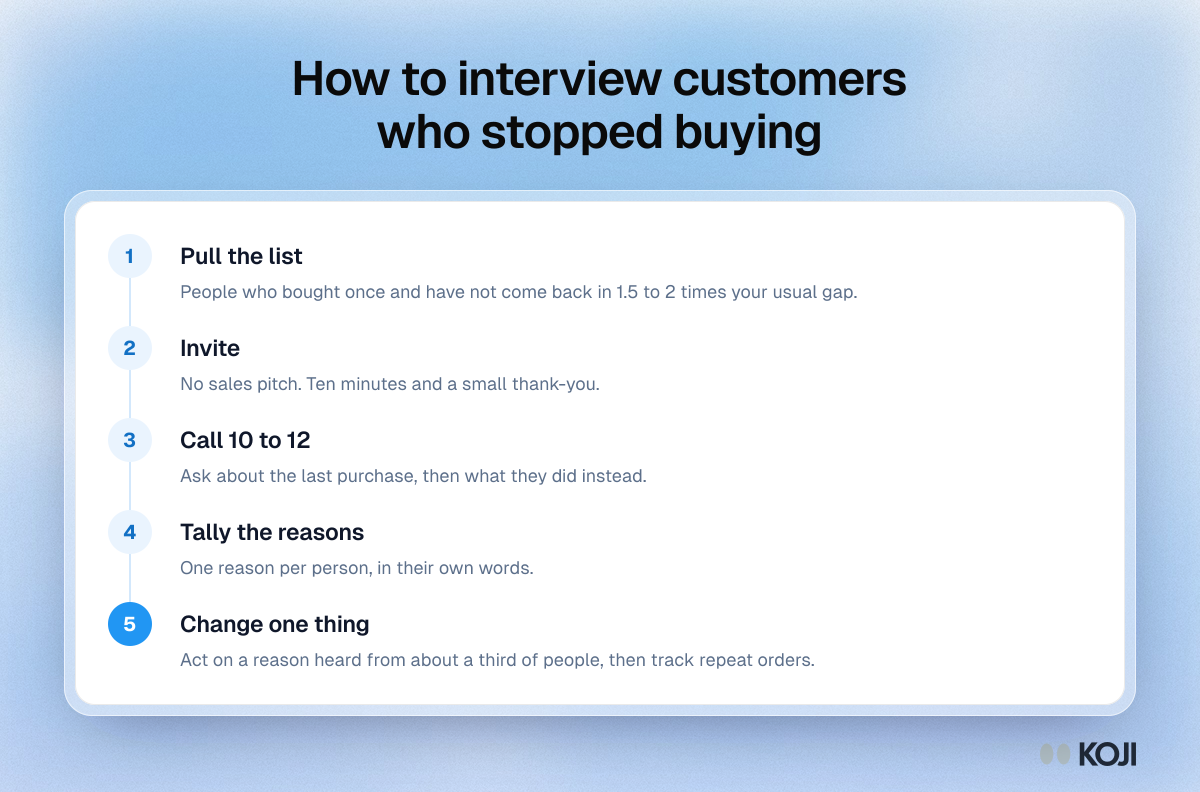
Day 1 pull the list and send invites. Days 2 to 5 run the calls, 15 minutes each, and write a one-line reason straight after each. Day 6 tally. Day 7 pick one change.
A worked example
Say you run a two-person online coffee roaster. You've sold to about 400 people and only a third have reordered. You pull everyone who bought once and hasn't ordered in 90 days, split it into big first orders and small ones, and invite 30 by email with a "no sales pitch, ten minutes, a thank-you" message. Twelve talk to you. This is an illustration, not real data.

Photo by Yanapi Senaud on Unsplash
What you'd hear, tallied from your one-line notes:
- Five bought it as a gift and never thought of it for themselves.
- Three couldn't tell which beans to choose and ordered the wrong grind.
- Two said delivery took longer than the shop promised, so they bought a supermarket bag that week.
- One moved to a competitor's subscription because it was one click.
- One said the price felt high (when asked "compared with what?", it was the supermarket bag, after a late delivery).
Price looked like the story on a quick read. It turned out to be one person, and that person's answer pointed back at delivery. The real pattern: gift buyers who never became customers, and a choosing problem. So you add a one-line "what grind do you use?" step and a gentle "want this for yourself?" note in the gift parcel, and you track how many of the next 50 first-time buyers reorder.
Reading the results and deciding
Tally one reason per person, in their words, not yours. Then use these rules. They're a rule of thumb from how themes accumulate in small samples, not a statistic:
- A reason from 4 or more of 12 (about a third). Act on it first. Make one change, and measure repeat orders for the next cohort.
- A reason from 2 or 3 of 12. Worth a cheap fix, or a follow-up question to your next 50 customers to see if it grows.
- A reason from 1 of 12. Write it down and move on. One story is a sentence, not a plan.
- A mix of ten different reasons. You probably mixed groups. Split the list by customer type and look again.
- "I just forgot you." This is a real answer. The fix is a reminder or a reason to come back, not a product change.
Quote the customers when you share the result with a partner or your team. A sentence in their own words beats a percentage that comes from twelve people.
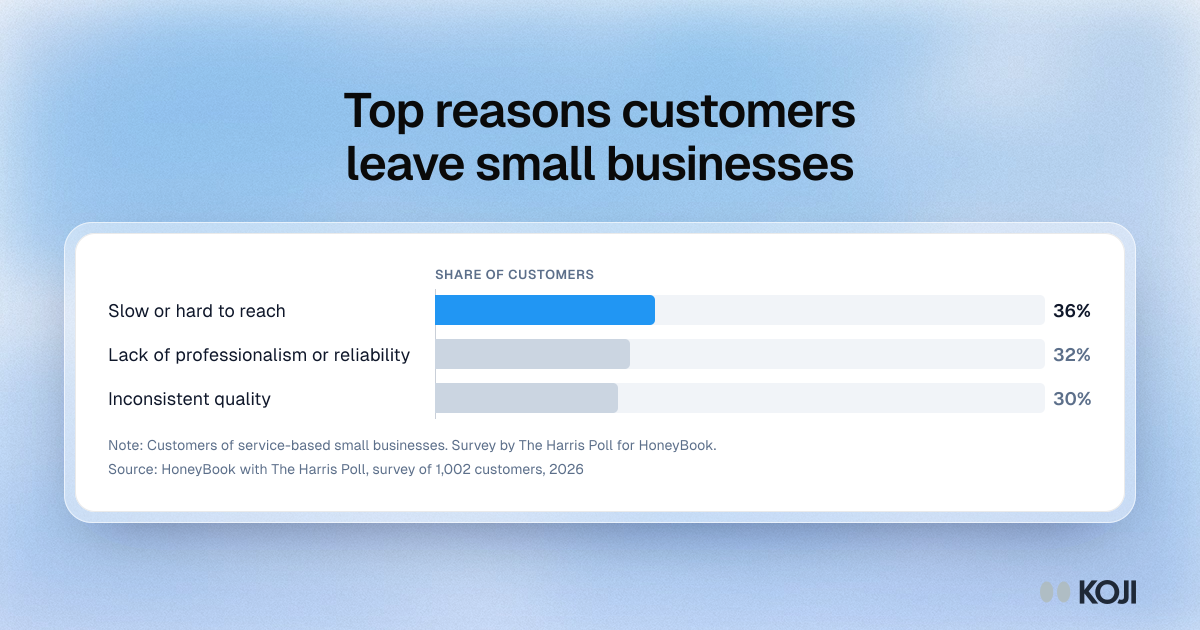
HoneyBook's 2026 research with the Harris Poll, which surveyed 1,002 customers of service-based small businesses, gives a useful reference for what to listen for. Slow or hard-to-reach service was the top reason people left, at 36%, ahead of a lack of professionalism or reliability at 32% and inconsistent quality at 30% [1]. HoneyBook sells software to these businesses, so read it as one data point from an interested source. It does suggest that responsiveness and reliability, not price, are worth checking first.
Run it this week with Koji
You can do all of this with a phone and a spreadsheet, and for your first six calls I'd suggest you do. Koji earns its place when you want twelve or thirty conversations without twelve or thirty evenings.
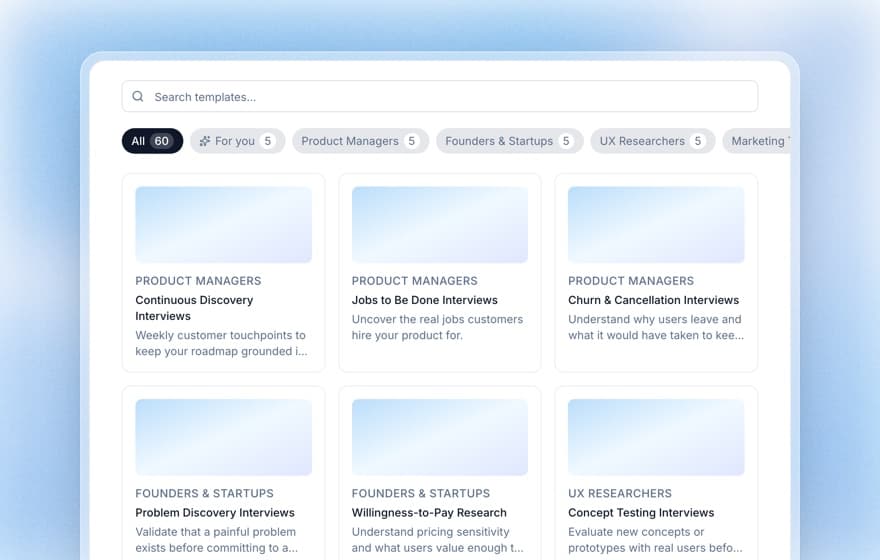
- Start from the template. In the template library, pick Churn & Cancellation Interviews and trim it to the question bank above. Change the opening so it says you're asking about the last time they needed you.
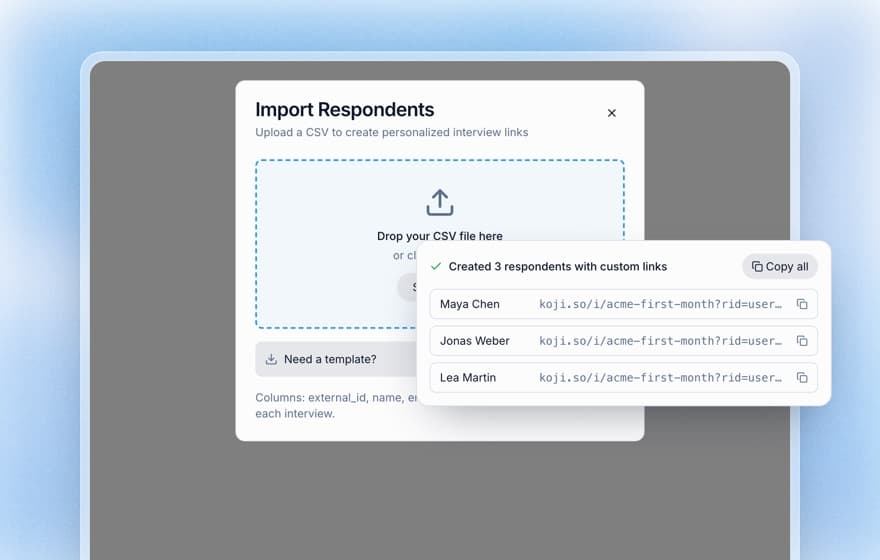
- Add your lapsed customers. Import the list as a CSV on the Participants page. Each person gets their own interview link, and you can email them from Koji, with a reminder for people who haven't started. The Participants page and Koji-sent email are on every paid plan. On any plan, including Free, you can instead share one interview link in a text message or print it on a receipt.
-
Thank them. Turn on an incentive in the study's settings. You choose an amount per participant, you approve each one after seeing the interview's quality score, and the participant picks a gift card, a prepaid Visa card or a donation. Incentives are on every paid plan.
-
Keep it private. Turn on Remove personal details in the study settings and Koji takes names, emails, phone numbers and addresses out of each transcript when it finishes. It can miss details, so check before you share.
-
Read the report. Koji interviews in text or voice, asks follow-ups on vague answers like "it was just a bit much" and groups what people said into themes with the quotes behind each one. You can download the report as an editable slide deck or a PDF, which suits a bank, a partner or a landlord meeting.
Two extras fit this topic. If "price" keeps coming up, run a separate price test: a ladder of prices a participant answers one at a time, with the reasons behind each answer. It reads best from about 30 interviews, so it's a second study, not part of this one. And if the real problem is that customers don't understand your offer, attach a screenshot of your product page to a question and show it for five seconds, then ask what they remember.
Common mistakes
- Asking only your best customers. They're not who left.
- Pitching on the call. It ends the honesty. Save the win-back for later.
- Leading questions. "Was it the delivery?" gets a yes. "What happened with that order?" gets a story.
- Counting your guesses. Tally what they said, then read your own theory against it.
- Changing five things at once. You'll never know which one worked.
- Stopping at three calls. Three people can be a coincidence.
When research will mislead you
- You only hear from people who answer. Lapsed customers who reply are friendlier than the ones who don't. Say so in your notes, and don't generalise past the people you reached.
- People soften the truth to your face. "I was just busy" is common. Ask for the last specific event, or let them answer in writing to a link instead of out loud.
- Stated reasons aren't behaviour. A customer who says they'd come back for a discount often won't. Check against orders: try the fix on the next cohort and count repeat orders.
- Small samples can't prove a number. Twelve calls tell you what the reasons are. They can't tell you how common each one is across all 400. Use the one-question follow-up for counting.
Where this fits
This is the retention step in the founder's research playbook. It sits after you've sold to enough people to have lapsed ones, and before you decide your price or your offer. If you haven't found the people to talk to yet, read how to find people to interview with no audience. When you reach the price question, pricing with 30 conversations comes next. The full path for small businesses is at the founder's research playbook, and the founders page shows how others set it up. For method detail, see the churned customer interview guide, how many interviews are enough and research participant incentives.
FAQ
How many lapsed customers should I call? Twelve for one kind of customer, and 10 to 12 for each if you serve two very different kinds. Saturation research suggests most common themes show up by then [4][5].
Should I offer a discount to get them to talk? Offer a small thank-you, not a discount on your product. A discount turns the call into a sales pitch and changes what people say [7].
What if nobody replies? Expect a modest response, and invite more people than you need. Send one reminder, keep the ask short and make the thank-you clear. If your list is small, call the biggest accounts yourself.
Is it okay to ask why they left if they never "cancelled"? Yes, but ask about the last time they needed what you sell, not about leaving. They didn't decide to leave, they just didn't come back.
Can I do this with a survey instead? Use a one-question survey to count reasons after you've had conversations. As a first step, a fixed list can only return reasons you already thought of.
Do I need Koji? No. A phone, a notes file and an hour a day will do it. Koji helps when you want more conversations than you have evenings.
Next step
Open your orders, pull the 30 people who bought once and haven't come back, and send ten of them the invite today.
References
- HoneyBook with The Harris Poll. "HoneyBook research: poor communication is the top reason customers leave small businesses." HoneyBook newsroom, 2026 (survey of 503 service-based small business owners and 1,002 customers, fielded August to September 2025). https://news.honeybook.com/news/honeybook-research-poor-communication-top-reason-customers-leave-small-businesses
- SumUp. "73% of Small Businesses Still Operate Without Loyalty Programs, SumUp Survey Finds." SumUp press release, December 2025 (617 US micro and small business owners, fielded 7 to 16 November 2025). https://www.sumup.com/en-us/press/loyalty-data-story/
- Zendesk. "Zendesk 2025 CX Trends Report." Zendesk newsroom, January 2025. https://zendesk.de/newsroom/articles/2025-cx-trends-report
- Guest, G., Bunce, A. and Johnson, L. "How Many Interviews Are Enough? An Experiment with Data Saturation and Variability." Field Methods 18(1), 2006, pp. 59 to 82. https://doi.org/10.1177/1525822X05279903
- Hagaman, A. K. and Wutich, A. "How Many Interviews Are Enough to Identify Metathemes in Multisited and Cross-Cultural Research?" Field Methods 29(1), 2017, pp. 23 to 41. https://journals.sagepub.com/doi/10.1177/1525822X16640447
- "Does usage of monetary incentive impact the involvement in surveys? A systematic review and meta-analysis of 46 randomized controlled trials." PLoS ONE, 2023. https://pmc.ncbi.nlm.nih.gov/articles/PMC9844858
- Channel Futures. "How to Survey 'Lost Customers' (The Right Way)." Channel Futures, undated. https://channelfutures.com/channel-business/how-to-survey-lost-customers-the-right-way-
Further reading
- Churned customer interviews: Koji's guide to the same conversation for subscription products, useful if you add a recurring plan later.
- Switch interviews (jobs to be done): the method behind "what did you do instead?", with a fuller script.
- Why price is never the real reason customers churn: what to do when the first answer you hear is "too expensive".
- Guest, Bunce and Johnson (2006): the saturation paper itself, short enough to read in one sitting.