You've been charging the same price for a year because it feels about right, and now costs are up and you can't tell whether to raise it. The short answer: ask 30 recent customers what they'd pay and why, test a short ladder of prices, then try the winner on new bookings only. By the end of this page you'll know who to ask, what to say, how to read what comes back and how to check it against real money.
This is for the owner of a small business with no research team: a salon, a shop, an agency, a repair service or a bootstrapped product. If you sell to a few hundred people and know many of them by name, you have the best pricing research panel there is. It is already in your phone.
When you need this
You need it when you're about to change a price, or when you suspect you should have. The signs:

Photo by Ali Mkumbwa on Unsplash
- Nobody has pushed back on your price in months, and you're busy without earning more.
- Your costs went up and you're choosing between eating them and guessing a new number.
- You're about to add a new service, package or size and have no idea where it sits.
- A competitor opened nearby and you're tempted to match them.
You're not alone in this. Bank of America's 2025 Business Owner Report, which surveyed 1,072 small and mid-sized business owners, found 77% said their costs had risen by an average of 18%, and 76% said they had raised prices by an average of 12% in response [1]. NFIB's June 2026 survey of small business owners put the net share raising average selling prices at 38%, the highest since early 2023; unadjusted, 47% reported higher prices and 7% lower [2]. Most owners are moving prices right now, and most are doing it by feel.
Guessing is expensive in both directions. McKinsey's analysis of a typical S&P 1500 company found that a 1% price increase, with volume unchanged, lifted operating profit by about 8% [3]. That is a large company, so don't copy the number into your own plan. The same analysis found that a point of price moved profit nearly half as much again as a point off variable costs. The idea carries over to a small shop: price is a strong lever, so a lazy guess is costly. The arithmetic runs the other way too. A discount you didn't need comes straight out of what you keep.
The method in brief
For a small business, the right method is a short conversation with recent customers, with a price ladder inside it. You ask about their last purchase and what they compared it with. Then you show a few prices, one at a time, and ask why they answered the way they did.
Two methods do the heavy lifting, and both have their own reference pages:
- Van Westendorp: four questions about the price that feels too cheap, a bargain, getting expensive and too expensive. It finds the range you should be in. It dates to a 1976 ESOMAR paper by Peter van Westendorp [4]. See the Van Westendorp price sensitivity meter.
- Gabor-Granger: you show one price at a time and ask how likely they are to buy. It tells you which price inside that range earns the most. See the Gabor-Granger pricing method.
If you're choosing between them, Gabor-Granger vs Van Westendorp compares them side by side. The short version: if you have no idea where to start, use Van Westendorp's questions first. If you already have a rough range, go straight to a price ladder.
You don't need to buy anything to do it. A notebook and a phone work. The steps below are the same whether you use a tool or not.
Step by step: who to ask and what to say
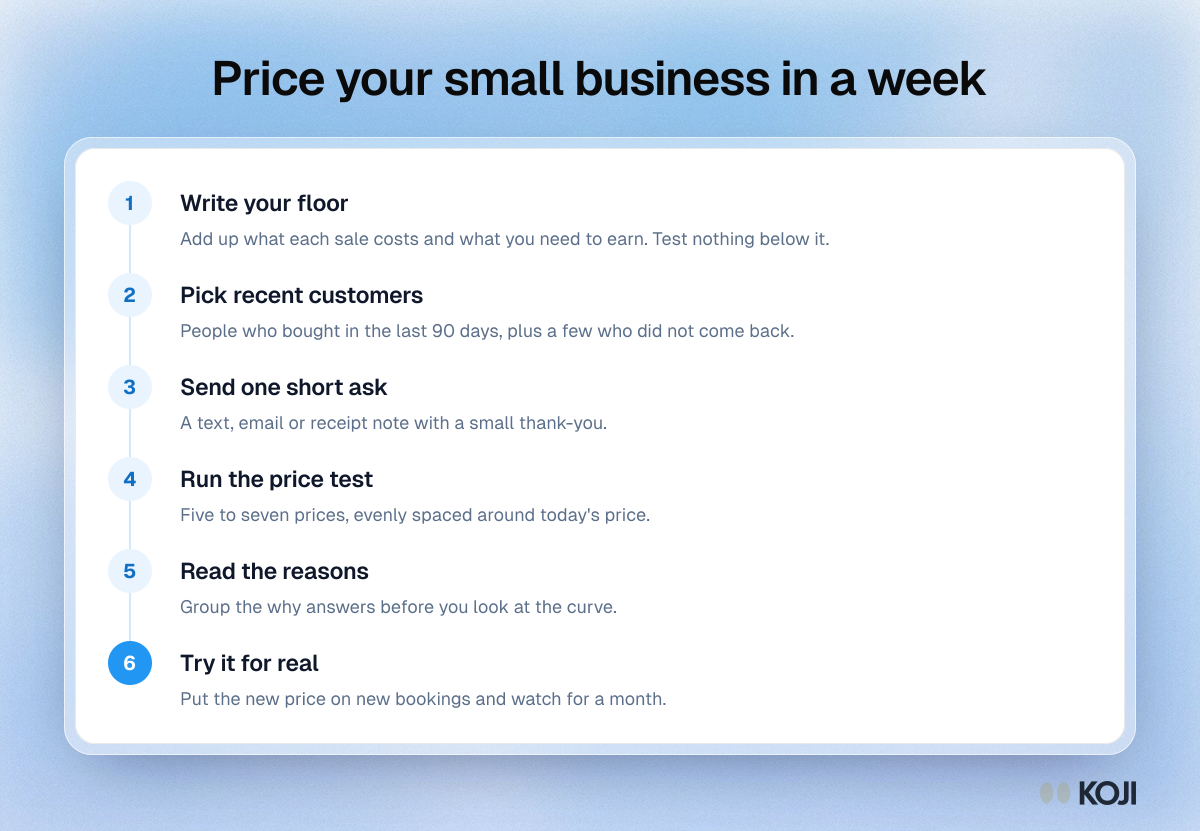
Start with your floor. Before you ask anyone, work out what each sale costs you (materials, time, the share of rent and software it carries) and what you need to earn from it. Nothing you test goes below that line. Customers can't tell you your costs, and a price that wins every vote but loses money is not a result.
Ask recent buyers, not friends. Pick people who bought from you in the last 90 days. They remember the decision, so their answers are about a real choice. Avoid family and staff, who are kinder than strangers. Mix in a few who bought once and didn't come back, because regulars alone will tell you what regulars already accept. If you haven't talked to your lapsed customers yet, why customers leave a small business shows how.
How many. Aim for about 30. That's the floor for reading a price curve at all. Koji's price test flags anything under 30 as an early signal. Survey guidance usually asks for 100 or more per segment before you trust a number to the dollar, and you probably can't get that. So treat 30 as a rough map of the terrain, with reasons attached, rather than a precise answer. If you have fewer than 15 customers, skip the curve and have the conversations anyway: ten honest ones beat a guess. Our piece on pricing a product with 30 conversations goes deeper on sample size.
How to reach them. Send a personal message: a text, an email, a note with the receipt, or a card at the counter. Keep it short and say what it is: "I'm deciding on next year's prices and want to hear from the people who use us. Ten minutes, and I'll send you a thank-you." Offer a small incentive, like a coupon or a coffee card. Recruitment email templates and participant incentives cover wording and amounts. Expect a minority to reply, so send to more people than you need.
What to ask. Ask about the last purchase first, then the price questions. Order matters: if you open with price, you get a negotiating stance, not a story. The bank below is the one to copy.
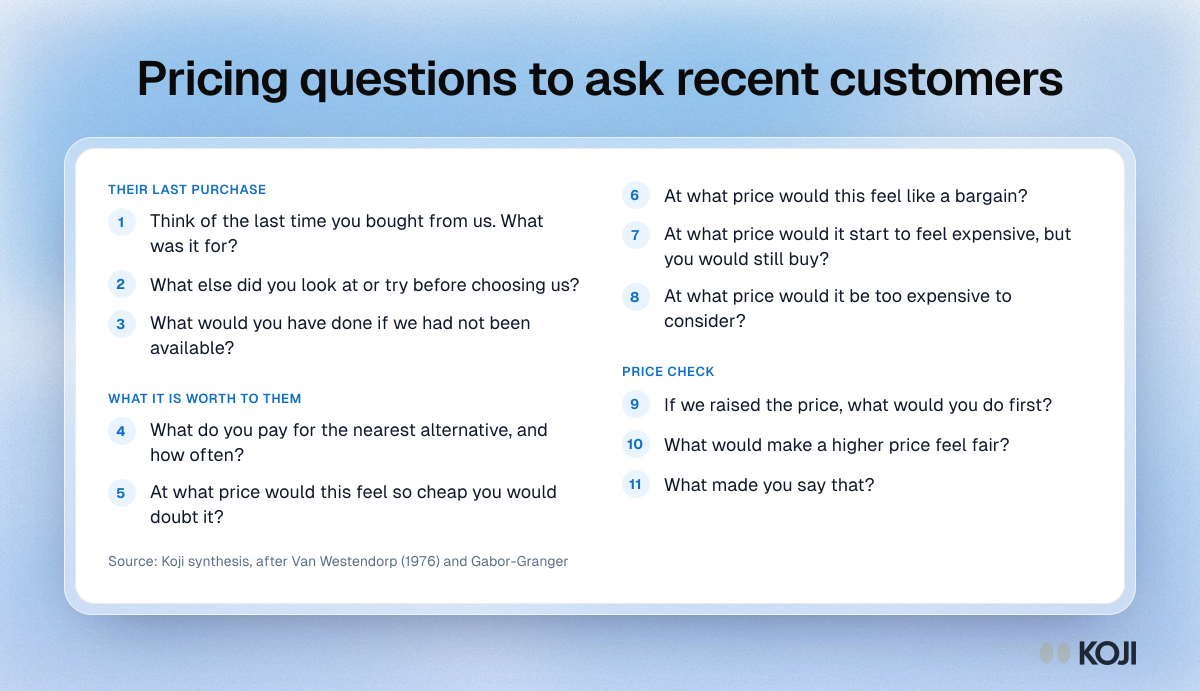
Two rules while you ask. First, never say what you hope to charge before they answer; people anchor on the first number they hear. Second, after every price answer, ask "What made you say that?" The reason is the useful part. A price that earns "that's what I pay the other place" is a different finding from "it felt too much for a quick fix".
A worked example
Say you run a two-chair dog grooming salon. A full groom costs the same as it did two years ago. Shampoo, insurance and your groomer's pay are all up. You can't tell whether the price is too low, too high, or fine.
You write your floor first: after supplies, time and your share of rent, you need a minimum per visit. Then you text 45 people who visited in the last 90 days, including six who came once and haven't been back. You offer a small gift card. Thirty-one of them respond.
You run a price test with five prices evenly spaced around today's $50 full groom. Here's what the results look like (made-up numbers for this scenario):
| Price per visit | Share who would buy | Revenue per person asked |
|---|---|---|
| $40 | 93% | $37.20 |
| $45 | 87% | $39.15 |
| $50 (today) | 77% | $38.50 |
| $55 | 60% | $33.00 |
| $60 | 37% | $22.20 |
The curve is flat between $45 and $50. Revenue per person asked is within 10%, so the report would call those a near-tie. The drop comes after $50, and when you read the reasons there, the dog owners who stopped say things like "I'd go to the other groomer, they're 10 minutes closer" and "for a bath, not for a haircut".
You decide: don't cut, and don't jump to $55. Keep $50 for regulars, and try $52 on new bookings for a month. Add a premium add-on for the people whose reasons mentioned a haircut. You also notice the six who came once all stopped at the lowest prices, which says something about who you attract on first visit and gives you a question for your next round.
Reading the results and deciding
Look at reasons before the curve. A curve shows where people stop, and the reasons show whether you can move them.
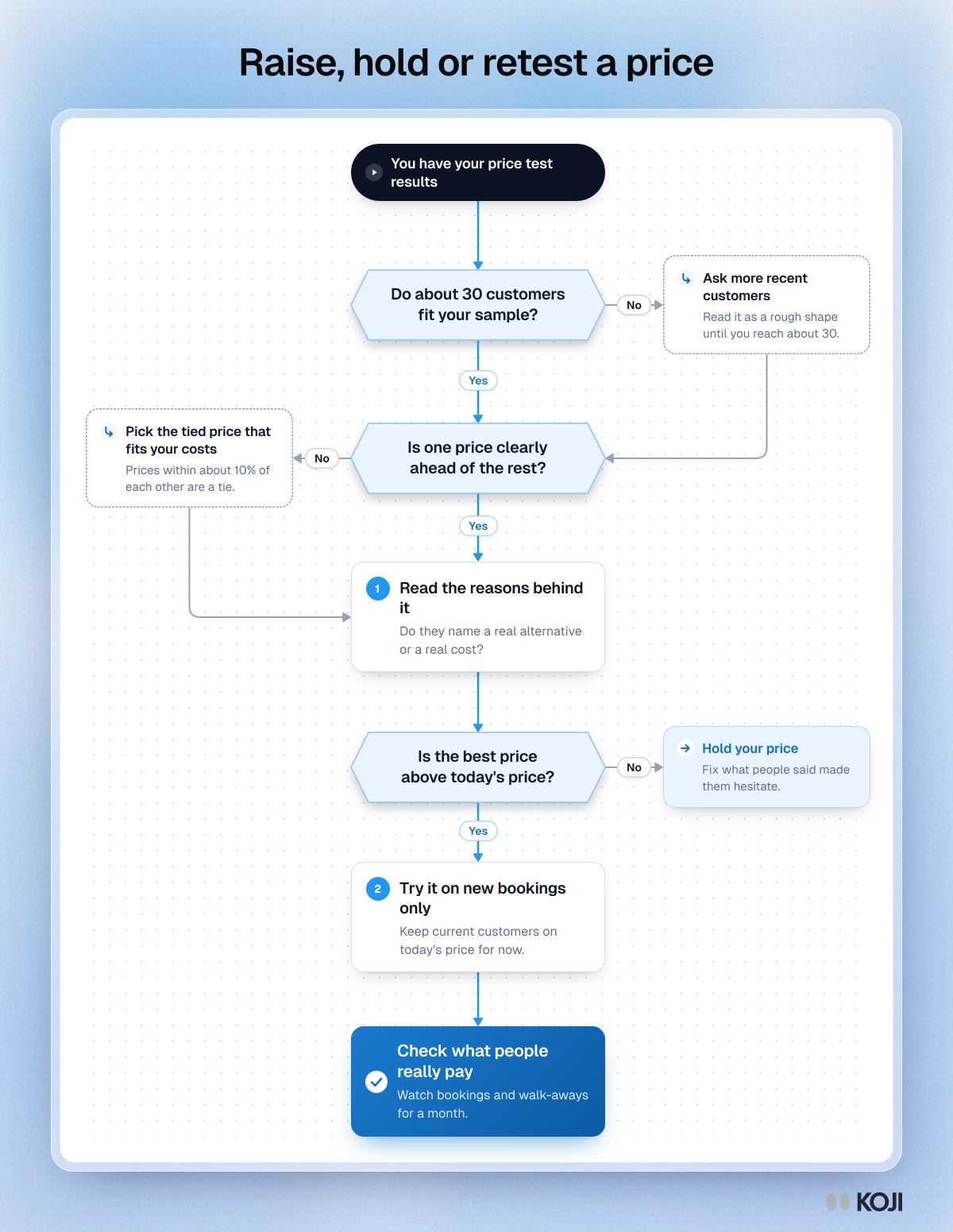
Some rules that hold up:
- A near-tie is a tie. If two prices earn within about 10% of each other per person asked, one answer more or less could flip the order. Pick the one that fits your costs and your brand, usually the lower for a service people book repeatedly.
- The best price is always one you tested. If the winner is your top price, the ladder stopped too low. Add higher prices and run another small round. If most people refuse even your lowest, go lower.
- The reasons beat the shape. "I pay my cousin less" is a price you can't beat. "Nobody else does it this way" is value you can price on.
- Stated beats real by a wide margin. Schmidt and Bijmolt's meta-analysis of 77 studies in 47 papers found hypothetical willingness to pay was overstated by about 21% on average [5]. So read the curve as a ceiling. If a decision is hard to reverse, count only "definitely would buy" as a yes.
- Customers who left aren't in the sample. That's why a few lapsed customers matter.
Then check it against real money. Before you commit, put the new price on a new package, a menu update or a quote in front of new customers and watch bookings and walk-aways for a month. A conversation tells you where to look. The register tells you whether you were right.
Run it this week with Koji
If you'd rather not run thirty conversations by hand, Koji can run the interviews and the maths for you. The setup, from a free account:
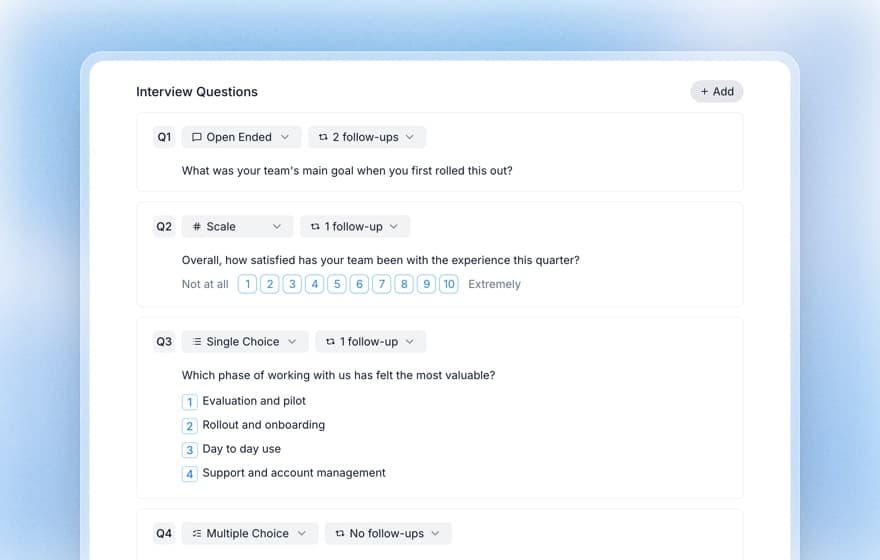
- Create a study and add your ordinary questions first: the last purchase, what they compared it with. You can ask the research assistant ("help me test pricing for a dog grooming visit") and it drafts them.
- Add a Price Test question. Change the question type to Price Test (Gabor-Granger), describe what they'd buy in the question text, enter five to seven evenly spaced prices, pick your currency and set the unit, such as "per visit" or "per month". Choose who counts as a buyer; "Definitely only" is the strict setting.
- Optionally attach an image to the question, such as your menu, a package mockup or a new service card, and set a timed view if you want a first impression before the price.
- Share the interview link by text, email or receipt, using a custom link name that people recognise. To email your own customers with reminders, use the recruitment email feature; to offer a thank-you, use incentives. Both are on the Insights plan and above.
- Read the report. It shows the share who would buy at each price, the revenue each price implies, the price that earns the most and the quotes behind each point. It's labelled directional, which is accurate. Download it as a PDF or slides if you want to share it with a partner or an accountant.
A few facts to know first. A price test runs in text and voice interviews, not phone calls. Prices lock once the first interview comes in, so test your ladder on yourself with the preview first. It reads best from about 30 interviews, and under that the report says so. The price test setup guide walks through every setting, and how many prices to test helps you choose the range.
Honest limits: Koji is a faster route to the same method, not a different answer. You can run all of this with a spreadsheet and a phone, and for under about 15 customers you should.
Common mistakes
- Asking "what would you pay?" with no anchor. People lowball or pick a round number. Show a ladder, or ask what they pay for the nearest alternative.
- Testing only your happiest regulars. They're kind and they're loyal, which skews yes.
- Testing a range centred on your cost. Centre it on today's price and what people compare you with.
- Changing the ladder halfway. Mixing answers to different prices gives you a curve that means nothing.
- Treating one angry comment as the market. Count the reasons; don't chase the loudest.
- Raising prices for everyone at once. Test on new bookings first.
When research will mislead you
Stated intent isn't payment. Your customers like you, and a friendly answer costs them nothing. Existing customers also exclude everyone who looked and left. If your price is a deliberate premium signal, or your market is tiny, a number from 30 people can't carry the whole decision. Pair it with something people actually do: a pre-order, a deposit, a quote that's accepted or declined, or a live price on new bookings. If you can run a real price on a slice of your sales for a month, that beats every survey.
Where this fits
Before this, the question is usually "who is leaving and why?" Start with why customers leave a small business. After a price change, look at contact us or a published price if you sell bigger jobs by quote. The whole sequence is in the founder's research playbook, and /for/founders has the rest of the setup.
FAQ
How many customers do I need to ask before I change my price? About 30 gives a rough curve with the reasons attached. Survey guidance asks for 100 or more per segment for precision, so treat 30 as direction. With fewer than 15, hold conversations instead of calculating a curve.
Should I just ask customers what they'd pay? Not on its own. People overstate: a meta-analysis of 77 studies found hypothetical willingness to pay about 21% too high on average [5]. Ask about their last purchase and what they pay for alternatives, then show a ladder of prices.
What if I only have a few customers? Talk to all of them, and add people who looked at you and didn't buy. Ten real conversations about the last purchase tell you more than a calculated curve from eight.
Is Van Westendorp or Gabor-Granger better for a small business? Use Van Westendorp's four questions when you don't know the range. Use a Gabor-Granger price ladder once you do. You can ask both in the same conversation.
How do I know the new price worked? Try it on new bookings or a new package for a month. Count bookings and walk-aways at the old and new price, and ask the people who say no what made them decide.
Your next step
Write your floor price today, then pick the 30 people you'd text. If you want the interviews and the demand curve done for you, set up a price test from a free account.
References
- Bank of America, 2025 Business Owner Report, press release and report, 18 November 2025. Covered by Axios, "Small-business owners are worried about inflation and raising prices, BofA finds", 18 November 2025. https://www.axios.com/2025/11/18/inflation-small-business-bofa
- NFIB, Small Business Economic Trends, June 2026 report, released 14 July 2026. https://www.nfib.com/news/monthly_report/sbet
- Michael Marn, Eric Roegner and Craig Zawada, "The power of pricing", The McKinsey Quarterly, 2003, no. 1. https://www.mckinsey.com/featured-insights/business-functions/the-power-of-pricing
- Peter H. van Westendorp, "NSS-Price Sensitivity Meter (PSM): A new approach to study consumer perception of price", Proceedings of the 29th ESOMAR Congress, 1976, pp. 139-167. Overview: https://en.wikipedia.org/wiki/Van_Westendorp%27s_Price_Sensitivity_Meter
- Schmidt, J. and Bijmolt, T. H. A., "Accurately measuring willingness to pay for consumer goods: a meta-analysis of the hypothetical bias", Journal of the Academy of Marketing Science, 48(3), 2020, pp. 499-518. https://www.marketingcenter.de/en/publication/151167
Further reading
- Pricing research interviews: the conversations that explain the numbers, when you want more than a curve.
- How to research a price increase before you raise prices: the next step if the answer is "up".
- Ways to test your pricing as a startup, compared: every option side by side, including the ones that need no tool.
- The Mom Test method: how to ask about real behaviour so you get stories, not compliments.