You're the first product manager at a startup. The founder has run product, sales and support for two or three years, and now it's yours. This playbook gives you a 30-day plan to hear from at least 15 customers and the people inside the company who talk to them, using AI-moderated interviews so the calls don't eat your first month. By day 30 you send the founder a short memo: what customers actually need, where that matches the roadmap you inherited and where it doesn't.
Why the first PM's first 30 days matter now
The first month is the only time you can ask basic questions without anyone thinking you should already know. It is also when the founder's picture of the customer gets handed to you, and that picture is usually a year old.
- You arrive later than you think. Lenny Rachitsky's research on when well-known startups hired their first PM found the typical company waited about two to three years, with roughly 10 to 15 engineers and 15 to 25 people in total (Lenny's Newsletter, 2023). The ranges were wide. Either way, by the time you join, the founder has made dozens of product calls from memory of early customers.
- Almost every PM says they don't see customers enough. In Product Focus's 2026 survey of 677 product people in 40 countries, 71 percent said they don't spend enough time with customers, rising to 75 percent among heads and directors of product (Product Focus, 2026). The same survey found 60 percent are frequently disrupted by unplanned work, and 34 percent have no clear primary metric they're held to.
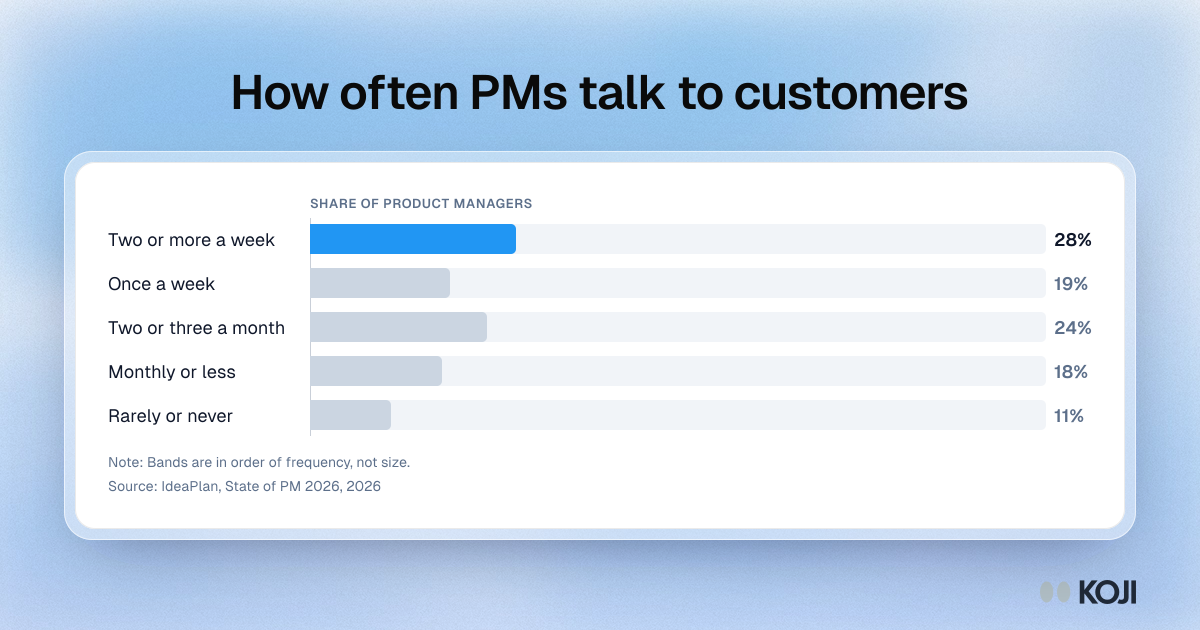
- The habit is thin across the profession. IdeaPlan's State of PM 2026 reports that only 28 percent of PMs hold two or more customer conversations a week; 19 percent talk to customers once a week, 24 percent two or three times a month, 18 percent monthly or less and 11 percent rarely or never (IdeaPlan, 2026).
- Time runs out fast. Atlassian's State of Product 2026 found 49 percent of product teams lack enough time for strategic planning, roadmap development or deep analysis (Atlassian, 2026, via Mind the Product).
- Opinions beat frameworks. ProductPlan and the Product-Led Alliance's State of Product Management 2026, from about 250 product leaders, found more than 60 percent of prioritisation frameworks get overridden by leadership escalations (ProductPlan and Product-Led Alliance, 2026). Sales or customer escalations were the next most common override, at 38.5 percent, according to the Alliance's breakdown.
Put those together and the risk is clear. If you spend month one in onboarding docs and sprint ceremonies, you'll be pulled into the backlog before you've formed your own view. After that, every disagreement with the founder is your opinion against theirs, and the founder wins that. Fifteen customer conversations in month one give you something else to bring.
The 30-day plan
Run the plan in four one-week blocks with a fixed deliverable at the end. Don't stretch it to 90 days. The day-30 memo is the point.
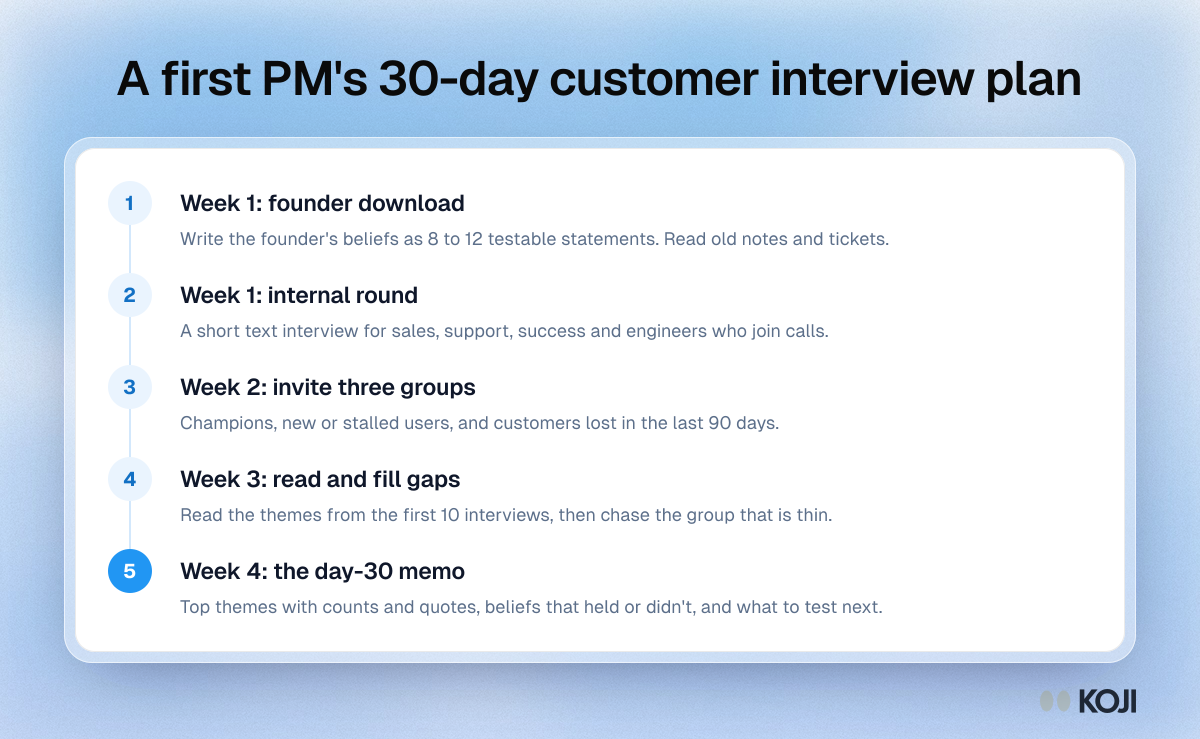
Week 1: founder download and the internal round. Spend two hours with the founder and write down their beliefs as testable statements: "Our best customers are ops teams of 5 to 20", "People churn because setup takes too long". Aim for 8 to 12. Then send a short text interview to everyone who talks to customers: sales, support, success, and the engineers who sit in on calls. Ask each what customers ask for, complain about and praise. You'll hear from people who would never get a 1:1 slot in your first week.
Week 2: three customer groups. Invite customers in three groups, because each answers a different question:
- Champions: active accounts that use the core workflow every week. They tell you what the product is really for.
- New and stalled: people who signed up in the last 60 days, especially those who haven't reached the core action. They tell you what onboarding hides.
- Lost: churned customers and lost deals from the last 90 days. They tell you what the founder may not want to hear.
Week 3: read, then fill the gaps. By now 10 or more interviews are in. Read the themes, then send a second wave to the group that is thin. If champions are overrepresented (they usually are), chase the lost group harder.
Week 4: the day-30 memo. Write it before your first roadmap review, not after.
Who to talk to, and how many
Aim for at least 15 completed customer interviews, five per group, plus 6 to 10 internal ones. Five per group is enough to spot patterns that repeat. It is not enough to size them, so treat any theme that appears in fewer than three customer interviews as a lead to test, not a finding. Our guide on how many user interviews you need explains the reasoning.

Photo by Content Pixie on Unsplash
Invite three to four times as many customers as you want to hear from, and send the invitation from the founder's name if you can. A first PM is a stranger; the founder isn't.
Common mistakes
- Pitching the roadmap. The moment you describe what's coming, people react to your idea instead of describing their week. Ask about the last time they did the job, not about features.
- Only talking to fans. Champions are easy to book and pleasant to talk to. A listening tour made only of them confirms the founder's view and teaches you nothing.
- Starting from scratch. Read the founder's old notes, support tickets and any earlier research first. Your interviews should test what's already believed, not rediscover it.
- Hoarding the notes. If the findings only live in your notebook, they can't win an argument. Share themes weekly.
- Turning it into a verdict on the founder. The memo says what customers said. Where it contradicts a belief, say so plainly and propose a test, not a reversal.
Copy this interview guide
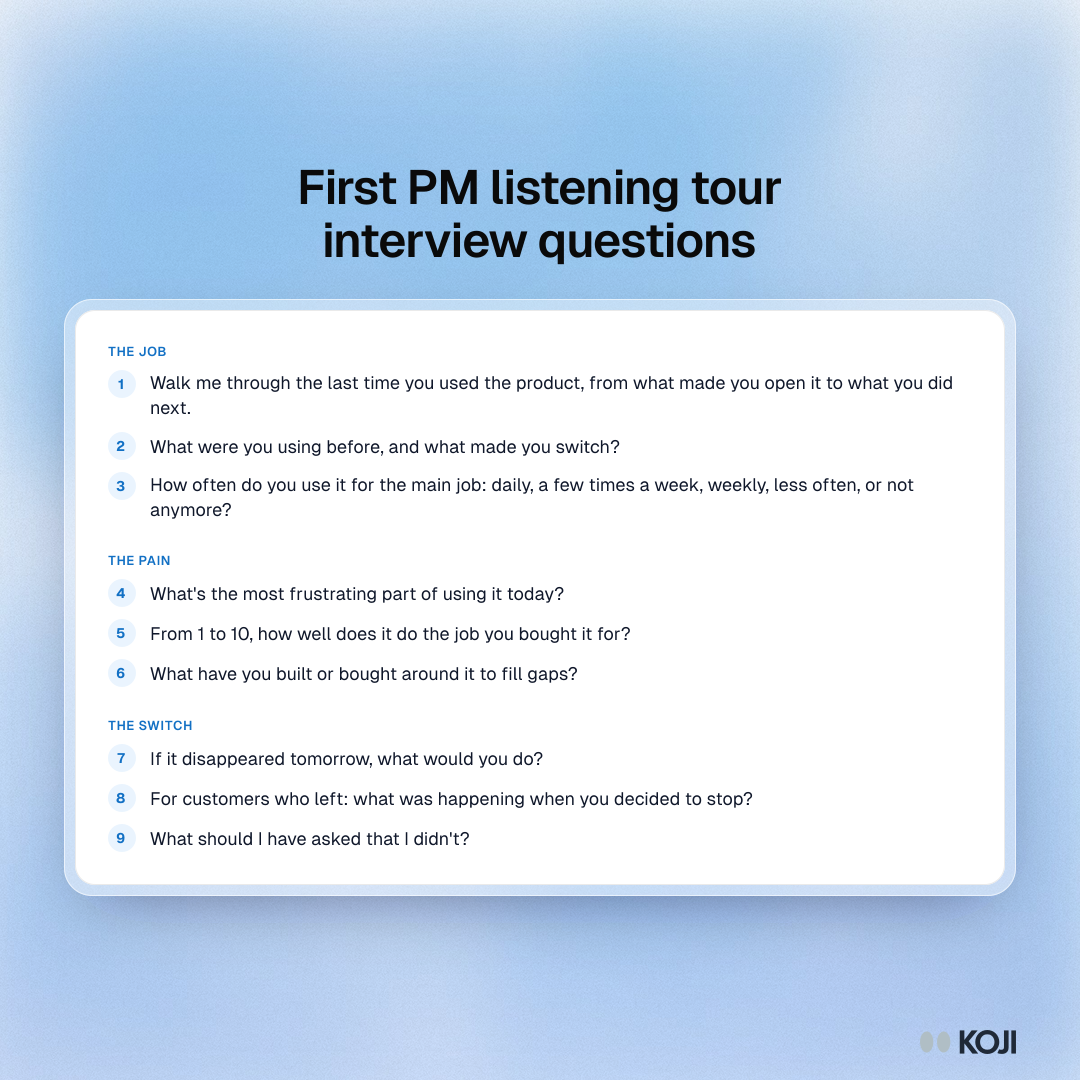
Paste this into any tool, or into Koji. It's written for all three customer groups; the AI follow-ups adapt to what each person says.
Opening line: "Thanks for making time. I'm new on the product team and I want to understand how you actually use [product] in your work. There are no wrong answers, and nothing you say will hurt anyone's feelings."
- Open: "Walk me through the last time you used [product], from what made you open it to what you did next." Probe: "What happened right before that?"
- Open: "What were you using before [product], and what made you switch?" Probe: "What almost stopped you from switching?"
- Single choice: "How often do you use [product] for [core job]?" (Daily, a few times a week, weekly, less often, I've stopped.) Probe: "What decides whether you use it that week?"
- Open: "What's the most frustrating part of using it today?" Probe: "When did that last happen, and what did you do instead?"
- 1 to 10 scale: "How well does [product] do the job you bought it for?" (1 = not at all, 10 = perfectly.) Probe: "What would move that up by two points?"
- Open: "What have you built or bought around [product] to fill gaps?" Probe: "How much time does that workaround cost you?"
- Open: "If [product] disappeared tomorrow, what would you do?" Probe: "How painful would that be, honestly?"
- Open (lost group only): "What was happening when you decided to stop or choose something else?" Probe: "What would have had to be different?"
Closing: "What should I have asked that I didn't?"
One-line brief for Koji: "I'm the new PM at [company] and want to understand how champions, new users and churned customers use [product] today, so I can test the founder's assumptions before my first roadmap review."
For a longer script with timings, see the user interview script template.
How to set it up in Koji, step by step
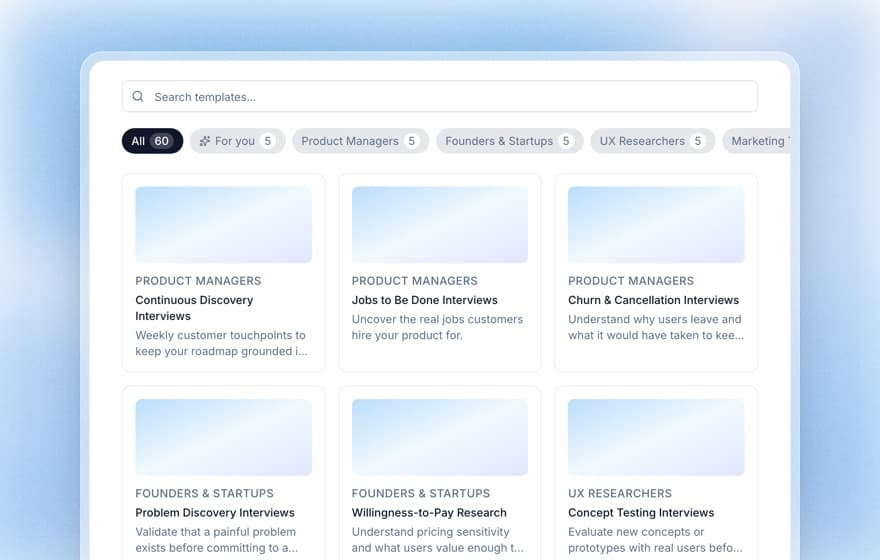
- Start from a template. Open the template gallery from your dashboard, filter by Product Managers and pick Continuous Discovery Interviews. Its questions already anchor on the last real workflow, which is what a listening tour needs. Or paste the one-line brief above into the "What do you want to research?" box and the research assistant drafts a brief for you.
- Upload the founder's material as context. Add the founder's notes, old research or a roadmap draft as context files. The research assistant reads them when it drafts and edits your brief and questions; the AI interviewer never sees them, so nothing about your roadmap reaches a customer.
- Shape the brief and add guardrails. Swap in the eight questions above. Mark question 3 as single choice and question 5 as a 1 to 10 scale so you get numbers you can compare across groups. Add guardrails such as "Do not discuss upcoming features or pricing".
- Choose voice or text. Turn both on. Busy champions often prefer typing at their desk; churned customers tend to say more out loud.
- Invite each group. Import a CSV per group so every person gets their own invite link, then send it from your email tool or CRM. Use one study per group, or one study with a single-choice question asking which describes them. Duplicate the study for the internal round and swap the questions.
- Preview, then launch. Run a preview yourself first; previews aren't counted. Then send.
Which plan. You can build, preview and run your first interviews on the Free plan, which comes with 10 credits at signup: a text interview uses 1 credit and a voice interview 3. Importing a CSV with a personal link for each person works on every plan. Sending invitations and reminders from Koji itself, recruiting from Koji's panel and paying incentives need a paid plan. See pricing for the current plans. Only interviews that score 3 or more out of 5 for quality use credits.
What you get, and the day-30 memo
Each finished interview gets its own summary with key findings, pain points and a quality score. The study report pulls them together into themes, each with the share of participants behind it and the quotes that support it, so you can click from a claim to the people who said it. Download the report as an editable PowerPoint deck or a PDF; the guide to generating reports covers the options.
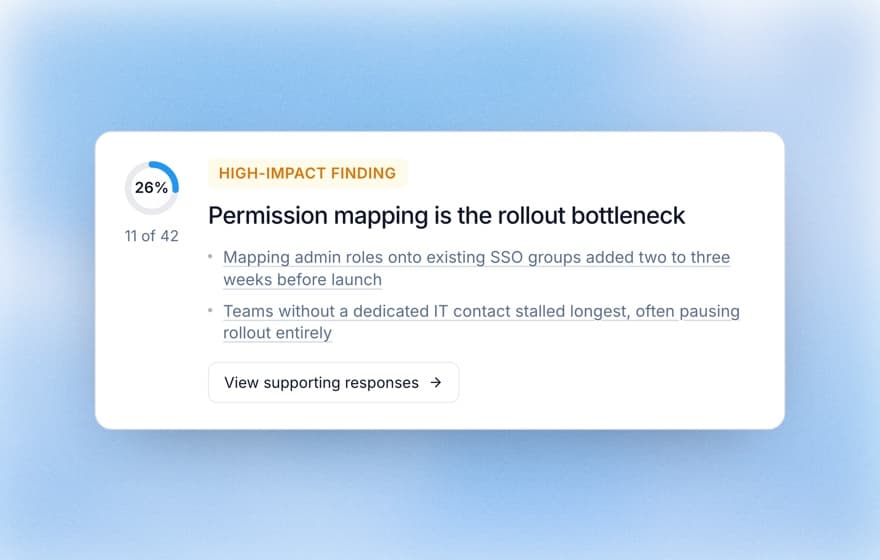
Turn that into a one-page memo for the founder, in this order:
- What I heard: the top five themes, each with how many of the 15 raised it and one quote.
- What matched: founder beliefs the interviews backed.
- What surprised me: beliefs that didn't hold up, with the group that contradicted them.
- What I'd test next: two or three questions you can't answer from interviews alone, and how you'd test them (usage data, a prototype, a price test).
- Where I'd change the roadmap: at most two items, each tied to evidence.
Send the memo and the deck together. It's the first document that shows the founder you've listened before you push, and it's the baseline every later study gets compared with.
The same playbook elsewhere
The first-PM listening tour is a handover: someone who held the customer relationship in their head passes it on, and the newcomer checks it against reality. The same shape shows up in other roles.
- The founder's first sales hire. The founder hands over the pitch rather than the roadmap. See what your first buyers actually bought.
- An agency taking on a new client. Stakeholder interviews across the client's teams before the first proposal. See the new-client stakeholder discovery playbook.
Once the tour is done, the same study becomes your weekly habit. The continuous discovery handbook shows how to keep it running, and the launch window playbook covers your first release.
Why Koji for a first-PM listening tour
The realistic alternatives are booking every call yourself, sending a survey, or recording your own calls and analysing them in a tool like Dovetail, which handles analysis of recordings and documents but doesn't recruit or run the interviews. Here's how they compare on what a new PM cares about in month one.
| Your own calls | Survey | Own calls plus an analysis tool | Koji | |
|---|---|---|---|---|
| Depth | High, if you probe well | Low, no follow-up | High | Follow-up on every answer |
| Your time for 15 customers | 15+ hours of calls, plus scheduling | An hour to write | Calls plus tagging time | Setup and reading |
| Reaching churned users | Hard to book | Low response | Hard to book | Async, voice or text, any time |
| Candour with a new PM | Polite, they don't know you | Anonymous but shallow | Polite | No one to impress |
| Consistency across groups | Drifts as you learn | Fixed | Drifts | Same guide for everyone |
| Analysis effort | All yours | Charts only | Tagging by hand | Themes and quotes drafted |
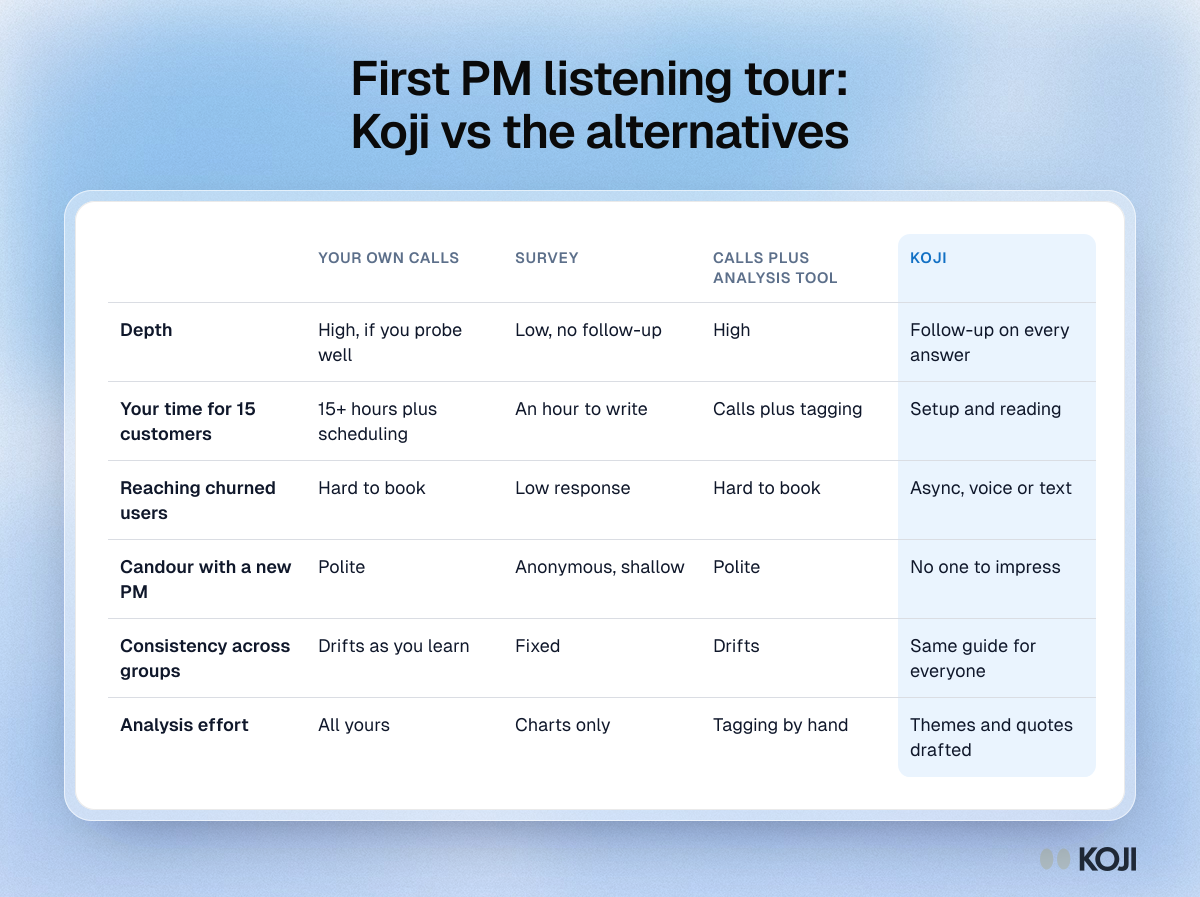
Five things make the difference in practice:
- Your calendar stays free. Interviews run in parallel while you're in onboarding, so 15 customer interviews don't take 15 hours of calls.
- Every person gets their own link, on every plan, so you can invite three groups from a CSV and see who has and hasn't taken part.
- Your roadmap stays private. Context files inform the brief, not the interviewer, and guardrails keep it off topics you name.
- Weak interviews don't count. Each interview is scored 1 to 5, and only those scoring 3 or more enter the report or use credits.
- The deck is already built. The report downloads as editable slides for the founder meeting.
Questions you might have about AI interviews
Will customers really talk to an AI? They choose voice or text, answer when it suits them and can pick up where they left off after a break. You'll still want a few live calls with your biggest accounts; use AI interviews for the breadth you can't book.
Can it probe like a trained interviewer? It asks follow-ups based on what each person said, up to the depth you set per question, and keeps to the same guide for everyone. That consistency matters when you're comparing three groups.
Where does customer data go? You can turn on a study setting that removes names, emails, phone numbers, postal addresses and employers from transcripts when each interview finishes. It can miss details, so check before you share quotes widely. See removing personal details.
When Koji may not be the right fit
If your startup has fewer than ten customers, call them all yourself. You need the relationships more than the efficiency, and the founder will want to introduce you. The same goes for your two or three biggest accounts at any size. And if your product's users can't be reached by email or link (some regulated or offline settings), a listening tour needs live visits.
Metrics to track
- Completed customer interviews by day 21, by group (target: at least five each)
- Share of founder beliefs confirmed, contradicted or still open on day 30
- Themes raised by three or more customers
- Roadmap items changed, added or dropped after the memo
- Customer conversations a week after day 30, against the IdeaPlan bands above
FAQ
How many customer interviews should a first PM do in the first month? At least 15, five in each of three groups: champions, new or stalled users, and lost customers. That's enough to spot repeated patterns, not to size them.
Should a new PM talk to customers before learning the product? Learn enough to follow the conversation, then start in week two. Waiting until you feel expert means waiting until your view is set by the backlog.
Who should send the interview invitation? The founder, if possible. Customers know them, and a short note introducing the new PM gets more replies than a stranger's email.
What goes in a first PM's 30-day memo? The top themes with counts and quotes, what matched and contradicted the founder's beliefs, what to test next, and at most two roadmap changes tied to evidence.
Can I use AI interviews for the internal stakeholder round too? Yes. A short text interview reaches everyone in sales, support and engineering at once, including people who wouldn't get a 1:1 slot in your first week.
Start your listening tour
Open the template gallery, pick Continuous Discovery Interviews and paste in the guide above, or type the one-line brief into the research box. Start free and send your first group this week. See how other product managers use Koji on the product manager page, or browse every playbook for product managers.