You have a customer list in Stripe or your app database, a nagging doubt about product-market fit, and no time to book thirty calls. The short answer: pick one cohort, send each person a personal link to a short asynchronous interview, chase the people who have not started, and read the answers next to plan and signup date. Fifteen to twenty finished interviews from one cohort is enough to decide what to build for, and you can do the setup in an afternoon.
This playbook is for founders with a product and first customers who are asking whether they have fit and for whom. It sits after how to find people to interview when you have no audience, because you do have an audience now: your own customers.
When you need this
You are in this spot when one or more of these is true:
- Your Sean Ellis survey came back at 25% "very disappointed" and you do not know who the 25% are.
- Growth is flat and you have three theories about why, each from a different customer you spoke to last month.
- You are about to change the pricing page, the onboarding or the homepage and the only evidence is the last call you took.
- You have a list of two hundred customers and have talked to eight of them, always the friendly ones.
The cost of guessing is real. Rahul Vohra's first survey of Superhuman users came back at 22% "very disappointed", and what moved the number was segmenting the users, finding the ones who loved the product, learning why, and building for them [1]. You can only do that if you know who said what. An anonymous form tells you the score. It does not tell you which customers produced it.
The method in brief
Three methods fit this decision, and most founders need two of them.
| Method | Good at | Weak at |
|---|---|---|
| One-question survey (the Sean Ellis test) | A score you can track over time | Why. A number with no reasons behind it |
| Live calls (customer discovery interviews) | Depth, rapport, a founder hearing the voice | Scheduling. Thirty calls is a month of calendar tetris |
| Asynchronous interviews from personal links | Reach and reasons from your own list, joined to account data | Reading a face, and the unplanned tangent |
The combination that works is the survey question plus an interview that follows up on the answer, sent to a defined cohort. Keep the live calls for the five or six accounts where the stakes are highest. The Mom Test still governs every question you write: ask about the last time something happened, not what people would do in future.
Step by step
1. Pick one cohort, not "everyone"
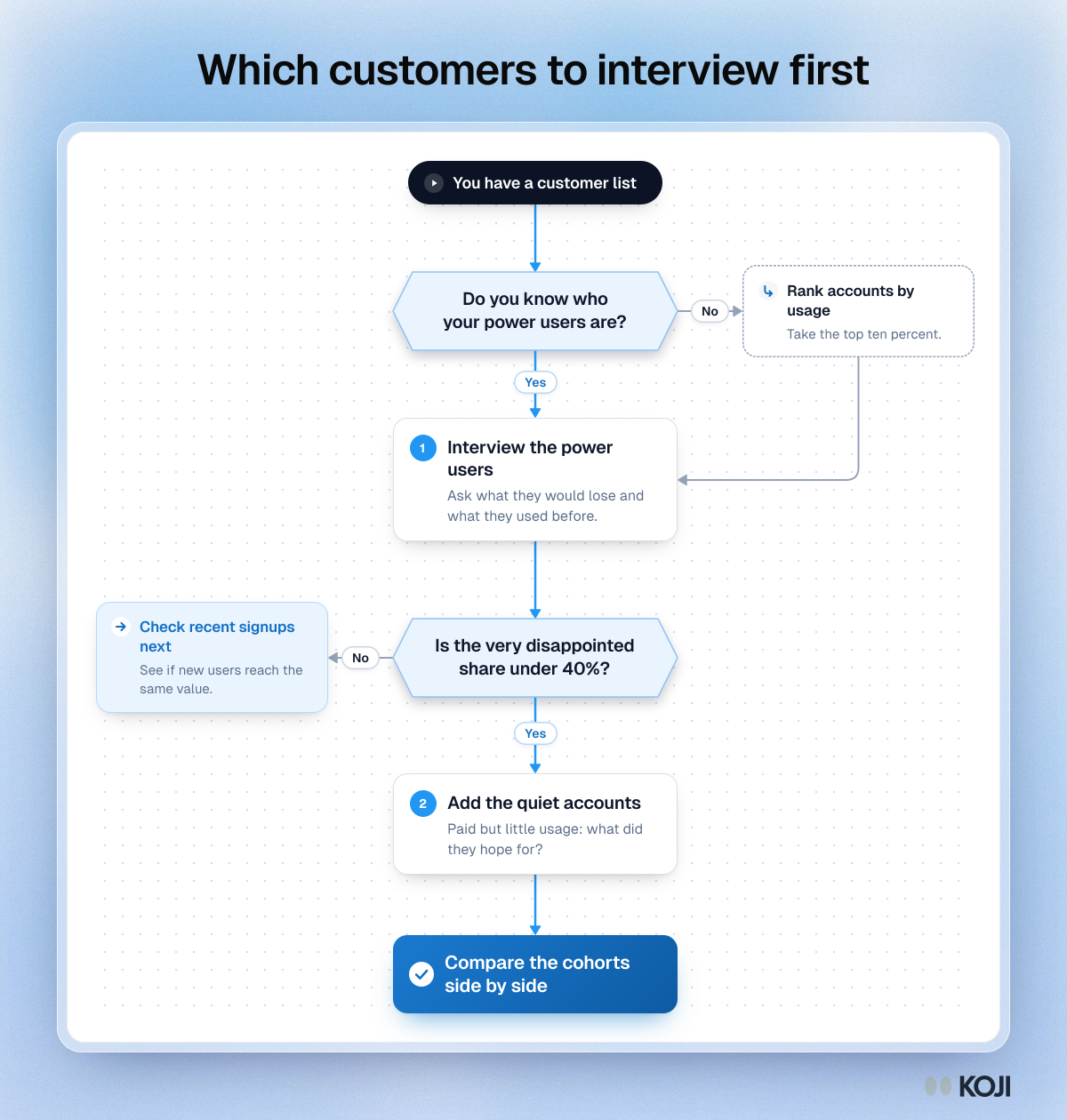
A list of all customers gives you a blend. Pull one of these instead:
- Recent signups (last 30 days who used the product at least once): why did you sign up, what did you expect, what happened? Good for activation and positioning.
- Power users (top ten percent by usage): what would you use instead, what would you lose? Good for finding the people who would be very disappointed.
- Quiet accounts (paid, but little usage): what did you hope this would do, and what got in the way? Good for finding the gap between promise and product.
Take fifty to eighty people from one cohort. You will not hear back from everyone, and that is fine.
2. Decide how many you need
Guest, Bunce and Johnson analysed 60 in-depth interviews with a fairly uniform group. 70% of the 114 themes they found appeared in the first six interviews and 92% by the twelfth [2]. The authors' own caveat matters: that holds for a relatively homogeneous group, which is why you pick one cohort. If you want to compare two cohorts, plan on twelve to fifteen each. For a price test the floor is higher, closer to thirty, which is a separate decision (see Price your first product with 30 customer conversations). The interview sample size guide goes through the reasoning.
3. Write the ask
Short, honest, personal, and clear about the time. Something like:
Hi Maya, I'm one of the founders at {product}. You've been using it since March and I'd like to understand how it fits into your week. It's a 10 minute chat with an AI interviewer, by text or voice, whenever suits you. Nothing is for sale. Your link is below. It's yours alone, so please don't forward it.
Say who you are, say it takes ten minutes, say what you will do with the answers, and say it is not a sales call. A reply from a founder's own inbox beats a branded blast. If you offer a thank-you, make it small and mention it in the first message (the recruitment email templates have wording that works).
4. Chase, once or twice
Most people will not answer the first email, and that tells you little about them. Send one reminder two or three days later and one more a week after the first. Vendor surveys report that reminders lift responses by anywhere from 14% to 40%, but those are marketing claims, not controlled studies, so plan for the lower end [3]. Do not reply to silence with a longer email. Make it shorter.
5. Expect low response from customers you have not heard from
Response to emailed surveys is low and has been falling for years. Retently's analysis of more than 25 million survey invitations across 600 ecommerce brands found response rates of 6.67% to 7.16% over 2025 [4]. The US Bureau of Labor Statistics saw business participation in its jobs survey fall from 75% in 2015 to 35% in April 2025 [5]. Your own customers who know you will do better than a cold list, so my rule of thumb is that 20 to 30 percent is a good result and 10 percent is normal. Start with enough people that ten percent still gives you twelve interviews.
The question bank
A ten-minute interview covers about six questions, so pick from this bank of ten. The first is the Sean Ellis question, so you get a score and a story from the same person. The rest anchor on real events: how they use it, what they would lose, what comes next.
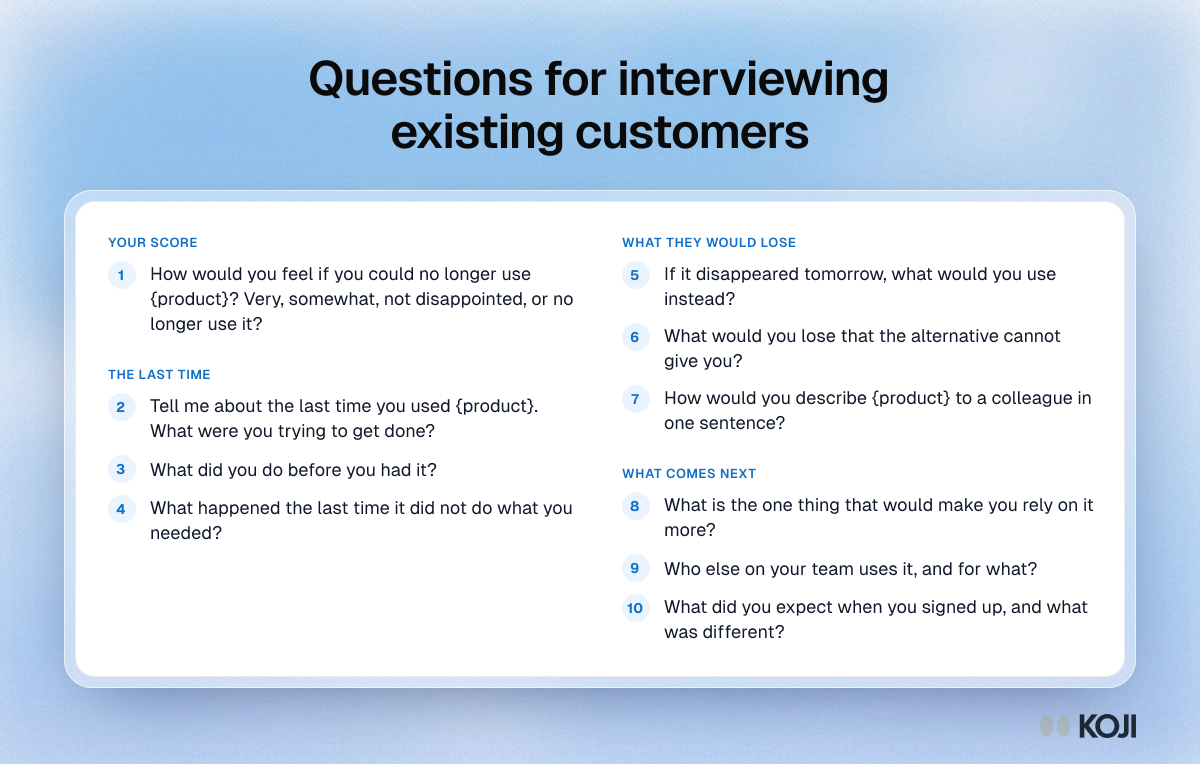
Two rules while you write:
- Ask about the last time. "Tell me about the last time you used it" gets a story. "Do you like it?" gets a polite yes.
- Ask what they would lose, not what they would pay. Money questions belong in a separate study.
A worked example
Say you are a two-person team selling scheduling software to dental clinics. Your Sean Ellis survey went to 61 active clinics and 18 answered. Five said "very disappointed" (28%), nine "somewhat" and four "not disappointed". The score is under 40% and that is all it tells you.

Photo by Deliberate Directions on Unsplash
You pull the 40 clinics with the highest usage, send each a personal link and chase twice. Twenty-two start, seventeen finish. You export the answers next to plan and clinic size.
What you hear: the five "very disappointed" clinics all have three or more hygienists and all say the same thing, that the recall reminders stop no-shows. The nine "somewhat" clinics are mostly one-dentist practices who use it as a calendar and could switch to a free one. Two of the four "not disappointed" signed up for online booking, which you barely offer.
What you decide: the product has fit with multi-hygienist clinics for recall reminders. You stop building online booking, rewrite the homepage around recall, and run the next round of outreach only to clinics with three or more hygienists. The number you track is the Sean Ellis score within that group, not across everyone. The clinics and numbers are an illustration, not data from a real company.
Reading the results and deciding
Do three passes, in this order.
- Group by answer to the first question. Read all "very disappointed" interviews together, then the "somewhat" ones. What do they have in common? Plan, size, role, how they found you.
- Look for the job. What were they doing before they used you, and what do they use if you disappear? A strong answer names a specific alternative and a specific loss.
- Count themes, not quotes. Write each theme on one line and count how many of your finished interviews mention it. A theme in one interview is a hint. In five of fifteen it is a finding.
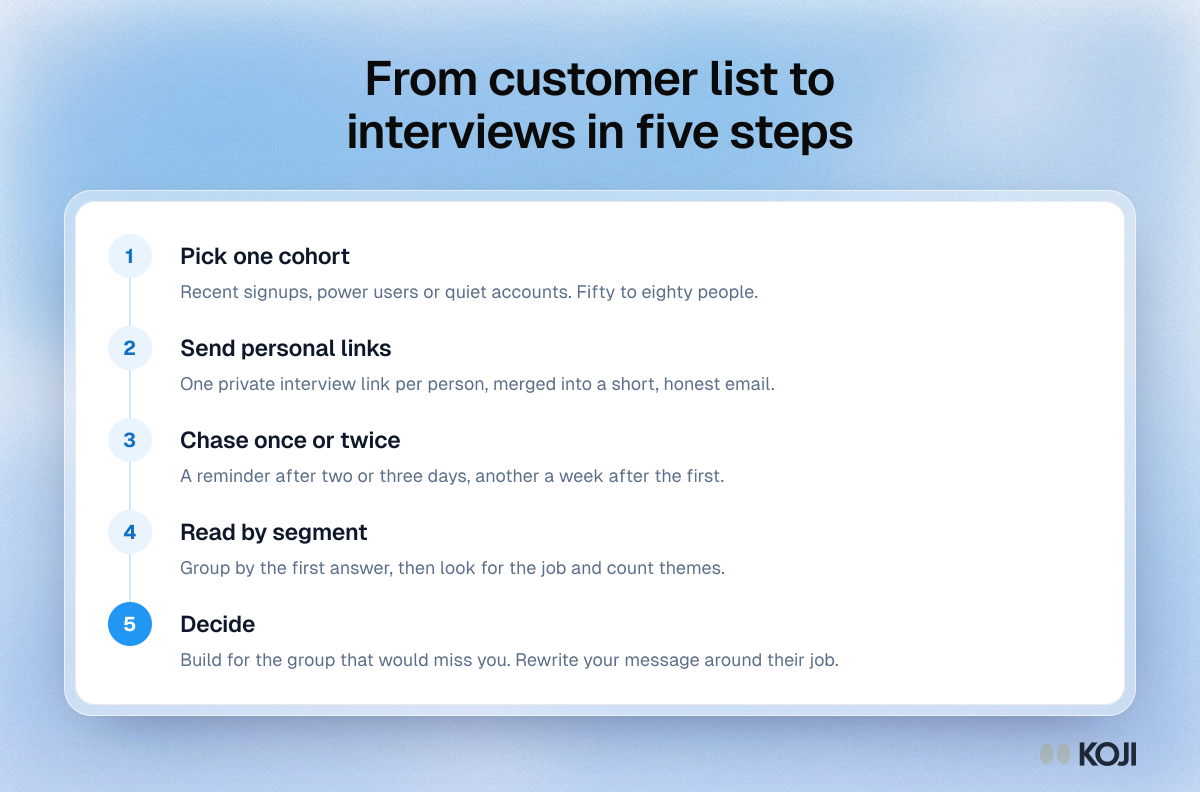
Decision rules:
- If the "very disappointed" group shares a segment and a job, build for that segment and rewrite your message around that job.
- If they have nothing in common, you may not have fit yet. Talk to five of them live and find out what the shared thread is.
- If the "somewhat" group is large and wants one thing, ask whether that thing is core. If yes, build it. If it only serves the lukewarm, leave it.
- Do not read a 28% as a failure. The Ellis 40% bar comes from his observation of roughly 100 startups, a correlation and not a controlled study, and it is a rule of thumb [6]. Treat it as a prompt for the next question.
Run it this week with Koji
This works in any tool that gives each person a unique link. Here is the setup in Koji, which takes about an hour. Personal invite links are available on the Interviews and Enterprise plans.
- Write the study. Start from a brief ("understand why our best customers stay and who they are") and let the research assistant draft the questions, then replace them with the bank above. Add the Sean Ellis question as a single-choice question with four answers (very disappointed, somewhat disappointed, not disappointed, no longer use it), then open questions for the rest.
- Publish it. Links only work once the study is live.
- Export your cohort from Stripe or your database as a CSV with
emailandnamecolumns. Extra columns such as plan, signup date and MRR band are kept and come back in the download, so keep them. - Choose "a link per person" in the share sheet and upload the file. Koji gives each person their own link to your normal landing page, where they pick text or voice.
- Download the list back. It is your file with an Interview link column added. In Gmail, your CRM or your email tool, use that column as a merge tag.
- Send, then chase. The participants table shows who has started and finished, with a Not started filter. Copy a single person's invite link when you want to message them yourself, and remove an invite if someone asks. If you prefer to send from Koji, recruitment email handles the invitation and reminders.
- Read the report with the segment in mind. The report shows the answer distribution for the Sean Ellis question and the interview findings behind it. Download the invite list with status and join it to your plan and signup columns to see who said what.
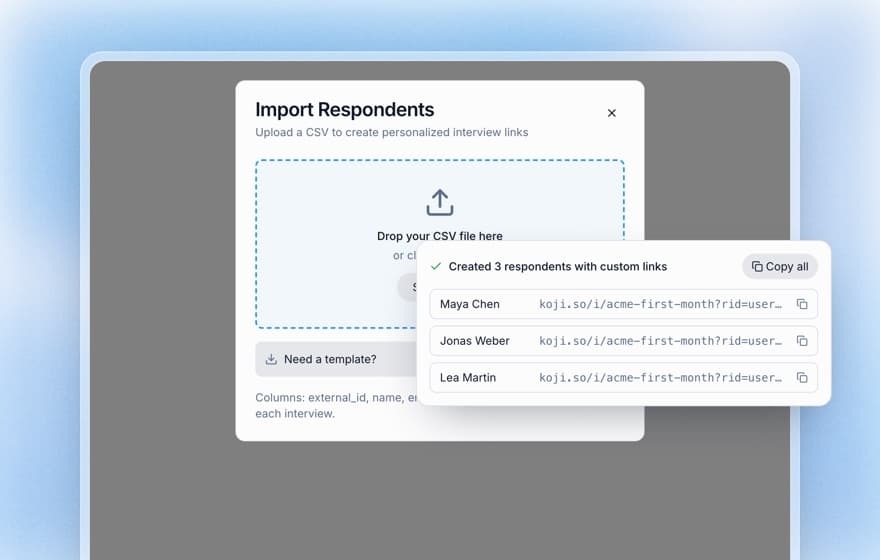
The personalised links guide and the CSV import guide cover the details. Since these links tie an interview to one person, tell people the link is personal and that you will read what they write. If the topic is sensitive, use one shared link instead and give up the follow-up.
When Koji is not the right tool: if you have fewer than ten customers, just call them. If you need to watch someone use the product, book a live session.
Common mistakes
- Asking only fans. Include quiet accounts and recent churn, or you will confirm what you already believe.
- Sending one blast to everyone. Different cohorts need different questions.
- Skipping the chase. The first send is the weakest.
- Mixing money into the same study. Pricing answers are shaped by the story you just told. Run it separately.
- Treating a score as a verdict. It is a way to find whom to listen to.
When research will mislead you
People who answer are not a random sample of your base. Happy and angry customers reply more than the indifferent. A sample of ten percent can be a skewed ten percent, so read the pattern, not the percentage. Stated enthusiasm is not behaviour: pair what you hear with usage data, renewals and, where you can, a request for money or a commitment. A 2025 review of 776 cross-national surveys found that falling response rates did not by themselves raise nonresponse bias [7], which is reassuring for your decision as long as you compare answers against who your customers actually are.
Where this fits
Before this: find people to interview with no audience and why new users stall. After this: rewrite your homepage in your customers' words, then price your first product with 30 conversations. The whole path is in the founder's research playbook, and Koji for founders shows how this fits into a weekly routine. For the product-market fit method itself, read product-market fit research beyond the 40% survey.
FAQ
How many customers should I email to get 15 interviews? Plan on 50 to 100 from one cohort. Expect roughly 10 to 30 percent of people who know you to finish (my rule of thumb from step 5); cold lists do far worse.
Will customers really talk to an AI interviewer? Many will, especially when it is by text and fits around their day. Be upfront that it is an AI interviewer, say who reads the answers and let them choose text or voice. For your five most important accounts, call.
Is anonymous better for honest answers? Sometimes, on sensitive topics. Personal links let you follow up, chase and join answers to account data. If the topic is sensitive, use one shared link.
Do I still need the 40% survey? It is a useful number to track, but the interviews tell you what to do about it. Ask the question and keep the score as a trend.
What if only unhappy customers reply? That is a signal too, but compare it to your usage data and chase quiet accounts again with a shorter note.
Can I do this without Koji? Yes. Any survey tool with per-person links, a spreadsheet and Gmail mail merge will do. The follow-up questions are what a form cannot do.
Next step: pull the sixty power users from your database today and write the ask.
References
- Rahul Vohra, "How Superhuman built an engine to find product-market fit", First Round Review, 2018. https://review.firstround.com/how-superhuman-built-an-engine-to-find-product-market-fit/
- Greg Guest, Arwen Bunce and Laura Johnson, "How Many Interviews Are Enough? An Experiment with Data Saturation and Variability", Field Methods, 2006. https://doi.org/10.1177/1525822X05279903
- Pointerpro and other survey vendors on reminder timing, summarised in "Survey Reminder Email Templates That Double Responses", Instantly, 2025. https://www.instantly.ai/blog/survey-reminder-email-templates-that-double-responses/ (vendor claims, not controlled studies)
- Retently, "Survey response rate study", 2025. https://retently.com/blog/survey-response-rate-study/
- Marketplace, "What happens when government survey participation falls", 13 August 2025. https://www.marketplace.org/story/2025/08/13/what-happens-when-government-survey-participation-falls
- Sean Ellis, product-market fit survey and the 40% benchmark, via Umbrex, "Sean Ellis Product-Market Fit Survey". https://umbrex.com/resources/frameworks/product-management-frameworks/sean-ellis-product-market-fit-survey/
- "Against All Odds: On the Robustness of Probability Samples Against Decreases in Response Rates", Survey Research Methods, 2025. https://ojs.ub.uni-konstanz.de/srm/article/view/8475
Further reading
- The Mom Test: the rules for the questions you will write.
- Sean Ellis test guide: how to run and read the score.
- Customer discovery interviews: when to pick up the phone instead.
- Rahul Vohra's First Round Review piece (reference 1): the best account of how a founder used a score to find who to build for.