You have users, a few of them love the product, and your homepage still reads like it was written for someone else. The decision is what your headline should say. The short answer: stop writing it from your own head and borrow it from the five people who would miss you most, then check it on strangers for five seconds. By the end of this guide you can run that in about a week, with a script, a pass mark and a plan for what to do with each result.
When you need this
You are probably here because of one of these signs:

Photo by Salah Ait Mokhtar on Unsplash
- Visitors arrive and leave, and when you ask them, they cannot say what the product does.
- A customer describes your product to a friend in words you have never used on your site.
- You have changed the headline three times on instinct and cannot tell which version is better.
- You are about to pay for traffic, post on Product Hunt or send a cold email, and the page is the thing everyone will land on.
The cost of guessing is real but quiet. People decide fast. In one set of studies, people rated the visual appeal of homepages after seeing them for 50 milliseconds, and their ratings matched those given after 500 milliseconds [1]. That is about looks, not words, but the lesson carries: the first impression is formed before anyone reads your second paragraph. Jakob Nielsen's advice from the same era was to state your value proposition clearly within about ten seconds if you want a visitor to stay for minutes [2].
Founders usually know this and still write vague headlines. In a 2025 survey of 100 B2B SaaS marketing leaders, only 6% rated their own messaging "very distinctive", 46% said "somewhat" and 40% said "only slightly" [3]. If the people paid to write it are unsure, a two-person team writing at midnight should be too.
The method in brief
Three moves, in this order.
- Listen to your best users. Not your friends, not everyone who signed up. The people who use the product most and would be upset to lose it. Ask what they were doing before, what the product does for them and how they would describe it to a colleague. This is a short switch-style interview; the full method is in switch interviews and positioning research.
- Rewrite from their words. Take the phrases several of them used, unprompted, and build the headline and first paragraph from those. Keep the phrasing ugly if it is theirs.
- Test the rewrite on strangers who fit. A five-second test tells you whether the new first screen is understood. A messaging test goes further when you have two or three candidate lines.
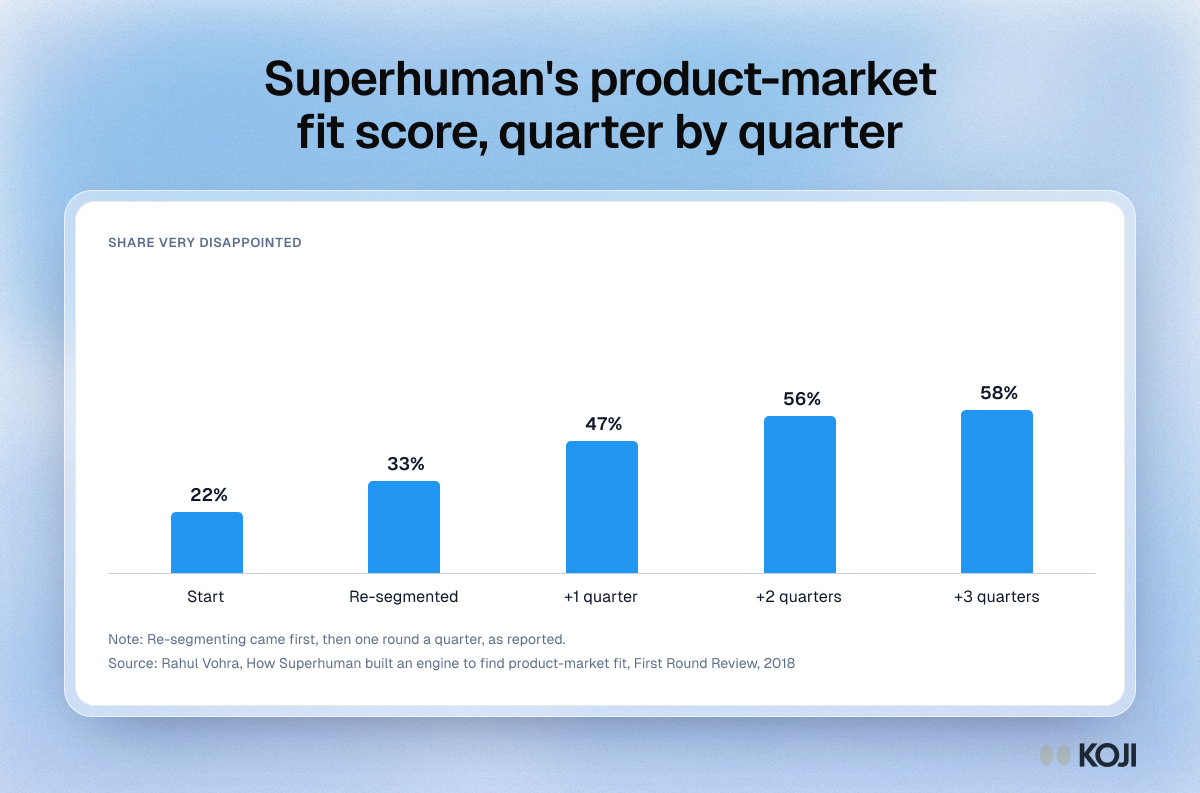
Why start with the best users instead of everyone? Superhuman's founder, Rahul Vohra, found that out the hard way. His team's product-market fit survey started at 22% "very disappointed". Re-segmenting, meaning focusing on the users who loved it and on what they said the main benefit was, lifted the score to 33% before any product change, and later quarters took it to 47%, 56% and 58% [4]. Two of the questions he asked are the heart of this playbook: what type of person would most benefit from the product, and what is the main benefit you get from it [4]. Happy users, asked who the product is for, tend to describe themselves, and that is the customer your page should speak to.
April Dunford's positioning work points the same way: start from your best-fit customers, ask what they would use if you did not exist, and let that shape how you describe the value [5]. The two ideas fit together. Dunford tells you what to establish. Vohra tells you who to ask.
Other ways exist. You can read support tickets and sales call recordings for phrases, which costs nothing and is a good first pass. You can run an A/B test, which needs more visitors than most early products have. You can ask an AI chatbot for ten headlines, and I would treat what it gives you as a list of candidates, not evidence. A 2025 preprint compared synthetic respondents with human benchmarks across 90 model and question pairs and found about 94% of the model answers differed statistically from the human answers [6]. A 2025 report from Verasight, which tried to match a nationally representative survey of 1,500 adults with model-generated data, advised using synthetic data only as an exploratory signal [7]. Use a chatbot to draft options. Use people to choose.
Step by step: five calls, one rewrite, one test
Plan for a week. Two days of calls, a day to rewrite, two days to test.
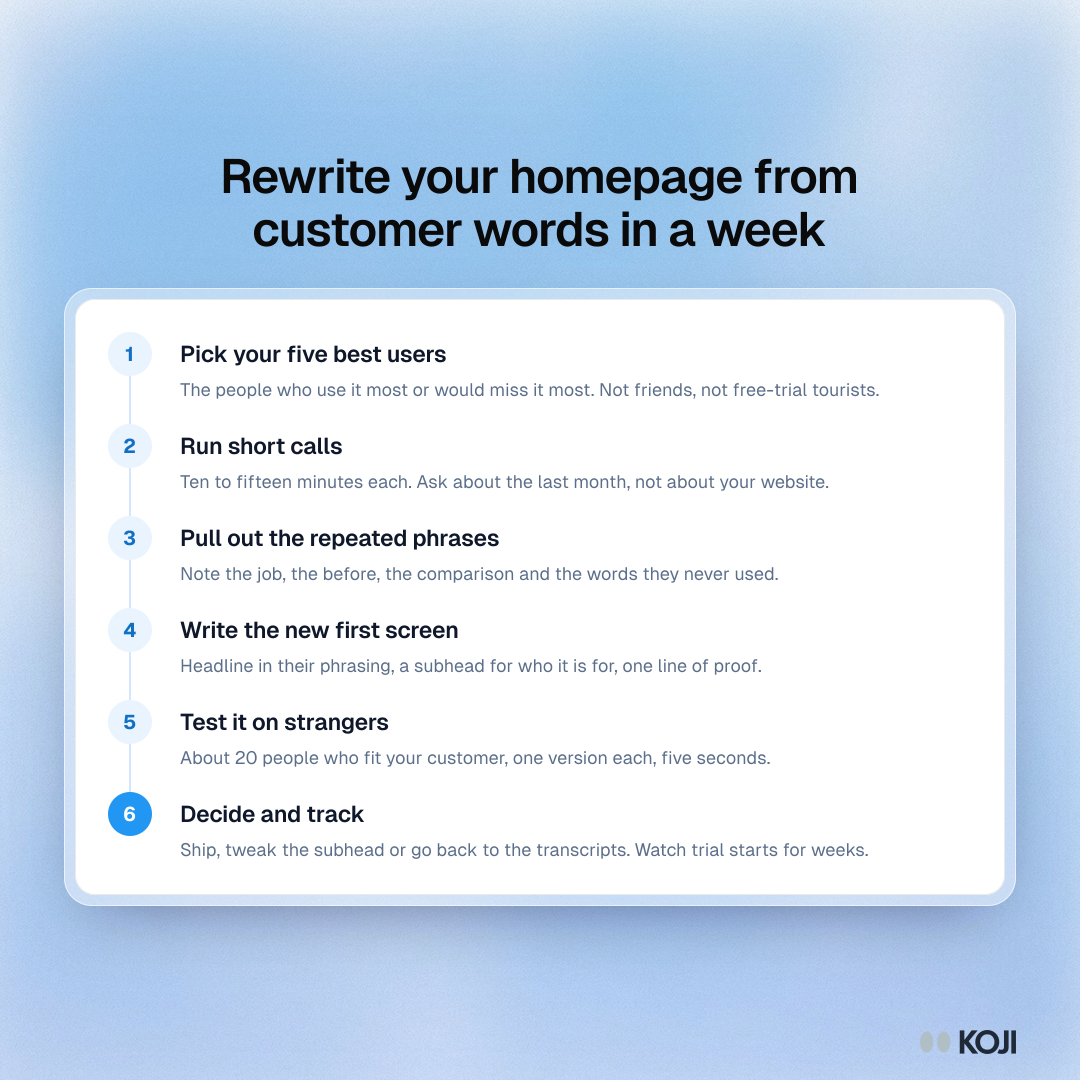
1. Pick five people, and pick them strictly
Start with usage, not goodwill. From your product data, take the people who came back most often in the last month or who paid and stayed. If you have a survey score, take those who said they would be "very disappointed" to lose it. If you have no data yet, take the five you would hate to lose. Avoid friends, investors and anyone who got the product free in exchange for feedback.
If you cannot find five, you have your answer about the stage you are at: you need more usage before you can write this page. The previous guide in this path, why new users stall, is the place to go.
Reach them with a short, honest note: you are rewriting the website and want ten to fifteen minutes on how they describe the product. An interview they can do in their own time is easier to say yes to than a calendar slot. If you need more ideas for the invite, see how to find people to interview and recruitment email templates.
2. Run the calls
Anchor on what actually happened. People are bad at describing why they chose something in the abstract and good at telling you what they did last month. Here is the question bank.
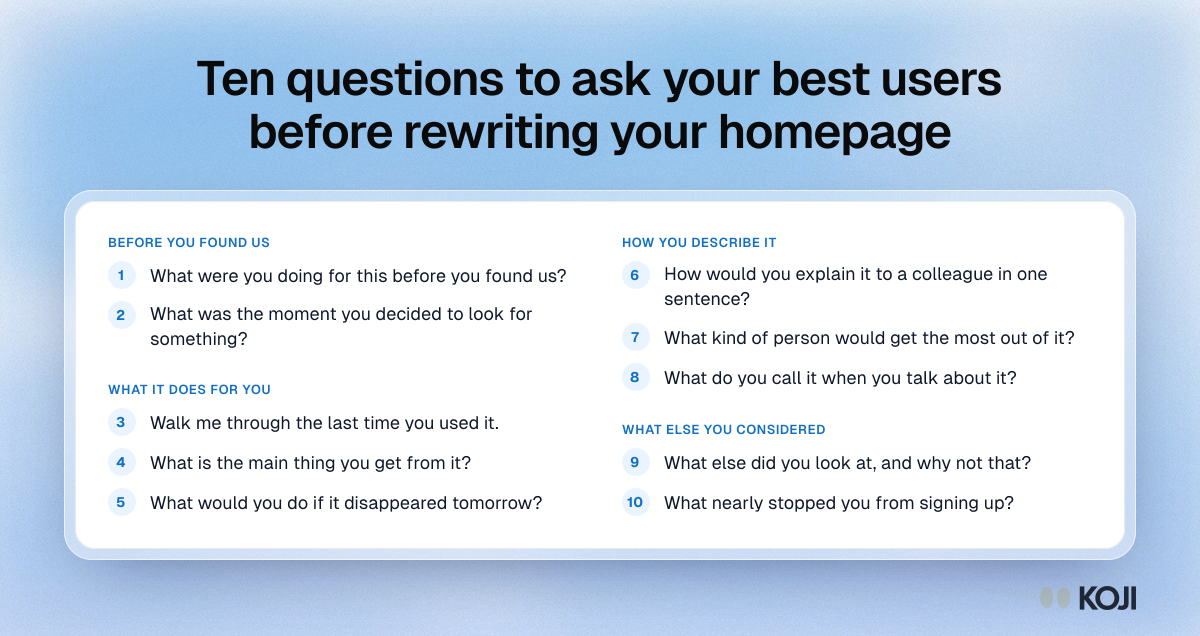
Two habits make these calls work. Let silence run after the first answer, since the second answer is usually the one you can use. And write down their phrases verbatim, including the odd ones. You are collecting vocabulary, not opinions.
3. Pull out the phrases
After all five, put the answers side by side. Look for:
- The job in their words. The sentence that starts "I use it to..."
- The before. The workaround or tool they used instead.
- The comparison. What they called you when explaining you to someone else ("it's like X but for Y").
- The words they never used. If every word in your current headline is missing from five transcripts, that is a finding.
Count matches. A phrase that three or four of the five used independently is a candidate headline. This is practice from running such calls, not a statistical rule: five people cannot prove anything, they can show you whether a clear pattern is there. If all five describe different benefits, do not write copy yet. You do not have one customer yet, and the next step is deciding which of them to pursue.
4. Write the new first screen
Write a headline that names the job in their phrasing, a subhead that names who it is for and the before they are escaping, and one line of proof. Write two versions, not ten. Fewer options make the test cheaper to read.
5. Test it on strangers for five seconds
Find about 20 people who look like your customer but have never seen your product. Show half of them the old first screen and half the new one, one version per person, for five seconds. Then hide it and ask what the company does, who it is for and what they remember. The full question list is in the five-second test guide, and the earlier landing page playbook, test your landing page before you launch, covers recruiting for it.
A worked example
Say you are a two-person team selling scheduling software to dental clinics. Your homepage reads "AI-powered scheduling for modern practices". It has had steady signups and poor trial conversion. This scenario is made up to show the steps; the quotes are illustrative.
You pick five practice managers who still log in daily after four months. In the calls you hear the same shape three times. One says she used to spend Friday afternoons phoning patients to fill gaps. Another says it "stops the no-show hole in the afternoon". A third says she describes it to other managers as "the thing that fills cancelled slots". Nobody says AI. Nobody says modern. Two of the five say they found you because a colleague at another clinic mentioned it.
You build the new first screen: "Fill the gaps when patients cancel", with a subhead "Scheduling for dental front desks that are tired of phoning round on Fridays". Then you run the five-second test on 20 front-desk staff and practice managers from a panel or your own contact list, ten per version. Say 4 of 10 can say what the old page does and 8 of 10 say what the new one does. Say 7 of the 10 on the new page also name the right audience.
Decision: ship the new headline, keep the old one's proof line, and note that "who is it for" still needs work. You write down that you will compare trial-start rates over the next four weeks and, with so little traffic, you will not call it a win on conversion alone. You will also ask the next ten trial users how they would describe the product.
Reading the results and deciding
These thresholds are working rules from running such tests, not published standards. Treat them as a way to decide, not as proof.
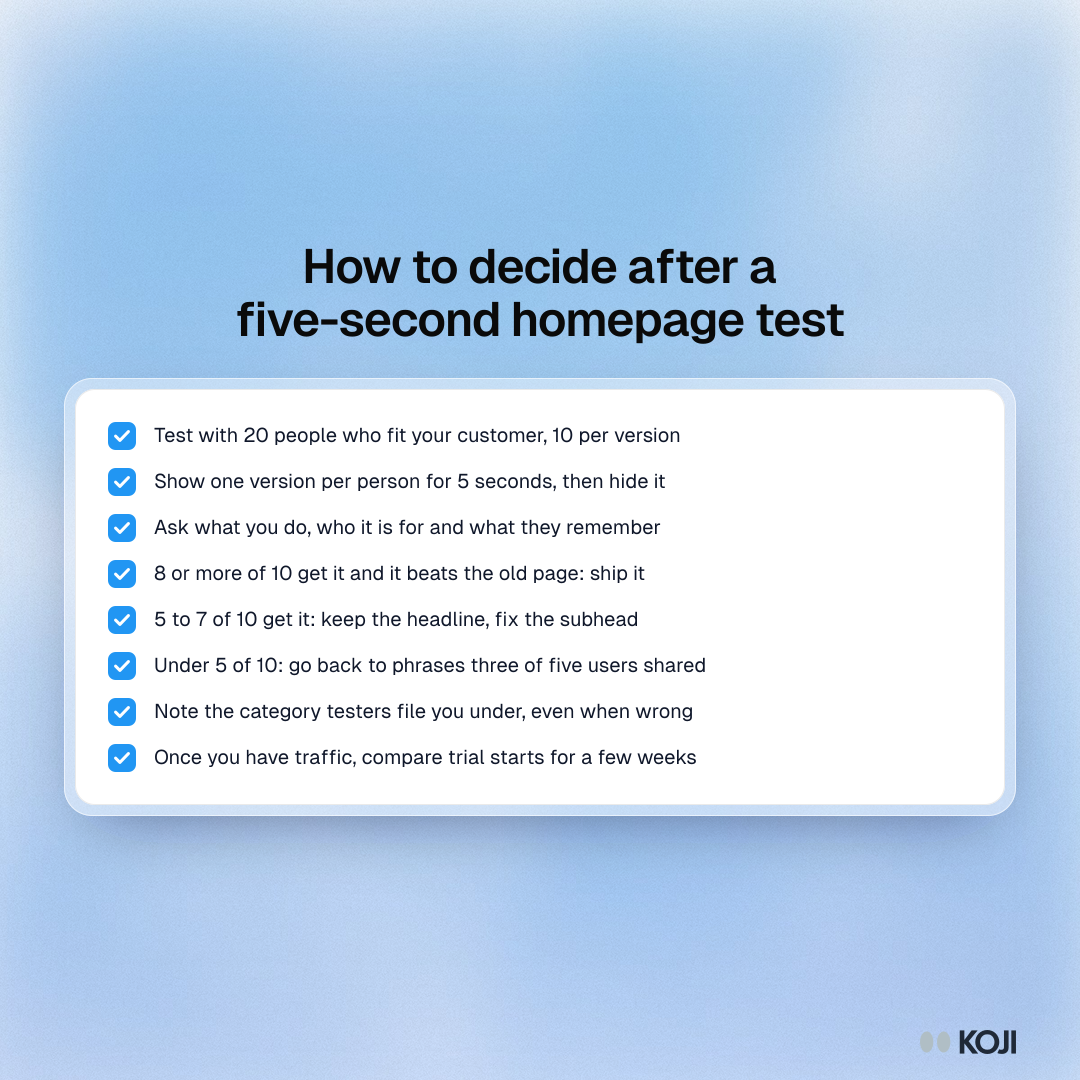
If the new version is understood by at least 8 of 10 testers and clearly beats the old one, ship it. If it lands between 5 and 7 of 10, keep the headline and change the subhead, because the headline is usually working and the audience line is not. If it is under 5 of 10, go back to the five transcripts: you probably took a phrase that one person said instead of one that three said.
Do not forget to read the words people give you when they get it wrong. A tester who says "a calendar app" for your scheduling tool is telling you which category your readers file you under. That is useful whether you like it or not.
Once the page has traffic, compare the share of visitors who start a trial before and after, over at least a few weeks, and read it next to the interviews, not in place of them. With low traffic, a few extra signups can come from noise alone.
Run it this week with Koji
You can do every step above by hand with a spreadsheet and a video call. Koji speeds up the parts that are slow: sending the invites, holding the conversation at each person's own time and seeing the repeated phrases side by side.
Build the study
Describe the study to the research assistant in a sentence ("I want to learn how my best users describe the product and what they used before") and it drafts the questions. Edit them to match the question bank above. The questions are open ended, and Koji asks follow-ups on each answer, which is where the second, more usable answer tends to come from.
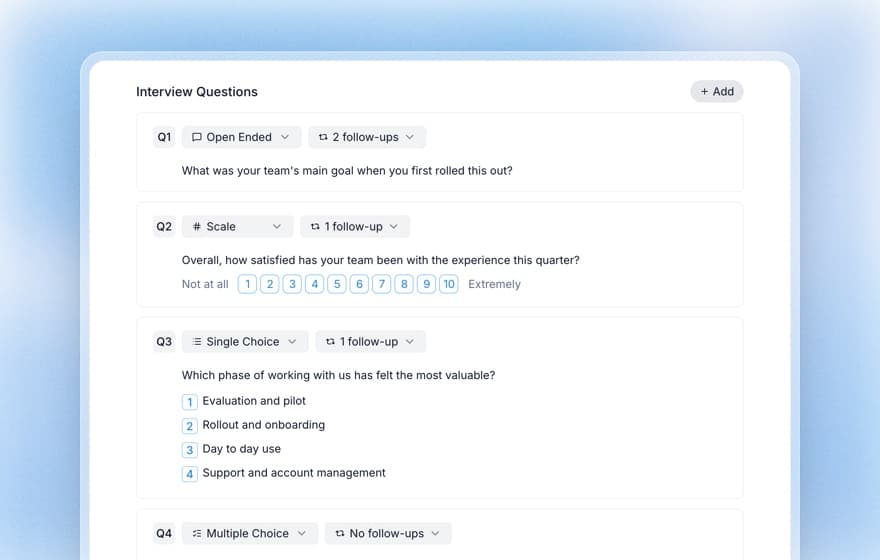
For the test, create one study per version of the page. In each, add the first screen as an image on a question, set it to show for 5 seconds, and ask what the company does. Participants see the image once, full screen, for the time you pick (3, 5, 10 or 15 seconds), then it disappears and Koji asks what they remember. Koji knows what the image shows, so its follow-ups are about your page and not generic. This works in text and voice interviews, not phone calls. Send each stranger to only one of the two studies, so nobody sees both versions.
Invite people and read the report
Email your best users from Koji, with reminders, or send each a personal invite link. For the stranger test, recruit from a panel or your own contact list and use a screening question to keep out people who would never buy. If you offer a thank-you, gift cards or a donation are options.
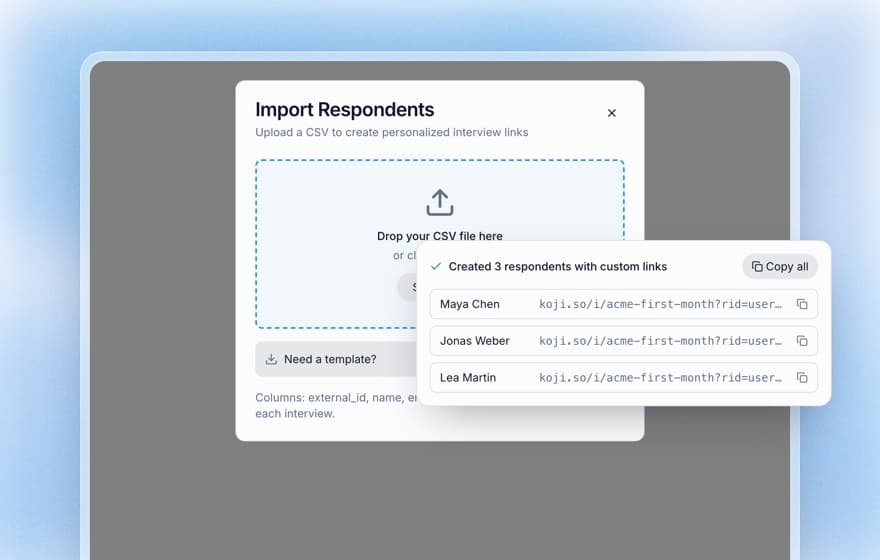
The report groups answers into themes with the quotes behind each one, so you can see which phrase three of five used. Download it as slides or a PDF if you want to show the co-founder or an advisor why the headline changed. Your next step: pick your five users today and send the invite.
Common mistakes
- Interviewing everyone. The average user is not the one who defines your best customer, and averaging their words produces beige copy.
- Asking about the website. Customers cannot critique copy they have not seen the need for. Ask about their last month, then show the page to strangers.
- Writing from one vivid quote. One memorable sentence feels like proof. Look for the phrase several people used.
- Testing on friends. They know what you do and want you to win.
- Changing everything at once. If you change headline, image and pricing together, you will not know which one mattered.
- Letting the chatbot decide. Let it draft, then put the options in front of real people [6][7].
When research will mislead you
Five users tell you how your fans talk. If your happiest users are a small, unusual group, the page will speak to them and nobody else. That may be fine, since it is where Superhuman started [4], but make it a choice.
A five-second test measures whether the first screen is understood, not whether people will pay. A page can pass and still fail to convert because the offer is weak, the price is off or the next step is unclear. People also say they would sign up more readily than they do, so pair the result with a real action: a signup, a booking or a deposit.
Finally, stated reasons are tidy. Someone who joined because a colleague mentioned you will tell you about speed, since that is easier to say than "it was recommended". Ask for the story, and note where the story and the stated reason disagree.
Where this fits
This is the positioning step in the founder path. The step before it is understanding why new users stall, which tells you who your best users are. The step around it is the landing page test, and after it comes measuring fit with the Sean Ellis survey and a price test. The full list lives in the founder's research playbook, and Koji for founders shows how the pieces connect. For a wider read on testing value propositions, see value proposition testing.
FAQ
How many best users do I need to interview for a homepage rewrite?
Start with five. If three or four use the same phrase for the main benefit unprompted, you have enough to write from. If every person describes something different, add five more from the same group before you write anything, and if they still differ you may have two customers rather than one.
Can I just ask an AI to write my headline from my product description?
You can use it to draft options, but not to pick one. Research comparing AI-generated respondents with real people finds the model answers differ from human ones and are more uniform [6][7]. Your headline needs to match how real buyers talk.
What if I only have 10 users?
Interview the 3 to 5 who use it most and run the five-second test on strangers, which does not need any users. If you have no engaged users at all, your problem is activation, not positioning.
How is this different from a Sean Ellis survey?
The survey measures how many users would be very disappointed without the product. This playbook uses the same group, the ones who would, to find the words. Run the survey first if you can: it tells you which users to call.
Is a five-second test enough to know the new headline works?
No. It shows whether the first screen is understood. Follow it with a real-action check, such as the trial-start rate over a few weeks, and keep talking to new users.
How long should the whole thing take?
About a week of elapsed time and a few hours of your own: five calls of 10 to 15 minutes, an hour of writing and a test that runs while you do other things.
References
- Gitte Lindgaard, Gary Fernandes, Cathy Dudek and J. Brown, "Attention web designers: You have 50 milliseconds to make a good first impression!", Behaviour & Information Technology 25(2), 2006. Reported by Nature News: nature.com/news/2006/060109/full/news060109-13.html.
- Jakob Nielsen, "How Long Do Users Stay on Web Pages?", Nielsen Norman Group, 2011: nngroup.com/articles/how-long-do-users-stay-on-web-pages.
- Wynter, "What's happening to B2B SaaS brand marketing today, straight from 100 marketing leaders", 2025: wynter.com/post/b2b-saas-branding-2025-survey.
- Rahul Vohra, "How Superhuman built an engine to find product-market fit", Superhuman blog and First Round Review, 2018: review.firstround.com.
- April Dunford, Obviously Awesome: How to Nail Product Positioning so Customers Get It, Buy It, Love It, Ambient Press, 2019. Summary: Business of Software, 2019.
- "Synthetic social data: trials and tribulations", arXiv:2510.19952, 2025: arxiv.org/abs/2510.19952.
- Verasight, "Synthetic Sampling Report II", 2025: verasight.io/reports/synthetic-sampling-2.
Further reading
- April Dunford, Obviously Awesome (above): the clearest book-length method for deciding what to say about a product, starting from best-fit customers.
- Koji's positioning research guide: the interview method behind steps 1 to 3, with more question variants.
- Koji's messaging testing guide: how to compare several candidate lines once you have them.
- Koji's five-second test guide: the questions to ask after the image disappears.