When to launch a second product comes down to three things you can check with customers before you split the team: the first product's market is solved, a specific group of customers has a second job they already spend time or money on, and enough of them commit (not just say yes) at a price that pays for a new team. This playbook shows how to check all three in about four weeks: who to interview, how many, what to ask, how to read the answers and what to do with each outcome.
If you're a Series A to C founder or a first PM who has been asked "what's our second act?", you'll leave with a question bank, a decision flowchart and the setup to run it this month.
When you need this
The moment usually arrives in one of four ways. Growth on the core product slows and the board asks where the next curve comes from. Sales keeps hearing "do you also do X?" and someone has started a spreadsheet of those requests. A competitor bundles something next to your product. Or an AI shift makes a neighbouring job suddenly cheap to build, and the team wants to ship it before someone else does.
The pull is real. In Tidemark's 2025 benchmark of more than 200 vertical SaaS companies, 59% offered more than one product, and multi-product companies grew about 21% faster at the median than single-product peers [1]. Tidemark, citing Lone Pine Capital's analysis of US-listed software companies, reports that multi-product companies were valued 58% higher even at the 2023 low, and that 78% of public software companies worth more than $5bn are multi-product [2]. Both are correlations from investors who back multi-product companies, so read them as "the winners got there", not "adding a product causes growth".
The cost of guessing is just as real. Pendo's analysis of 615 subscriptions found 80% of features rarely or never used [3]. In Revenera's survey of 415 product and technology leaders published in October 2026, 96% had added AI capabilities to their products, yet 48% reported limited or low adoption and only 11% reported high adoption [4]. A second product is a bigger bet than a feature. It needs its own team, its own go-to-market and, as Insight Partners warns, its own proof of product-market fit: teams launching a second product often "assume that they understand the market and customer base and skip the process of confirming product market fit" [5].
The method in brief
You're answering three questions in order, and each one has a method that fits it.
- Is the first market solved enough to divert people? This is mostly your own data: retention, sales cycle, win rate. Research helps only at the edges. If your Sean Ellis score among core users is weak, fix that first (see the Sean Ellis test and what to do when your PMF score is under 40%).
- Is there a second job worth doing, and for whom? Interviews about past behaviour, in the style of Jobs to Be Done switch interviews: what they do today for that job, what it costs them, what they've tried. Not "would you use it?".
- Will they commit at a price that funds a team? A concept test with an image of the product, a price test across a ladder of prices, and then a real commitment ask: a paid pilot, a letter of intent or a deposit. The Gabor-Granger method gives you a demand curve; the commitment ask tells you whether the curve is honest.
The common mistake is to run only step 3, with your happiest customers, and treat the polite yes as demand.
Step by step: the four-week plan
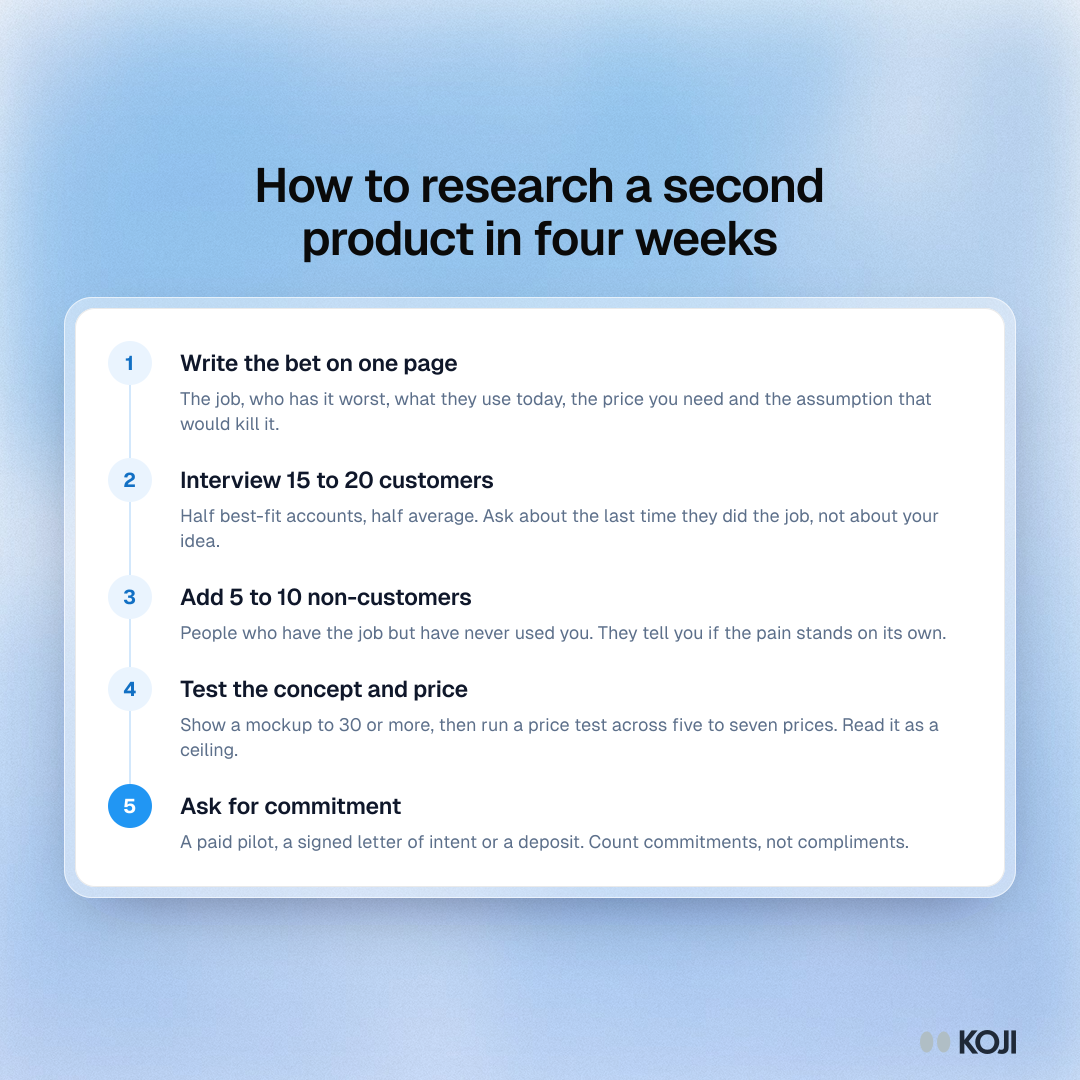
Week 1: write the bet down. One page. The job you think the second product does, the customers who have it worst, what they use today, the price you'd need, and the single assumption that would kill the idea if it were wrong. Usually that's "they already spend real time or money on this job" or "they'd buy it from us rather than a specialist".
Week 1 to 2: interview 15 to 20 existing customers about the job, not your idea. Pick them on purpose: about half from your best-fit accounts and half from average accounts, plus a few who asked for the second product by name. Saturation research suggests most themes in a fairly uniform group show up within 12 interviews [6], and a 2022 systematic review put the range at 9 to 17 [7], so 15 to 20 across two groups is enough to see a pattern without overreading it. If the second product is for a different buyer inside the same account (finance instead of ops, say), interview that buyer, not your champion.
Week 2: add 5 to 10 non-customers who have the job. Your customers like you. People who've never heard of you tell you whether the job is painful on its own, without your brand doing the work. If the second product only makes sense to people who already use the first, it's a feature or an add-on, not a product.
Week 3: test the concept and the price with 30 or more. Show a mockup, a one-page description or a landing page. Ask what they think it does, who it's for, and what they'd stop using if they had it. Then run a price test across five to seven prices. About 30 responses gives a directional curve with the reasons behind it; survey guidance asks for 100 or more per segment for a figure you'd put in a plan. People also state prices about 21% higher than they actually pay, on average, across 77 studies [8], so treat the curve as an upper bound.
Week 4: ask for commitment. To the people who scored highest: a paid pilot at a real price, a signed letter of intent with a start date, or a deposit. Count commitments, not compliments. Our pre-selling playbook covers how to ask without making it awkward.
What to ask
Keep the first two sections to the past. Bring in the concept only after you've heard how they handle the job today.
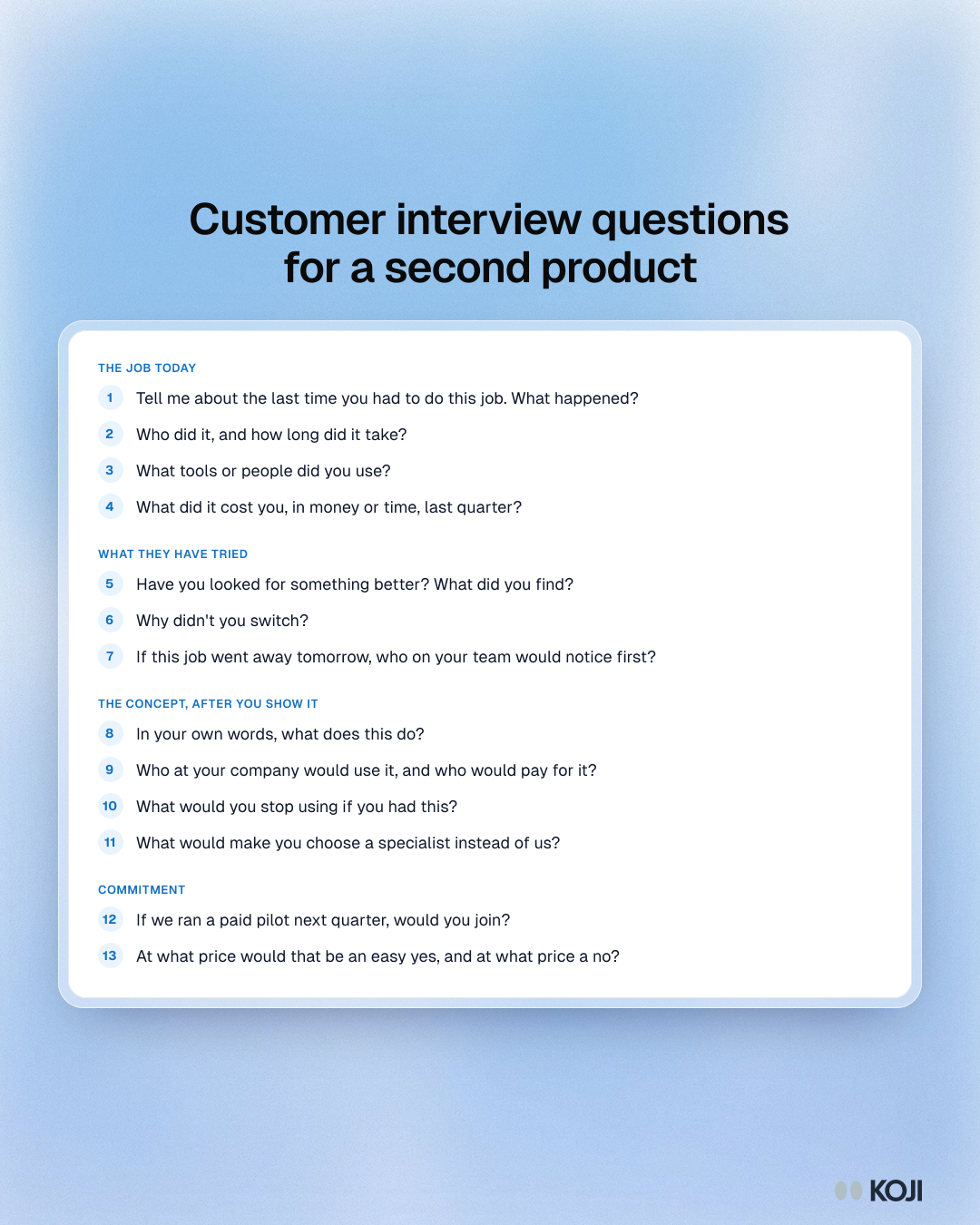
- The job today: "Tell me about the last time you had to [do the job]. What happened?" "Who did it, and how long did it take?" "What tools or people did you use?" "What did it cost you, in money or time, last quarter?"
- What they've tried: "Have you looked for something better? What did you find?" "Why didn't you switch?" "If this job went away tomorrow, who on your team would notice first?"
- The concept (after showing it): "In your own words, what does this do?" "Who at your company would use it, and who would pay for it?" "What would you stop using if you had this?" "What would make you choose a specialist instead of us?"
- Commitment: "If we ran a paid pilot next quarter, would you join? At what price would that be an easy yes, and at what price a no?"
A worked example
Say you run a 50-person company selling appointment scheduling software to dental clinics. Growth on the core product has slowed and sales has logged dozens of "do you do patient payments?" requests. Two ideas are on the table: patient payments, or a recall and reminder tool for lapsed patients.

Photo by Deliberate Directions on Unsplash
You write the bet for payments: "Clinic office managers spend hours a week chasing unpaid balances, and they'd pay us for it rather than their practice software vendor." You interview 18 customers, 9 high-usage and 9 average, and 6 office managers at clinics that don't use you.
What you'd likely hear: most office managers describe chasing balances in detail, with a phone list, a spreadsheet and a card terminal. Several already use the payment module in their practice management software and are lukewarm on switching. On the recall tool, people are polite but vague: "that would be nice." When you ask about the last time they ran a recall campaign, few can name one.
That's your signal. Payments is a job people already spend time on; recall is a job people say they should do. In week 3 you show a payments mockup to 35 clinics and run a price test from $49 to $199 a month. Interest peaks in the middle of the ladder, and the reasons behind the "no" answers cluster around one thing: "we already pay for this in our practice software." In week 4 you offer a paid pilot. Seven clinics sign up, all of them without payments in their practice software.
The decision: don't build payments for every clinic. Build it for the segment that lacks it, price it from the pilot, and set a rule that you only staff a full team if pilots convert at the price you tested.
Reading the results and deciding
Use rules you write down before the interviews start, so the team can't move the bar later.
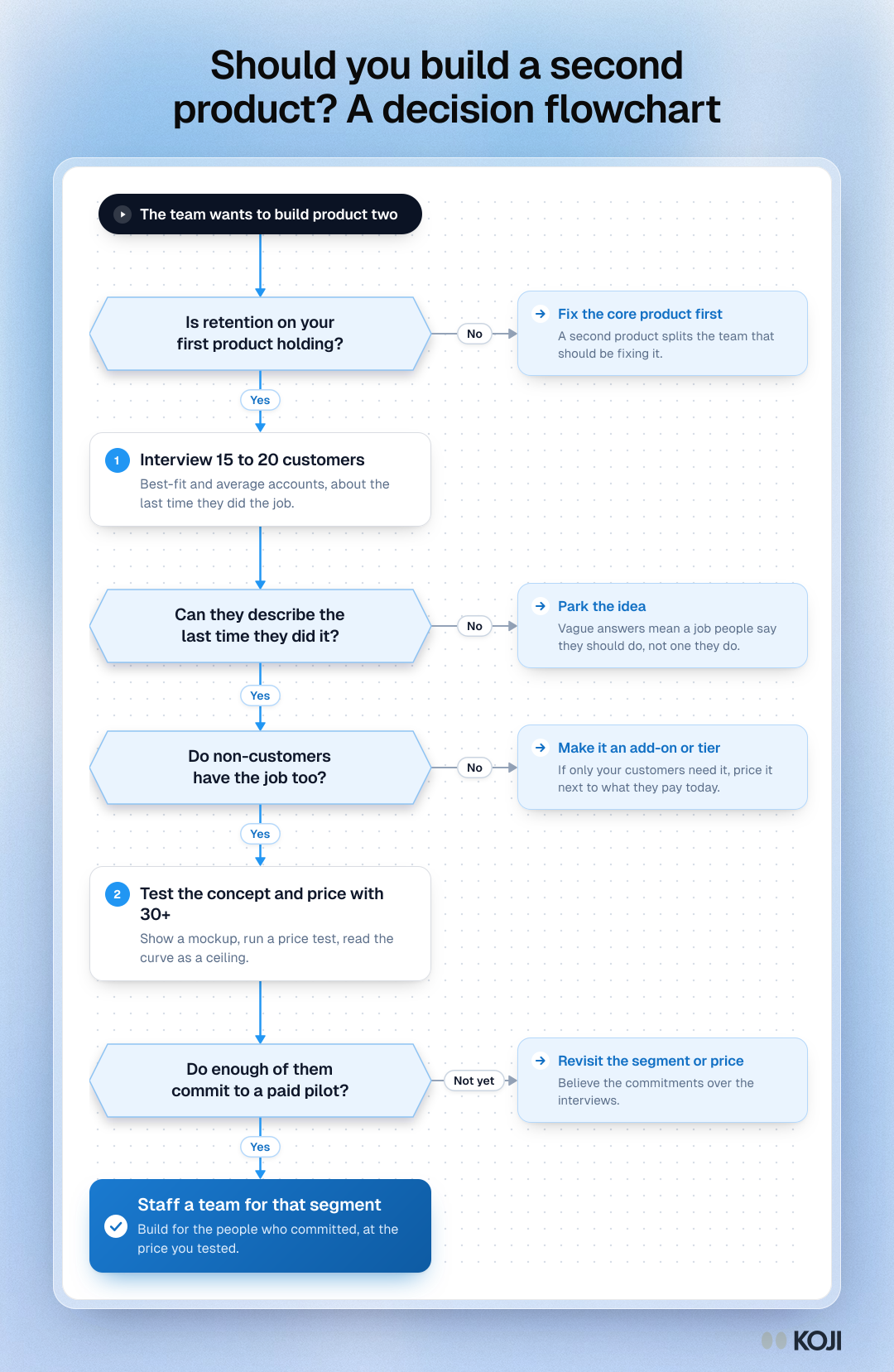
- Go: most interviewees in one segment describe the job in detail, with a cost they can name; the non-customers recognise it too; the price curve holds at a price that funds a team; and a real share of the people you asked commit to a paid pilot. Decide the share before you ask.
- Go narrow: the job is real only for one segment (like the clinics without a payment module). Build for that segment first and say so in the plan.
- Add-on, not product: the job only makes sense to existing customers and they expect it in the price they pay today. Package it as a tier or add-on instead. Our guide to researching good-better-best tiers and the contact us or published price playbook help here.
- Not yet: answers are vague, nobody can recall the last time they did the job, or they nod at the concept and nobody commits. Park it and look at the next idea on the list.
- Fix the core first: if the interviews keep drifting back to problems with your first product, that's the finding.
Run it this week with Koji
You can run the interviews, the concept test and the price test in one Koji study, without booking 50 calls.
- Start from the brief. Describe the bet in one message on the home screen ("research whether our dental clinic customers would buy a patient payments product"). The research assistant drafts the brief and the questions; edit them to match the bank above.
- Ask about the job first. Keep the opening questions open-ended. The AI interviewer asks follow-ups on each answer, so "tell me about the last time" turns into the detail you'd get on a call.
- Show the concept with an image. Attach a mockup or a landing page screenshot to a question. Participants see it with the question and the follow-ups are about what's in it. For a first-impression test, set the image to show once, full screen, for 5 or 10 seconds, then ask what they remember.
- Add a price test. Add a Price Test question with five to seven prices, a currency and a unit like "per month". Koji starts each person at a price in the middle of the ladder, moves up or down until it finds the highest price they'd still buy at, then asks why. The report shows the share who'd buy at each price, the revenue each implies and the quotes behind each point. It's labelled directional for the reasons above, and it reads best from about 30 interviews.
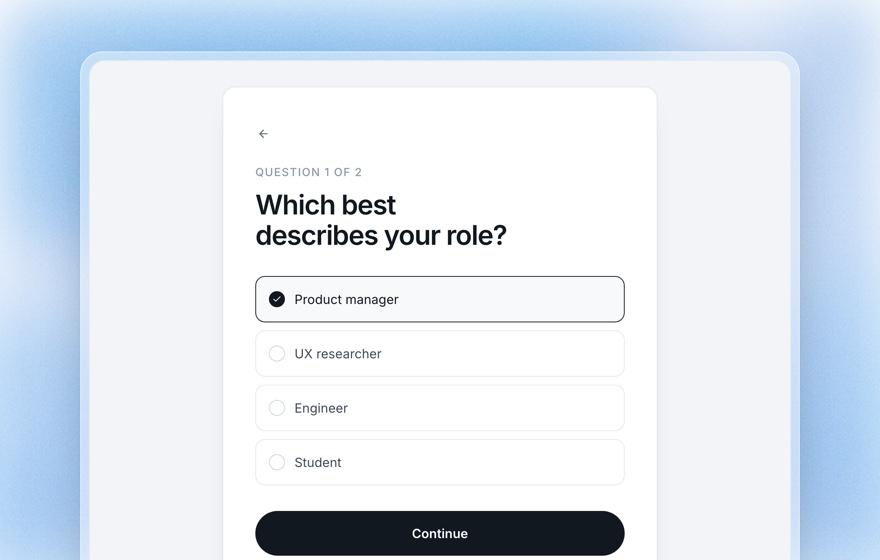
- Know which group each person is in. Add a single-choice question near the start (for example, "Does your practice software include patient payments?") so every interview carries the answer, and use a screening question to screen out people who never do the job.
- Invite the right people. Import your customer list as a CSV to get a personal link for each person, or email them from Koji with reminders. Use panel recruitment to reach non-customers who do the job, where the panel can find them. Recruitment email, incentives and panel recruitment are on paid plans; personal links work on any account.
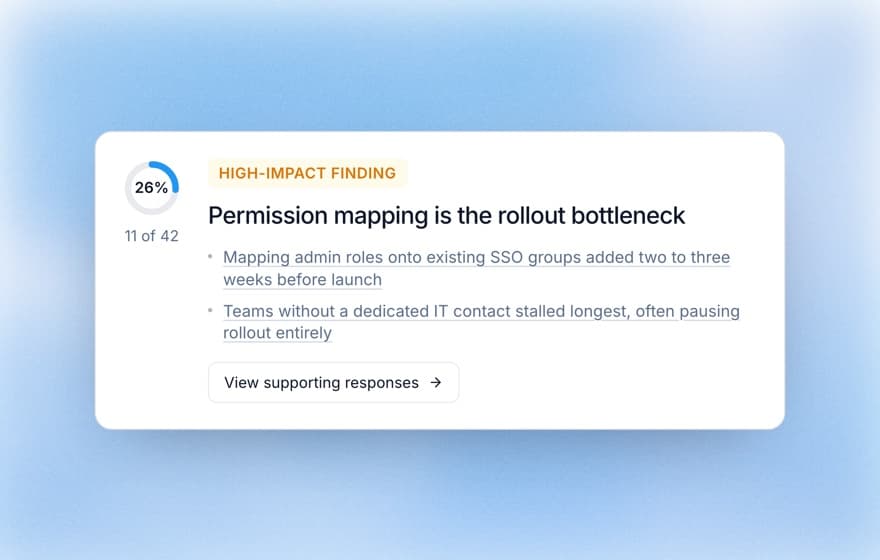
- Take it to the board. Download the report as an editable slide deck or a PDF. Each finding shows how many participants back it and links to the quotes.
For how to present it, see what to show your board.
Common mistakes
- Only interviewing fans. Your best customers will say yes to almost anything you show them. Mix in average accounts and non-customers.
- Asking about the idea before the job. Once they've seen the concept, every story about the past gets bent to fit it.
- Counting requests as demand. A spreadsheet of "do you also do X?" tells you where to look, not what to build.
- Interviewing the wrong buyer. If product two is bought by finance and product one by ops, your champion can't tell you what finance will pay.
- Moving the bar. If you didn't write the go rule down before the interviews, the team will find a reason to go.
When research will mislead you
Interviews tell you about the job and the reasons. They're weak at predicting what people will pay and how many will switch. Stated willingness to pay runs high [8], and a happy customer's "I'd definitely use that" costs them nothing. Pair the interviews with something that costs the customer: a paid pilot, a signed letter of intent with a date, a deposit, or a fake door test on your site that measures clicks to a real pricing page. If the interviews and the commitments disagree, believe the commitments.
Research also can't tell you whether you can staff it. A second product needs a team that isn't also on call for the first one. That's a decision for you and your board, not your customers.
Where this fits
Before this, make sure the first product holds: find the users who would miss you. If the second product is for a new type of buyer, the next step is interviewing 25 people in the new segment before you build. For a bigger buyer in the same accounts, see researching enterprise buyers before moving upmarket. The whole path is in the founder's research playbook, and Koji for founders shows how teams at this stage use it.
FAQ
How do I know if it's too early to launch a second product? If your core product's retention is still moving or your PMF score among core users is weak, it's too early. A second product doesn't fix a first product that hasn't found its market; it splits the team that should be fixing it.
How many customers should I interview before building a second product? 15 to 20 existing customers split across best-fit and average accounts, plus 5 to 10 non-customers who do the job, is enough to see whether the job is real. Add 30 or more for the concept and price test.
Should I interview my best customers or average ones? Both, and keep them apart in the analysis. Best customers show you the upside; average ones tell you whether it works beyond your fans.
Is a second product the same as an add-on? Not if only your current customers would ever buy it. If the job makes sense only next to your first product, package it as a tier or add-on and price it that way.
Can I test a second product's price before it exists? Yes, with a mockup and a price test across a ladder of prices, but read the result as a ceiling. People overstate what they'd pay by about a fifth on average, so confirm with a paid pilot.
Your next step
Write your one-page bet today, then put the question bank above into a study and send it to 20 customers this week. If you want the follow-ups, the price test and the board deck done for you, start a study in Koji.
References
- Tidemark. "2025 Vertical & SMB SaaS Benchmark Report." Tidemark, 2025. https://www.tidemarkcap.com/post/2025-vertical-smb-saas-benchmark-report
- Tidemark, citing Lone Pine Capital. "Platforms of Compounding Greatness." Tidemark, 2023. https://www.tidemarkcap.com/post/platforms-of-compounding-greatness
- Pendo. "The 2019 Feature Adoption Report." Pendo, 2019. https://www.pendo.io/resources/the-2019-feature-adoption-report/
- Revenera. "Monetization Monitor: Software and AI Pricing Models and Strategies" (2027 edition), reported by VMBlog. October 2026. https://vmblog.com/news/2027-revenera-monetization-monitor-new-research-challenges-conventional-wisdom-on-ai-pricing/
- Pablo Dominguez and Travis Kassay. "[ScaleUp Blueprint] Launching a new SaaS product." Insight Partners, 2024. https://www.insightpartners.com/ideas/new-product-launch-growth-framework/
- Guest, G., Bunce, A. and Johnson, L. "How Many Interviews Are Enough? An Experiment with Data Saturation and Variability." Field Methods, 2006. https://doi.org/10.1177/1525822X05279903
- Hennink, M. and Kaiser, B. N. "Sample sizes for saturation in qualitative research: A systematic review of empirical tests." Social Science & Medicine, 2022. https://doi.org/10.1016/j.socscimed.2021.114523
- Schmidt, J. and Bijmolt, T. H. A. "Accurately measuring willingness to pay for consumer goods: a meta-analysis of the hypothetical bias." Journal of the Academy of Marketing Science, 2020. https://doi.org/10.1007/s11747-019-00666-6
Further reading
- Jason Lemkin, "Dear SaaStr: How Do I Launch a Second Product? And Who Should Launch It?" (SaaStr). https://www.saastr.com/dear-saastr-how-do-i-launch-a-second-product-and-who-should-launch-it Blunt advice on timing and on who should own product two.
- Casey Winters, "When and How to Build Second Products." https://caseyaccidental.com/second-products/ A clear framework for adjacent products versus new markets from someone who has done it.
- a16z, "Pricing and Packaging Additional Products." https://a16z.com/pricing-packaging-additional-products/ Read before you decide between a new product and an add-on.
- Product-market fit interviews, Koji's method doc, for the interview technique behind steps 2 and 3.