First and Second Cycle Coding: Saldaña's Coding Methods Explained
The two cycles of qualitative coding from Saldaña's Coding Manual: first cycle methods, second cycle methods such as pattern coding, a worked example and how to choose.
Short answer: First and second cycle coding are the two stages of qualitative coding described by Johnny Saldaña in The Coding Manual for Qualitative Researchers. In first cycle coding you go through the raw data and assign initial codes to passages, using methods such as descriptive, in vivo, process, emotion or values coding. In second cycle coding you work with those codes, not the raw data, to group, reorganise and condense them into categories, themes or concepts, using methods such as pattern, focused, axial or theoretical coding. First cycle breaks the data open; second cycle puts it back together in a form you can explain and act on.
This guide explains the two cycles, the main methods in each, how to pick a combination for your study, and how Koji handles the first cycle so you can spend your time on the second.
Why coding happens in cycles
Saldaña defines a code as follows:
"A code in qualitative inquiry is most often a word or short phrase that symbolically assigns a summative, salient, essence-capturing, and/or evocative attribute for a portion of language-based or visual data." (Johnny Saldaña, The Coding Manual for Qualitative Researchers)
One pass is rarely enough to get from raw transcripts to findings. The first pass produces many codes, often too many, close to the data. The second pass looks across them to find the patterns that matter. Saldaña calls coding cyclical rather than linear: you recode, merge, split and rename as your understanding grows.
The manual is the most widely used catalogue of coding methods. The second edition (2013) profiled 32 methods, and SAGE describes the fifth edition (2025) as offering more than 35. You don't need most of them. Most product and UX studies use two or three first cycle methods and one second cycle method.
First cycle coding methods
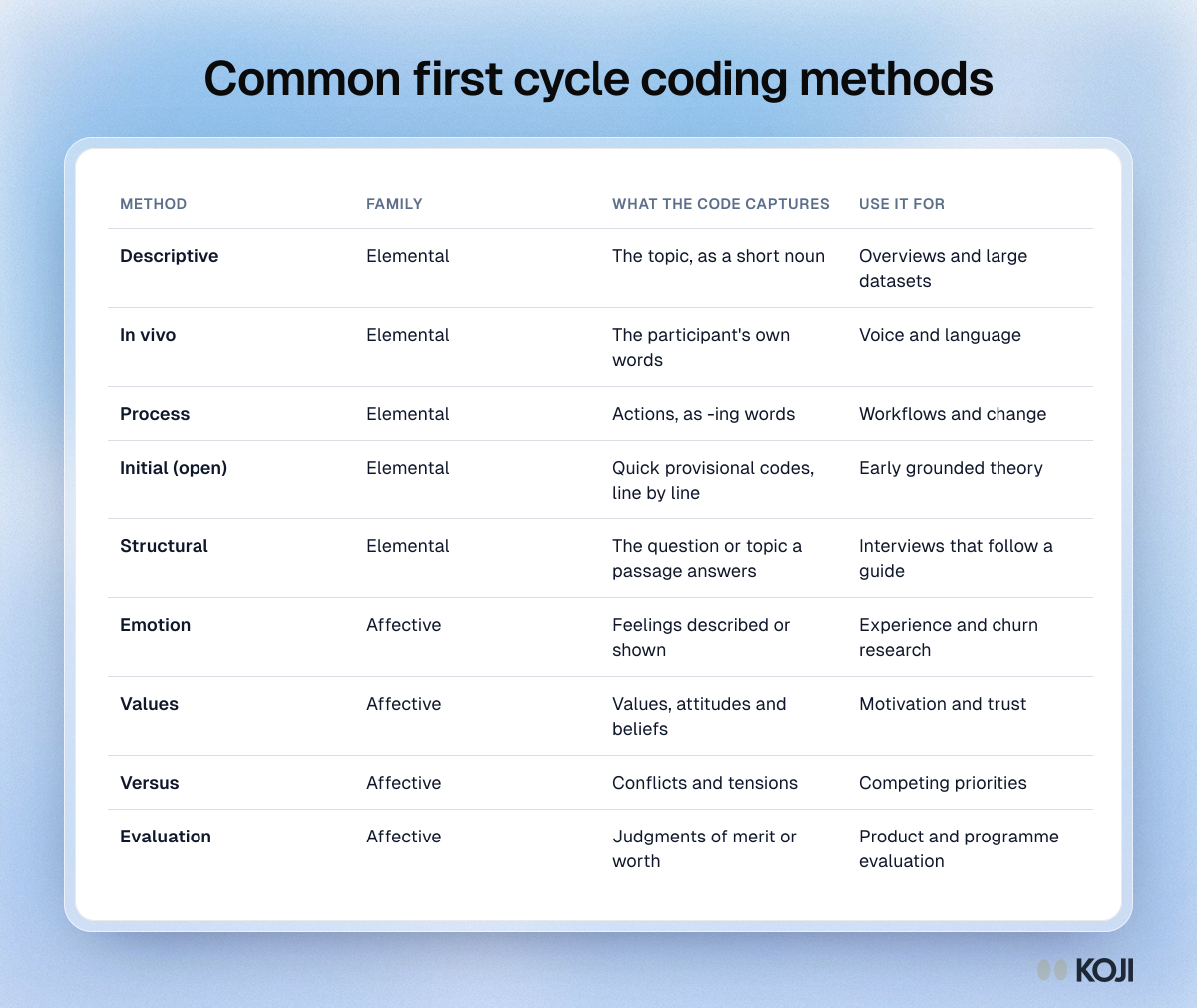
Saldaña groups first cycle methods into families. These are the ones researchers reach for most:
Elemental methods
- Descriptive coding summarises the topic of a passage in a word or short noun phrase: "pricing", "onboarding", "reporting". It is the workhorse for large datasets and for anyone who needs an overview.
- In vivo coding uses the participant's own words as the code, in quotation marks: "felt like doing taxes". It keeps voice and vocabulary. See in vivo coding.
- Process coding uses gerunds ("-ing" words) to capture action: "switching tools", "working around the export". It suits workflows and change over time.
- Initial coding (also called open coding) is a quick, line-by-line pass with provisional codes, common in grounded theory.
- Structural coding tags passages by the question or topic they answer, which helps when interviews follow a guide.
Affective methods
- Emotion coding labels the feelings participants describe or show: "relief", "embarrassment", "dread".
- Values coding captures values, attitudes and beliefs, often abbreviated as V, A and B: "V: fairness to the team", "A: sceptical of dashboards", "B: data is always out of date".
- Versus coding names conflicts in the data: "speed vs accuracy", "IT vs operations".
- Evaluation coding records judgments of merit or worth, useful in programme and product evaluation.
Other families
- Grammatical methods such as attribute coding (participant details like role or plan) and magnitude coding (intensity or frequency).
- Exploratory methods such as holistic coding, which applies one code to a large chunk to get a first sense of the data, and provisional coding, which starts from a list of expected codes.
- Procedural methods that follow a fixed protocol or outline.
Second cycle coding methods
Second cycle methods take your first cycle codes as their data. The most common:
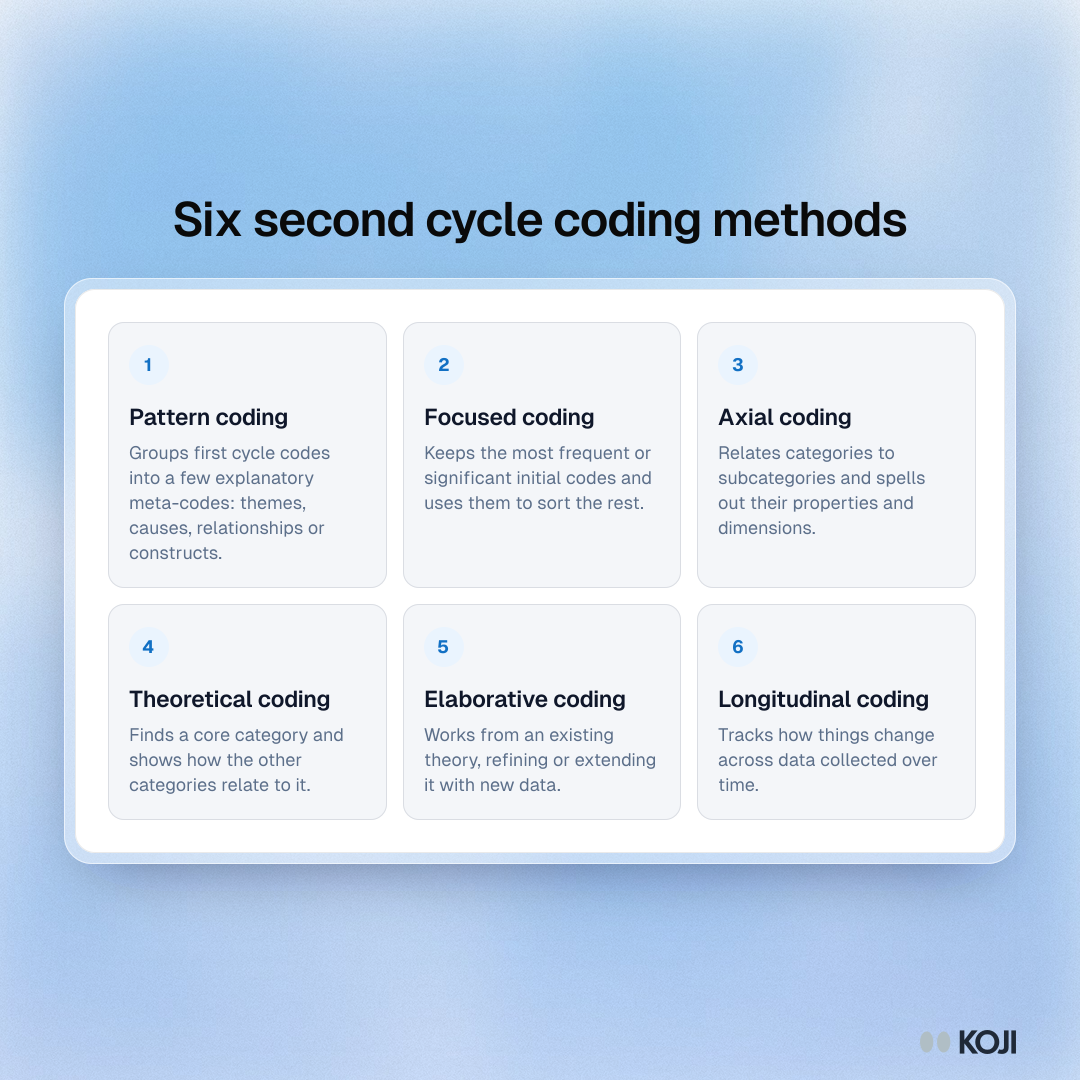
- Pattern coding groups first cycle codes into a smaller number of meta-codes that explain something: a theme, a cause, a relationship or a theoretical construct. It is the default second cycle method for most applied research.
- Focused coding keeps the most frequent or most significant initial codes and uses them to sort the rest of the data. It is common in Kathy Charmaz's constructivist grounded theory.
- Axial coding relates categories to subcategories and specifies their properties and dimensions. It comes from Strauss and Corbin's grounded theory. See open, axial and selective coding.
- Theoretical coding identifies a core category and how the other categories relate to it, to build a theory.
- Elaborative coding works top-down from an existing theory, refining or extending it with new data.
- Longitudinal coding tracks change across time in data collected over months or years.
A worked example
A team interviews 15 customer success managers about renewal risk.
First cycle (descriptive plus emotion plus in vivo) on one passage:
"When the champion leaves I basically start from zero. Nobody else knows why they bought us, and honestly it's a bit scary walking into that first call."
- Descriptive: champion turnover, lost buying context
- Emotion: anxiety
- In vivo: "start from zero"
After all 15 interviews, the team has around 120 first cycle codes.
Second cycle (pattern coding) groups them:
| Pattern code | First cycle codes it groups |
|---|---|
| Renewal risk follows people, not product | champion turnover, lost buying context, "start from zero", new exec sponsor |
| Value is invisible to new stakeholders | no usage report, ROI not documented, "they don't know what we do" |
| CSMs carry the emotional load of rescue | anxiety, dread before QBR, "a bit scary" |
The pattern codes are what goes in the readout. The first cycle codes are the evidence trail behind them.
How to choose methods for your study
- Discovery research with no fixed frame: initial or in vivo coding, then focused or pattern coding.
- Evaluating a product, programme or launch: descriptive plus evaluation coding, then pattern coding.
- Churn, frustration or experience research: descriptive plus emotion coding, then pattern coding.
- Building a theory of behaviour: initial coding, then axial and theoretical coding.
- Testing an existing framework: provisional or structural coding, then elaborative coding.
Mixing first cycle methods is normal. Saldaña calls it eclectic coding, and it often works better than applying one method rigidly.
How many codes is too many?
There is no fixed number, but two findings from saturation research help set expectations. Guest, Bunce and Johnson (2006) found that in a study of 60 interviews, 92% of the codes developed for one country's 30 transcripts had appeared within the first twelve interviews, which means first cycle code lists tend to stabilise fairly early. Hennink, Kaiser and Marconi (2017) found that code saturation came at nine interviews, while meaning saturation needed 16 to 24. Second cycle work is where you build that meaning, which is why it takes longer than first cycle tagging.
A 2024 JMIR study by Squire and colleagues adds that studies relying heavily on deductive coding, or using a more structured interview guide, reached saturation sooner. If time is tight, a clear guide and a small set of planned codes will get you there faster, at the cost of fewer surprises.
Coding as a team
When more than one person codes, agree the first cycle methods and a short codebook before you start, code one or two transcripts together, and compare. Meet again before the second cycle, because that is where people's interpretations differ most. Whether you also measure agreement depends on your approach. See inter-rater reliability for when it makes sense and when it doesn't.

Photo by Vitaly Gariev on Unsplash
Common mistakes
- Treating first cycle codes as findings. A list of 120 codes is not an insight. Do the second cycle.
- Using too many methods. Three first cycle methods on every passage creates noise. Choose deliberately.
- Recoding raw data in the second cycle. Second cycle methods work on codes. If you go back to the raw data, that is a new first cycle pass, which is fine, but name it as one.
- Losing the evidence trail. Every pattern code should lead back to codes, and every code back to passages.
- Skipping memos. Write down why you grouped codes the way you did. That is what makes your themes defensible.
"Any researcher who wishes to become proficient at doing qualitative analysis must learn to code well and easily." (Anselm Strauss, Qualitative Analysis for Social Scientists, 1987)
How Koji helps
On a manual project, first cycle coding is where most of the hours go: transcribing, reading line by line and tagging hundreds of passages in a spreadsheet or a coding tool. Survey tools with text analytics can tag short answers quickly, but they rarely capture the reasons behind them, which is what second cycle work needs. Koji takes on the first cycle and the evidence trail.
- Interviews with depth. AI-moderated interviews by text or voice, with follow-up probing on open-ended questions, give you material worth coding.
- First cycle coding for every answer. Koji codes each answer question by question, splitting answers that contain several reasons into separate codes. Each code is backed by a verbatim quote from the participant, checked against the transcript, in the participant's original language.
- Reasons behind structured answers. When you use scale, choice, ranking or yes/no questions, Koji also codes the reasons people give for the answer they picked, so numbers and explanations sit together.
- A first grouping across interviews. The report groups related phrasings from different interviews into themes, counts how many interviews mention each, and lets you open the supporting quotes behind every finding. It also flags when there are too few interviews for themes to be settled.
- Sentiment and notable quotes. Each interview gets a sentiment reading, and the report pulls out notable direct quotes.
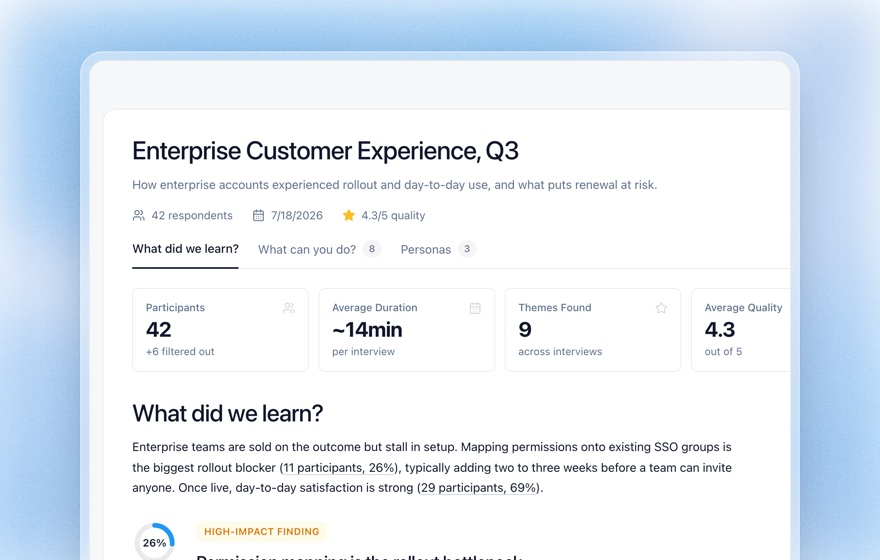
Treat Koji's themes as a strong first draft of your second cycle, not the final word. Read the supporting quotes, merge or split themes where your judgment differs, and write the pattern codes in your own terms.
Related Resources
- How to Code Qualitative Data
- In Vivo Coding
- Structured Questions Guide
- Open, Axial, and Selective Coding
- The Constant Comparative Method
- Qualitative Research Codebook
FAQ
What is the difference between first cycle and second cycle coding? First cycle coding assigns initial codes directly to the raw data. Second cycle coding works on those codes to group and condense them into categories, themes or concepts.
What is pattern coding? Pattern coding is a second cycle method that groups first cycle codes into a smaller number of explanatory meta-codes, such as themes, causes, relationships or theoretical constructs.
Which first cycle coding method should I use? It depends on your question. Descriptive coding suits overviews and large datasets, in vivo coding keeps participants' language, process coding captures actions, and emotion and values coding capture feelings and beliefs. Many studies combine two or three.
Do I always need a second cycle? If you want findings rather than a list of tags, yes. Second cycle coding is where codes become themes or concepts you can explain and act on.
Is open coding first cycle or second cycle? First cycle. Saldaña lists initial coding, also called open coding, as a first cycle method. Axial and theoretical coding, which follow it in grounded theory, are second cycle methods.
Sources
- Saldaña, J. The Coding Manual for Qualitative Researchers. SAGE (2nd ed. 2013; 4th ed. 2021; 5th ed. 2025).
- Strauss, A. L. (1987). Qualitative Analysis for Social Scientists. Cambridge University Press.
- Guest, G., Bunce, A., & Johnson, L. (2006). How many interviews are enough? An experiment with data saturation and variability. Field Methods, 18(1), 59–82.
- Hennink, M. M., Kaiser, B. N., & Marconi, V. C. (2017). Code saturation versus meaning saturation: How many interviews are enough? Qualitative Health Research, 27(4), 591–608.
- Squire, C. M., Giombi, K. C., Rupert, D. J., Amoozegar, J., & Williams, P. (2024). Determining an appropriate sample size for qualitative interviews to achieve true and near code saturation: Secondary analysis of data. Journal of Medical Internet Research, 26, e52998.
Related Articles
How to Code Qualitative Data: A Step-by-Step Guide
Learn the complete process of qualitative coding — from building a codebook to identifying themes — and how AI tools like Koji automate the most time-consuming parts.
The Constant Comparative Method: A Step-by-Step Guide
How the constant comparative method works: Glaser and Strauss's four stages, a product research example, how to know when to stop, and common mistakes.
In Vivo Coding: How to Code Qualitative Data in Participants' Own Words
What in vivo coding is, how to do it step by step, how it compares with descriptive and other first cycle methods, and the mistakes that weaken it.
Open, Axial, and Selective Coding: The Complete Guide to Qualitative Coding Phases
A complete guide to the three coding phases of grounded theory — open, axial, and selective coding. Examples, decision points, and how AI-native research with Koji compresses weeks of coding into minutes.
How to Build a Qualitative Research Codebook (With Examples and Templates)
A qualitative codebook is the rulebook for how you code your data — code names, definitions, inclusion criteria, examples, and exceptions. Done well, it makes coding consistent across analysts. Done badly, it produces findings nobody can defend.
Structured Questions in AI Interviews
Mix quantitative data collection — scales, ratings, multiple choice, ranking — with AI-powered conversational follow-up in a single interview.