Reflexivity in Qualitative Research: How to Practise It and Write a Positionality Statement
What reflexivity in qualitative research means, the three kinds of reflexive work, how to keep a reflexive journal and how to write a positionality statement, with prompts and an example.
Reflexivity in qualitative research is the habit of examining, and writing down, how you as the researcher shape what a study finds: what you chose to ask, how participants saw you, and how your background steered your reading of the data. It does not try to remove you from the study, because in interviews that is impossible. It makes your influence visible so a reader can judge the findings with it in view.
In practice that means three things: a reflexive journal kept from the first planning note to the final report, a short positionality statement in the write-up, and analysis decisions you can explain. This guide covers all three, with prompts you can copy.
Try it on your next study: before your first interview, write five lines answering "What do I expect to hear, and why?" Keep them. They are the baseline you compare your findings against at the end.
Why reflexivity matters
Kirsti Malterud put the case plainly in The Lancet in 2001: "A researcher's background and position will affect what they choose to investigate, the angle of investigation, the methods judged most adequate for this purpose, the findings considered most appropriate, and the framing and communication of conclusions." She named reflexivity, alongside relevance and validity, as one of the standards qualitative work should be judged by.
This is not only an academic worry. A product manager interviewing churned customers about a feature they built hears criticism differently from an outside researcher. A founder interviewing prospects wants the problem to be real. A participant who knows they are talking to the company's CEO tells a politer story than they would tell a peer. None of these effects can be switched off. They can be named, watched and reported.
Most published studies still leave this out. When Walsh and colleagues checked 197 interview and focus group studies from nursing journals against the COREQ reporting checklist, 65% identified who did the interviewing, but fewer than 20% reported the interviewer's experience and training, whether a relationship existed with participants before the study, or what participants knew about the interviewer (Walsh et al., 2020, International Journal of Qualitative Methods). Only 8% reported the interviewer's gender. If peer-reviewed studies skip it, most product research decks skip it too, and readers are left to guess.
Reflexivity, bias and objectivity
Reflexivity is often confused with "removing bias". The two ideas overlap but start from different places.
- The bias view treats the researcher as a source of error to control: standard scripts, neutral wording, multiple coders, agreement scores.
- The reflexive view treats the researcher as part of how meaning gets made. Your questions, your rapport and your interpretation are part of the method. The aim is transparency about that role, not its absence.
Good studies use both. Neutral, non-leading questions still matter (see avoiding bias in interviews). Reflexivity adds the honest account of what you brought to the study that wording alone cannot fix: your stake in the outcome, your assumptions about users, your relationship to the people you interviewed.
The three kinds of reflexive work
1. Personal reflexivity
How your identity, experience and interests shape the study. Typical questions: Do I want a particular answer? Have I been a user of this product, or a person like these participants? Which findings would be awkward for me or my team?
2. Relational reflexivity
How participants saw you, and how that changed what they said. Did they know you work for the company? Were they existing customers who might worry about their account? Did you share a background that made them more open, or a status gap that made them guarded?
3. Methodological and analytic reflexivity
How your choices of method, sample, questions and coding framework shaped what could be found. Why interviews and not observation? Why these 12 people? Why did a theme get a name that matches the roadmap you already had?
How to keep a reflexive journal
A reflexive journal is a running, dated record of your thinking. It sits next to your analytic memos (see analytic memos) but focuses on you rather than the data. Keep entries short and honest; nobody else needs to read them in full.
Write at three moments:
- Before fieldwork. Record what you expect to find and why, what you hope to find, and your relationship to the topic and the participants.
- Straight after each interview. Note what surprised you, where you felt uncomfortable, what you think the participant assumed about you, and any question you asked in a leading way.
- During analysis. Note each time you merge, rename or drop a code, why you did it, and whether the change moves the findings towards what you expected.
These prompts work for most studies:
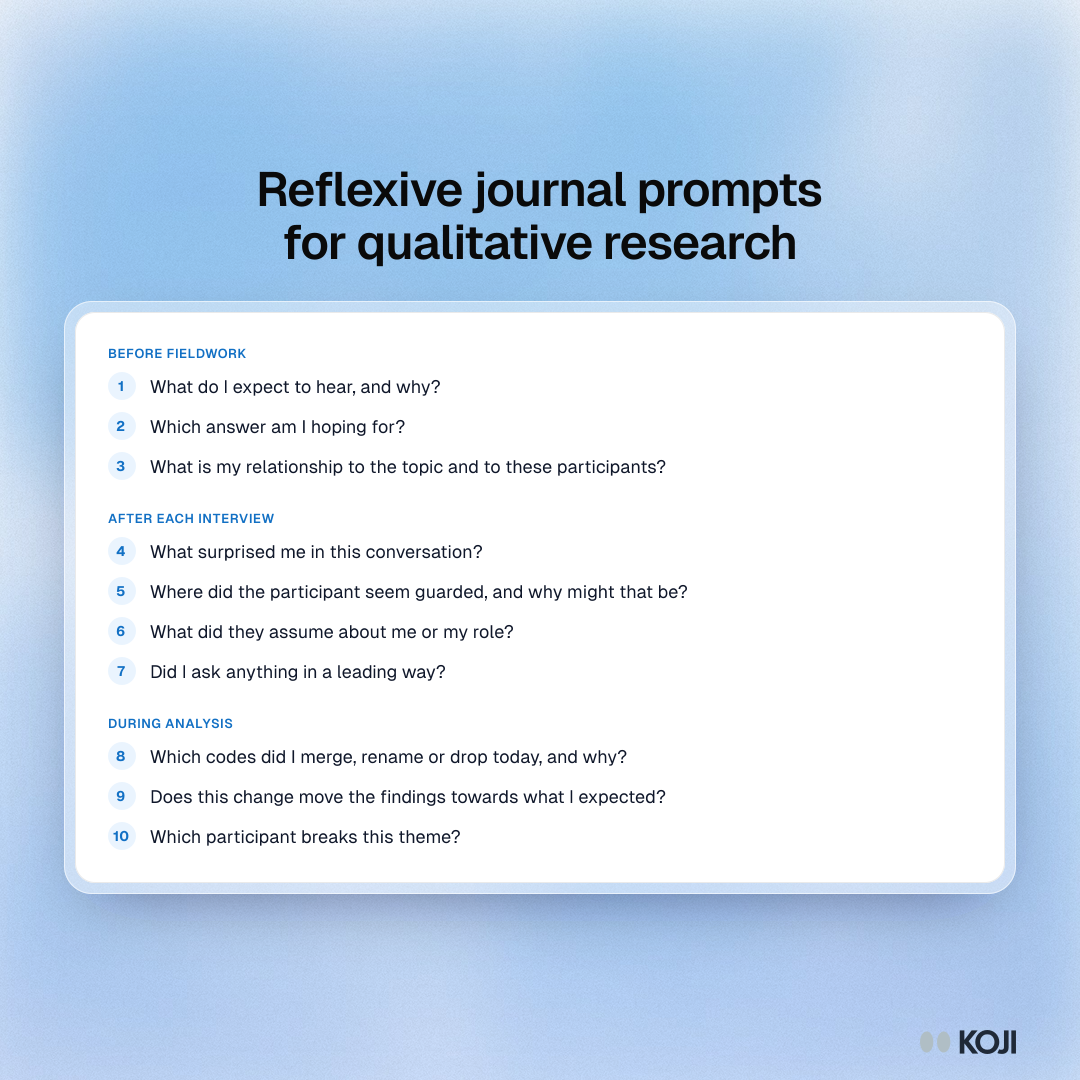
At the end of the study, reread your "before" entry next to your findings. Where they match, ask whether the data really supports the match or whether you went looking for it. Where they differ, you have evidence that the data moved you, which is a good sign.
How to write a positionality statement
A positionality statement is the public, condensed version of your journal. In a research report it is usually one paragraph in the method section. It answers a reader's question: who did this research, and how might that have shaped it?
Include:
- Who planned the study, who ran the interviews and who did the analysis, with their role and relevant experience.
- Any relationship with participants before the study (customers, colleagues, people recruited from your own network).
- What participants were told about the interviewer and the purpose of the study.
- Your stake in the outcome, and what you expected to find.
- What you did about it: a second coder, a check against usage data, sharing early themes with someone who had no stake.
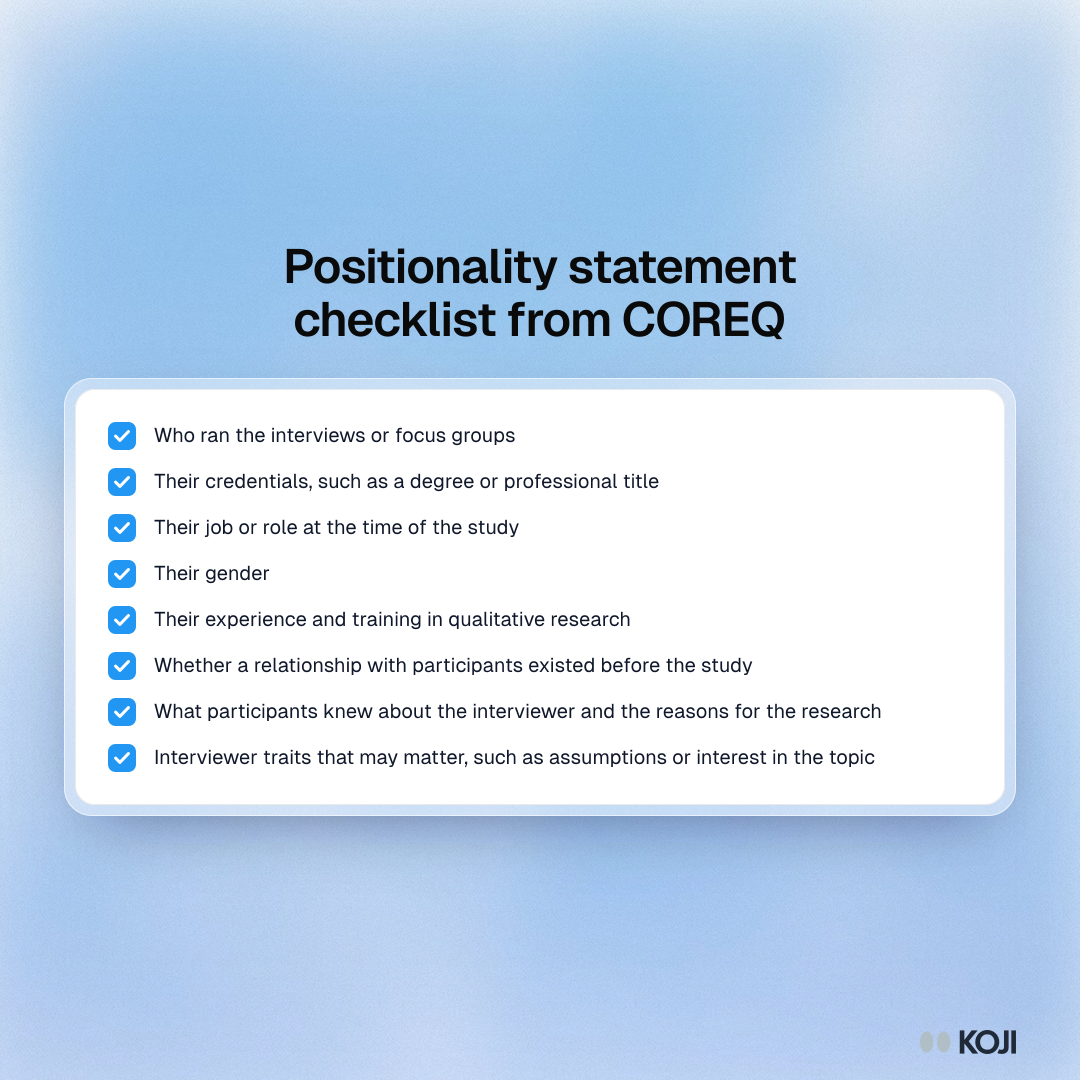
The COREQ reporting checklist (Tong, Sainsbury and Craig, 2007) gives a useful frame. Its first domain, "research team and reflexivity", lists eight items, and they make a good checklist for the statement:
A short example for a product study:
The study was designed and analysed by the product manager responsible for onboarding, who built two of the flows discussed. Participants were current customers recruited by email from the product, and were told the interviews were run by the product team to improve onboarding. The interviewer expected setup time to be the main complaint. To check this reading, a designer outside the onboarding team coded a third of the transcripts independently, and every theme was checked against activation data before it went into the report.
Five sentences, and a reader now knows how much weight to give the finding that "setup time is the main complaint".
Reflexivity during analysis
Analysis is where your influence is strongest and least visible. Three habits help:
- Name codes from the data first. Start with descriptive or in vivo codes (the participant's own words, see in vivo coding) before you reach for labels that match your roadmap.
- Look for the case that breaks your theme. Search deliberately for participants who say the opposite (see negative case analysis). If you cannot find any, ask whether you looked.
- Get a second reading. A colleague with no stake in the outcome, coding a sample of transcripts, will see what you skipped. In reflexive thematic analysis the second reading is a conversation about interpretation rather than an agreement score (see reflexive thematic analysis).
Record each of these in the journal. That record is what lets you defend a finding when a stakeholder asks "are you sure, or is that what you wanted to hear?"
After each interview: a five-minute routine
The single most useful reflexive habit is a short note written straight after every interview, before you read the transcript. Memory of how the conversation felt fades within hours. Write down where the participant seemed guarded, where you talked too much, and which answer you found yourself agreeing with. Over a dozen interviews these notes show patterns in your own behaviour, such as always probing harder on the answers that support your hypothesis.

Photo by Vitaly Gariev on Unsplash
If you interview as a team, swap these notes at the end of each day. Two people who ran similar interviews often notice that participants treated them differently, which is relational reflexivity in its plainest form.
Common mistakes
- A statement that lists identity and stops. Saying "I am a designer with ten years' experience" is not reflexive unless you say how it may have shaped the study.
- Writing the journal after the fact. A reconstructed journal tells you what you now think you thought. Date your entries as you go.
- Treating reflexivity as a confession. The point is useful information for the reader, not self-criticism. Keep it short and specific.
- Using it as a substitute for good method. Reflexivity does not excuse leading questions or a sample of friends. It sits on top of a sound design.
How Koji helps
Koji does not remove the researcher from a study, and it would be misleading to claim it does. You still write the research goal and the questions, and the AI interviewer follows them. What changes is where your influence sits and how easy it is to see.
- One written interview guide for everyone. Each participant gets the same questions from the study brief, asked by the same interviewer, with follow-ups set to the depth you chose. Relational effects such as status gaps or rapport with one participant and not another are reduced, and the guide itself becomes the place to check for leading wording.
- Preview your own interview. The Preview tab lets you take the interview yourself, by text or voice, before anyone else does. Hearing your own questions asked back to you is one of the quickest ways to spot an assumption baked into the wording.
- Guardrails. You can list topics the interviewer must avoid, such as quoting prices or naming other customers, so it does not steer participants towards answers you did not intend.
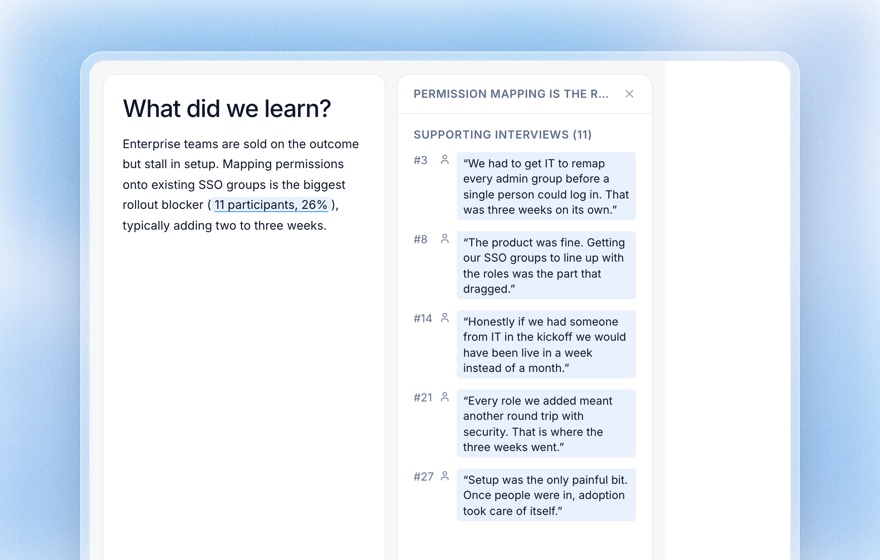
- Findings you can trace. Each theme in the report links to the codes and the participant quotes behind it, and each quote opens in the transcript. When you suspect you have read your expectations into a theme, you can check the evidence in a few clicks.
- Full transcripts to export. Download every conversation as CSV or JSON with timestamps, so a second coder can read the raw data independently.
Your journal and positionality statement still belong to you. Keep them in the study notes, and add the statement to the report before you share it.
Related Resources
- Qualitative research validity and reliability
- Reflexive thematic analysis
- Analytic memos in qualitative research
- Interviewer bias
- Qualitative research codebook
- Structured questions guide
Sources
- Malterud, K. (2001). Qualitative research: standards, challenges, and guidelines. The Lancet, 358(9280), 483–488.
- Tong, A., Sainsbury, P., and Craig, J. (2007). Consolidated criteria for reporting qualitative research (COREQ): a 32-item checklist for interviews and focus groups. International Journal for Quality in Health Care, 19(6), 349–357.
- Walsh, S., Jones, M., Bressington, D., et al. (2020). Adherence to COREQ reporting guidelines for qualitative research: a scientometric study in nursing social science. International Journal of Qualitative Methods, 19.
Related Articles
Analytic Memos in Qualitative Research: What to Write and When
Analytic memos are short notes where qualitative analysis actually happens. The five types, what to write in one, an example, when to write them and how memos tell you when you have enough interviews.
Interviewer Bias: How Moderators Distort Research (and How AI Removes the Variance)
Interviewer bias is the distortion caused by a moderator's wording, reactions, expectations, and characteristics. Learn the types, the evidence, mitigation techniques, and why an AI interviewer eliminates interviewer variance.
How to Build a Qualitative Research Codebook (With Examples and Templates)
A qualitative codebook is the rulebook for how you code your data — code names, definitions, inclusion criteria, examples, and exceptions. Done well, it makes coding consistent across analysts. Done badly, it produces findings nobody can defend.
Qualitative Research Validity and Reliability: How to Build Studies You Can Trust
A practical guide to Lincoln and Guba's trustworthiness framework — credibility, transferability, dependability, and confirmability — and how to build each into your qualitative research studies.
Reflexive Thematic Analysis: Braun and Clarke's Approach in Practice
How to do reflexive thematic analysis: the six phases, how it differs from codebook and coding reliability TA, common reporting mistakes, and where AI tools fit.
Structured Questions in AI Interviews
Mix quantitative data collection — scales, ratings, multiple choice, ranking — with AI-powered conversational follow-up in a single interview.