"None of the Above", "Other" and "Prefer Not to Say": How to Word and Place Escape Options
When to add None of these, Other, Not sure and Prefer not to say to a choice question, how to word them, where to put them, and copy-ready option sets for six common questions.
Short answer: add an escape option only when an honest person could fail to find their answer in your list, and pick the one that matches why. Use "Other (please tell us)" when real answers vary beyond your list, "None of these" when the list is complete but may not apply, "Not sure" only for facts some people genuinely don't know, and "Prefer not to say" for personal or sensitive questions. Put escape options last, in the same order every time, and keep them out of any shuffle.
Try it this week: take one choice question from your next study. Ask yourself who couldn't answer it honestly. Add only the escape option that person needs, word it in plain language, put it at the bottom, and if you randomize the other options, fix the escape options in place. In Koji that is the option order setting Randomize except last 1 (or 2, or 3).
Why escape options matter
A choice question without a way out forces some people to pick something untrue. A question with too many ways out invites people to skip the thinking. Escape options sit between those two failures, which is why their wording and placement matter more than their size on the page suggests.
Survey researchers call the second failure satisficing: picking an answer that is good enough rather than the right one, to save effort. Jon Krosnick and colleagues tested whether "no opinion" options protect data quality across nine experiments in three household surveys (Public Opinion Quarterly, 2002). Leaving the option out did not make the answers less reliable or less sensitive. They concluded that "many or even most respondents who choose an explicitly offered no-opinion response option may have meaningful attitudes." In other words, an easy exit draws in people who did have an answer.
Online surveys behave differently again. Pew Research Center notes that people are much less likely to skip questions online than on the phone, so an explicit option changes results more. In Pew's 2023 split-sample experiments on online panels, half the sample saw a "Not sure" option and half didn't. In Australia, the share rating Chinese universities as "average" fell from 47% to 33% when the option was offered. In the US the shift was about 11 points. Most of the change came out of the middle answers, and Pew decided to include a "Don't know" option in future online cross-national surveys.
So the evidence points two ways, and both matter in practice:
- For opinions, an escape option can soak up people who do have a view. Offer it sparingly.
- For facts and familiarity, leaving it out forces guesses into real answers. Offer it when people may genuinely not know.
The four escape options and when each belongs
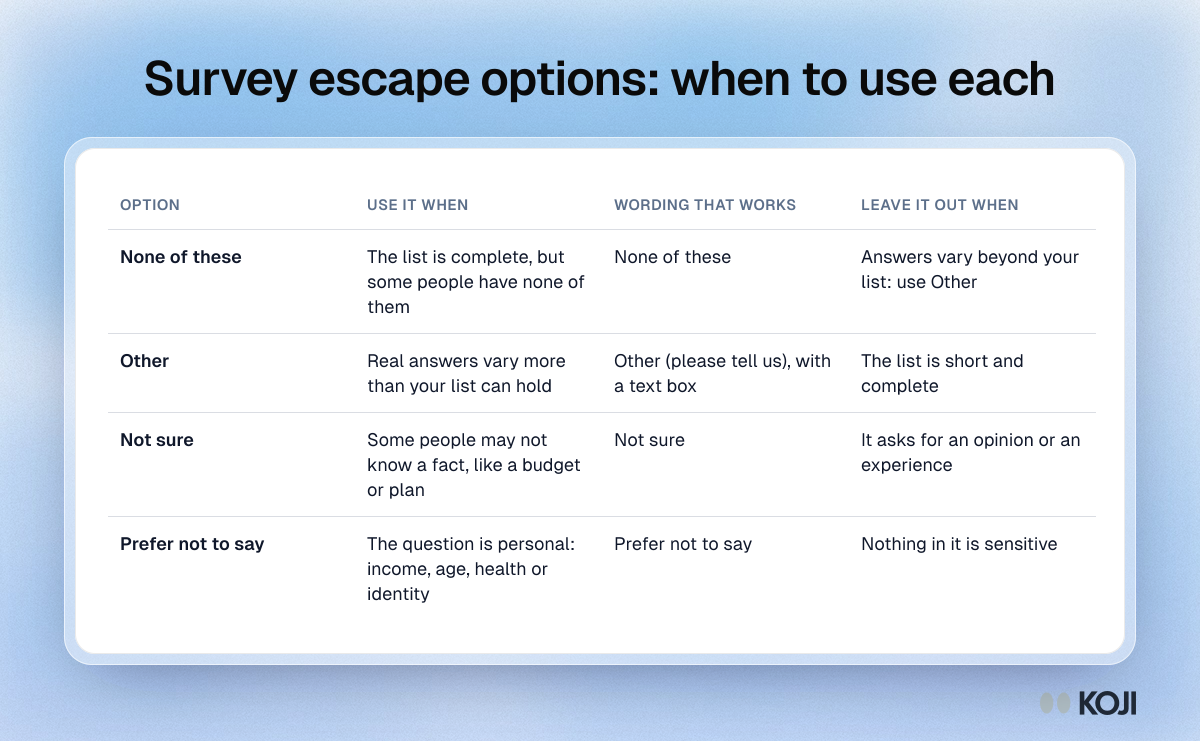
"None of these"
Use it when your list covers every relevant answer but some people won't have any of them. "Which of these tools do you use for invoicing?" needs it, because some people don't invoice with a tool at all.
- Wording: "None of these" reads better than "None of the above" on a phone screen, where the list may not be above.
- In a multi-select: it should stand alone. Someone who ticks "None of these" and a tool has made a mistake. Many survey tools can make it exclusive, so picking it clears the rest. If yours can't, use a single choice question or check for those answers before you count.
"Other (please tell us)"
Use it when real answers vary more than your list can hold, which is most questions about tools, roles, reasons and channels. It is also your best early warning: if more than a small share pick "Other", your list is missing something.
- Wording: "Other (please tell us)" or "Something else". Always collect the text. An "Other" with no text tells you only that your list is incomplete.
- Read the text before you report. Many "Other" answers belong in an existing option ("Google" written in when "Search engine" was listed). Recode those and report how many you moved.
"Not sure" or "Don't know"
Use it for facts some people genuinely don't have: their company's budget process, the plan they're on, when they signed up. Leave it out of opinion and experience questions ("How easy was setup?"), where it becomes a resting place.
- Wording: "Not sure" sounds less like a test than "Don't know".
- Report it: a high "Not sure" share is a finding. It may mean you asked the wrong person.
"Prefer not to say"
Use it for income, age, health, identity and anything else people may reasonably keep private. Forcing an answer on these produces either dropouts or made-up answers, and both damage the data.
- Wording: "Prefer not to say" is neutral and widely understood. Avoid "Decline to answer", which sounds like a legal form.
- Report it as its own group. Don't drop these people from the base without saying so. The people who decline are often different from those who answer, so dropping them can bias the result.
Where to put them, and in what order
Last, always. People reading a list on screen tend to pick from the top. Krosnick and Alwin's 1987 work on response order described it plainly: "the order in which response alternatives are presented to respondents may have a significant influence upon their selections." An escape option near the top gets picked by people who stop reading.
In a fixed order. When you have more than one, use the same order across the whole study: the substantive escape first, then the opt-outs.
- "Other (please tell us)"
- "None of these"
- "Not sure"
- "Prefer not to say"
Rarely use more than two on one question. If you need all four, the question is probably trying to do too much.
Outside the shuffle. Randomizing answer options per person is a good default when the options have no natural order: it spreads the top-of-list advantage evenly. Pew found that select-all questions in its online surveys moved by an average of 3 percentage points depending on option order, against 0 for forced-choice questions. But a shuffled "None of these" that lands at the top breaks the list. Shuffle the substantive options and keep escape options fixed at the bottom. The survey randomization guide covers when to shuffle at all.
Does this question need an escape option?
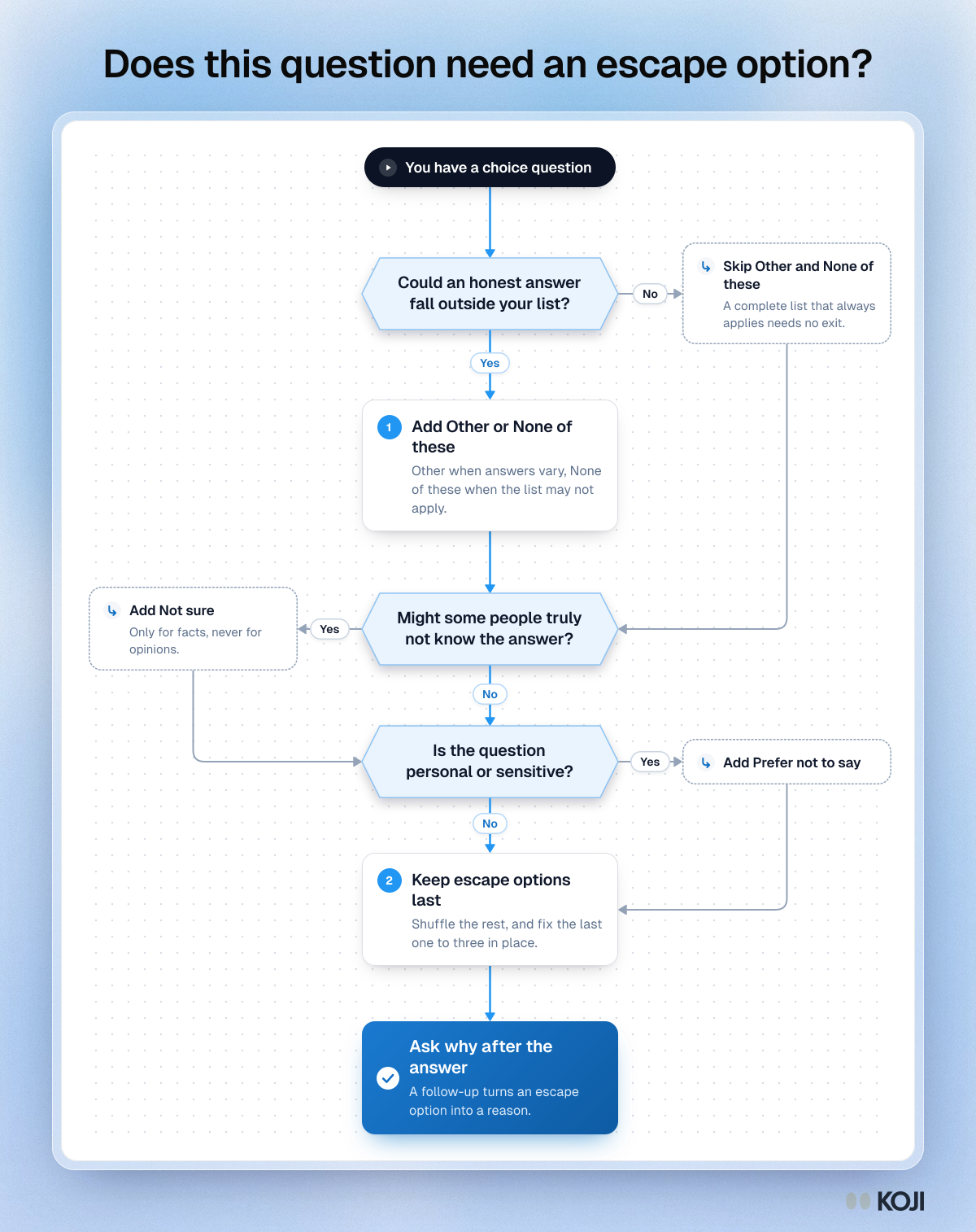
Three questions settle it:
- Could an honest answer fall outside your list? If yes, add "Other" (answers vary) or "None of these" (the list is complete but may not apply).
- Might some people truly not know? If it is a fact, add "Not sure". If it is an opinion, leave it out and let people explain in a follow-up instead.
- Is it personal? Add "Prefer not to say".
Copy-ready option sets for six common questions
Adjust the options to your audience, but keep the escape options as shown.
What best describes your role? (single choice) Founder or executive · Product manager · Designer · Researcher · Engineer · Marketing · Sales or customer success · Other (please tell us)
How many people work at your company? (single choice) Just me · 2 to 10 · 11 to 50 · 51 to 200 · 201 to 1,000 · More than 1,000 · Not sure
Which tools do you use for this today? (multiple choice) [Your 5 to 8 most common tools] · A spreadsheet · Pen and paper · Other (please tell us) · None of these
What was the main reason you cancelled? (single choice) Too expensive · Missing a feature I needed · Too hard to use · Switched to another tool · No longer needed it · Other (please tell us)
No "Prefer not to say" here: people who don't want to say will skip the study, and a forced reason is better collected in their own words.
What is your household income before tax? (single choice) [5 to 7 bands for your country] · Prefer not to say
How did you first hear about us? (single choice) [Your channels, shuffled] · Other (please tell us) · Not sure
The How did you hear about us? question templates have full channel lists by business type.
Pilot the list with five people
Before you launch, run the question past five people from your audience and watch what they do.

Photo by Vitaly Gariev on Unsplash
- If anyone picks "Other", read what they wrote. Is it a missing option?
- If anyone hesitates between two options, the options overlap. Merge or reword them.
- If anyone picks "Not sure" on an opinion question, the question is probably vague. Make it concrete ("in the last month").
- If anyone asks what an option means, rewrite it in their words.
Five people won't tell you how common each answer is. They will show you the list's gaps, which is what a pilot is for.
How Koji helps
Koji runs choice questions inside an AI-moderated interview, which changes what an escape option costs you.
- Option order per question. Choose Order as shown, Randomize order, or Randomize except the last 1, 2 or 3 options, so "Other", "None of these" and "Prefer not to say" stay at the bottom while the rest is shuffled. Each participant keeps their own order if they refresh, and the report always lists options in your original order.
- A follow-up after the pick. Each question can carry up to three follow-ups, with optional guidance for the interviewer ("if they pick Other or None of these, ask what they use instead"). The escape option then comes back with a reason instead of a blank.
- Pick limits on multiple choice. Any number, an Exact number or a Range. Text interviews enforce the limit; voice interviews ask people to adjust.
- Set it by asking. Tell the research assistant "shuffle the options in question 3 and keep the last one in place" and it applies the setting.
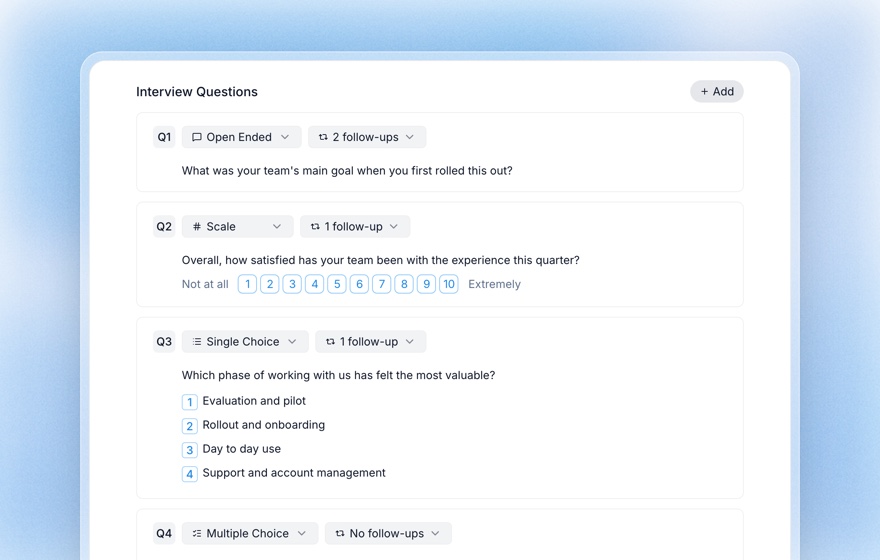
One limit to know: in Koji, "None of these" is an ordinary option, not an exclusive one. In a multiple choice question someone can tick it along with other options. If that matters, ask the question as single choice, or check the responses for people who ticked both before you report the counts.
Common mistakes
- "Other" with no text box or follow-up. You learn that the list is incomplete and nothing else.
- "Not sure" on every question. It turns into a resting place on opinion questions.
- Escape options in the shuffle. "None of these" at the top of the list breaks the question.
- Dropping "Prefer not to say" from the base without saying so. Report it.
- Four escape options on one question. Split the question instead.
Related Resources
- Structured Questions Guide: every question type in Koji, with settings
- Survey Randomization Guide: when and how to shuffle questions and options
- Select All That Apply or Pick Your Top 3?: capping a multi-select
- Demographic Survey Questions: age, income and identity questions that respect people
- Satisficing in Surveys: why people take the easy answer
- How Did You Hear About Us? Question Templates: option lists by business type
Sources
- Jon A. Krosnick, Allyson L. Holbrook and colleagues, "The Impact of 'No Opinion' Response Options on Data Quality: Non-Attitude Reduction or an Invitation to Satisfice?", Public Opinion Quarterly 66(3), 371 to 403, 2002.
- Pew Research Center, "How adding a 'Don't know' response option can affect cross-national survey results", Decoded, September 2023.
- Pew Research Center, "When Online Survey Respondents Only 'Select Some That Apply'", May 2019.
- Jon A. Krosnick and Duane F. Alwin, "An Evaluation of a Cognitive Theory of Response-Order Effects in Survey Measurement", Public Opinion Quarterly 51(2), 1987.
Related Articles
Demographic Survey Questions: Examples, Best Practices & Templates (2026)
Copy-paste demographic and firmographic survey questions for B2C and B2B research, plus wording best practices and how to collect them conversationally with AI interviews.
"How Did You Hear About Us?" Question Templates by Business Type, With Option Lists
Ready how did you hear about us option lists for B2B SaaS, ecommerce, agencies and local services, with the question design that keeps the answers honest: single choice, shuffled channels and a follow-up.
Satisficing: Why Respondents Give You Good-Enough Answers Instead of True Ones
Satisficing is the theory that explains acquiescence, straightlining, don't-know answers and response-order effects as one behaviour. Understand the mechanism and you can design it out instead of detecting it afterwards.
Select All That Apply or Pick Your Top 3? How to Cap a Multi-Select Question
When to use select all that apply, a yes/no question per item, or a capped top 3 pick. What Pew and Smyth et al. found about under-counting and order effects, and how to word and read each format.
Structured Questions in AI Interviews
Mix quantitative data collection — scales, ratings, multiple choice, ranking — with AI-powered conversational follow-up in a single interview.
Survey Randomization: How to Rotate Questions and Answer Options Without Wrecking Your Data (2026)
Randomizing answer order cancels primacy and recency bias — but randomize the wrong thing and you break your tracker, your skip logic and your comparability. The rules for what to rotate, what to anchor, and what to leave alone.