If OpenAI, Anthropic or Google just shipped a feature that does part of what your startup does, the fastest way to know whether it hurts you is to interview 20 to 30 of your customers in the next 14 days, before you touch the roadmap. Your timeline on X will tell you that you got sherlocked. Your customers will tell you which of them are actually exposed, why the rest stay, and how much revenue sits on each side. AI-moderated interviews let you hear all of them in parallel instead of the handful you could fit in your calendar. By the end of this playbook you will have a decision rule, a 14-day plan, an interview guide to paste into any tool, and the exact setup in Koji.
Why customer interviews matter after a lab launch
A frontier-lab launch used to be a news story. In 2026 it is a competitive event for most AI-native startups, because the labs now sell directly to the same buyers you do.
The labs are taking more of the money. Menlo Ventures' 2026 State of Enterprise AI report (November 2026) puts enterprise AI deployment spending at $176.8 billion by September 2026, and says Anthropic, OpenAI and Google command $122.7 billion of it: 69% of all deployment dollars, up from 50% the year before. The labs' own first-party apps account for $40.0 billion (Menlo Ventures, 2026). Menlo notes it is an investor in Anthropic and many of the companies it covers, and its dollar figures are modelled estimates.
But startups still win the application layer. The same report says AI-native providers capture 77% of application-layer spend, up from 63%. That is the point of this playbook: a lab launch is a threat to some products and a non-event for others, and the difference is in how your customers use you, which you cannot see from outside.
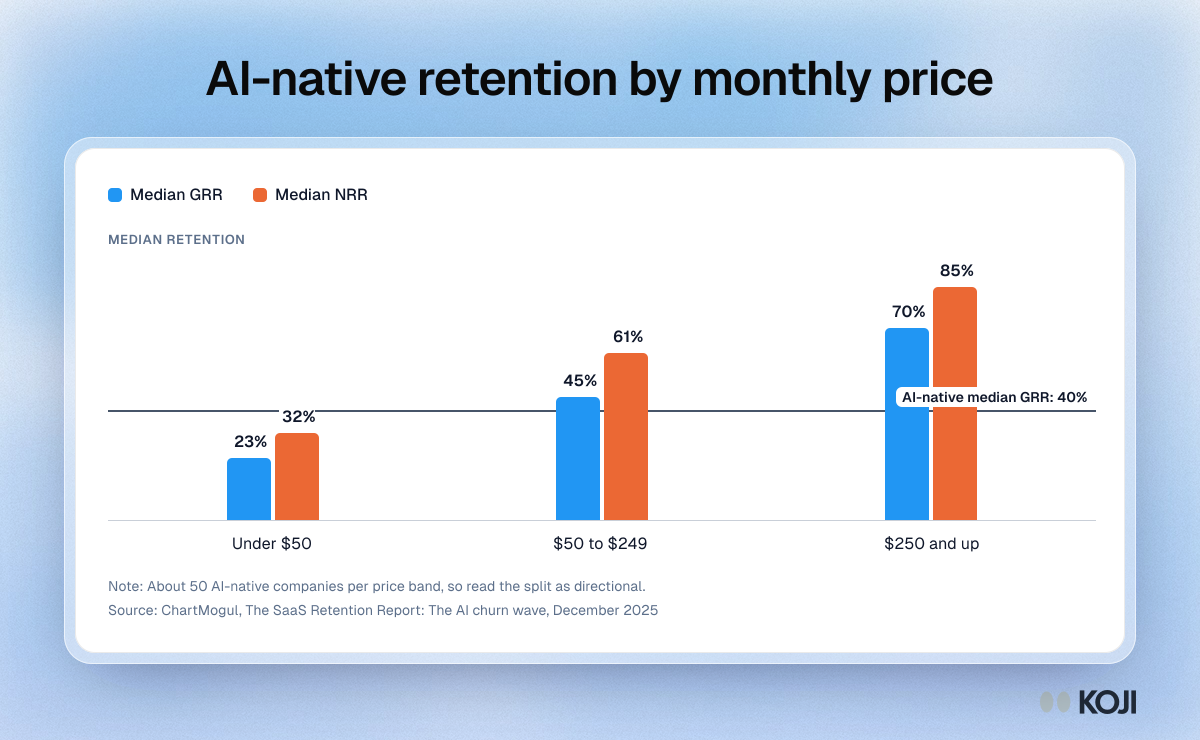
AI-native retention is already fragile. ChartMogul's study of about 3,500 software companies, including roughly 200 AI-native ones with at least $250k ARR, found a median gross revenue retention of 40% and a median net revenue retention of 48% for AI-native companies (ChartMogul, The AI churn wave, December 2025). Median GRR rose from 27% in January to 40% in September 2025, which the author reads as early "tourists" leaving. Price mattered most: products under $50 a month kept 23% GRR and 32% NRR, products at $50 to $249 kept 45% and 61%, and products above $250 kept 70% and 85%. There were about 50 companies per price band, so treat the split as directional.
Buyers are adding AI vendors, and building their own. In BCG's May 2026 IT spending survey of 423 technology decision-makers, 55% planned to add AI and machine learning suppliers, against 21% planning to consolidate (BCG, 2026). Retool's 2026 Build vs. Buy report found that 35% of respondents had already replaced the functionality of at least one SaaS tool with custom software, and 78% expected to build more internal tools this year (Retool, February 2026). Retool sells a build platform and surveyed its own customers and builders, so read that as an upper bound.
Put together: your customers will try the lab's feature, some will build around it, and most will keep more than one vendor. Churn shows up in your numbers months after the decision is made. If you wait for the renewal data, you are reading last quarter's choice. If you react to the launch thread instead, you may rebuild a roadmap around customers you were never going to lose.
What good looks like: the 14-day platform-risk read
We call this the platform-risk read. It answers one question for every account: if the lab's feature does this job, what will this customer do, and how much revenue rides on the answer? Here is how to run it.

Photo by Devin Pickell on Unsplash
Use the launch yourself first. Before you write a single question, spend a morning running your three most common customer jobs through the lab's feature. Write down what it does well, what it does badly and what it does not do at all. Your interview guide needs this, and so does your judgement when customers start comparing.
Sample by revenue, not by enthusiasm. Interview every one of your top ten accounts by revenue, then add active users across your plans, and everyone who cancelled or downgraded since the launch. Aim for 20 to 30 completed interviews. If you have fewer than 15 paying customers, invite all of them. Stop adding interviews when the last five gave you no new reason to stay or leave (our guide to how many user interviews you need explains the logic).
Ask unprompted before you ask aided. Start with how they do the job today and what changed in their tools this month. Only then name the launch and show it. If they bring it up first, that tells you something on its own. If you open with it, every answer after that is about the launch, not about their work.
Anchor on the last real event. "Would you switch?" gets you a guess. "Walk me through the last time you did this, and what you used" gets you a fact. The Jobs to Be Done switch questions work well here: what pushed them, what pulls them, what worries them about moving, and what habit keeps them.
Sort every account into one of three groups. When the interviews are in, place each account in one bucket and add up the revenue in each:
- Exposed: they use you mainly for the job the lab now does, they already pay for the lab's product, and replacing you would take them less than a week.
- Contested: they will use both for a while. The outcome depends on what you ship next.
- Anchored: they rely on something the lab does not touch, such as your workflow, your integrations, their data in your product, or a compliance need.
Use one rule to decide. If exposed accounts hold more than a third of your revenue, change the roadmap this month. If they hold less, double down on the reasons anchored customers gave for staying, and tell your investors that is what you found.
Common mistakes
- Reading the launch thread on X instead of asking customers. The loudest voices are rarely your buyers.
- Asking "would you switch to it?" first. You plant the idea and get a hypothetical answer.
- Interviewing only your champions. They like you. The admin who pays the invoice may not care.
- Naming the launch in the invite. People arrive with an opinion formed by the headline.
- Waiting for churn to show up. By then the decision is a quarter old.
- Pivoting on the first five calls. Run the full set, then sort by revenue.
Should this launch get interviews?
Not every launch needs a study. This is the decision path we use.
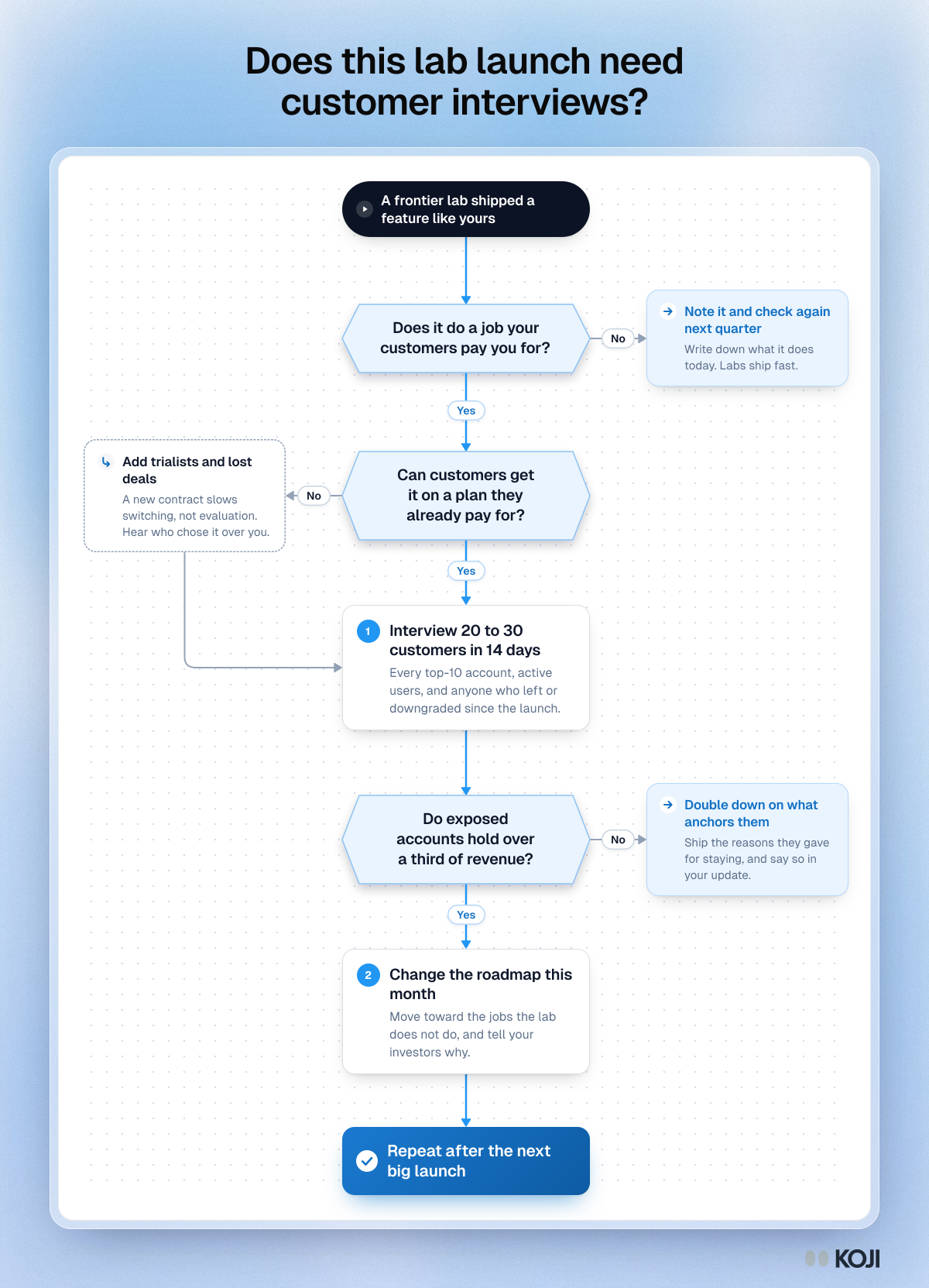
If the feature does not do a job your customers pay you for, write down what it does and check again next quarter. If customers would need a new contract to use it, the threat moves slower, but still interview the people who are trialling or chose it over you.
The 14-day plan
Count back from the day of the launch. Fourteen days is long enough to hear 20 to 30 customers and short enough that you decide before the story hardens inside your team.
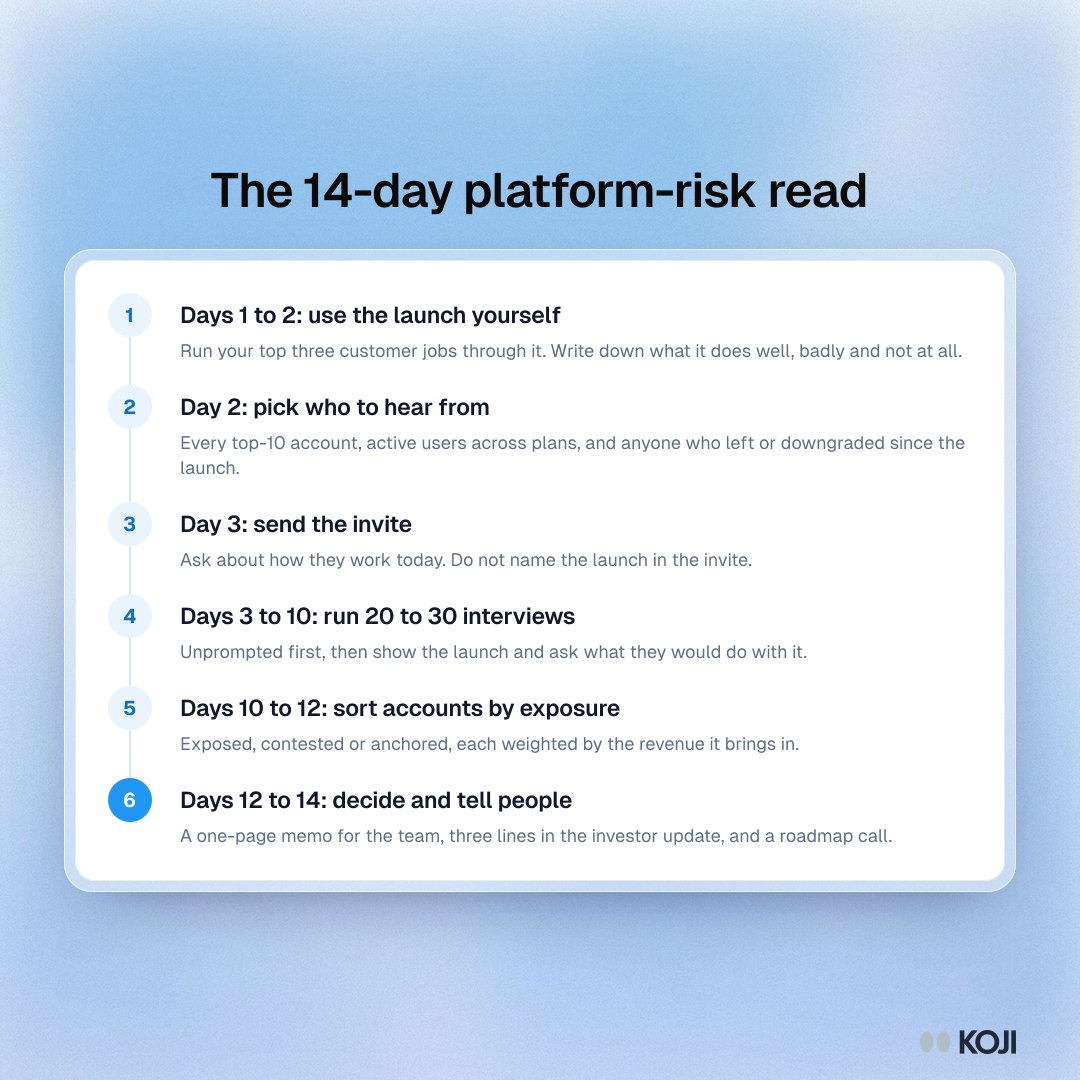
The deliverable on day 14 is short: a one-page memo for the team with the revenue share in each group, the top reasons anchored customers gave for staying, the jobs where you are exposed, and the roadmap change. Three lines of it go into your next investor update. Our guide on showing customer evidence to your board covers the format.
Copy this interview guide
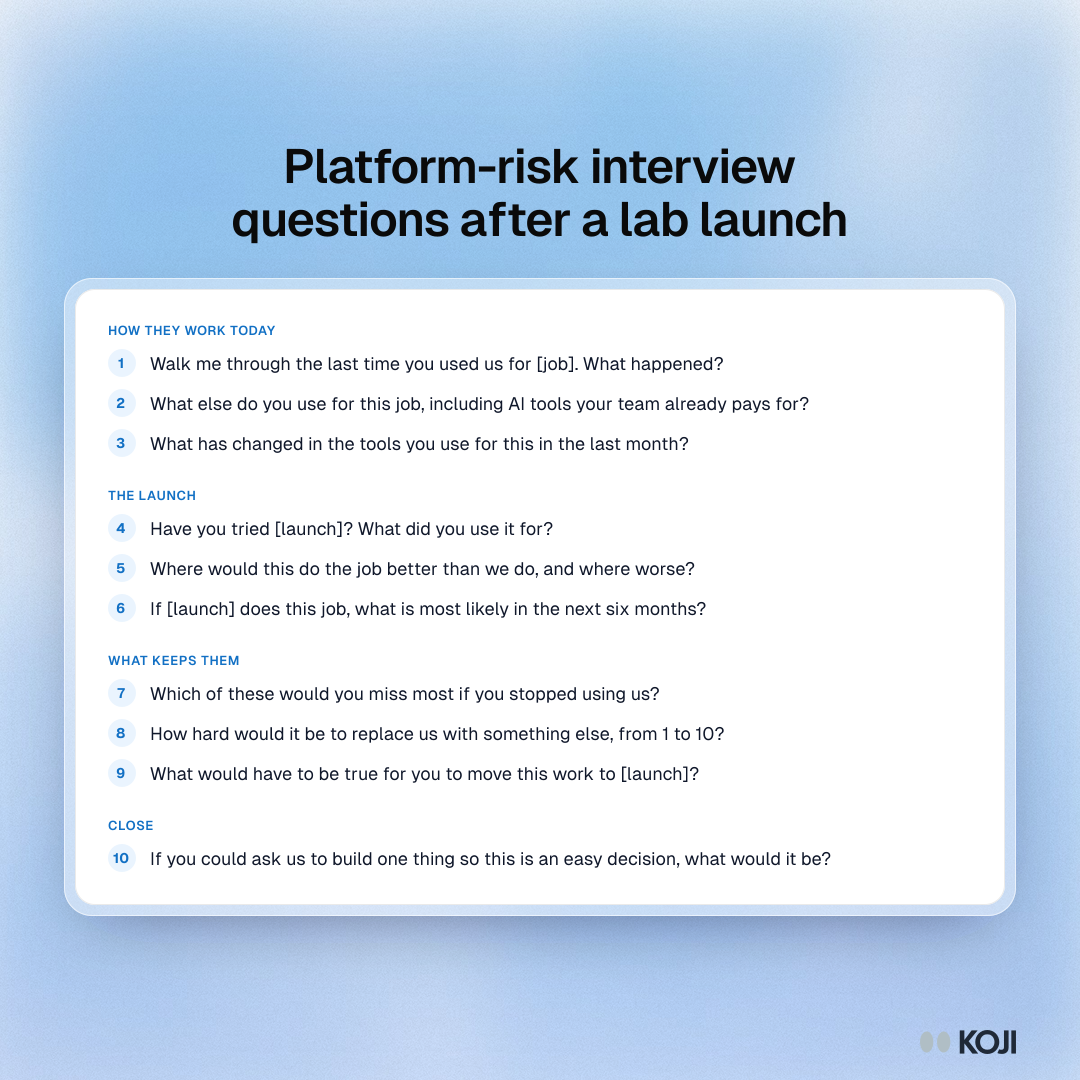
Paste this into Koji or any interview tool. Replace [job] with the job customers hire you for and [launch] with the lab's feature name.
Opening: "Thanks for making time. We want to understand how you work today and what is changing in the tools you use. There are no right answers, and nothing you say will change your account."
- Open: Walk me through the last time you used us for [job]. What happened? Probe: what did you do right before and right after?
- Open: What else do you use for this job, including AI tools your team already pays for? Probe: who chose those, and when?
- Open: What has changed in the tools you use for this in the last month? Probe: if they name the launch unprompted, ask what they have heard and from whom.
- Single choice: Have you tried [launch]? (Yes, for this job / Yes, for something else / Heard of it, not tried / Not heard of it) Probe: what did you use it for?
- Open, with an image of the launch page: Where would this do the job better than we do, and where worse? Probe: ask for a specific task.
- Single choice: If [launch] does this job, what is most likely in the next six months? (Keep using us as we are / Use both / Move some work to it / Move fully to it / Not sure) Probe: what would make you pick that?
- Ranking: Which of these would you miss most if you stopped using us? (List 4 to 6 of your capabilities, shuffled) Probe: why that one first?
- Scale, 1 to 10: How hard would it be to replace us with something else? Probe: what would take the most work?
- Open: What would have to be true for you to move this work to [launch]? Probe: who would have to agree?
Closing: "If you could ask us to build one thing so this is an easy decision, what would it be?"
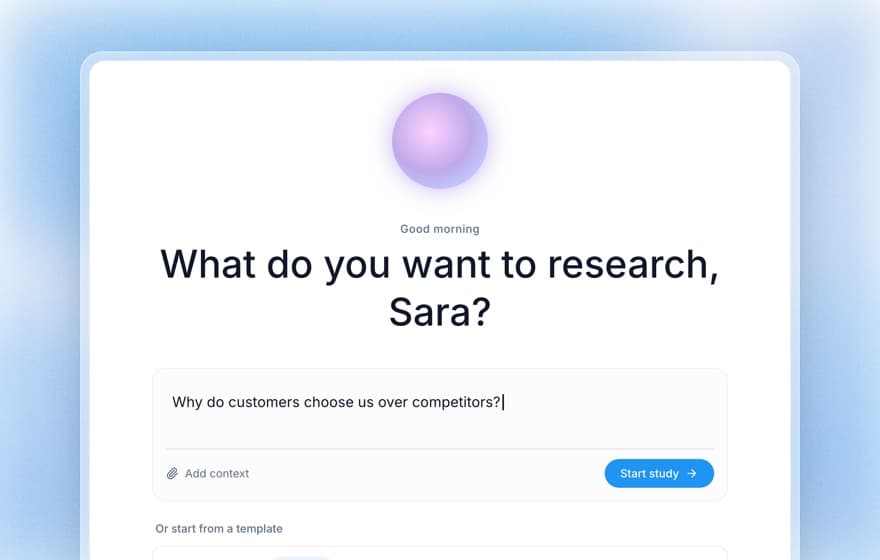
One-line research brief for Koji's "What do you want to research?" box: "Find out which of our customers would move the work they do with us to [launch], why the others would stay, and which capabilities they would miss most."
How to set it up in Koji, step by step
There is no Koji template for this exact study, so start from the brief above.
- Start the study. On the home screen, paste the one-line brief into "What do you want to research?" and start the study. Koji's research brief assistant drafts the research goal, the questions and the follow-up approach. Ask it for changes in plain words ("move the launch question after question 3").
- Give the interviewer context. Upload a short note on what the lab's feature does and your own feature list as context files, so follow-ups use the right names and the AI can probe on specific tasks.
- Add structured questions where you need a number. Make question 4 and 6 single choice, question 7 a ranking with shuffled options, and question 8 a 1 to 10 scale. Attach a screenshot of the launch page to question 5 as a question image, so participants see the same thing and Koji's follow-ups are about it. Read our structured questions guide for when to use each type.
- Set guardrails. Add rules such as "Do not mention [launch] before question 4" and "Do not promise roadmap items or discounts". The interviewer follows them in every conversation.
- Choose voice or text, then preview. Turn on voice, text or both. Run a preview interview yourself; previews are not counted as responses.
- Invite customers. Import your customer list with each account's plan, and send invitations from Koji with reminders, or give each person a private invite link from a CSV. Turn on "remove personal details" if you want names and emails taken out of transcripts. You can also offer an incentive paid through Koji.
- Read the report. Each finding shows the share of participants behind it and the quotes that support it, and each structured question gets its own chart. Download the report as slides or a PDF for your team meeting or investor update.
Which plan you need: the Free plan's 10 starting credits cover a pilot of up to 10 text interviews (a voice interview uses 3 credits). Sending invitations from Koji, private invite links and incentives need a paid plan; see pricing for what each includes.
What you get
On day 14 you have the transcript, a summary and a quality rating for every interview, a report with themes and the share of customers behind each, and charts for the switching question, the ranking and the replace-ability scale. Export the answers, add each account's revenue in a sheet, and the three groups fall out.
Here is how founders use it the next day:
- In the team meeting: the roadmap call, backed by quotes from customers the whole team knows.
- In the investor update: three lines, for example: "We interviewed 26 customers after the launch. Accounts holding most of our revenue rely on our integrations and workflow, which the launch does not cover. Here is what we are shipping next." Investors have read the same launch thread you have, and they want to know you checked.
- In sales: the reasons anchored customers stay become your answer when a prospect asks "why not just use the lab's version?"
The same playbook elsewhere
The platform-risk read is a cousin of several studies other teams run. Private equity operating partners run AI substitution interviews across a portfolio company's customers, weighted by revenue, to test the equity story. Customer success teams run renewal risk interviews before a renewal window. Borrow the PE habit of revenue weighting and the CS habit of starting early. If your read shows real exposure and you are weighing a bigger move, go on to our pivot decision playbook.
Why Koji for platform-risk interviews
The comparison that matters is how many customers you can hear, how honestly, inside 14 days.
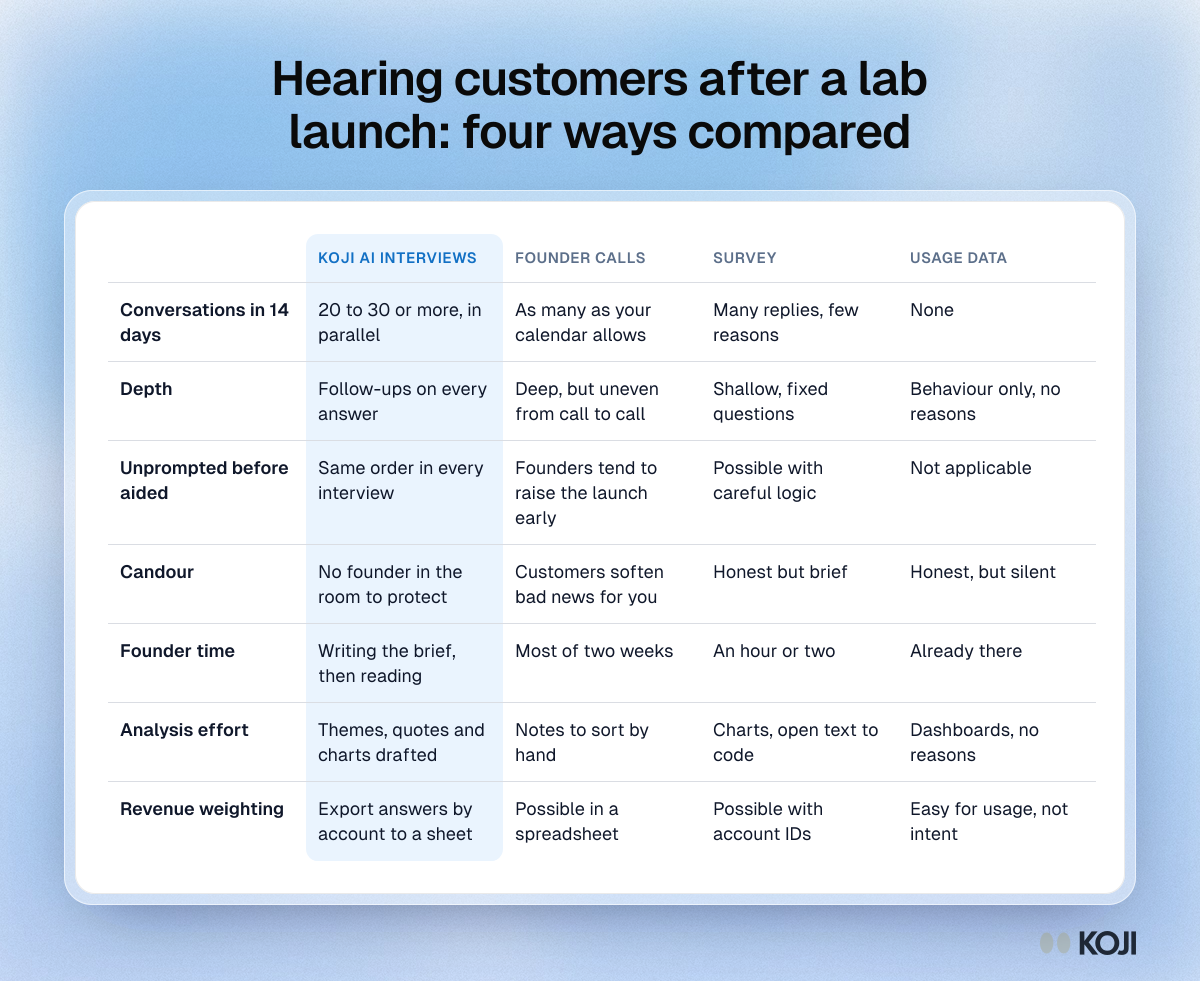
- Every customer gets the same order. The guide asks unprompted before aided in every conversation, and guardrails keep the interviewer from naming the launch early.
- It follows up on every answer. When a customer says "we'd probably use both", Koji asks what each would be for.
- Customers show you what they compare. With a question image, everyone reacts to the same launch screenshot.
- The structured answers come back as charts. The switching question, the ranking and the scale are counted for you, next to the reasons.
- The report is the deliverable. Download it as slides or a PDF and the evidence goes straight into the memo.
Questions you might have about AI interviews
Will my customers talk to an AI about a competitor? They choose voice or text, answer when it suits them, and the interview starts with their own work, not with a sales question. With no founder on the call, there is nobody for them to be polite to.
Doesn't this replace me learning first-hand? No. Read every transcript from your top ten accounts, and call the three most exposed ones yourself after the study. AI interviews give you the breadth; you still do the calls that need you.
Is my customer list safe? All customer data is stored in the EU, Koji never uses interview data to train AI models, and the remove personal details setting takes names, emails, phone numbers, addresses and employers out of transcripts when an interview finishes.
When Koji may not be the right fit
If you have three enterprise customers and each one is a third of your revenue, call them yourself this week. A study adds nothing that three honest conversations will not give you. Koji also cannot tell you what the lab will ship next, and it will not replace a technical benchmark of your product against the lab's feature. Do that comparison yourself on day one.
Metrics to track
- Share of revenue in exposed, contested and anchored accounts, at each launch
- Share of customers who raise the launch unprompted
- Top three reasons anchored customers give for staying, and whether they hold at the next read
- GRR and NRR for exposed accounts over the following two quarters
- Days from launch to roadmap decision
FAQ
How soon after a lab launch should I start interviewing? Within the first week. Send invitations by day 3 and close the study by day 12, so you decide while your team is still asking the question.
How many customers do I need to interview? 20 to 30 completed interviews, including all of your top ten accounts by revenue. With fewer than 15 paying customers, invite all of them.
Should I tell customers the interview is about the lab's launch? No. Invite them to talk about how they work today. The guide brings the launch in at question 4, after the unprompted answers.
What if most of my revenue turns out to be exposed? Change the roadmap this month toward the jobs the lab does not do, then run the same read again after you ship, to check that the move worked.
Can I run this with design partners before I have revenue? Yes. Weight by usage or by strategic value instead of revenue, and keep the same three groups.
Run it before the next launch
Labs ship on their own schedule, so set this up once and reuse it. Start free, paste the one-line brief, and add the guide above. See how founders use Koji on the founders page, and browse every playbook for founders in the use-case library. For how Koji fits into a founder's weekly research habit, read Koji for founders.