You have closed, lost or stalled about 20 deals, and you sold every one of them yourself. Your notes say "price", "bad timing" or "went quiet". The short answer: ask the buyers, in the weeks after the decision, how they decided, and ask the ones who said yes and the ones who vanished as well as the ones who said no. By the end of this page you can pick the deals, send the invites, run about a dozen short conversations in two weeks, and read them against a rule for when a pattern is real enough to change your pitch, your price or who you sell to.
This is the decision playbook for a team still finding product-market fit. Koji already has the method pages: win-loss analysis and the question list. If you sell bigger deals to buying groups, start with the scaleup version. This one is for the founder who is the whole sales team.
When you need this
You are probably here because of one of these:

Photo by Justin Morgan on Unsplash
- Demos go well and then nothing happens, and you cannot say why.
- You have started to explain losses to yourself ("they were never going to buy"), and the explanations are suspiciously kind.
- You are about to rewrite the homepage, cut the price or chase a new segment on the strength of three or four deals.
- A co-founder or an investor asked why you won the first few and stopped winning.
Guessing is expensive when you have 20 deals and not 2,000. Each one is a big share of your data. If you read three of them wrongly, you change the product, the price or the pitch on a story. Sellers are not good witnesses to their own losses. A Corporate Visions piece reports that, according to Primary Intelligence data, in 50 to 70 percent of deals the reason the seller gives differs from the reason the buyer gives [1]. That is secondary reporting of a vendor's data, so treat it as a strong hint, not a law. It fits what most founders find in their first round: the note in your CRM is your reading of the deal, not the buyer's.
The method in brief
For this decision the method is short interviews with the people who decided, done soon after the decision, by someone who is not the seller. Not a survey with a pick-list (it gives you "price" again) and not a retrospective with your team (that is the story you already tell).
Three things are different when you are the seller and the founder.
You are the wrong person to ask. Buyers soften what they say to someone who might call back, and they know you are the one who built it. People also cannot reliably report why they did something. Nisbett and Wilson's classic review found that people often give confident reasons for their choices that do not match what actually drove them [2]. So ask about events (what happened, who was involved, what they did next) rather than "why?", and let someone else ask when you can.
Some of your losses happened before your first call. Gartner's 2026 survey of buyers found 67 percent prefer a rep-free experience for at least part of a purchase [3]. So the first block of questions is about how they looked, not about your demo.
Even a small deal has more than one voice. Gartner's 2025 survey of 632 B2B buyers found 74 percent of buying teams showed "unhealthy conflict" during the decision, and that teams that reached consensus were 2.5 times more likely to call the deal high quality [4]. That survey covers B2B buying in general, not your size of deal, but if your buyer had to get a boss or a finance person to agree, you only heard one of the voices.
You may see win-loss programs described as a big lever. Clozd's 2025 survey with the PMM Alliance reports that 63 percent of respondents saw a higher win rate from their programs [5]. That is a vendor's own, self-selected survey, so do not plan on a number like that. Plan on this: after 20 deals you will know much more than you know now.
Step by step
1. Pick the deals (day 1)
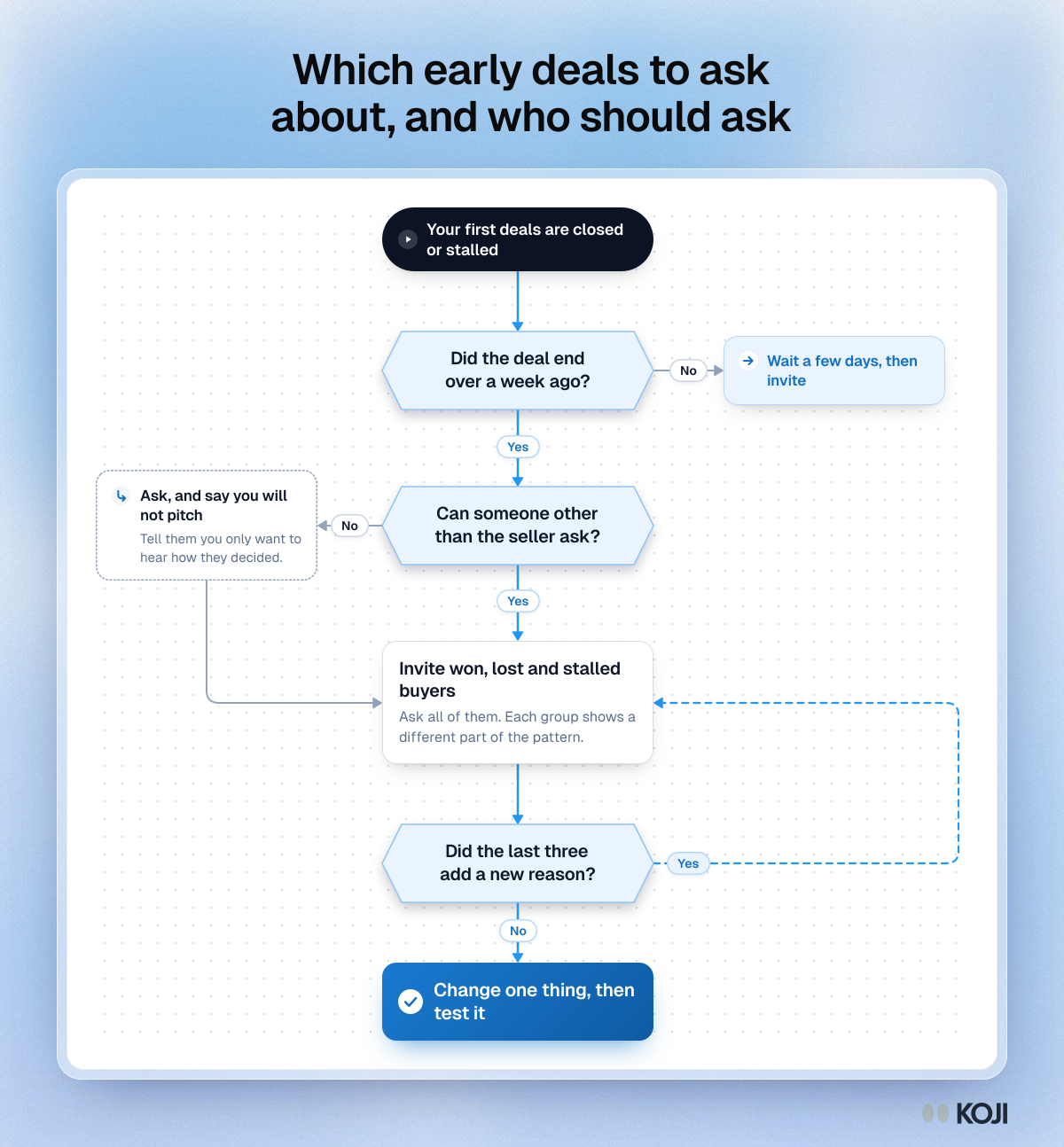
List every deal from your first 20 or so: won, lost, and stalled (the ones that went quiet or said "later"). For each, write down the date it ended, the person you spoke to, the company size and the reason you wrote down. Then do not look at your reasons again until the interviews are done. They will anchor you.
You have few deals, so ask all of them. Include the wins: if you only ask the people who said no, you cannot tell a real gap from something every buyer dislikes. A good mix is every lost deal, every stalled deal, and the wins that were closest calls plus a couple of easy ones.
2. Decide how many you need (day 1)
You will not get a reply from everyone, and you do not need that. Guest, Bunce and Johnson found in a set of 60 interviews that most of the themes appeared within the first twelve [6]. That was a study of one fairly narrow question with similar people, so twelve is a floor for a narrow question and not a promise.
My rule for this job:
- Aim for 8 to 12 conversations out of your 20 deals.
- Get at least three from each group (won, lost, stalled) before you read anything into a pattern.
- Stop when the last three conversations add no new reason.
3. Invite, and make it easy to say yes (days 1 to 3)
Send the invite within one to four weeks of the decision. That window is practitioner advice, not a studied cutoff: the later you wait, the tidier the story gets.
Keep it short and honest. Say you are not selling anything, it takes ten to fifteen minutes, and you want to know how they decided, not to change their mind. If you can, have a co-founder, a friend of the company or an interviewer tool send it, since a buyer who is not talking to the person who pitched them says more. Offer a small thank-you if it suits the person. Expect a minority to reply to the first message and plan reminders. I will not put a reply rate here: the public figures come from vendors, and they vary a lot with who is asked.
4. Ask about the decision, not the product (weeks 1 to 2)
Ask in the order the buyer lived it. Start with what was going on before they looked, move to what they compared and who was involved, then what almost changed the outcome. Leave product feedback for last. Three habits help. Ask for a specific moment ("walk me through the day you decided"). When someone says "price", ask what they compared it with and who raised it. And ask what nearly changed their mind, because it surfaces the deal you almost won.
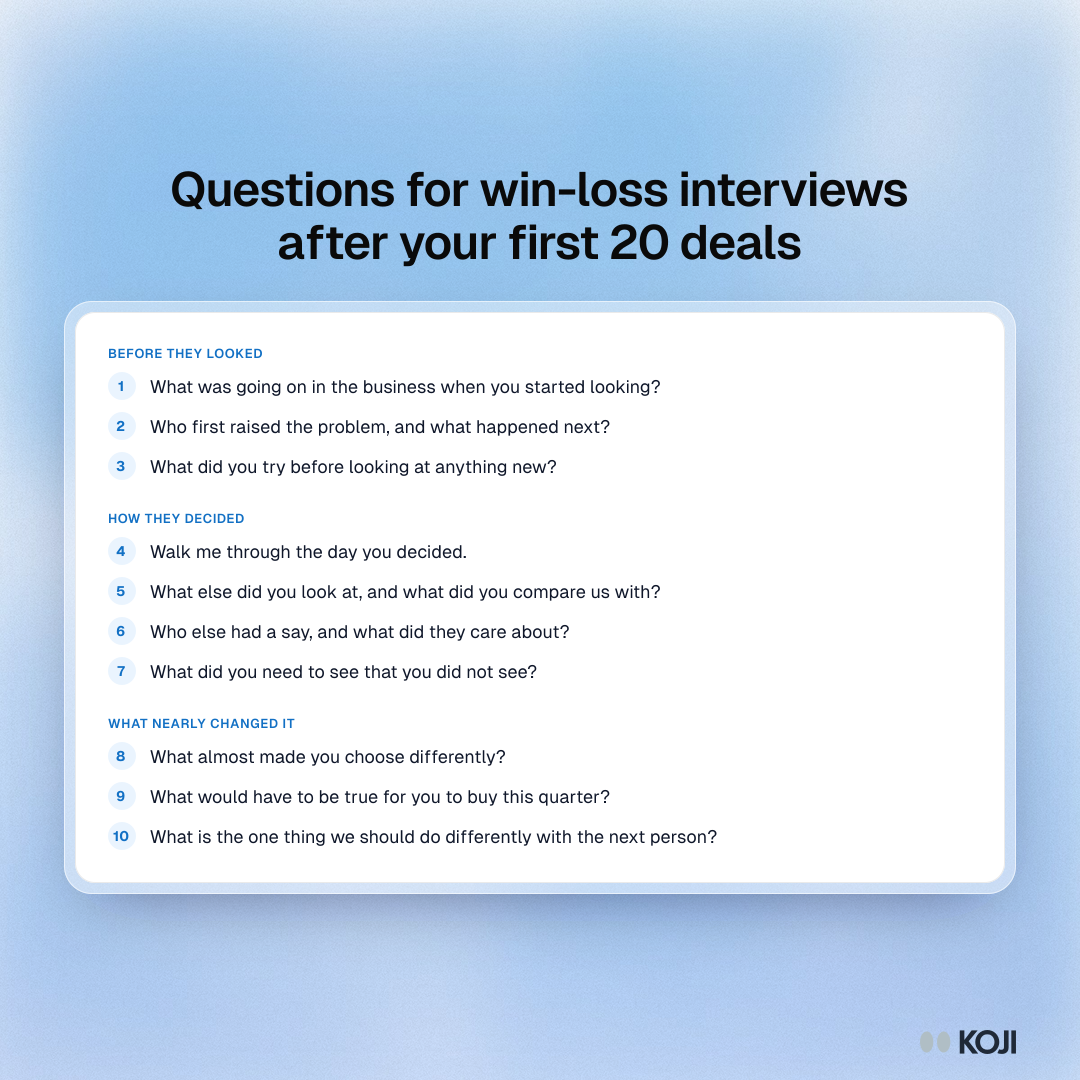
For stalled deals, change two questions: ask what they are doing about the problem now, and what would have to be true for them to buy this quarter.
A worked example
Say you are a two-person team selling a booking tool to independent yoga and pilates studios. In five months you have 20 deals. Six studios signed, nine said no, five went quiet. Your notes say price for five of the nine and "not ready" for most of the quiet ones.
You invite all 20 and thank people with a small gift. Eleven reply: four wins, five losses, two stalled. You run them in ten days.
What you hear: three of the five lost studios did not say price first. They said they already had a free calendar plus a payment link and could not see what they would gain in the first month. Two of them mention the same thing: your demo spent ten minutes on reports and never showed how a class fills when someone cancels. Two of the four winners say that cancellation flow was the moment they decided. One says, "I did not care about the reports at all." The two stalled studios both run a single-teacher studio and both say they would need to see it with a second teacher before it mattered.
What you decide: the pattern is not price. It is a demo that leads with the wrong feature, and a segment (one-teacher studios) that does not yet feel the pain. You rebuild the first five minutes of the demo around the cancellation flow, stop chasing one-teacher studios for now, and keep the price as it is. You will test that on the next ten deals. All of that came from eleven conversations and no change to the price.
Reading the results and deciding
Code each conversation by deal, not by quote. For every deal write down: what started the search, who was involved, the one or two things that decided it, and the moment that nearly changed it. Then count across deals.
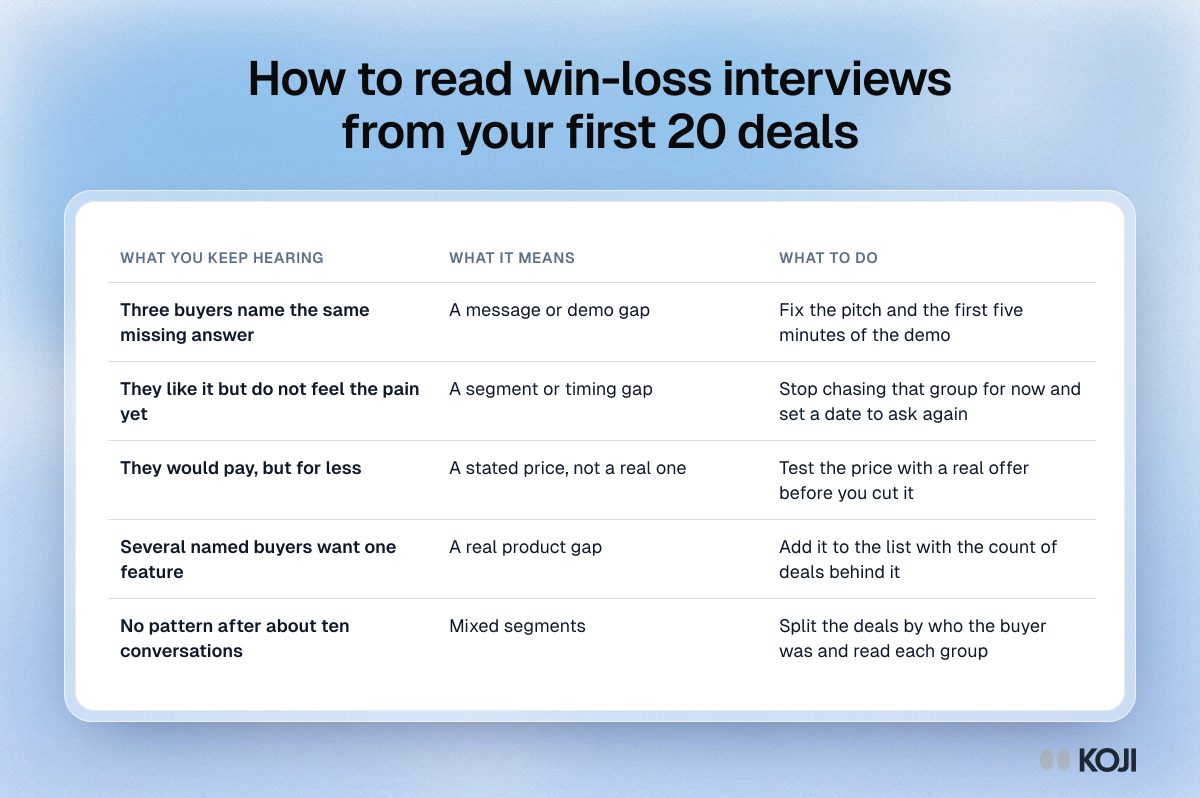
My decision rules:
- A pattern is three or more buyers raising the same thing without being asked. One is a story. Two is a hunch.
- Check it against the wins. If the reason you lose is what the winners praised, it is a real gap. If the winners never mentioned it, it is noise or a different segment.
- Name who said it. A user saying "too expensive" and the person who signs off saying "I could not justify it" are different findings.
- Change one thing per pattern. A line in the pitch, the first five minutes of the demo, the price for one segment, or a group you stop chasing.
- Write down who you did not hear from. The angriest and the most indifferent people reply least.
What to do for each outcome:
- Most losses are a message or demo gap: fix the pitch first. It costs an afternoon. Rewrite your homepage in your customers' words is the follow-up.
- They like it but do not feel the pain yet: this is a segment or timing finding. Decide whether to stop selling to that group for now, and put a date on when you will ask again.
- They say they would pay, but for less: do not cut the price on this alone. Stated prices run high: a meta-analysis found stated willingness to pay averaged about a fifth above what people really pay [7]. Test price with a real offer, as in price your first product with 30 conversations.
- A feature gap with several named buyers: add it to your list with the count of deals behind it.
- No clear pattern after 10 or so conversations: you may have mixed segments. Split the deals by who the buyer was and look at each group.
Run it this week with Koji
You can do all of this by hand with a spreadsheet, a short script and a calendar, and with fewer than ten deals that is a good choice: call them all yourself. Koji helps when you want a dozen conversations in the same week without scheduling anything, and when you want someone other than you to ask.
- Make the study. Tell the research brief assistant what you are trying to learn ("why studios chose us or did not") and paste the questions above. Add one single-choice question near the end, "Which of these mattered most in your decision?", with your own list of options and a "why?" follow-up. That gives you a count and the reasons behind it.
- Choose voice or text. People answer in their own time, by voice or by text. Ten to fifteen minutes fits most buyers better than a booked slot.
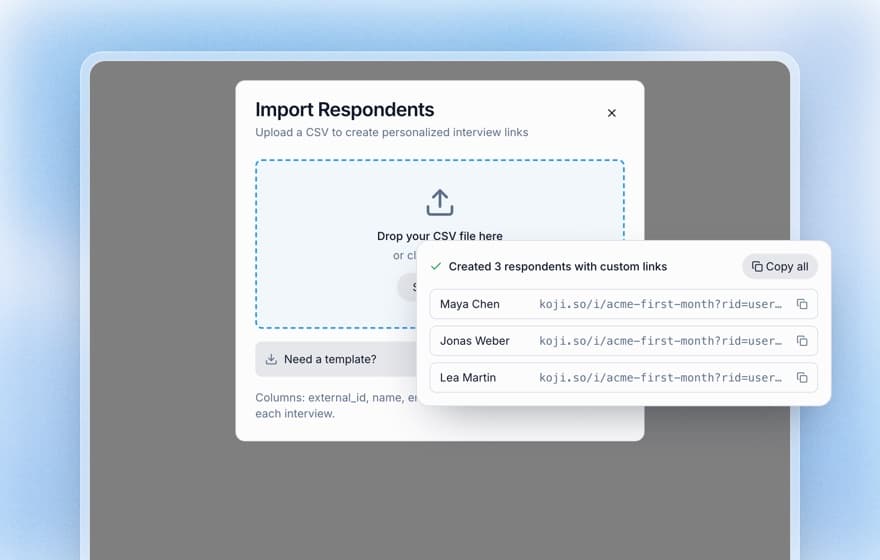
- Invite by name. Import your list of buyers from a CSV and each person gets a personal interview link, so you know which deal each answer belongs to. On a paid plan you can also email the audience from Koji, with reminders after 2, 3, 5 or 7 days.
- Say thank you. On a paid plan you can attach an incentive to completed interviews (a gift card, a prepaid Visa or a donation). See research participant incentives for how much to offer.
- Protect names. A per-study setting removes names, emails, phone numbers and employers from transcripts when interviews finish. It can miss details, so read before you share.
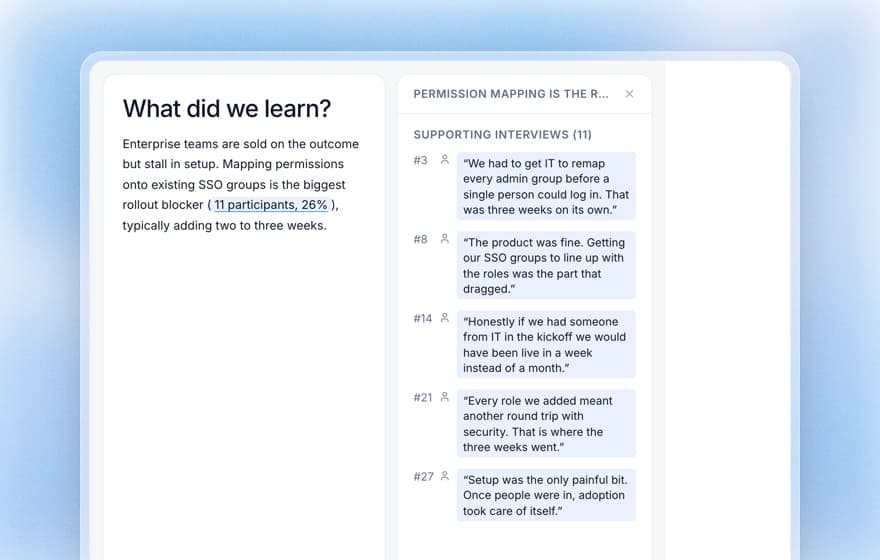
- Read the report. Koji groups the themes and shows the quotes behind each one, so you can open a finding and see which buyers said it. Check it against your own coding of the 20 deals.
- Share it. Download the report as editable slides or as a PDF for your co-founder, your advisors or your next investor update.
Two honest notes. An AI interviewer is not a person with a relationship, and some of your best-fit buyers will tell you more on a call with you. For your three biggest deals, call. And no tool fixes a tiny list: if you lost four deals, call all four.
Common mistakes
- Asking as the seller. The answers change when the person who pitched them is on the line.
- Starting with the product. You get a feature list instead of a decision.
- Only asking the buyers who said no.
- Reading your own deal notes first.
- Asking "why did you not buy?" and accepting the first answer. "Price" is the polite answer, and "not now" is the other one.
- Changing three things at once, so you cannot tell what worked.
- Reading too much into one loud buyer.
When research will mislead you
Buyers explain their choice after the fact, and a polite person gives a reason that closes the call. Interviews cannot tell you how many of your deals are lost for each reason; for that you need more deals, or your funnel numbers. A dozen buyers of one kind tell you nothing about another kind. The people who reply are more often the ones who liked you. So pair the interviews with something people did: how far they got in the funnel, who used the trial, and what happens when you change the pitch for the next ten deals.
Where this fits
Before this, you needed people to talk to: find people to interview when you have no audience and interview your existing customers without booking thirty calls. After this, the next question is usually why new users stall: interview your first 20 signups. The whole path is in the founder's research playbook, and there is more for founders.
FAQ
How many lost deals do I need to ask about? Ask all of them, plus the stalled and some of the wins. Around twelve conversations is a floor for a narrow question about one kind of buyer, not a guarantee. With fewer than ten deals, just call everyone.
Should I ask the people who said yes? Yes. What won them over is the part of your pitch to keep, and without them you cannot tell a real gap from something every buyer dislikes.
Will buyers who said no talk to me? Some will. Expect a minority to answer a first message, so plan reminders and a small thank-you. Say clearly that you will not try to sell again.
Is it ever really price? Sometimes. Ask what they compared it with and who raised it. If the answer is a free alternative they already use, it is about value, not the number.
Can I do this without a tool? Yes. A spreadsheet, a short script and your calendar work. A tool helps with reminders, volume and reading a dozen transcripts.
When should someone else take over the sales calls? Common founder advice is to keep selling until you have closed 10 to 20 deals and can write down why customers buy, which objections come up and who the ideal buyer is (practitioner advice, not a studied rule). These interviews are how you get that written down.
Your next step: list your last 20 deals today, split them into won, lost and stalled, and invite the first five by Friday.
References
- Corporate Visions. "Using Customer Feedback to Find and Fix Seller Blind Spots." Corporate Visions blog, citing Primary Intelligence data, undated. https://corporatevisions.com/blog/get-customer-feedback-b2b-sales/
- Nisbett, R. E., and Wilson, T. D. "Telling more than we can know: Verbal reports on mental processes." Psychological Review 84(3), 1977. https://doi.org/10.1037/0033-295X.84.3.231
- Gartner. "Gartner Sales Survey Finds 67% of B2B Buyers Prefer a Rep-Free Experience." Gartner newsroom, March 9, 2026. https://www.gartner.com/en/newsroom/press-releases/2026-03-09-gartner-sales-survey-finds-67-percent-of-b2b-buyers-prefer-a-rep-free-experience
- Gartner. "Gartner Sales Survey Finds 74% of B2B Buyer Teams Demonstrate 'Unhealthy Conflict' During the Decision Process." Gartner newsroom, May 7, 2025. https://www.gartner.com/en/newsroom/press-releases/2025-05-07-gartner-sales-survey-finds-74-percent-of-b2b-buyer-teams-demonstrate-unhealthy-conflict-during-the-decision-process
- Clozd and the PMM Alliance. "2025 State of Win-Loss Analysis Report." Clozd, 2025. https://www.clozd.com/guides/2025-state-of-win-loss-report
- Guest, G., Bunce, A., and Johnson, L. "How Many Interviews Are Enough? An Experiment with Data Saturation and Variability." Field Methods 18(1), 2006. https://doi.org/10.1177/1525822X05279903
- Schmidt, J., and Bijmolt, T. H. A. "Accurately measuring willingness to pay for consumer goods: a meta-analysis of the hypothetical bias." Journal of the Academy of Marketing Science 48, 2020. https://doi.org/10.1007/s11747-019-00666-6
Further reading
- Win/loss analysis guide: Koji's reference for the method behind this playbook.
- Win-loss interview questions: a longer bank to pull extra questions from.
- How many interviews are enough: the reasoning behind the sample sizes here.
- The Mom Test: how to ask about the past so buyers give you facts instead of being nice.