Pricing power due diligence asks one question: will customers keep paying when the price goes up by what the model assumes? Management answers it with a history of past increases. That shows the company raised prices before, not that it can do it again under a new owner. Three weeks of AI-moderated interviews with the target's customers and with blind category buyers, including a price test, give you a demand curve and the reasons behind it, weighted by revenue, before the investment committee meets. By the end of this playbook you will have the method, a day-by-day plan, an interview guide to paste and the setup in Koji.
This sits next to the other deal-team playbooks: confirmatory customer calls sample the whole base, and change-of-control interviews test whether the top accounts stay. This one tests the price line.
Why pricing power needs customer evidence now
Warren Buffett told the Financial Crisis Inquiry Commission in May 2010 that "the single most important decision in evaluating a business is pricing power" (FCIC interview transcript, released 2016). Most deal teams agree, and most models carry a price line. Few test it with customers. Five numbers explain why that is a problem this year.
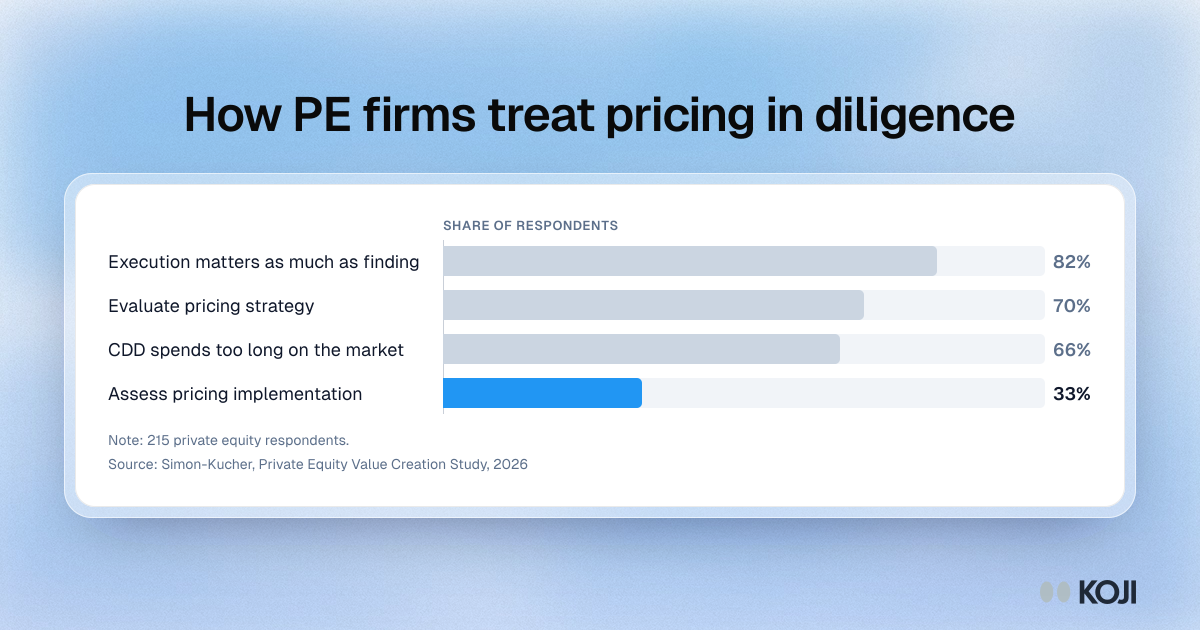
Pricing is assessed in diligence, but its delivery is not. In Simon-Kucher's Private Equity Value Creation Study 2026, 70% of 215 respondents said they evaluate pricing strategy among the commercial levers, but only 33% assess pricing implementation. 66% said commercial due diligence spends too much time on the market opportunity and too little on whether management can deliver it. 82% said executing commercial value creation now matters as much as finding it (Simon-Kucher, 2026).
Companies keep less than half of the increases they plan. Simon-Kucher's Global Pricing Study 2025, from more than 2,200 respondents, put average price realization at 43%, down about five points in two years. The top barriers were customer resistance (23%) and competitive pressure (22%) (Simon-Kucher, 2025). If the model assumes the full list increase lands, it assumes the target does twice as well as the average company.
Software buyers have been hit with increases already. Zylo's 2026 SaaS Management Index found that 79% of IT leaders saw a price increase at renewal in the past 12 months (Zylo, 2026). Vertice's SaaS inflation index, built on more than $75 billion of managed spend, peaked at 16.4% in June 2026, cooled to 12.9% in July and 12.7% in August, and read 14.3% in early, preliminary September data (Vertice, 2026). Your target's customers have heard this conversation from many vendors this year. Some have pushed back, and procurement teams are better at it.
Small errors in the price line move the return. McKinsey's analysis of the 1,200 largest public companies found that a 1% price increase, with no loss of volume, lifts operating profit by 8.7% on average (McKinsey). The same arithmetic runs in reverse when an assumed increase does not land.
A worked example, to make it concrete. Say the target has €30 million of revenue and the plan assumes 5% a year from price. If it realizes 43% of that, as Simon-Kucher's average company does, the real figure is about 2.15% a year. After three years the plan expects about €34.7 million from price alone; the realized path gives about €32.0 million. That €2.75 million gap is almost all margin, because a price increase that does not land takes no cost out with it. The cost of not testing is a valuation built on a number nobody asked the customers about.
What good looks like
Pricing power is the ability to raise prices without losing customers, so the evidence has to come from the people who would pay. Do not interview management about it; they wrote the plan. Do not lean on two or three expert calls; experts can describe the category but not this customer base.
The teams that get this right do four things most do not.
- They write the price assumption down as a sentence before fieldwork. "List price rises 6% in each of the next three years with no more than 2 points of extra churn." Every question ties back to that sentence. If you cannot write it, you are not ready to interview.
- They split revenue by how it is priced. Revenue on a published list price can take a price test. Negotiated enterprise contracts cannot: each customer pays something different, so you ask about their reaction at renewal instead.
- They ask two different groups. The target's own customers tell you about switching cost, value and how they would react. Blind category buyers, who are not told whose product it is, tell you what the market will pay for this kind of offer. Neither group is enough alone.
- They report by revenue, not by head count. "31 of 44 customers would accept" can hide that the six who would not are 40% of ARR.
Common mistakes
- Reading past increases as proof. A company that raised prices in a hot market with no competition tells you little about the next three years.
- Asking "would you pay more?" People say yes to a hypothetical and no to an invoice. Ask about a specific price, or about what they would do at their next renewal.
- Running a price ladder on existing customers for their own product before signing. It signals an increase is coming, and it puts the seller in an awkward spot. Use the blind sample for the ladder.
- Testing only prices below the modelled one. If the ladder tops out at the plan's price, you cannot see whether there is more room.
- Letting the seller choose the customers. You get the happy ones. Agree a rule (all top accounts, plus a random draw by tier) in the process letter.
- Treating a price test as a forecast. It is directional, and stated intent runs ahead of what people do (see the objections section below).
The Headroom Test: two samples, one verdict
The Headroom Test is Koji's working method for this question, not an industry standard. It puts the price assumption against two kinds of evidence and ends in one of three verdicts.
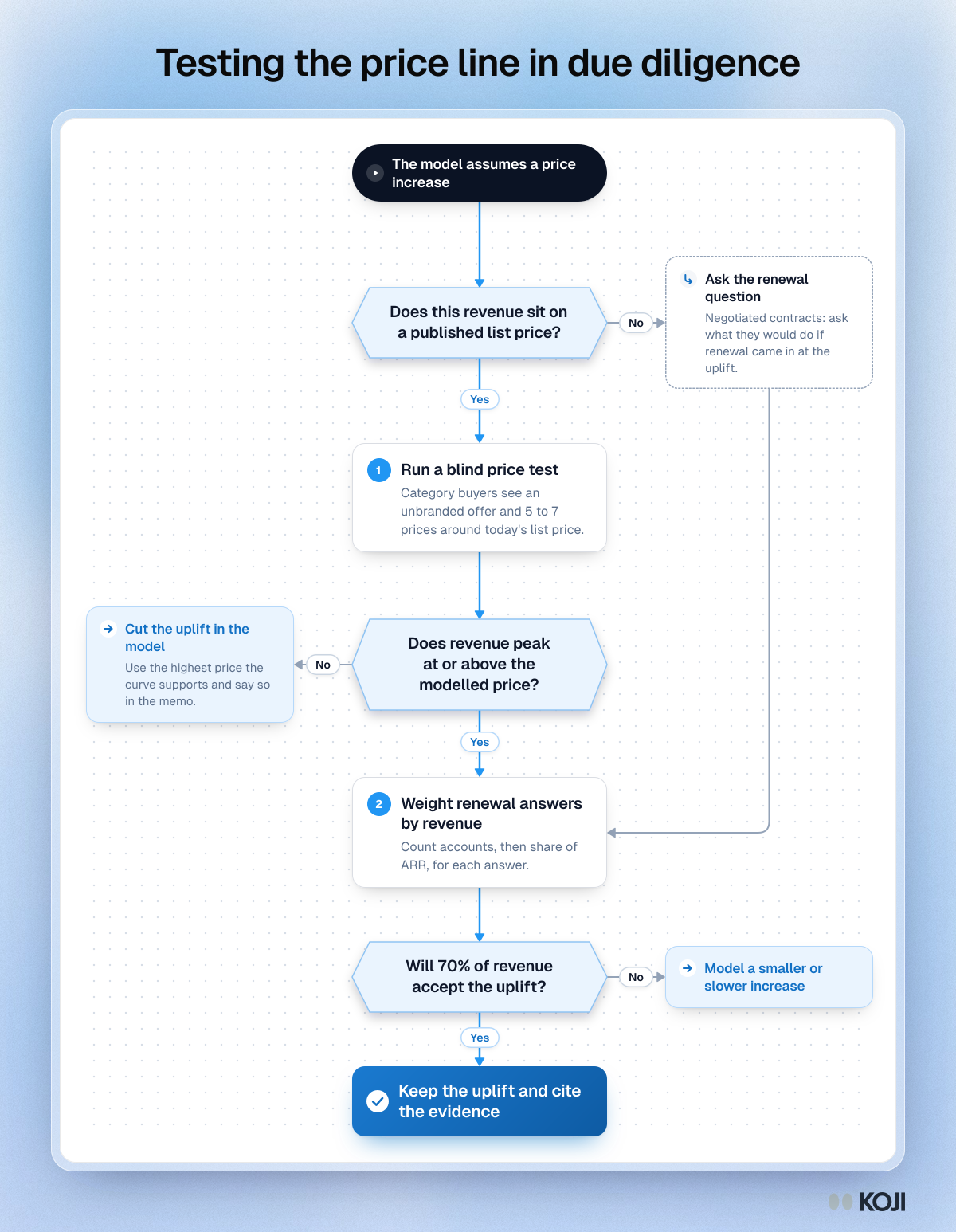
Sample A: the target's current customers. Invited by the seller, under the process letter, with a personal link each. If the target has fewer than 25 customers that matter, invite all of them. Otherwise aim for 30 to 60 completed interviews, stratified by price tier and tenure, with every top-10 account invited and two contacts at each (the user and whoever owns the renewal). Ask about value, alternatives, the last price increase they received and what they would do if the next renewal came in at the modelled uplift. No price ladder here.
Sample B: blind category buyers. People who buy this kind of product but are not told whose it is. Recruit them from a research panel or by job title. Show an unbranded one-paragraph description of the offer and run a price test with 5 to 7 prices. Start the ladder about 20% below today's list price and end one step above the modelled price, so the modelled price is never the top rung. Aim for at least 30 completed interviews per segment you will price separately; 40 to 60 is better.
The verdict. These thresholds are Koji's rule of thumb. Set your own before you read the data and write them in the memo.
- Headroom confirmed: in Sample A, accounts holding at least 70% of the sampled revenue say they would accept the modelled increase without reopening the contract, and in Sample B revenue peaks at or above the modelled price.
- Partial headroom: 50% to 70% of revenue would accept, or Sample B's revenue peaks between today's price and the modelled one. Model a smaller or slower increase.
- No headroom: under 50% of revenue would accept, or Sample B's revenue peaks at or below today's price. Take the price line out of the base case.
The three-week timeline
Counted back from the investment committee (T-0).
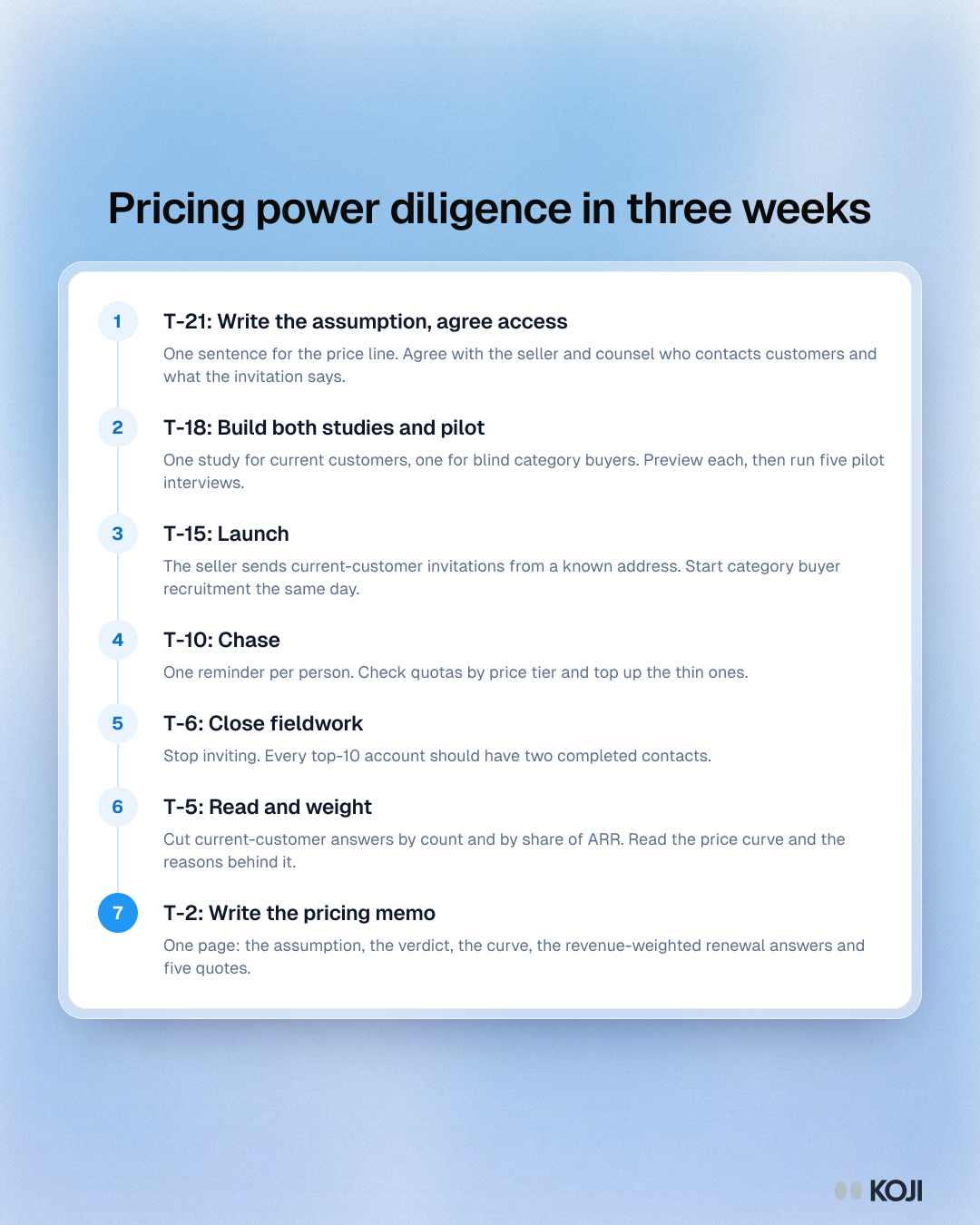
- T-21 to T-19: write the assumption and agree access. One sentence for the price line. Agree with the seller and counsel how, when and by whom customers are contacted, and what the invitation may say. This is not legal advice; settle it in the process letter.
- T-18 to T-16: build both studies and pilot. One study per sample. Preview each yourself, then run five pilot interviews and fix any question that confused people.
- T-15: launch. The seller sends Sample A invitations from a known address. Launch Sample B recruitment the same day.
- T-10: chase. One reminder per person. Check quotas by tier and top up thin ones.
- T-6: close fieldwork.
- T-5 to T-3: read and weight. Cut every Sample A answer by count and by share of ARR. Read Sample B's curve and the reasons behind it.
- T-2: write the pricing memo. One page: the assumption, the verdict, the curve, the revenue-weighted renewal answers and five quotes.
How to set it up in Koji, step by step
Koji's template gallery has due diligence templates. Start Sample A from Customer Reference Checks and Sample B from Competitive Positioning Research, then replace each brief with the one in the guide below. Or paste the one-line brief into "What do you want to research?" and let the research assistant draft the study. You can also ask it directly to help you test pricing.
- Start a study for each sample. Two studies keep the reports clean: Sample A answers are about this product, Sample B answers are about a blind offer.
- Shape the research brief. Write the decision (keep, cut or slow the price line), the audience and what to avoid. Edit it by hand or ask the assistant to change a part of it.
- Add structured questions where you need a number. Koji supports open-ended, scale, single choice, multiple choice, ranking, yes/no and price test questions. In Sample A, use a single choice for the renewal reaction and a 1 to 10 scale for how hard the product would be to replace. For unordered lists, such as who decides, shuffle the options so the first one is not favoured.
- Add the price test to Sample B. Enter 5 to 7 prices (Koji takes 3 to 10), the currency and a unit such as "per user per month". Each person rates how likely they are to buy at one price at a time on a five-point scale; Koji starts them at a random price in the middle of the ladder, moves up or down until it finds the highest price they would still buy at, then asks why. You choose which answer counts as a buy; the default is "Probably would buy" or higher. Prices lock once responses come in, so get the ladder right in the pilot. See the price test setup guide and choosing the prices to test.
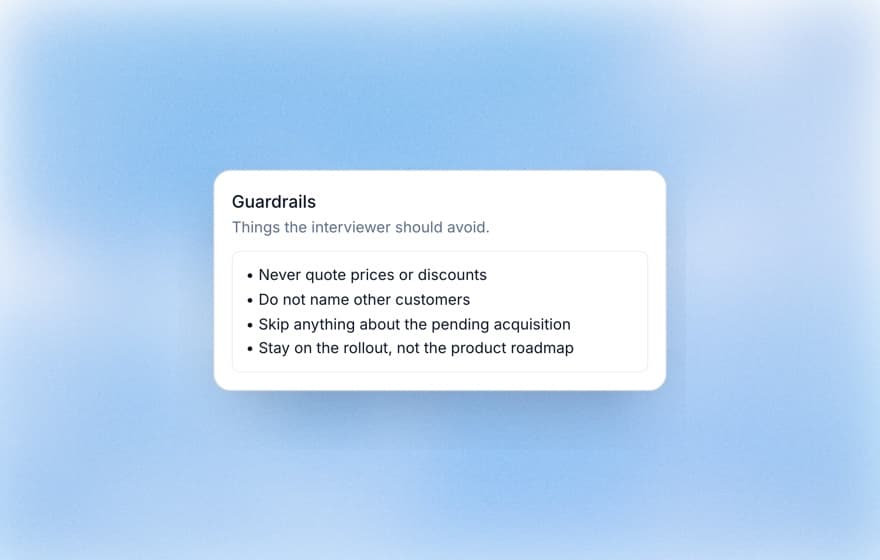
- Set guardrails. List what the interviewer must not do: mention a sale or acquisition, name the target in Sample B, say or suggest to Sample A that an increase is planned, or ask for confidential contract terms. Turn on removal of personal details if you want names and employers taken out of transcripts.
- Choose voice or text, then preview. Both work for the price test. Voice suits senior buyers who would rather talk for ten minutes; text suits everyone else. Previews are free and never reach the report.
- Invite. For Sample A, import the agreed contact list from a CSV so each person gets a personal link, and set a response limit so the study closes at the size you planned. For Sample B, recruit from Koji's research panel or use Find people to search professionals by title, seniority, industry and company size. Add an incentive for Sample B; Koji pays it as a gift card, prepaid card or donation.
- Read the reports. Then download each as an editable PowerPoint deck or a PDF for the memo.
Plan and cost. A text interview costs 1 credit and a voice interview 3, and only interviews that pass the quality check use credits. The price test works on every plan. The Free plan gives 10 credits at signup, enough for the pilot. For the full study, 50 Sample A interviews and 50 Sample B interviews by text use 100 credits; the Researcher plan (€99 a month, 70 credits) plus a credit pack, or the Team plan (€299 a month, 240 credits), covers it. Panel recruitment, Find people, recruitment email and incentives need a paid plan, and panel participants are paid for separately. Check the pricing page before you commit.
Copy this interview guide
Paste this into any tool. In Koji, paste a brief into "What do you want to research?" and edit.
Sample A brief (one line): We want to understand how [Product] customers value it today, what they compare it to, how they reacted to their last price change and how they would respond to a [X]% increase at renewal, weighted by account size.
Sample A opening line: "Thanks for making the time. We are reviewing how the product fits your work and what it is worth to you. We report themes across customers, not individual answers by name. It takes about 10 minutes."
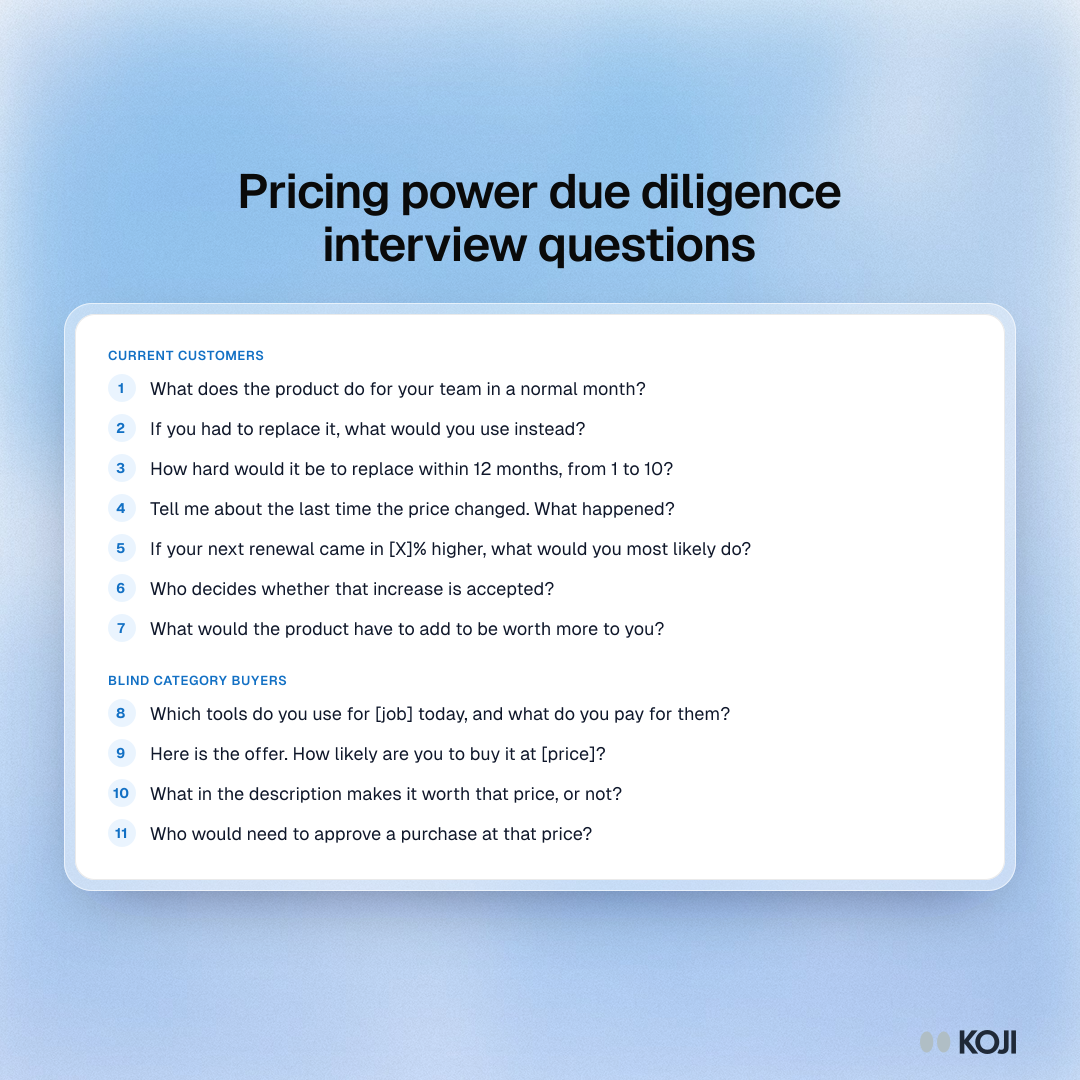
| # | Question | Type | Follow-up probe |
|---|---|---|---|
| 1 | What does the product do for your team in a normal month? | Open | Who else depends on it? |
| 2 | If you had to replace it, what would you use instead? | Open | What would that cost you in time and money? |
| 3 | How hard would it be to replace within 12 months? | 1 to 10 scale | What would make it easier? |
| 4 | Tell me about the last time the price changed. What happened? | Open | Did you negotiate, accept or cut back? |
| 5 | If your next renewal came in [X]% higher, what would you most likely do? | Single choice: accept, accept and ask for more, negotiate it down, cut users or scope, run a tender, cancel | What would make you choose differently? |
| 6 | Who decides whether that increase is accepted? | Single choice: me, my team, procurement, finance, someone else | Does that person use the product? |
| 7 | What would the product have to add to be worth more to you? | Open | Would you pay for that separately? |
Sample A closing question: "Is there anything about the value of the product we have not asked and should have?"
Sample B brief (one line): We want to learn what buyers of [category] software would pay for an offer like the one described, and why, without naming any vendor.
Sample B opening line: "We are researching how teams buy [category] tools. We will show you a short description of an offer and ask what you would pay. There are no right answers."
| # | Question | Type | Follow-up probe |
|---|---|---|---|
| 1 | Which tools do you use for [job] today, and what do you pay for them? | Open | How did you choose? |
| 2 | Here is the offer: [one unbranded paragraph]. How likely are you to buy it at [price]? | Price test, 5 to 7 prices, per user per month | Koji asks why at the highest price they would buy at |
| 3 | What in the description makes it worth that price, or not? | Open | What is missing? |
| 4 | Who would need to approve a purchase at that price? | Single choice: me, my manager, procurement, finance, a committee | How long would that take? |
Sample B closing question: "What would make you pay more for a tool like this?"
What you get
Two reports. In Sample A, themes are ranked by how many participants raised them, with the quotes behind each, and the renewal-reaction and replaceability answers show as distributions. In Sample B, the price test shows the share who would buy at each price, the revenue each price implies and the price that earns the most, with the reasons people gave. Koji flags when the curve needs more care: when prices within 10% of the top revenue are effectively tied, when one in five would buy even at the top price (try higher prices), when one in five would buy at none (try lower ones), and when fewer than 30 people answered.
How you use them before the committee:
- The memo's verdict line: headroom confirmed, partial or none, with the revenue-weighted Sample A split and Sample B's curve side by side.
- The model: replace the plan's price line with the one the evidence supports, and say so.
- The SPA and the 100-day plan: accounts that would "run a tender" at the modelled uplift are the ones to protect with multi-year terms after close, not to push in year one.
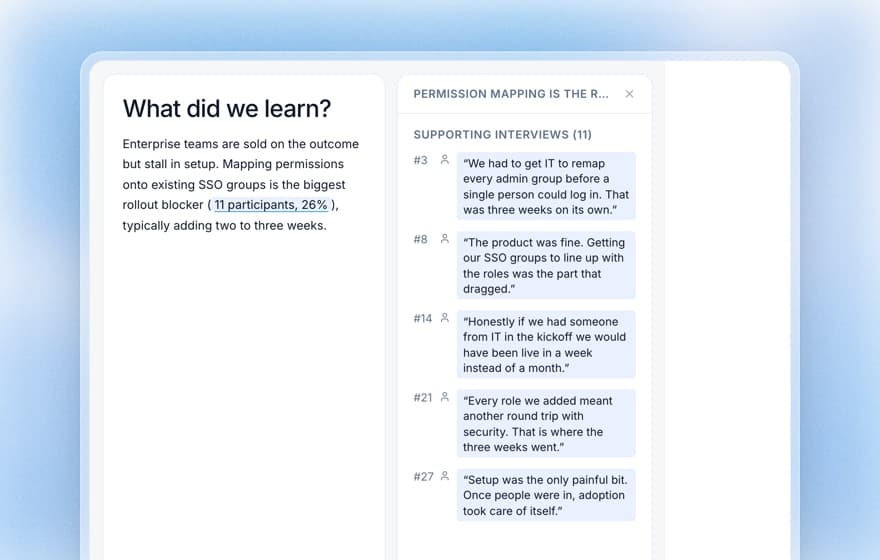
- The IC question you will get: "who said that?" Each finding links to the interviews that support it (tracing report findings to evidence).
The same playbook elsewhere
Customer success teams run the post-close version when the letter goes out: price increase rollout interviews hear accounts before and after. Operating partners test a different threat to the same revenue in AI substitution interviews. Founders face the reverse question, what to charge at all, in price testing methods compared. Borrow the CS habit of naming who signs off on an increase: in diligence, the renewal owner's answer is the one that counts. See every deal-team playbook at the due diligence use-case library.
Why Koji for pricing power diligence
The realistic alternatives are a pricing consultancy, expert network calls, and a survey or conjoint study. Simon-Kucher, for example, offers pricing due diligence; one of its case studies describes a European PE firm's software acquisition, worked outside-in, that used more than 40 expert interviews, a B2B customer survey of 120 and more than 350 cold calls to existing customers (Simon-Kucher case study). Expert networks such as GLG run expert calls and surveys for PE funds (GLG). Conjoint software such as Sawtooth's Lighthouse Studio models choice and price trade-offs (Sawtooth). None of these publishes a project price we could verify.
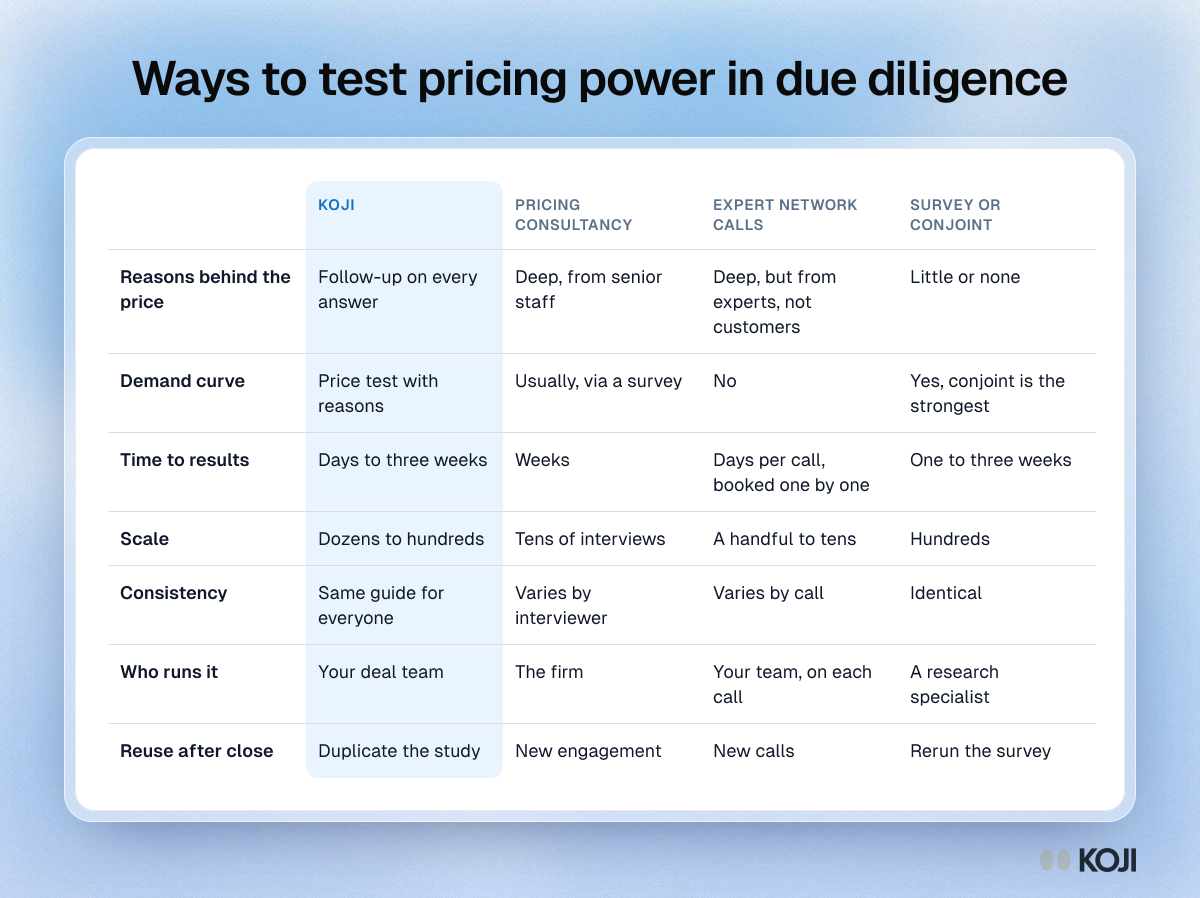
| Criterion | Koji | Pricing consultancy | Expert network calls | Survey or conjoint |
|---|---|---|---|---|
| Reasons behind the price | Follow-up on every answer | Deep, from senior staff | Deep, but from experts, not customers | Little or none |
| Demand curve | Price test with reasons | Usually, via a survey | No | Yes, conjoint is the strongest |
| Time to results | Days to three weeks | Weeks | Days per call, booked one by one | One to three weeks |
| Scale | Dozens to hundreds | Tens of interviews | A handful to tens | Hundreds |
| Consistency | Same guide for everyone | Varies by interviewer | Varies by call | Identical |
| Who runs it | Your deal team | The firm | Your team, on each call | A research specialist |
| Reuse after close | Duplicate the study | New engagement | New calls | Rerun the survey |
A consultancy is the right call when you need a full pricing strategy and a senior adviser to defend it at committee. Conjoint is stronger than any interview when the question is a trade-off between features and price across hundreds of buyers. Expert calls are good for the category story. For the middle ground, dozens of customers whose reasons you need inside an exclusivity window, Koji is built for the job:
- The price test and the interview are one conversation. People give the highest price they would buy at, then say why in their own words.
- Follow-ups on every answer. "We'd just accept it" gets "what would make you push back?" every time.
- Personal links from a CSV. You know which account answered, so you can weight by revenue and chase the missing ones.
- Guardrails. The interviewer will not mention the deal or name the target in the blind sample.
- Built-in warnings on the curve. Small samples, tied prices and ladders that stop too low are flagged in the report.
Questions you might have about AI interviews
Can I trust stated willingness to pay? Not at face value, and the report says so: it labels the price test as directional, because people say they would buy more often than they do. Research on purchase intent backs this up: Morwitz, Steckel and Gupta's 2007 review in the International Journal of Forecasting found that intentions predict sales, but imperfectly, and better for products people already know and for purchases that are near (Morwitz et al., 2007). Sawtooth makes the same point to argue for conjoint over direct questions. That is why the Headroom Test does not rest on the curve alone: Sample A asks what customers did at their last increase, which is behaviour, not intent. Read more in how to read a price test.
Will senior customers talk to an AI, and will they work out there is a deal? The invitation comes from the seller, from a name the customer knows, and says how long it takes. Guardrails keep the sale out of the conversation, and Sample A only hears a hypothetical renewal question, never a planned price. Offer voice and text so executives can choose. See how AI interviewers work.
Where does the data go? Read AI interview data privacy and security and agree the data-handling terms with counsel before launch. Removing personal details takes names, emails and employers out of transcripts when an interview ends. Teams that need their own model keys can use bring-your-own-key on Enterprise plans (docs).
When Koji may not be the right fit
If the target has fewer than about 15 customers that matter, call each of them with the seller's blessing; a quota means nothing at that size. If pricing is set by tender or regulated tariffs, customers cannot tell you much about headroom; look at the bid history instead. If the question is a full repackaging of tiers and features, use conjoint, and use interviews to explain its results. And no interview replaces the price and churn history in the data room. Use that history to choose who to ask and interviews to learn why.
Metrics to track
- Completed interviews per tier, against quota, in each sample
- Share of top-10 accounts reached, with two contacts each
- Share of sampled ARR that would accept the modelled uplift
- Share choosing "run a tender" or "cancel", by count and by ARR
- Sample B: share who would buy at today's price and at the modelled price
- Days from first invitation to the pricing memo
FAQ
How many interviews do I need for pricing power due diligence? For current customers, invite all of them below 25 accounts; otherwise aim for 30 to 60 completes across tiers, with every top-10 account. For the blind price test, at least 30 per segment you price separately, 40 to 60 if you can.
Can I run a price test on the target's own customers before signing? You can, but we advise against it. It signals an increase is coming and needs the seller's explicit agreement. Ask current customers about renewal reactions and run the ladder on a blind category sample.
How many prices should the ladder have? Five to seven, evenly spaced, from about 20% below today's list price to one step above the modelled price. Koji accepts 3 to 10.
How long does it take? About three weeks: three days to agree access and write the assumption, three days to build and pilot, ten days of fieldwork and four days to read and write the memo.
What does it cost? Text interviews cost 1 credit and voice interviews 3. The price test is on every plan; a full two-sample study fits the Researcher plan plus a credit pack or the Team plan, with panel participants paid for separately.
Test the price line before the committee does
Start Sample A from the Customer Reference Checks template and Sample B from Competitive Positioning Research in the dashboard, or paste a brief above into "What do you want to research?". See Koji for due diligence and the commercial due diligence interview guide.