To test messaging in multiple markets, show the same two or three messages to buyers in each market, in their own language, and ask them what they understood, which one they would act on and why. Running it as AI-moderated interviews means every answer gets a follow-up in the participant's language, the pick stays comparable across languages, and you read the reasons in your own language a few days later instead of after a month of local fieldwork. By the end of this playbook you will be able to run a multi-market message test this month, with a copy-ready interview guide, a decision rule for picking a winner per market, and the exact setup in Koji.
This is for product marketers, brand leads and regional marketing managers who are about to launch a campaign, a new positioning or a product in more than one country, and who suspect that a good translation is not the same as a message that works.
Why multi-market message testing matters now
Most marketing teams already translate. Far fewer check whether the translated message still does its job.
The evidence that messages don't travel on their own is old and consistent. Kantar told Spikes Asia in 2019 that only 40% of the ads it tested transferred well within Asia, and about 52% globally (Campaign Asia, 2019). Kantar's Canadian team found in 2025 that about one third of highly effective US ads have a reduced impact in Canada, a market that shares a language and most of its media with the US (Kantar, 2025). If a message can lose its edge crossing the 49th parallel, it can lose it crossing into Germany or Japan.
What gets lost is rarely the literal meaning. In a February 2026 Lokalise survey of 392 marketers and company leaders who localize content, 43% said humor is the creative element most often lost in translation, and 39% said it is the hardest to localize well (Lokalise, 2026). Tone, idiom and the claim that sounded confident in English are where a message breaks.
And language still decides whether people engage at all. CSA Research's survey of 8,709 consumers in 29 countries found that 76% prefer to buy products with information in their own language (CSA Research, 2020).
So why don't teams test? Their own answers point at money and missing local knowledge. In a September 2026 NP Digital survey of 600 marketers, cost was the top barrier to effective localization (31%), followed by lack of local market expertise (16%), slow approval processes (13%) and insufficient data (10%). Poor coordination between global and local teams was named by 2% (NP Digital, 2026).
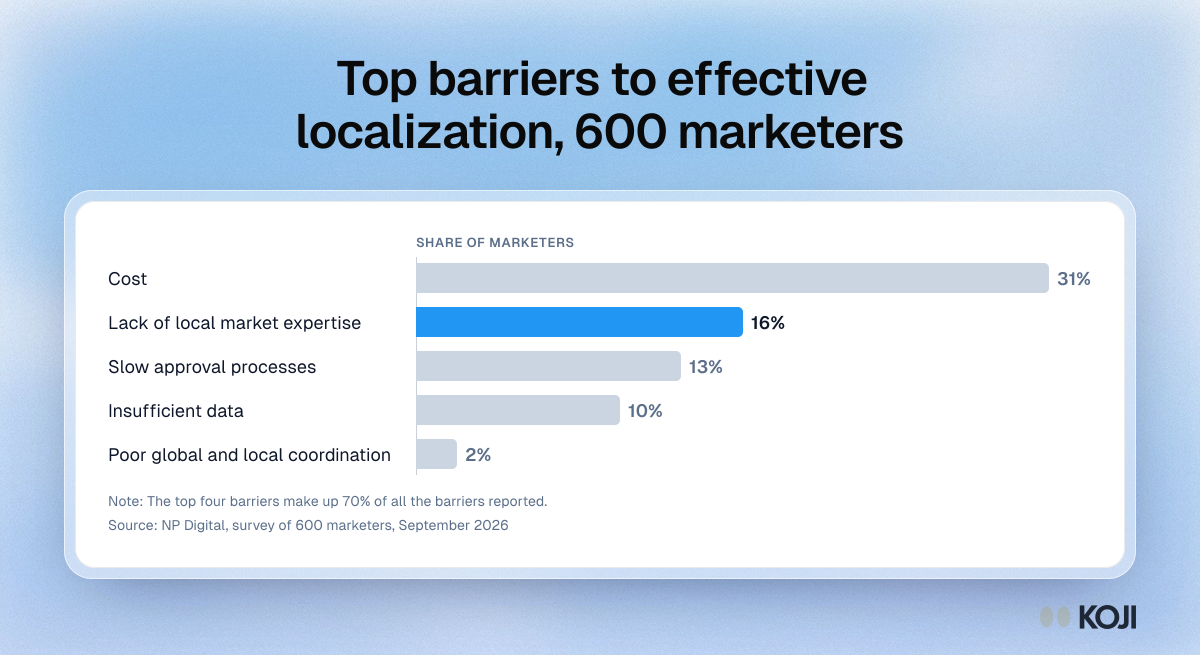
Two of those four barriers, local expertise and data, are exactly what a round of interviews in each market gives you. The same survey found that 67% of marketers want AI to own translation while 93% want humans on final campaign sign-off (NP Digital, 2026). Machine translation is now the easy part. Knowing whether the message lands is the part people still want evidence for, and it is the part most teams skip.
The cost of skipping it shows up in what you are measured on: media spend behind a message that one market shrugs at, a regional pipeline target missed, and a global team that never learns why. NP Digital's survey also found that only 3% of local discoveries are ever scaled globally (NP Digital, 2026). Testing across markets in one study is how a local insight reaches the people who write the next global brief.
What good looks like
After running this many times, the pattern that works is what we call the 3x3 market read: at most three messages, three markets first, and three things you read for every message in every market.

Photo by Leandro Barreto on Unsplash
Three messages, not six. Each extra message adds an exposure, makes the interview longer and blurs the pick. If you have six, cut to three in an internal review first. A typical set is the current message, the new one and a deliberately different angle (a pain-led line against an outcome-led one).
Three markets first. Start with the market you know best as a control, plus the two where the spend or the risk is highest. Add the rest once the method works.
Three reads for every message:
- Recall. Shown the message for five seconds, what do they remember? If the core claim isn't in the answer, the message failed before preference matters.
- Understanding. In their own words, what is this company offering? Compare that to what you meant. This is where translation errors and cultural misreads show up.
- Pull. Which message would make them want to learn more, and why? The pick is the number. The why is what you act on.
How many interviews. Plan 20 to 30 completed interviews per market for a directional pick with clear reasons. Go to 50 per market when the result will decide a large media budget and you need the split to be convincing. Below 15 per market, treat the result as a pilot.
Who to talk to. People who match the buyer you will spend media on in that market, not your existing customers there. Customers already know your product, so they read the message through what they know. Use customers only for a separate check that the new message doesn't confuse them.
The decision rule. A message wins a market only when three things hold: it gets the most picks, most people in that market describe the offer the way you meant it, and nobody flags a word in it as odd or foreign. If two messages are close on picks, take the one people described more accurately. If markets disagree, look at the reasons. Different reasons (Germany wants proof, Brazil wants speed) justify a local message. The same reasons with a different pick are usually noise, so keep the global message.
Common mistakes:
- Translating, then testing in English. A message tested only in the source language tells you nothing about the market you are spending in.
- Testing on customers. They already believe you. Test on cold buyers.
- Asking "which do you prefer?" first. Ask what they remember and understood before you ask them to choose, or the pick colours everything after it.
- Showing messages in the same order to everyone. The first message gets an advantage. Swap the order for half your sample (see the setup below).
- Reading the pick without the reasons. A message can win on picks and still be misunderstood. Always check the understanding question.
- Running one market at a time. By the time the third market is done, the campaign is live. Field all markets in the same week.
One study or one per market?
You can run the whole test as one study in every language, or as one study per market built from a single master. Pick by what you need to decide.
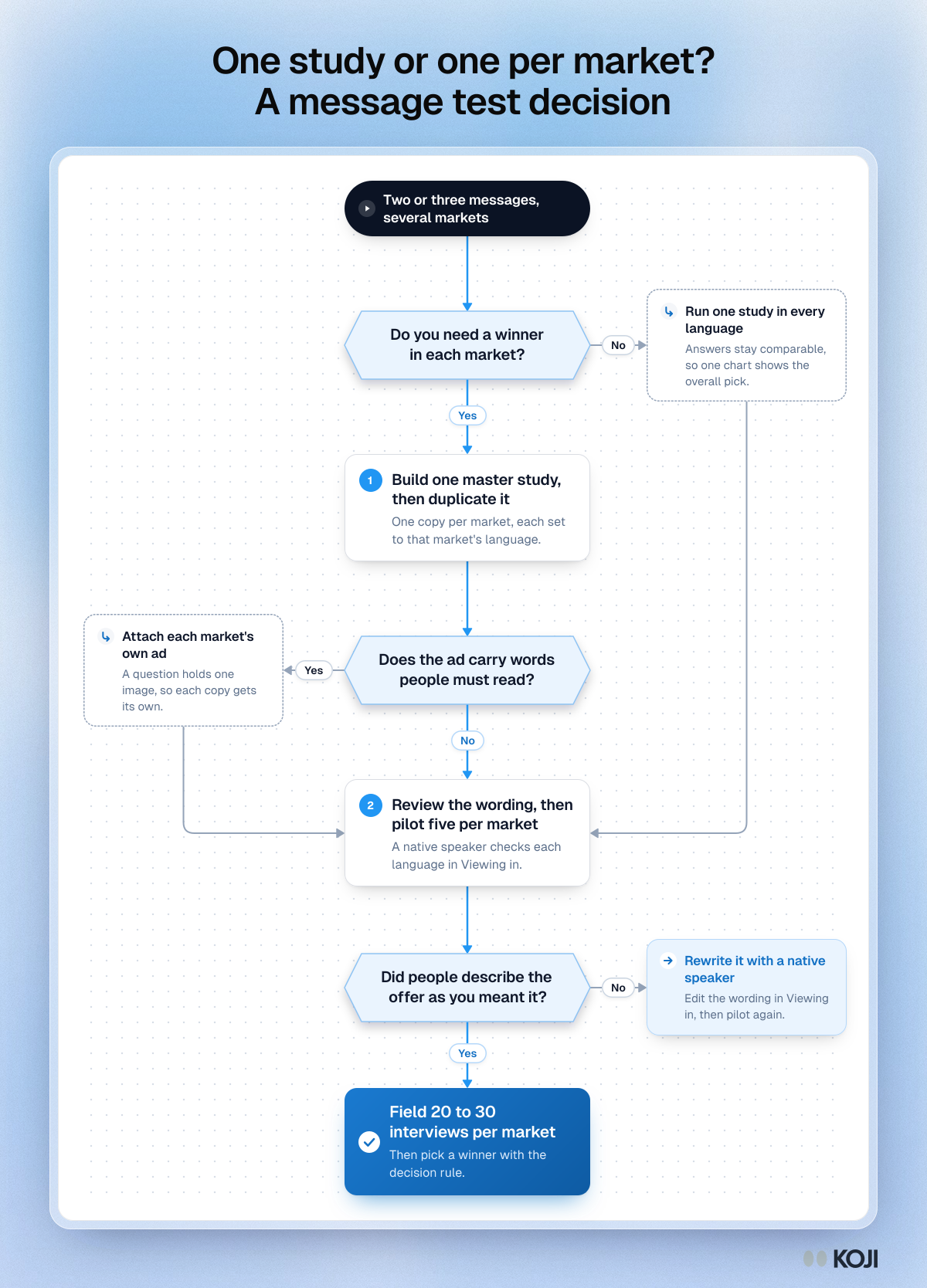
- One study in every language gives you one chart where every answer is stored against the original options, so the pick is comparable across languages. Use it when you want the overall winner across a region, with quotes from each market.
- One study per market gives each market its own report and its own creative. Use it when you need a winner in each market, or when the ad itself carries words that people have to read, because a question holds one image.
Most teams launching a campaign need a winner per market, so the setup below builds one master study and duplicates it.
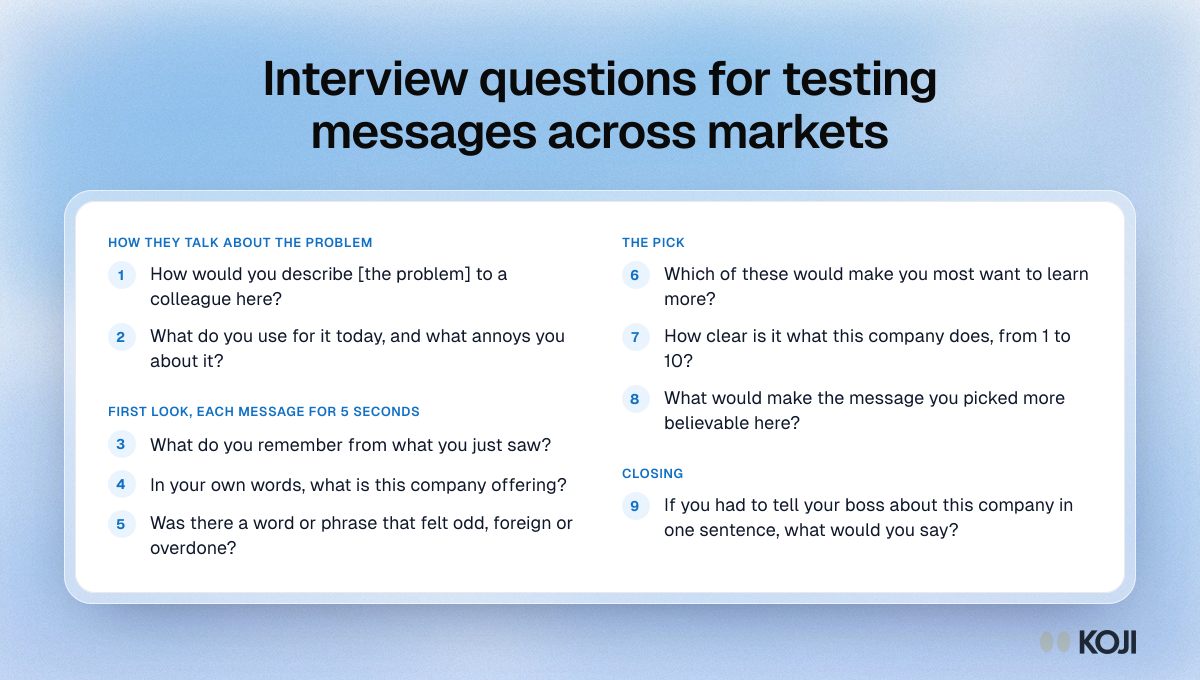
Copy this interview guide
Paste this into any tool, or into Koji. Replace the brackets.
Opening: "Thanks for helping. I'm going to show you a few short messages from a company in [category] and ask what you make of them. There are no right answers, and nothing you say will be passed on with your name."
- Open: How would you describe [the problem] to a colleague here? Probe: what word would you use for it at work?
- Open: What do you use for it today, and what annoys you about it? Probe: what did you try before that?
- Open, with Message A shown for 5 seconds: What do you remember from what you just saw? Probe: what stood out first?
- Open: In your own words, what is this company offering? Probe: who do you think it's for?
- Open, with Message B shown for 5 seconds: What do you remember from this one? Probe: how is it different from the first? (Repeat 3 to 5 for Message C.)
- Open: Was there a word or phrase in any of them that felt odd, foreign or overdone? Probe: how would someone here say it?
- Single choice, options shuffled, "None of these" kept last: Which of these would make you most want to learn more? Probe: what made you pick it over the others?
- Scale, 1 to 10: How clear is it what this company does, from the message you picked? Probe: what would make it clearer?
- Open: What would make the message you picked more believable here? Probe: what proof would you look for?
Closing: "If you had to tell your boss about this company in one sentence, what would you say?"
One-line research brief for Koji's "What do you want to research?" box: "Find out which of our three launch messages buyers in [market] remember, understand and would act on, and why, so we can choose a message for each market before the campaign."
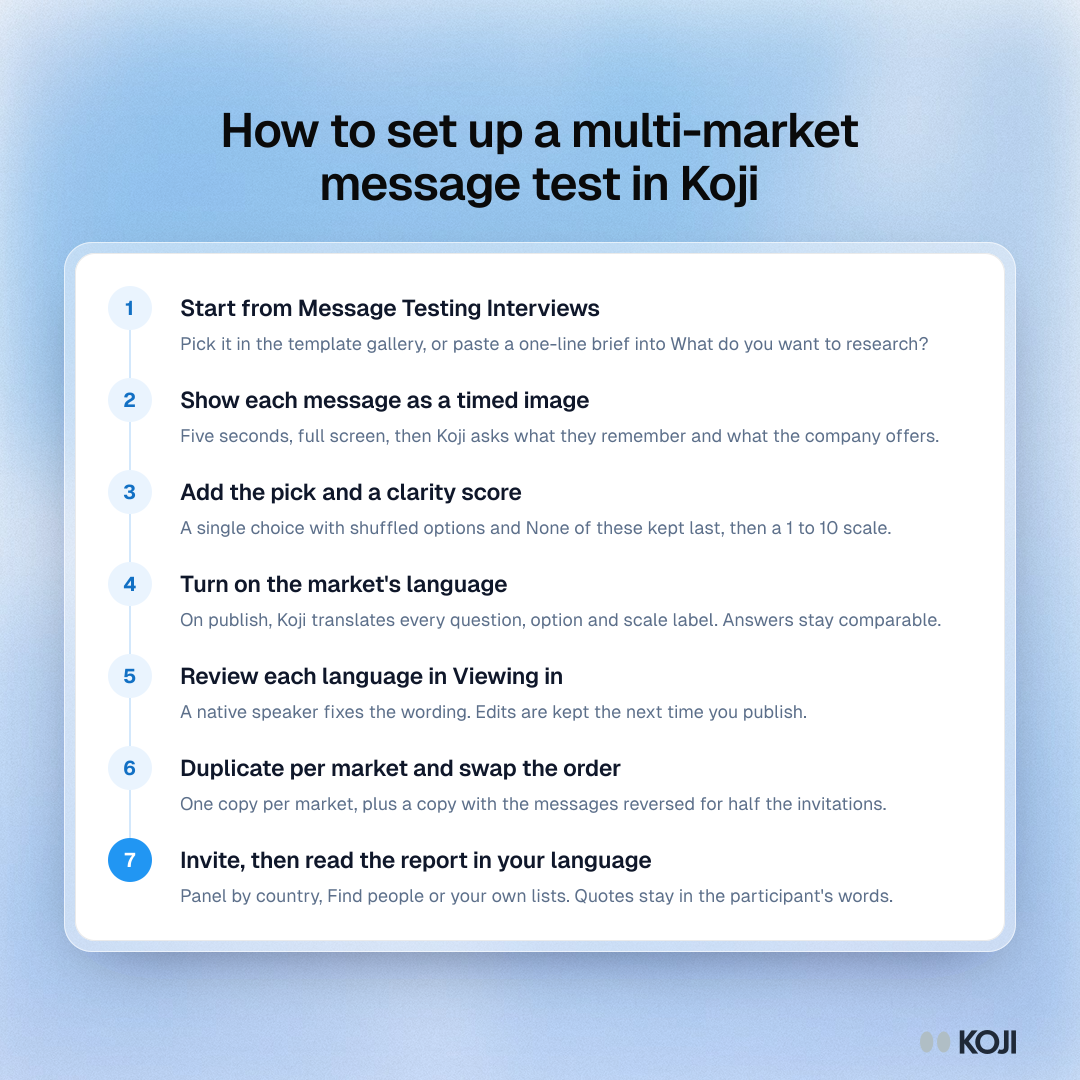
How to set it up in Koji, step by step
- Start from the template. Open the template gallery and start from Message Testing Interviews, or paste the one-line brief above into "What do you want to research?" on the home screen. The research assistant drafts the goal, the questions and the follow-up approach. Ask it for changes in plain words ("add a third message after question 5").
- Put each message in its own question. Attach the message (an ad, a headline card or a landing page screenshot) as an image on questions 3 and 5, and turn on the timed view for 5 seconds. The image is shown once, full screen, then hidden, and Koji asks what they remember. Koji knows what the image shows, so its follow-ups are about the message. When the message is only words, you can put the line in the question text instead, and it will be translated with everything else.
- Add the pick and the clarity score. Make question 7 a single choice question listing the messages, turn on option shuffling and keep "None of these" in place at the end. Make question 8 a 1 to 10 scale with a label at each end. The structured questions guide covers each type.
- Turn on the market's language. In the Context tab, choose the interview language. Koji runs interviews in more than 30 languages and, when you publish, translates every question, answer option, scale label and ranking item. Answers are stored against the original options, so charts stay comparable.
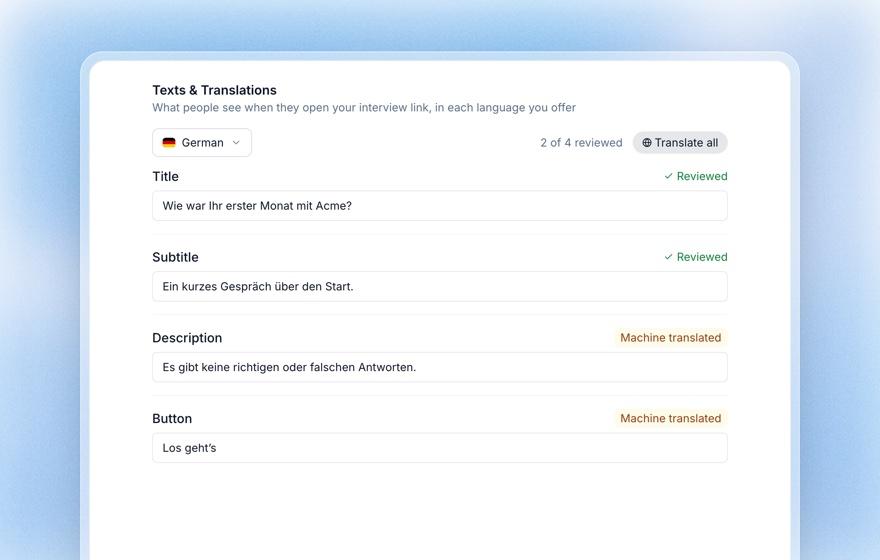
- Review every language before you field. Use the "Viewing in" toggle in the research brief header to read the study in each language. Have a native speaker fix anything that reads like a translation. Your edits are kept the next time you publish. Then run a preview interview in that language yourself.
- Duplicate for each market and for order. Duplicate the study from its card menu. The copy keeps the brief and settings, so you only change the language and, if the ad carries words, swap in that market's creative. For each market, make a second copy with Message B shown before Message A and send half your invitations to it.
- Invite people in each market. Recruit from Koji's panel filtered by country, use Find people to reach professionals by job title, seniority and location, or email your own lists from Participants with reminders. Text interviews cost 1 credit and voice interviews 3.
- Read the report in your own language. Set the report language to yours. Findings show the share of participants behind each theme with the quotes that support it, and the quotes stay in the participant's words. Each structured question gets its own chart.
Check every language before you publish
The interview's welcome texts are translated too, and you can edit them per language in Texts and Translations.
Which plan you need. Multilingual studies, question images with timed views, shuffled options, duplication and report downloads are on every plan, including Free, which comes with 10 credits at signup. That is enough to pilot one market. Recruiting from the panel, Find people and recruitment email need a paid plan (Insights, Interviews or Enterprise), and private invite links from a CSV need Interviews or Enterprise.
What you get
For each market, a report that tells you what people remembered from each message, how they described your offer, which message they would act on and how clear they found it, with the quotes behind every theme. You can download it as an editable PowerPoint deck or a PDF.
How marketers use it the next day:
- In the launch review, a slide per market with the pick, the clarity score and the two quotes that explain it. That settles the "global or local message" debate with evidence instead of opinion.
- For the regional teams, the words buyers used to describe the problem in question 1. These become ad copy and search terms in each language.
- For the agency or translators, the list of words people flagged as odd in question 6, with how locals would say it. That is a transcreation brief written by the market.
- For the global brief, the reasons that repeat across markets. Those belong in the master message.
The same playbook elsewhere
The method carries well beyond campaign launches:
- Agencies fielding one client guide in many languages use the same review and comparison steps; see multi-market qualitative research for agencies.
- Founders about to enter a country can run the first three questions of this guide before translating anything; see research a new country before you translate.
- Researchers comparing scale answers across languages should read translating rating scales before trusting the 1 to 10 question across markets.
Earlier marketing playbooks pair with this one: buying group mapping tells you who in each market to put the message in front of, and self-reported attribution tells you, after launch, whether the message is what brought them in.
Why Koji for multi-market message testing
The realistic alternatives are a survey tool with translations, a B2B message testing panel, or a local agency in each market. Each does part of the job well.
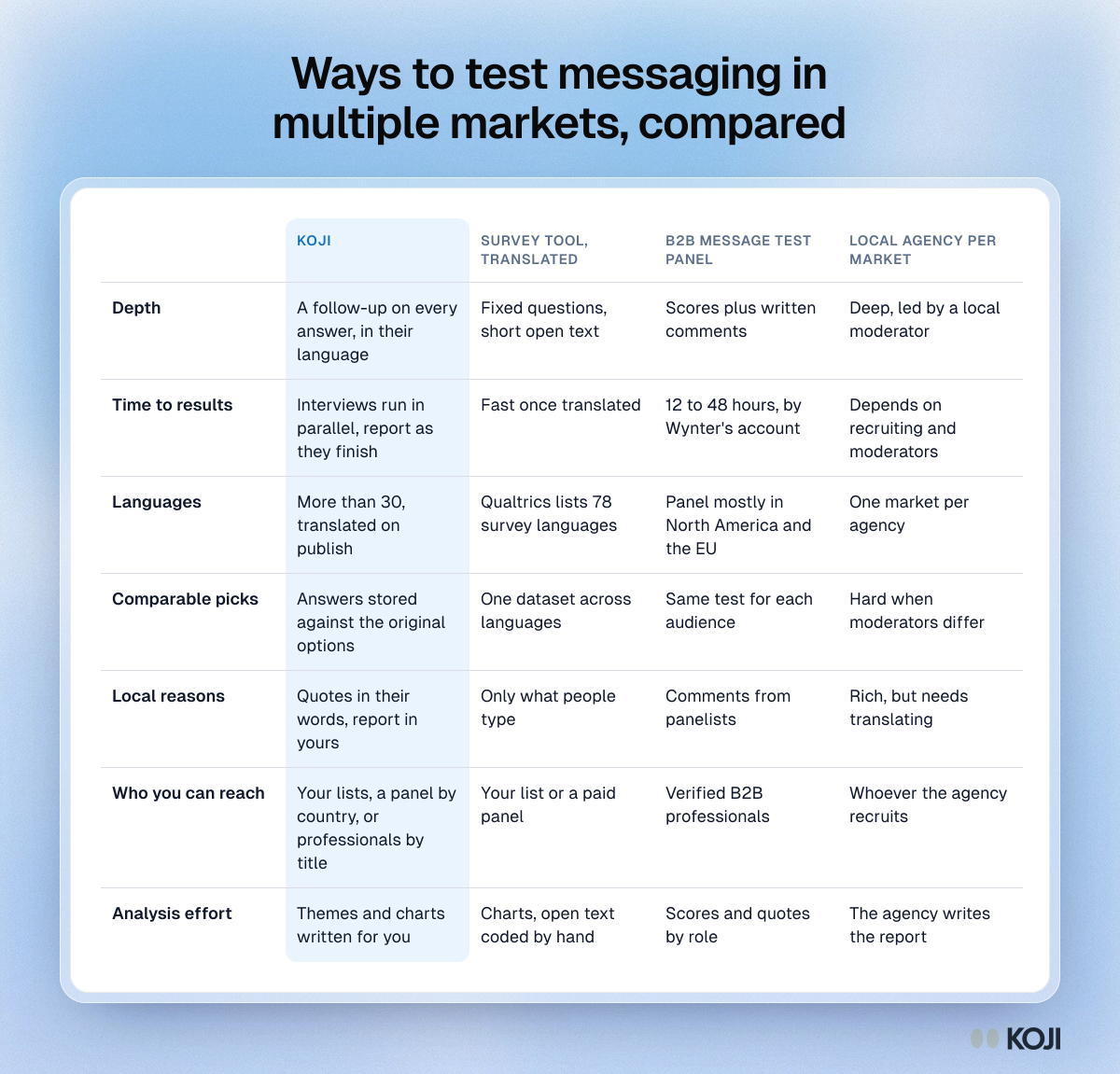
Survey tools such as Qualtrics hold every language version in one survey, so results land in one dataset, and offer machine, uploaded or professional translation in 78 languages (Qualtrics). They are strong for large samples, but open answers are only as good as what people bother to type. Wynter tests B2B messages with verified professionals, mostly in North America and the EU, and returns scores with quotes, usually within 12 to 48 hours by its own account (Wynter). It is fast for English-speaking B2B audiences. A local agency gives you depth and a moderator who knows the culture, at the cost of time and of comparing reports written by different people.
Where Koji fits:
- Follow-up in every language. Every answer gets a probe in the participant's own language, so you hear why a message landed as well as whether it did.
- Comparable answers across languages. Choice, scale and ranking answers are stored against the original options, whatever language the participant saw.
- A review step built in. "Viewing in" lets a native speaker read and edit each language, and the edits survive republishing.
- First-impression tests on the message itself. Timed images give you a five-second test followed by a real conversation about it.
- One report language for the whole team. Write the report in yours while quotes stay in theirs.
Questions you might have about AI interviews
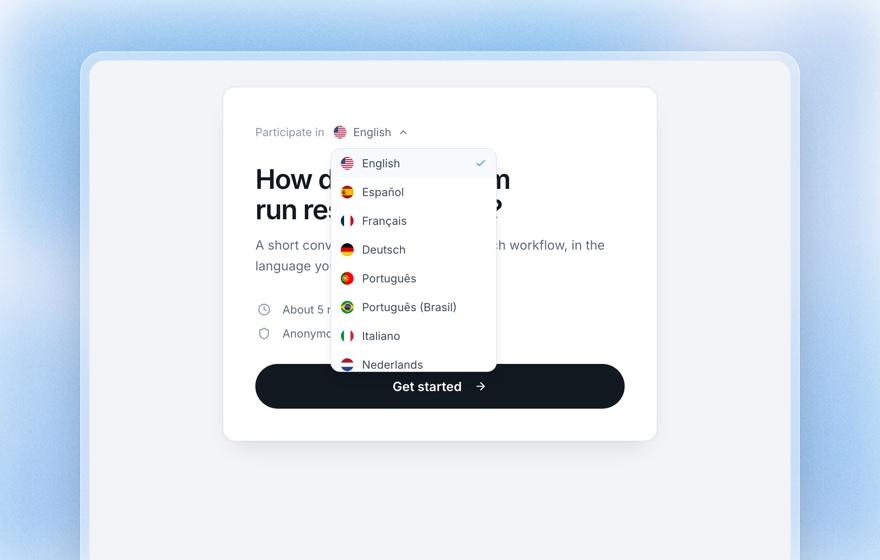
Will professionals in other markets talk to an AI about ads? They take part when the ask is short and in their language. The interview opens with a language selector, takes a few minutes, and participants choose text or voice when you turn on both, so a buyer can answer between meetings.
Can I trust machine-translated questions? Treat the translation as a first draft. Review each language in "Viewing in", have a native speaker edit it, and run a preview interview before you field. Never call it certified.
Are answers in different languages really comparable? The stored answers are. The meaning behind a scale point may not be: a 7 in one culture is not always a 7 in another. Compare picks with more confidence than scale averages, and read measurement invariance before comparing scores. Turn on "remove personal details" if you plan to quote people in internal decks.
When Koji may not be the right fit
If you need to measure in-market behaviour, a live A/B test of the ads with real spend will tell you more than any interview, because what people say they would click is not what they click. If you need precise preference shares across thousands of respondents, a survey is cheaper per answer. And if the market requires in-person research, such as testing packaging on a shelf, Koji runs online interviews only. Use Koji to choose which messages are worth the live test.
Metrics to track
- Pick share per message per market, from question 7.
- Understanding rate: the share of interviews where the description of the offer matches your intent.
- Flagged-word count: how many people flag the same word or phrase as odd.
- Clarity score per market, read alongside the quotes rather than averaged across markets.
- After launch: click-through and conversion by market for the winning message, compared to the message you would have run.
FAQ
How many markets can I test at once? As many as you can recruit for, but start with three: the market you know best as a control and the two with the most spend at risk. Add more once the method works.
Should I translate or transcreate the messages before testing? Transcreate. Have a native speaker rewrite each message for the market, then test it. Testing a literal translation mostly tells you the translation was literal.
How many interviews do I need per market? 20 to 30 completed interviews per market for a directional pick with clear reasons, 50 when the result decides a large media budget. Under 15, treat it as a pilot.
Can I test ads that contain text in different languages? Yes. A question holds one image, so run one study per market, duplicated from a master, and attach each market's own creative.
Who should I interview, customers or prospects? Prospects who match the buyer you will spend media on. Customers already know you and read the message through that.
Start your multi-market message test
Start a free Koji account, open the template gallery and pick Message Testing Interviews, or paste the one-line brief into "What do you want to research?". Build the first market, review it in "Viewing in", and pilot five interviews before you duplicate it for the next market. See how marketing teams use Koji on the marketing page, and every marketing playbook in the use-case library. For the method behind message tests, read the messaging testing guide and the multi-language research guide, and for wording reviews, translating research questions.