Audit Trail in Qualitative Research: What to Keep and How to Show It
What an audit trail is, the six kinds of records Lincoln and Guba recommend, how much a product or UX study needs, how to keep a decision log, how a colleague can audit it, and a reusable checklist.
Short answer: An audit trail in qualitative research is the record that lets someone else follow how you got from raw data to findings: what you collected, how you coded it, which decisions you made along the way and why. Lincoln and Guba made it the main test of two of their four trustworthiness criteria, dependability and confirmability. In practice it is a folder and a decision log kept while you work, not a document written at the end. If a sceptical stakeholder can pick any finding in your report and trace it back to the quotes and the coding decisions behind it, you have one.
Start today: open a plain document called "Decision log" next to your current study. Every time you change a question, drop a participant, merge two codes or reword a theme, add one line: the date, what changed, and why. That single habit covers most of what an auditor would ask for.
This guide explains what goes into an audit trail, the six kinds of records Lincoln and Guba recommend keeping, how much is enough for a product or UX study, and a checklist you can reuse. It's part of Koji's series on rigour, alongside qualitative research validity, reflexivity and member checking.
Why an audit trail matters
Qualitative findings are interpretations. Two researchers can read the same transcripts and come away with different themes, and both can be defensible. What makes a finding trustworthy isn't that nobody could disagree with it. It's that anyone who does disagree can see exactly how you reached it and judge for themselves.
Yvonna Lincoln and Egon Guba set this out in Naturalistic Inquiry (1985), which proposed four criteria for trustworthy qualitative work in place of the quantitative ideas of validity, reliability and objectivity.
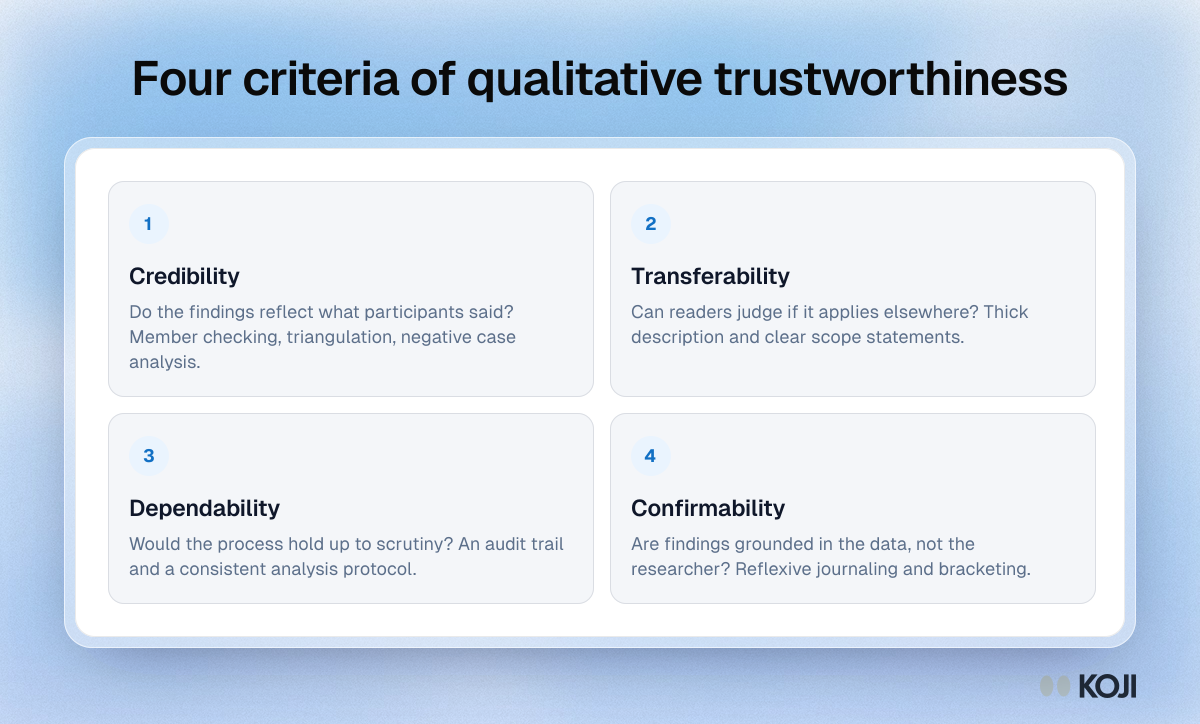
The audit trail serves two of them:
- Dependability asks whether the process was consistent and well documented: could someone follow what you did, and would it hold up?
- Confirmability asks whether the findings come from the data rather than from the researcher's assumptions: can each conclusion be traced to what participants actually said?
Lincoln and Guba's point was economical: "a single audit, properly managed, can be used to determine dependability and confirmability simultaneously." One well-kept trail answers both questions.
The gap between knowing this and doing it is large. Aref and colleagues (2021) reviewed qualitative studies in community pharmacy against the Standards for Reporting Qualitative Research. Trustworthiness techniques were absent or only partly reported in 21 of the studies, 68%, and the research approach and reflexivity were missing or partial in 30, or 97%. Those were peer-reviewed papers. Internal research reports in product teams rarely do better.
What an audit trail contains
Marian Carcary (2009) splits the trail in two. The physical audit trail documents the stages of the study and its key methodological decisions: who you recruited, which guide you used, how you coded. The intellectual audit trail shows how your thinking changed: the hunches you started with, the moments you changed your mind, and why.
Most teams keep some of the first and almost none of the second. The second is what lets a reader tell a finding you discovered from a belief you brought in.
Lincoln and Guba drew on Edward Halpern's 1983 work to list six classes of records an auditor would want to see.
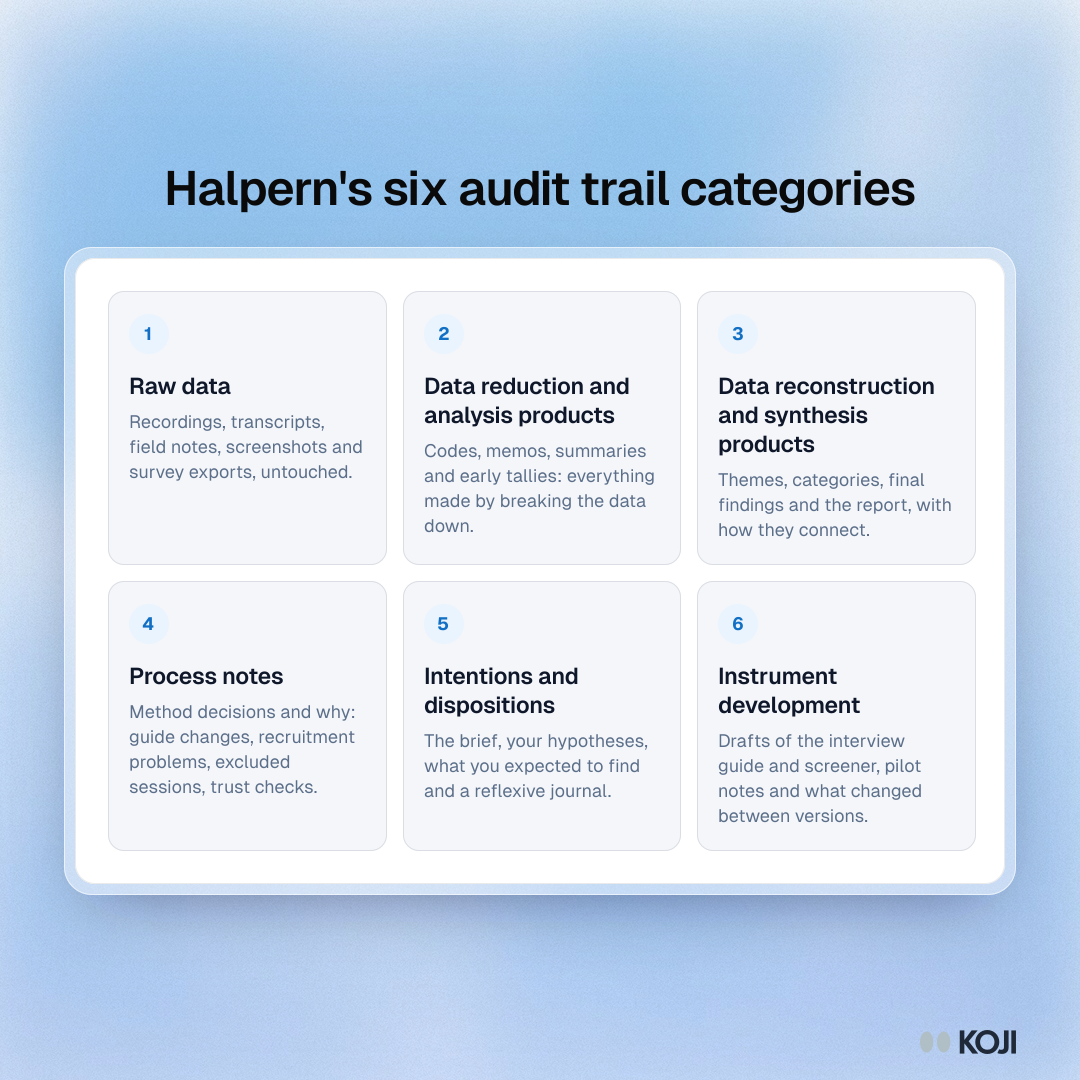
- Raw data. Recordings, transcripts, field notes, screenshots, survey exports. The untouched record of what people said and did.
- Data reduction and analysis products. Codes, memos, summaries, early tallies. Everything you made by breaking the data down.
- Data reconstruction and synthesis products. Themes, categories, the final findings and the report itself, along with how they relate to each other.
- Process notes. Methodological decisions and why you made them: changes to the guide, recruitment problems, why a session was excluded, what you did to check trustworthiness.
- Materials relating to intentions and dispositions. The research brief, your hypotheses, a reflexive journal and what you expected to find. This is where the intellectual trail lives.
- Instrument development information. Drafts of the interview guide, pilot notes, screener versions and what changed between them.
Lincoln and Guba themselves added a caveat: not every category will apply to every study. A five-interview usability check doesn't need the same trail as a year-long ethnography. The test is whether the records let a reader follow the path from raw data to each claim.
How much audit trail is enough?
Match the trail to the stakes of the decision the research feeds.
Light (a quick product study). Keep the brief, the guide, the transcripts, the codebook or theme list, and a decision log. If someone asks "where did this finding come from?", you can show the quotes in under a minute.
Standard (a study that shapes a roadmap or pricing decision). Add memos written during analysis, a record of codebook changes with dates, the screener and recruitment numbers (invited, screened out, completed), and notes on anything excluded and why. A colleague who wasn't involved should be able to retrace the analysis.
Full (published, regulated or contested work). Add a reflexive journal, pilot notes, every version of the instrument, and an external review: someone outside the team reads the trail and writes down whether the findings follow from it. If you plan to publish, check which items your target journal's reporting checklist asks for. COREQ has 32 items grouped in three domains, starting with the research team and reflexivity, and SRQR has 21. Our guide to COREQ and SRQR maps them in detail.
Don't over-collect. An audit trail nobody can navigate fails the test as badly as no trail at all. Name files consistently, date everything, and keep one index document that says where each kind of record lives.
Keeping a decision log people will actually maintain
The decision log is the heart of the process notes, and it's the part teams abandon first. Three rules keep it alive.
One line per decision, written at the time. "12 Mar: dropped P7, screened in as an admin but turned out to be a contractor with no buying role." Ten seconds now saves an hour of reconstruction later.
Log the why, not just the what. "Merged setup pain into onboarding friction" is half an entry. "...because coders couldn't tell them apart on three transcripts" is the whole one.
Include the decisions that went against you. If a stakeholder pushed for a question you thought was leading and you kept it anyway, write it down. If a theme you expected didn't appear, write that down too. These are the entries that make a trail credible.
Running an audit: how a colleague reviews your trail
An audit doesn't need a formal auditor. For most product studies, a colleague who wasn't involved can do it in an hour or two.

Photo by Vitaly Gariev on Unsplash
Give them the report and the index of records. Ask them to pick three findings, ideally one they find surprising and one they're sceptical of, and trace each back:
- Which quotes support it? Are those quotes representative, or the two best lines from one enthusiastic participant?
- Which codes or themes did those quotes come from, and how did those codes get defined?
- Were there participants who said the opposite? Where are they in the analysis?
- Did anything in the decision log, such as an exclusion or a mid-study change to the guide, shape this finding?
Then ask for a short written note: which findings traced cleanly, which didn't, and what was missing. Keep that note in the trail. It's the strongest single piece of evidence that the work holds up.
This review is also a good moment for negative case analysis: actively looking for participants whose experience contradicts each finding.
A reusable audit trail checklist
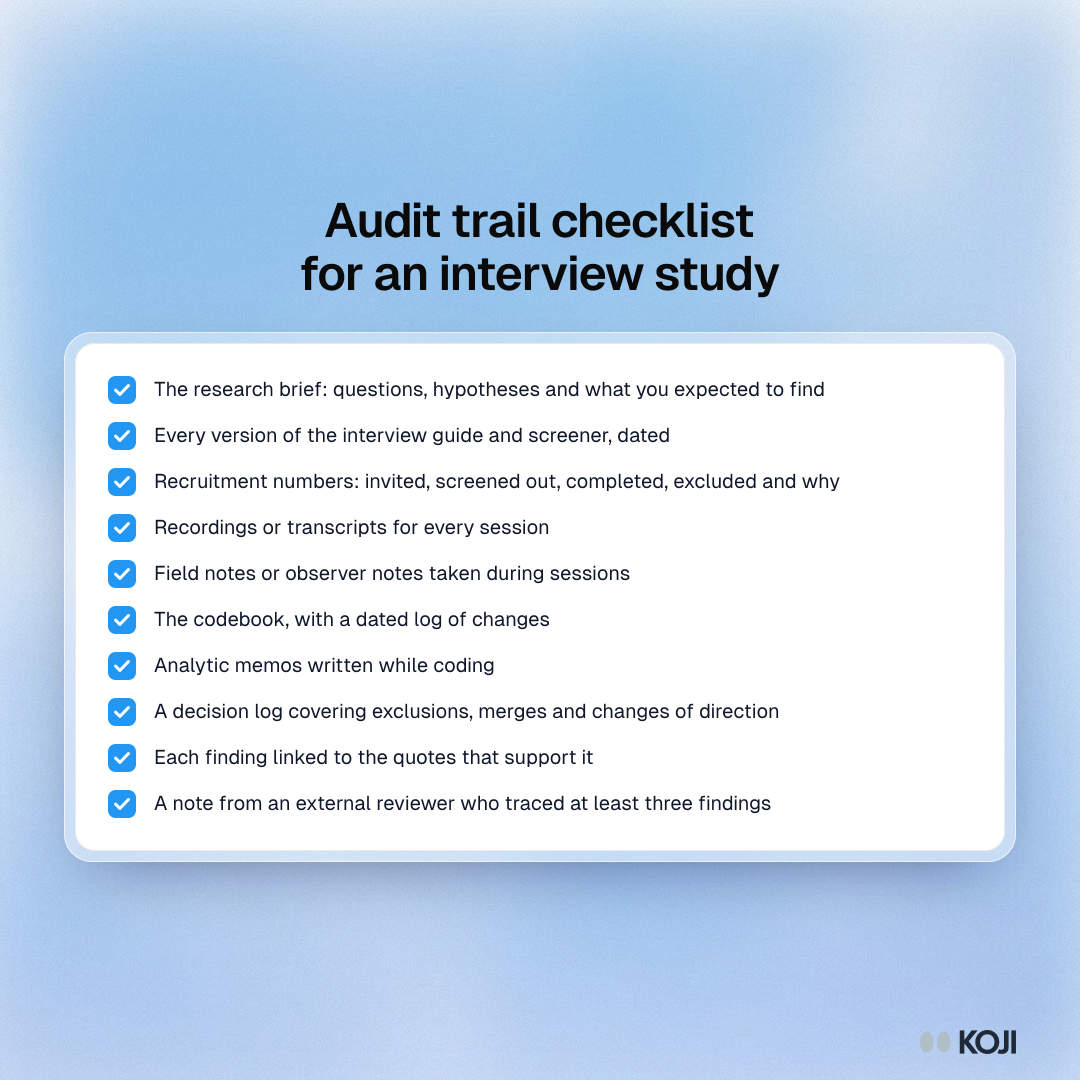
- The research brief: questions, hypotheses and what you expected to find
- Every version of the interview guide and screener, dated
- Recruitment numbers: invited, screened out, completed, excluded and why
- Recordings or transcripts for every session
- Field notes or observer notes taken during sessions
- The codebook, with a dated log of changes
- Analytic memos written while coding
- A decision log covering exclusions, merges and changes of direction
- Each finding linked to the quotes that support it
- A note from an external reviewer who traced at least three findings
How Koji helps
A lot of the physical audit trail can be produced as a side effect of running the study, and that's where Koji helps most.
The raw data is complete and consistent. Every Koji interview, voice or text, produces a full transcript organised by the study's questions, so you're not relying on notes taken mid-conversation. Every participant gets the same questions from the same research brief, which removes one of the biggest sources of undocumented drift: an interviewer who asks things a little differently each time.
Findings link to their evidence. Each finding in a Koji report opens the participant responses behind it, and the quotes are highlighted in their transcripts. Koji's analysis attaches a verbatim quote to every code it writes, so a reviewer can check a theme against the exact words without searching. That covers the hardest part of a confirmability audit, tracing claims back to data, without building the links by hand.
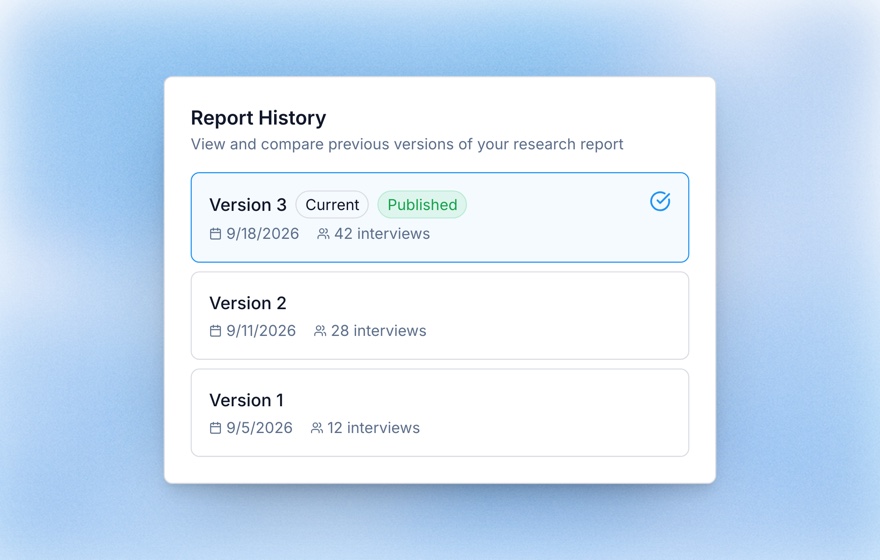
Report versions are kept. When you refresh a report as more interviews come in, Koji keeps the earlier versions in its report history, each with its date and interview count, and marks the current one. You can open an earlier version to see what the findings said at 10 interviews against what they say at 30.
Exports for your archive. The responses table exports to CSV, one row per participant with every answer, on every plan. Store it with the rest of the trail.
What Koji doesn't do is keep your intellectual audit trail. The reasons you merged two themes, the hunch you started with, the stakeholder conversation that changed a question: those belong in your decision log and memos. Compared with running interviews by hand, where transcripts, recordings and notes end up spread across a calendar, a transcription tool and someone's laptop, the physical trail mostly assembles itself, and you can spend the time on the part only you can write. Create a study to see what the trail looks like for a real one.
Frequently asked questions
What is an audit trail in qualitative research? It's the set of records that shows how a study moved from raw data to findings: data, codes, memos, themes, and a log of the decisions made along the way and why. It lets someone outside the study follow and judge the path. Lincoln and Guba treat it as the main evidence for dependability and confirmability.
What should an audit trail include? Lincoln and Guba, drawing on Halpern (1983), list six categories: raw data, data reduction and analysis products, data reconstruction and synthesis products, process notes, materials relating to intentions and dispositions, and instrument development information. Not every study needs all six. Keep what a sceptical reader would need to trace your main findings.
What is the difference between a physical and an intellectual audit trail? Carcary (2009) describes the physical trail as the documentation of the study's stages and methodological decisions, and the intellectual trail as the record of how the researcher's thinking developed. The intellectual trail shows which conclusions you reached from the data and which you brought with you.
Is an audit trail the same as an audit log in software? No. A software audit log records who did what in a system, such as who exported data or changed a setting. A qualitative audit trail records research decisions and the path from data to findings. The two can overlap for data governance, but they answer different questions.
Who reviews an audit trail? Formally, an external auditor: someone outside the study who checks whether the process was sound and the findings follow from the data. In product research, a colleague who wasn't involved can trace a few findings back through the trail and write a short note on what held up.
Do I need an audit trail for a small UX study? A light one, yes. Keep the brief, the guide, the transcripts, your theme list and a one-line-per-decision log. It takes minutes and means you can answer "where did that come from?" when a finding is challenged.
Related Resources
- Qualitative Research Validity and Reliability
- Reflexivity in Qualitative Research
- Analytic Memos in Qualitative Research
- COREQ and SRQR Reporting Checklists
- Tracing Report Findings Back to the Evidence
- Structured Questions Guide
Sources
- Lincoln, Y. S., & Guba, E. G. (1985). Naturalistic Inquiry. SAGE.
- Halpern, E. S. (1983). Auditing naturalistic inquiries: The development and application of a model. Doctoral dissertation, Indiana University.
- Carcary, M. (2009). The research audit trial: Enhancing trustworthiness in qualitative inquiry. Electronic Journal of Business Research Methods, 7(1), 11–24.
- Aref, H. A. T., Witry, M., Olufemi-Yusuf, D., & Guirguis, L. M. (2021). Ensuring quality qualitative research reporting in community pharmacy: A systematic literature review. International Journal of Pharmacy Practice, 29(5), 416–427.
- Tong, A., Sainsbury, P., & Craig, J. (2007). Consolidated criteria for reporting qualitative research (COREQ): A 32-item checklist for interviews and focus groups. International Journal for Quality in Health Care, 19(6), 349–357.
- O'Brien, B. C., Harris, I. B., Beckman, T. J., Reed, D. A., & Cook, D. A. (2014). Standards for reporting qualitative research: A synthesis of recommendations. Academic Medicine, 89(9), 1245–1251.
Related Articles
Analytic Memos in Qualitative Research: What to Write and When
Analytic memos are short notes where qualitative analysis actually happens. The five types, what to write in one, an example, when to write them and how memos tell you when you have enough interviews.
COREQ and SRQR: Reporting Checklists for Qualitative Interview Research
All 32 COREQ items and 21 SRQR standards explained, when to use each, and how to turn them into a one-page method note for a research report.
Qualitative Research Validity and Reliability: How to Build Studies You Can Trust
A practical guide to Lincoln and Guba's trustworthiness framework — credibility, transferability, dependability, and confirmability — and how to build each into your qualitative research studies.
Reflexivity in Qualitative Research: How to Practise It and Write a Positionality Statement
What reflexivity in qualitative research means, the three kinds of reflexive work, how to keep a reflexive journal and how to write a positionality statement, with prompts and an example.
Structured Questions in AI Interviews
Mix quantitative data collection — scales, ratings, multiple choice, ranking — with AI-powered conversational follow-up in a single interview.
Tracing Report Findings Back to the Evidence
Every finding, chart and recommendation in a Koji report links to the interviews behind it. Learn how to open the evidence panel, read supporting quotes and check a finding before you share it.
Deductive Coding: How to Code Interviews With a Start List of Codes
What deductive coding is, when to use it, how to build and define a start list, six steps to code with it, how to check agreement and how to keep it from finding only what you expected.