You're about to add a new service or package to your small business, and you have no sales history to price it from. The short answer: work out your floor, show the new offer and a short ladder of prices to about 30 recent customers, read the reasons before the curve, then check the winner with a few real bookings. By the end of this page you'll know who to ask, what to say, how to read the answers and how to confirm the number with actual money.
This is for the owner of a salon, a shop, a cleaning company, an agency or a bootstrapped product who sells to a few hundred people and has no research team. If you've already priced what you sell today and want to change that price, start with what to charge: a small business pricing playbook. This page is for the case where there is nothing to compare against yet: a new service, a new bundle, a new size.
When you need this
You need it when you're a few weeks from launching something and the price field is empty. The signs:
- You're copying a competitor's number because it's the only number you have.
- You're pricing from your costs alone and hoping customers agree.
- You plan a "launch discount" without knowing what you'd be discounting from.
- You're asking friends, and they all say it sounds great.
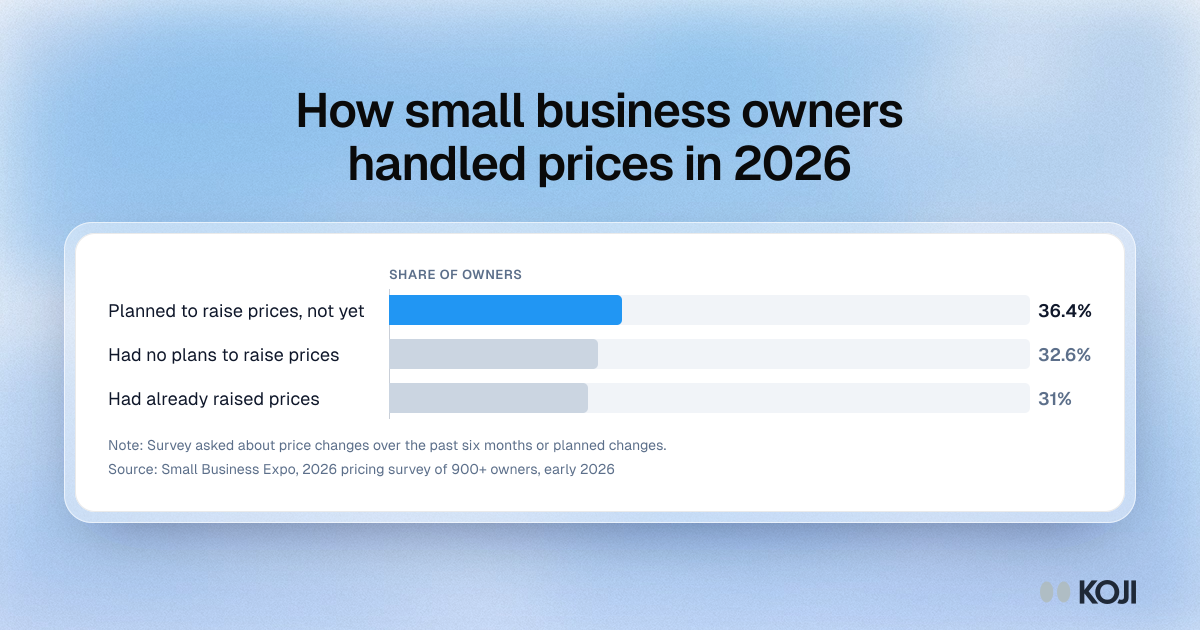
Most owners are moving prices right now. The Small Business Expo's survey of more than 900 owners at the start of 2026 found 31.0% had already raised prices, 36.4% had not yet but planned to, and 32.6% had no plans to [1]. NFIB's June 2026 survey put the net share of owners raising average selling prices at 38%, the highest since January 2023; unadjusted, 47% reported higher prices and 7% lower [2]. Prices are in motion, so a new price you set by guesswork lands in a market where plenty of other owners are changing theirs too.
Guessing can fail in two directions. Price a new service too low and your first customers get used to that number. Price it too high and you may read the silence as "no demand for the service" when the real problem was the number.
The method in brief
For a new service the method that fits is a short conversation with recent customers that has a price ladder inside it. You describe the offer, ask about their last similar purchase, then show a few prices one at a time and ask why they answered the way they did.
Two methods carry the weight, and each has its own reference page:
- Van Westendorp: four questions about the price that feels too cheap, a bargain, getting expensive and too expensive. It finds the range you should be in. It dates to a 1976 ESOMAR paper by Peter van Westendorp [3]. See the Van Westendorp price sensitivity meter.
- Gabor-Granger: you show one price at a time and ask how likely they are to buy. It tells you which price inside that range earns the most. See the Gabor-Granger pricing method.
With no idea where to start, ask the four Van Westendorp questions first. With a rough range in mind, go straight to a ladder. If you have only one or two ideas for the offer itself, settle those first with two offers tested on 20 customers and price the winner.
You can do all of it with a notebook, a phone and a spreadsheet. A tool only makes it faster.
Step by step: a week of work
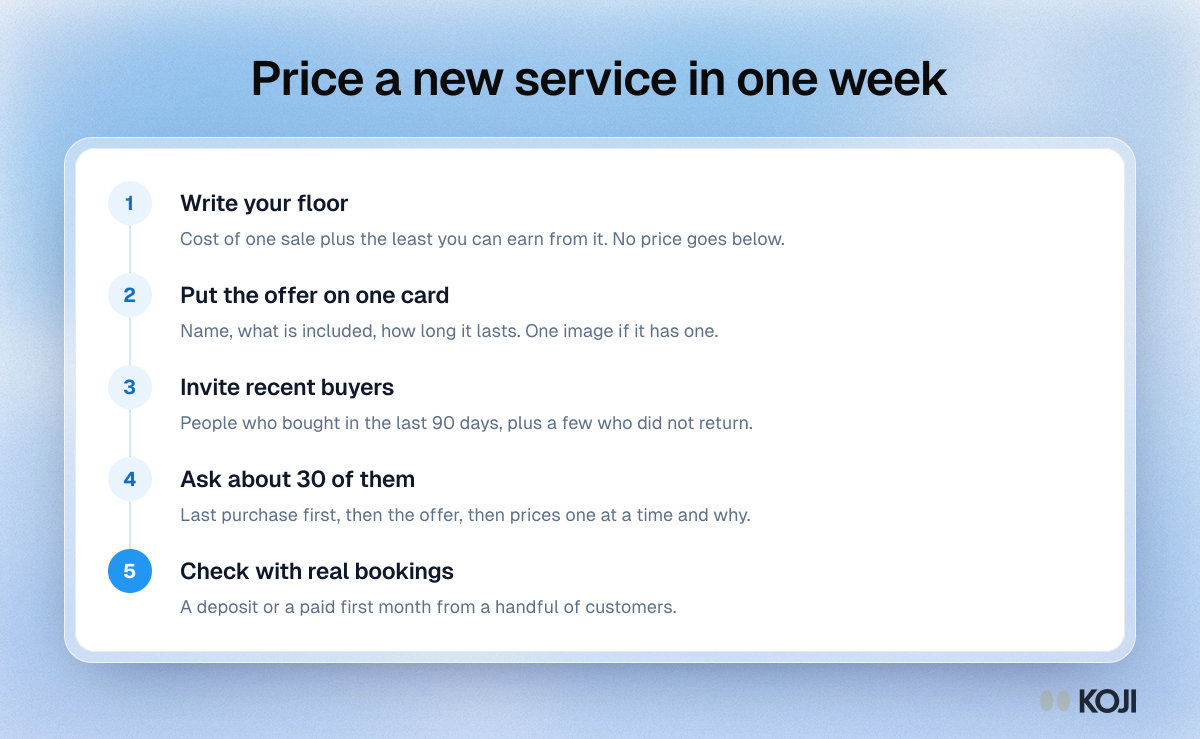
Day 1: write your floor. Work out what one sale of the new service costs you: materials, your time or your staff's, and the share of rent, insurance and software it carries. Then decide the least you can earn from it and stay in business. Nothing you test goes below that line. Customers can't see your costs, and a price that wins every vote but loses money is not a result.
Day 1 to 2: write the offer on one card. Name it, list what's included and say how long it lasts. A vague offer gets vague prices. If the offer has a picture (a menu, a package card, a mockup), keep it to one image you can show.
Day 2 to 3: invite. Send a short message to people who bought from you in the last 90 days. More on who below.
Day 3 to 6: run the conversations. Aim for about 30. Spend ten minutes on each.
Day 7: read the reasons, pick a price and plan the real test.
Who to ask and how many
Ask recent buyers, not friends. People who bought in the last 90 days remember the decision, so their answers come from a real choice. Skip family and staff; they're kinder than strangers. Mix in a few people who bought once and didn't come back, because regulars alone tell you what regulars already accept. Why customers leave a small business shows how to reach them.

Photo by Vitaly Gariev on Unsplash
How many. About 30 is the floor for reading a price curve at all. Two different counts are in play here, and they don't contradict each other. For understanding why people react the way they do, a systematic review of 23 saturation studies by Hennink and Kaiser found that studies with fairly similar participants and a narrow question reached saturation within 9 to 17 interviews [4]. That's why a dozen good conversations can already tell you the reasons. A demand curve is different. It's a share of people at each price, and shares from ten people jump around. So 30 gives you a directional curve with the reasons attached, while survey guidance usually asks for 100 or more per segment before you trust a number to the dollar. You probably can't reach 100, so treat 30 as a map, not a measurement. Under 15 customers, skip the curve and hold the conversations.
How to reach them with no list tool. A text, an email, a note with the receipt, or a card at the counter. Say what it is: "I'm launching something new and want to hear what you'd pay before I print a price. Ten minutes, and I'll send you a thank-you." If you offer a small thank-you, keep it the same for everyone. Recruitment email templates, participant incentives and getting customers to talk at checkout, on the receipt or by text cover wording and amounts. Expect a minority to reply, so invite more people than you need.
What to ask
Order matters. If you open with the price you get a negotiating stance. Open with the last time they bought something like this, then show the offer, then the prices.
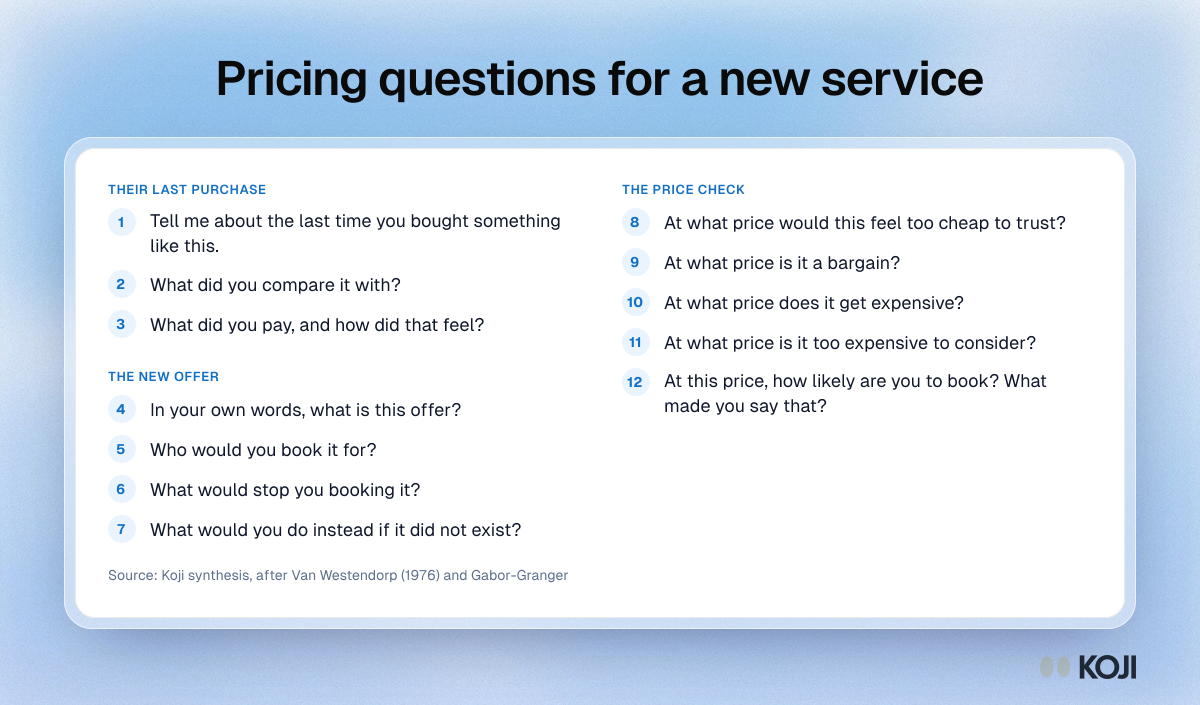
Two rules while you ask. First, don't say what you hope to charge before they answer. Second, after every price answer ask "What made you say that?" The reason is the useful part. "That's what the other place charges" is a different finding from "it felt like a lot for something I can't see".
Ask about behaviour, not opinions about the future. "Tell me about the last time you booked something like this" gets a story. "Would you use this?" gets a compliment. The Mom Test explains why. For a longer pricing conversation, see pricing research interviews.
A worked example
Say you run a two-van cleaning company. You do one-off cleans, and customers keep asking for a monthly "deep clean plus" package: oven, windows inside, fridge, one hour of extras. You have never priced it.
Your floor comes first. After supplies, two people's time, fuel and your share of insurance, the package must bring in at least $105 per month to be worth a slot on the van. Then you text 52 people who booked in the last 90 days, including seven who booked once and haven't been back. You offer a small gift card. Thirty-four reply and finish.
You describe the package on one card and test five prices, evenly spaced. The numbers below are made up for this scenario:
| Price per month | Would buy | Share | Revenue per person asked |
|---|---|---|---|
| $90 | 30 of 34 | 88% | $79 |
| $110 | 27 of 34 | 79% | $87 |
| $130 | 21 of 34 | 62% | $80 |
| $150 | 12 of 34 | 35% | $53 |
| $170 | 6 of 34 | 18% | $30 |
The curve is flat from $90 to $130. Revenue per person asked sits within about 10% across those three prices, so it's a near-tie. The $90 price is below your floor, so it's out whatever the curve says. Now the reasons (invented for the example, like the numbers). People who stopped at $150 say things like "I'd just book the one-off every other month" and "for the oven, yes, for windows, no". The people who said yes at $130 mention not having to think about it.
Your decision: launch at $130, not $110. Two vans means capacity, and at a near-tie it's better to earn more per slot than to fill slots with the cheaper plan. You also rebuild the package: a smaller version without windows for the "oven, yes, windows, no" group, priced at the lower end. Then you ask five regulars to book the first month and pay in advance. If at least three say yes, you go ahead. If none do, the curve was more polite than your customers, and you look at the reasons again.
Reading the results and deciding
Read the reasons first, then the curve. A curve shows where people stop, and the reasons show whether you can move them.
Rules that hold up:
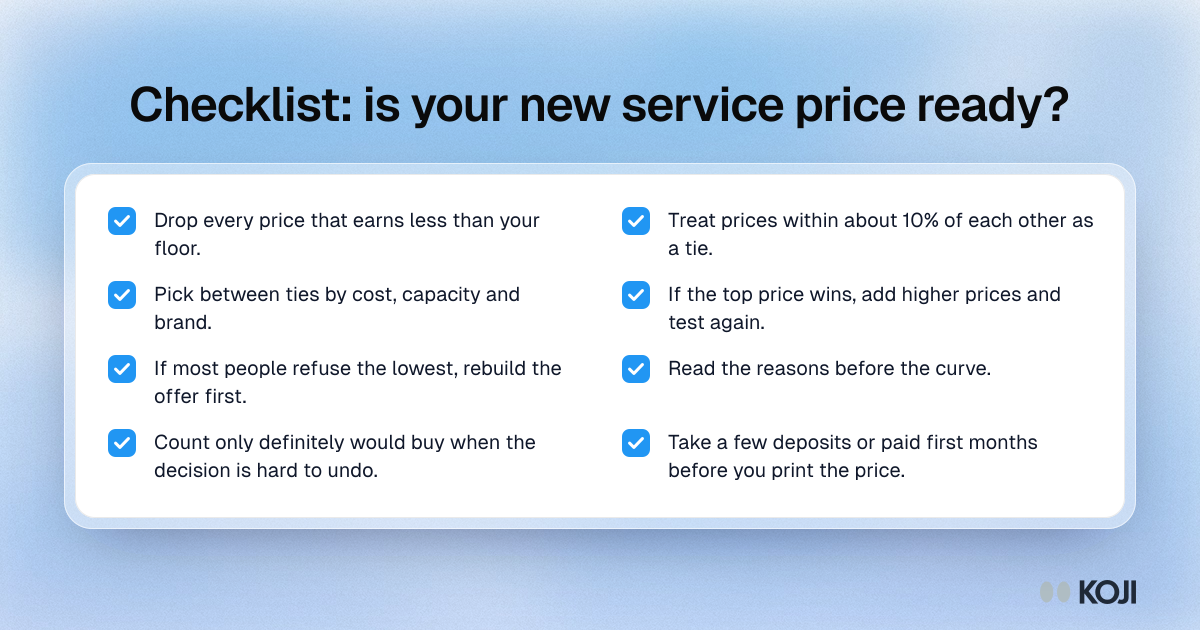
- Start at your floor. Drop every price that earns less than you need, whatever it did in the test.
- A near-tie is a tie. If two prices earn within about 10% of each other per person asked, one answer more or less could swap them. Pick by your costs, your capacity and your brand.
- The best price is always one you tested. If the top price wins, your ladder stopped too low; run a second small round with higher prices. If most people refuse even the lowest, rebuild the offer before you cut the price.
- The reasons beat the shape. "I can do it myself" is a price you can't beat. "Nobody else does it this way" is value you can price on.
- Treat the curve as a ceiling. Schmidt and Bijmolt's meta-analysis of 77 studies in 47 papers found that what people say they'd pay is about 21% higher on average than what they pay when real money is involved [5]. When the decision is hard to reverse, count only "definitely would buy" as a yes.
Then use real money. Before you commit, take a deposit, a pre-order or a first month paid in advance from a handful of customers. A conversation tells you where to look. The till tells you whether you were right.
Run it this week with Koji
If you'd rather not run 30 conversations by hand, Koji can run the interviews and the maths. You can set it up from a free account:
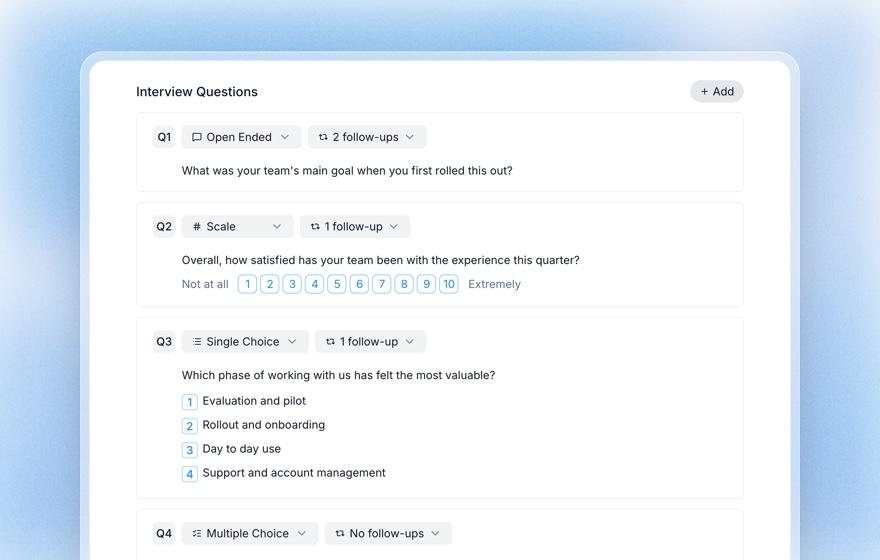
- Start a study and add ordinary questions first: the last purchase, what they compared it with. The research assistant will draft them if you say "help me test pricing for a monthly cleaning package".
- Attach your offer card to the price question. Attach one image to any interview question (a menu, a package card, a mockup) as a PNG, JPEG or WebP up to 4 MB. Participants see it with the question, and Koji's follow-ups are about what it shows. For a price test, leave the image visible. Use a timed view (3, 5, 10 or 15 seconds) only on a separate question that asks for a first impression, such as a package name or a logo.
- Add a Price Test question. Choose the Price Test type, describe what they'd buy in the question text, enter 3 to 10 prices (5 to 7 evenly spaced works best), set the currency and the unit, such as "per month". Choose who counts as a buyer; "Definitely only" is the strict setting. Koji starts each person at a random price in the middle of the ladder and moves up or down until it finds the highest price they'd still buy at, then asks why.
- Preview it yourself first. Prices lock once the first response comes in, so take it as a participant before you share it. Previewing your interview shows how; a preview isn't counted as a response.
- Send the link by text, email or receipt. To email your own customers with reminders, use the recruitment email feature; to send a thank-you, use incentives. Both are on paid plans.
- Read the report. It shows the share who would buy at each price, the revenue each price implies, the price that earns the most and the quotes behind each point. It's labelled directional, which is accurate, and the best price is always one of the prices you tested. Download it as an editable PowerPoint deck or a PDF if a partner, a bank or a landlord wants to see it.
The price test works in text and voice interviews, not phone calls, and reads best from about 30 interviews. The price test setup guide walks through every setting, and choosing the prices to test helps with the range. Koji is a faster route to the same method, not a different answer. Anyone can set it up themselves, and for under about 15 customers, a notebook is the right tool.
Common mistakes
- Pricing from cost alone. Your cost is a floor, not a price.
- Testing only your happiest regulars. They're kind and loyal, which skews toward yes.
- A ladder centred on a competitor. Centre it on what the offer is worth to a customer, and keep the competitor's price as one more row.
- Changing the ladder halfway. Answers to different prices make a curve that means nothing.
- Fixing the launch discount before the price. A discount on an untested number just hides the mistake for a month.
- Treating one loud comment as the market. Count the reasons.
When research will mislead you
Stated intent isn't payment. Your customers like you, and a friendly answer costs them nothing. Existing customers also leave out everyone who looked and walked away. If the service is aimed at a different kind of customer than the one you have, the people you ask aren't the people who'll buy. And if you serve only a handful of customers, a number from 30 people can't carry the decision. Pair the conversations with something people actually do: a deposit, a pre-order, a quote that's accepted or declined, or a real price on the first month of bookings.
Where this fits
Before this, the question is usually what to charge for what you already sell: start with the small business pricing playbook. If you're still choosing between two versions of the offer, run two offers with 20 customers first. The founder pieces on pricing before you have customers and pricing with 30 conversations cover the same ground for products. The whole sequence is in the founder's research playbook, and /for/founders has the rest of the setup.
FAQ
How do I price a new service when I have no sales history? Write your floor first, then show the offer and a ladder of five or so prices to about 30 recent customers, ask why after each answer, and check the winner with a few paid pre-bookings. Reasons matter more than the exact curve.
How many customers should I ask? About 30 for a rough price curve. Studies of when new themes stop appearing found 9 to 17 interviews enough for fairly similar people and a narrow question [4], but a share of buyers at each price is noisy below about 30. Survey guidance asks for 100 or more per segment for precision.
Should I just ask people what they'd pay? Not on its own. A meta-analysis of 77 studies found hypothetical willingness to pay about 21% higher on average than real payment [5]. Show a ladder and ask for the reason behind each answer.
Should I launch with a discount? Price first, discount second. A launch offer is a deliberate move on a number you trust, for a set time. If you discount an untested price you can't tell later what the real demand was.
What if I have fewer than 15 customers? Talk to all of them and add people who asked about the service but didn't book. Ten honest conversations tell you more than a curve from eight.
Your next step
Write your floor price today, then pick the 30 people you'd text. If you want the interviews and the demand curve handled for you, set up a price test from a free account.
References
- Small Business Expo Research Desk, "Small business pricing in 2026", survey of more than 900 small business owners, early 2026. https://thesmallbusinessexpo.com/blog/small-business-pricing-in-2026
- NFIB, Small Business Economic Trends, June 2026 report, released 14 July 2026. https://www.nfib.com/news/monthly_report/sbet
- Peter H. van Westendorp, "NSS-Price Sensitivity Meter (PSM): A new approach to study consumer perception of price", Proceedings of the 29th ESOMAR Congress, 1976, pp. 139-167. Overview: https://en.wikipedia.org/wiki/Van_Westendorp%27s_Price_Sensitivity_Meter
- Monique Hennink and Bonnie N. Kaiser, "Sample sizes for saturation in qualitative research: A systematic review of empirical tests", Social Science & Medicine, 292, 114523, 2022. https://pubmed.ncbi.nlm.nih.gov/34785096/
- Jörg Schmidt and Tammo H. A. Bijmolt, "Accurately measuring willingness to pay for consumer goods: a meta-analysis of the hypothetical bias", Journal of the Academy of Marketing Science, 48(3), 2020, pp. 499-518. https://www.marketingcenter.de/en/publication/151167
Further reading
- Pricing research interviews: the conversations behind the numbers, for when you want more than a curve.
- Gabor-Granger pricing method: how a price ladder turns answers into a demand curve.
- Five-second test questions: for testing the name or look of the new service before you price it.
- The Mom Test: asking about real behaviour so you get stories, not compliments.