Free to save and share

Frameworks and cheat sheets for customer research

Every framework, checklist and comparison from our guides, as an image you can download, drop into a deck or share with your team.
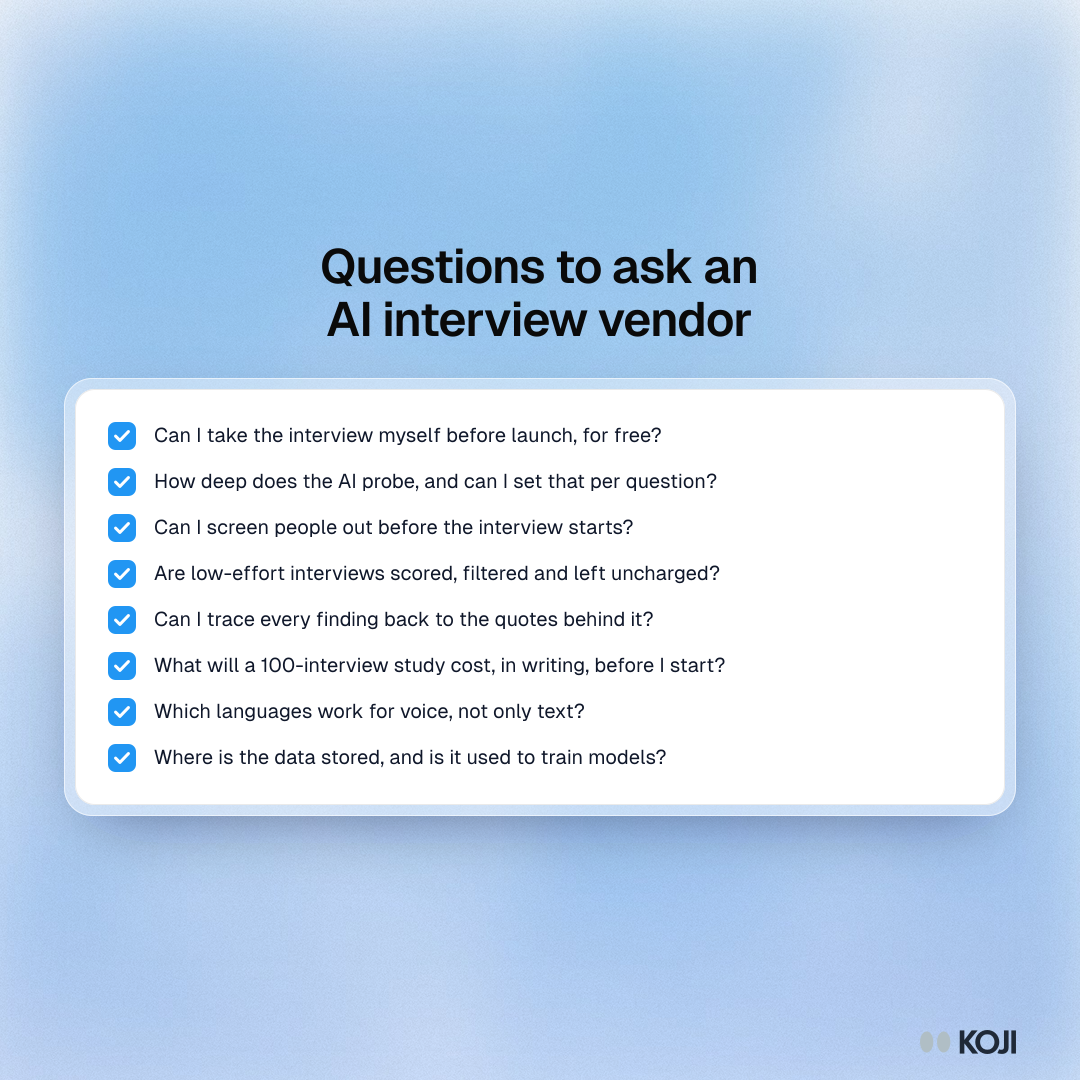
Checklist of eight questions to ask before choosing an AI interview platform, from free previews to data storage

Checklist

Questions to ask an AI interview vendor
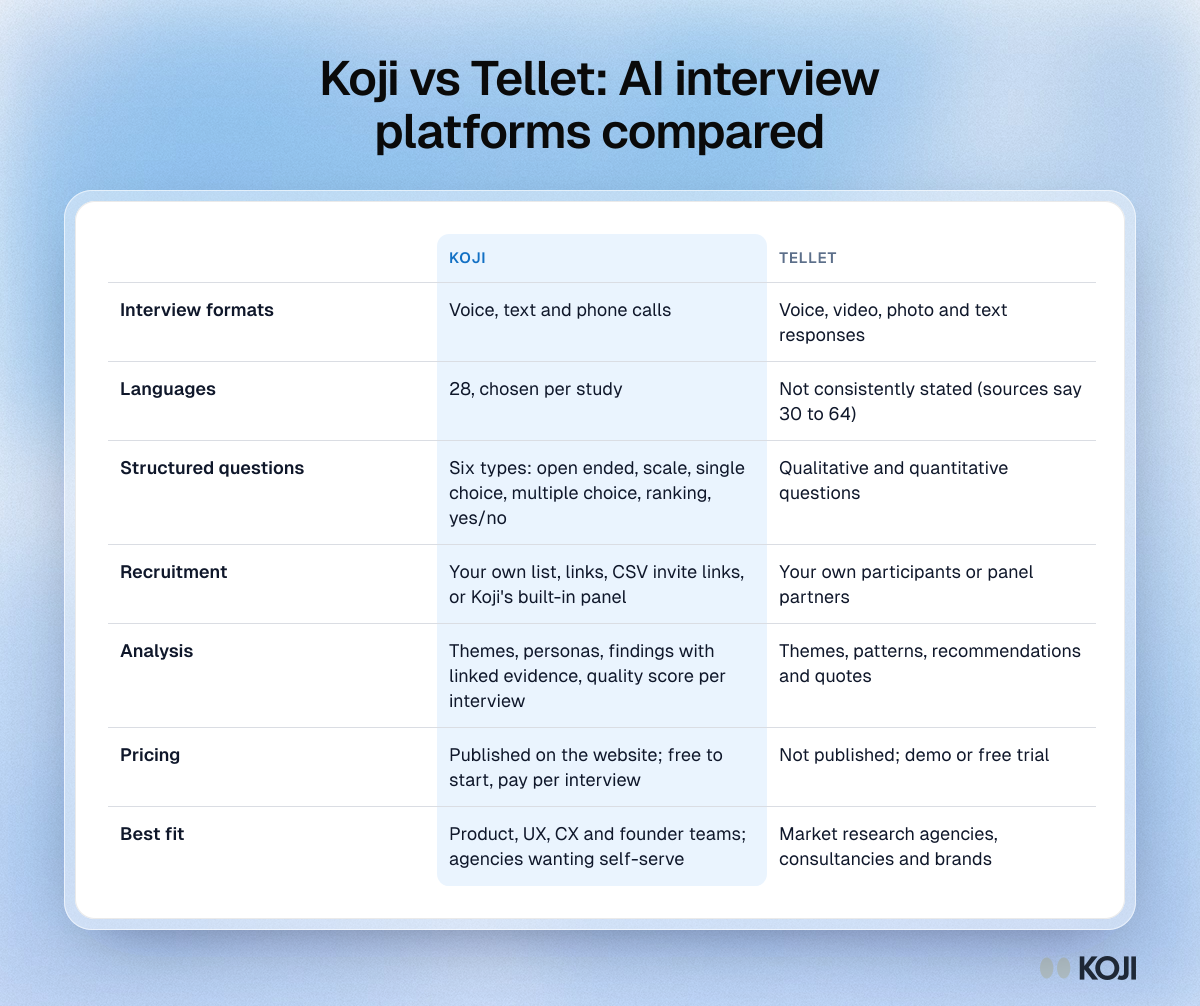
Table comparing Koji and Tellet on interview formats, languages, question types, recruitment, analysis and how each is bought

Reference table

Koji vs Tellet: AI interview platforms compared
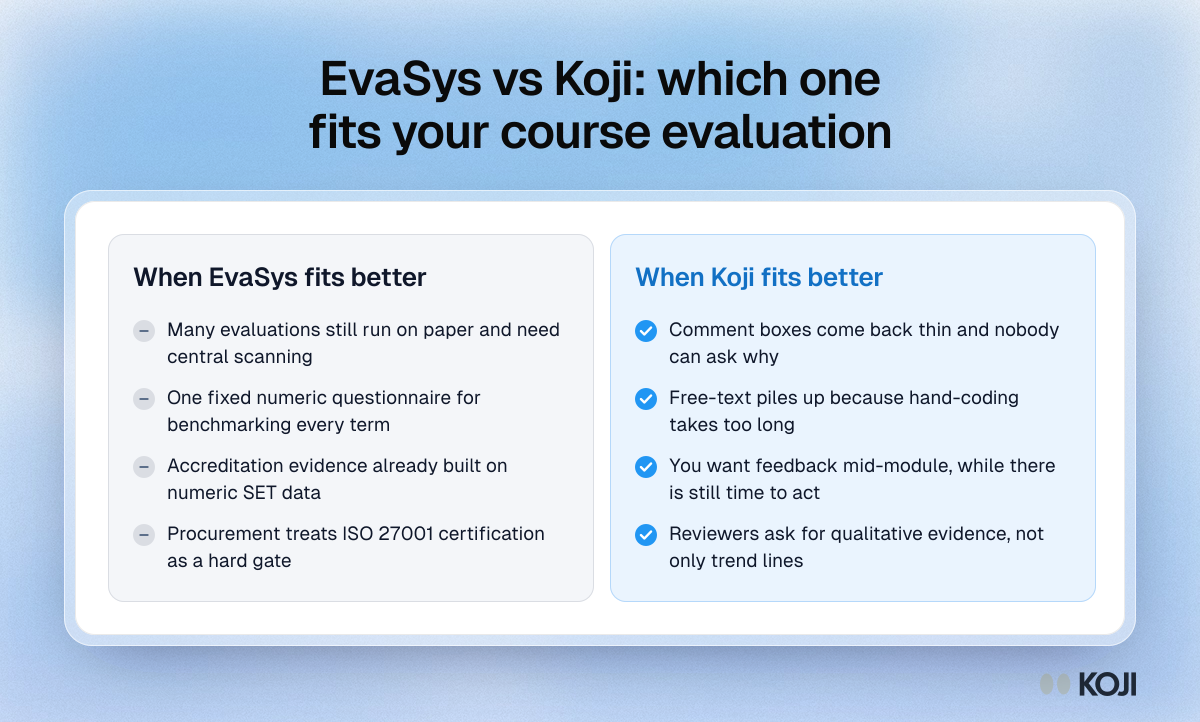
Comparison of when EvaSys suits course evaluation better, such as paper forms, and when Koji's AI interviews suit it better.

Comparison

EvaSys vs Koji: which one fits your course evaluation
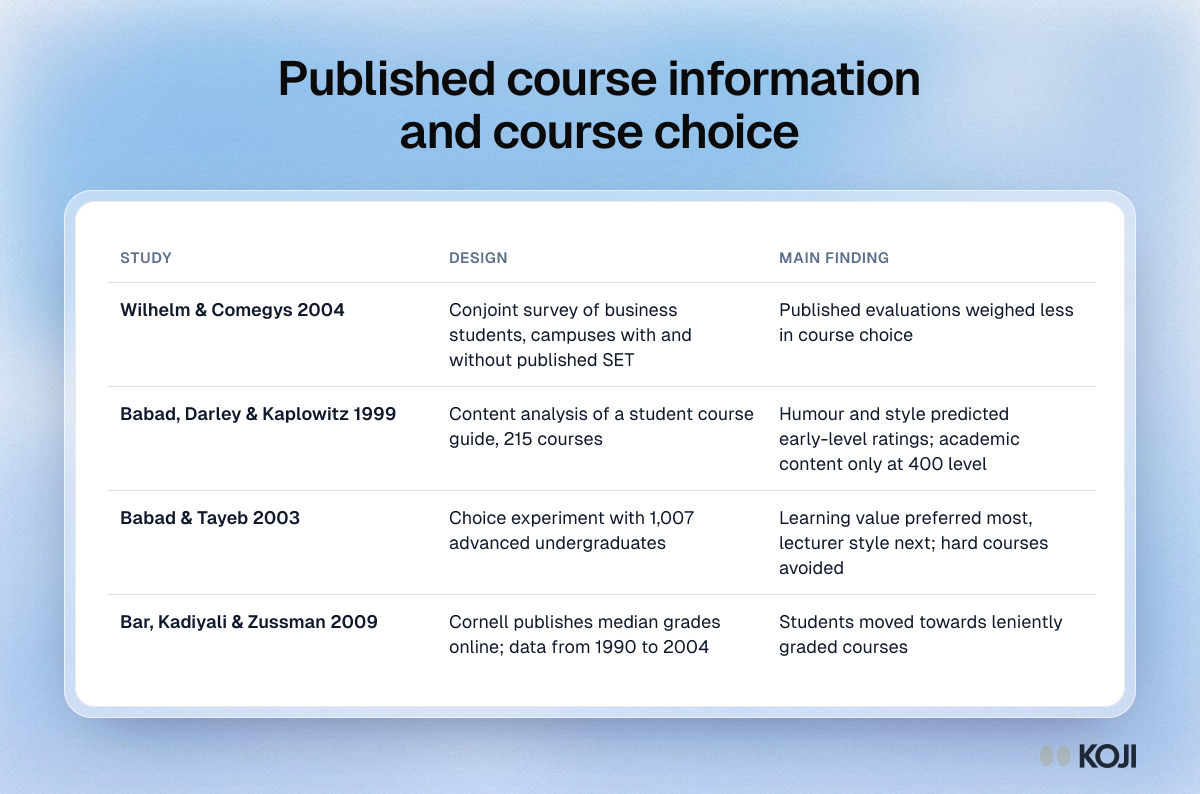
Table summarising four studies on publishing course information and how students choose courses, with design and main finding for each.

Reference table

Published course information and course choice
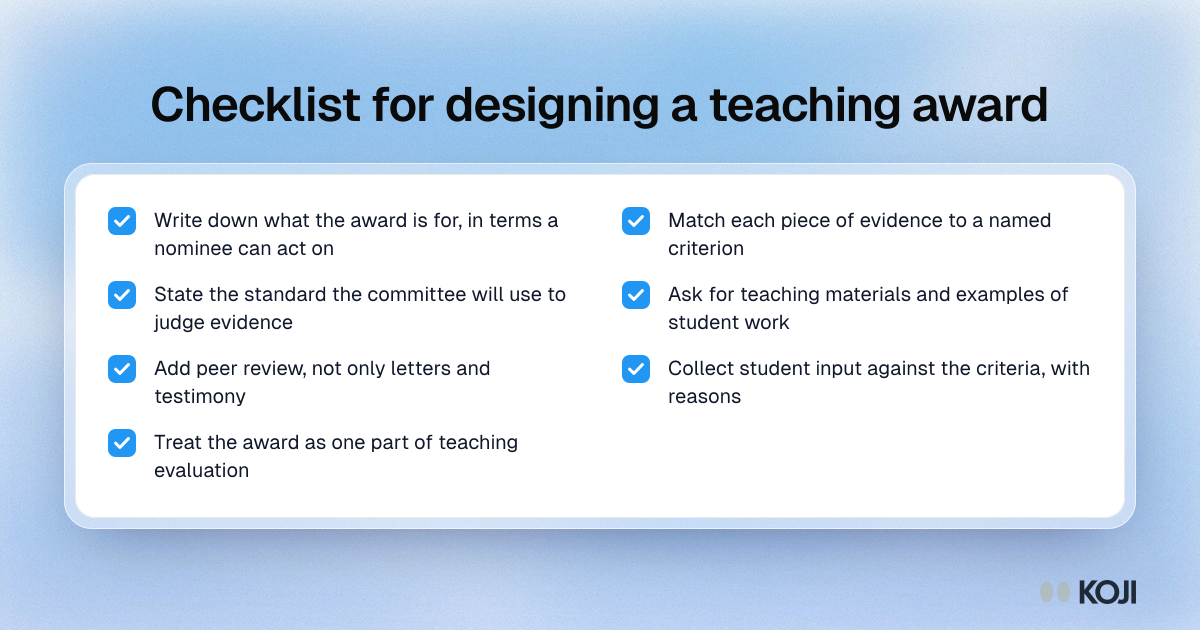
Checklist for designing a teaching award: state criteria, match evidence to each criterion, set standards, ask for teaching materials and student work.

Checklist

Checklist for designing a teaching award
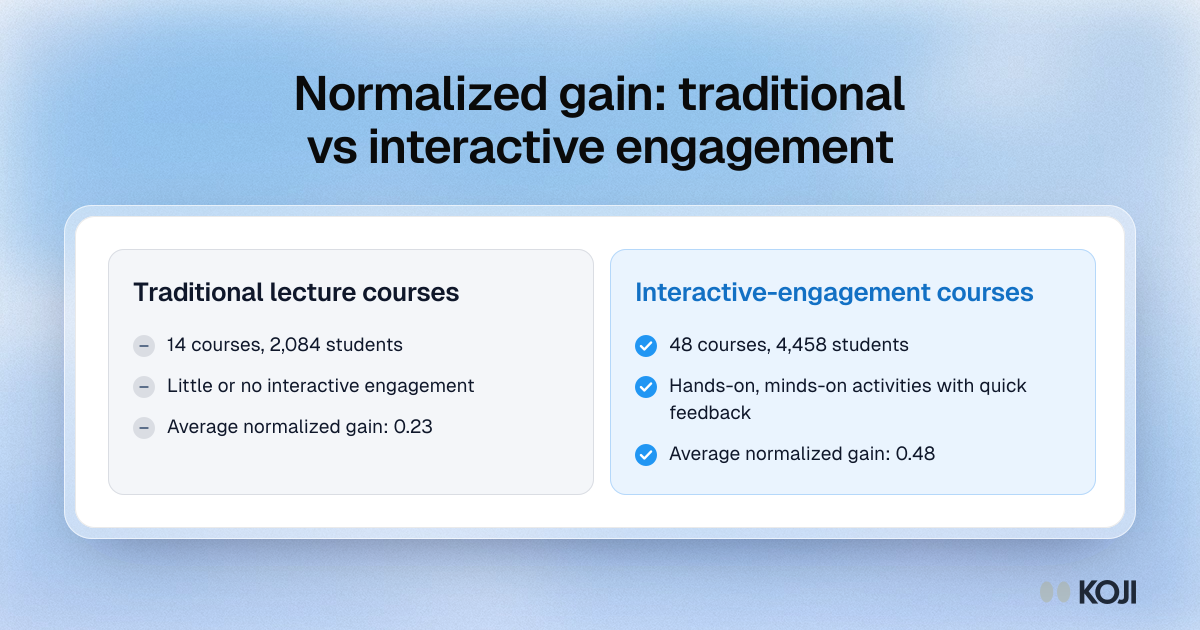
Comparison of average normalized gain in Hake's 1998 survey: 14 traditional courses at 0.23 against 48 interactive-engagement courses at 0.48.

Comparison

Normalized gain: traditional vs interactive engagement
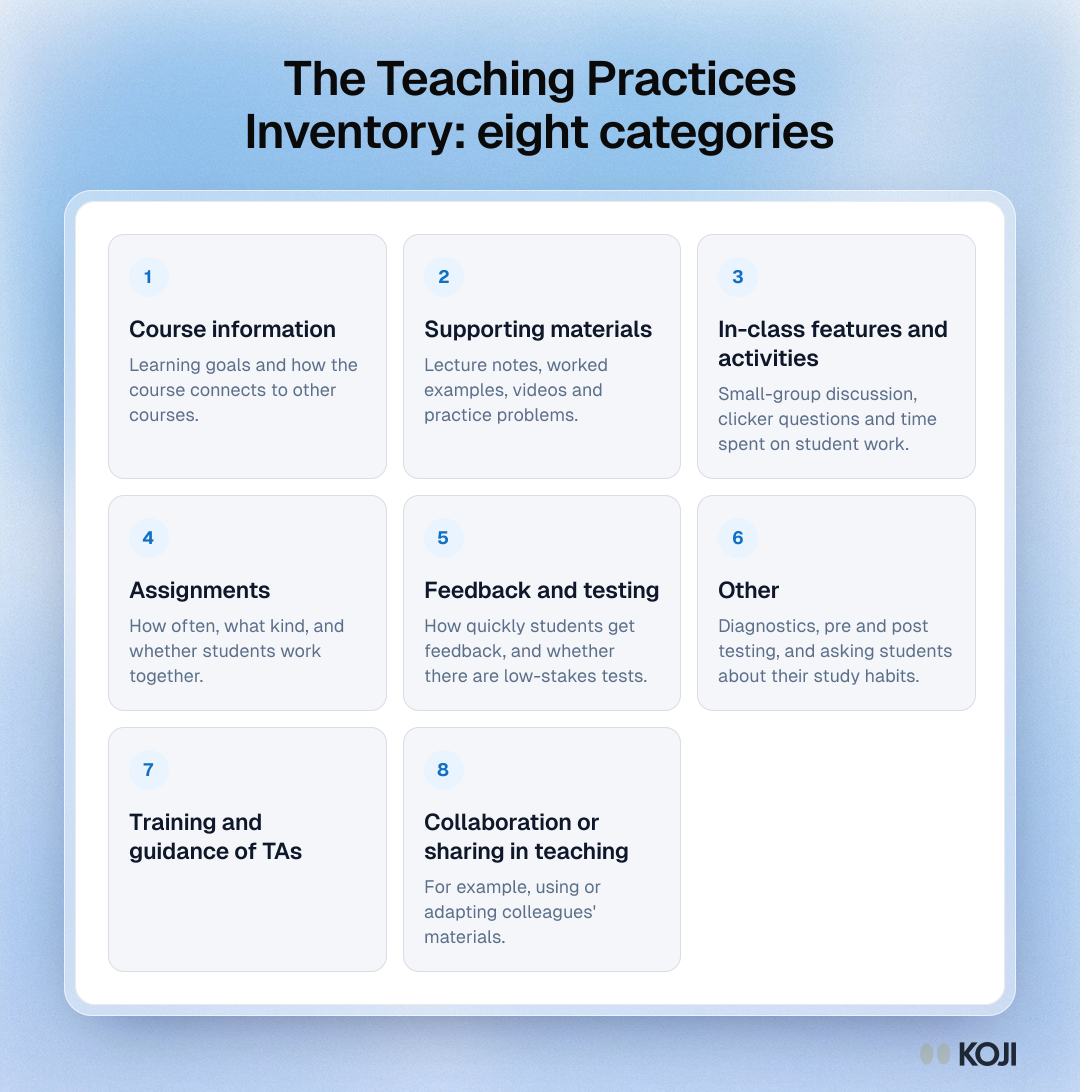
Framework showing the eight categories of the Teaching Practices Inventory, from course information and supporting materials to TA training and collaboration.

Framework

The Teaching Practices Inventory: eight categories
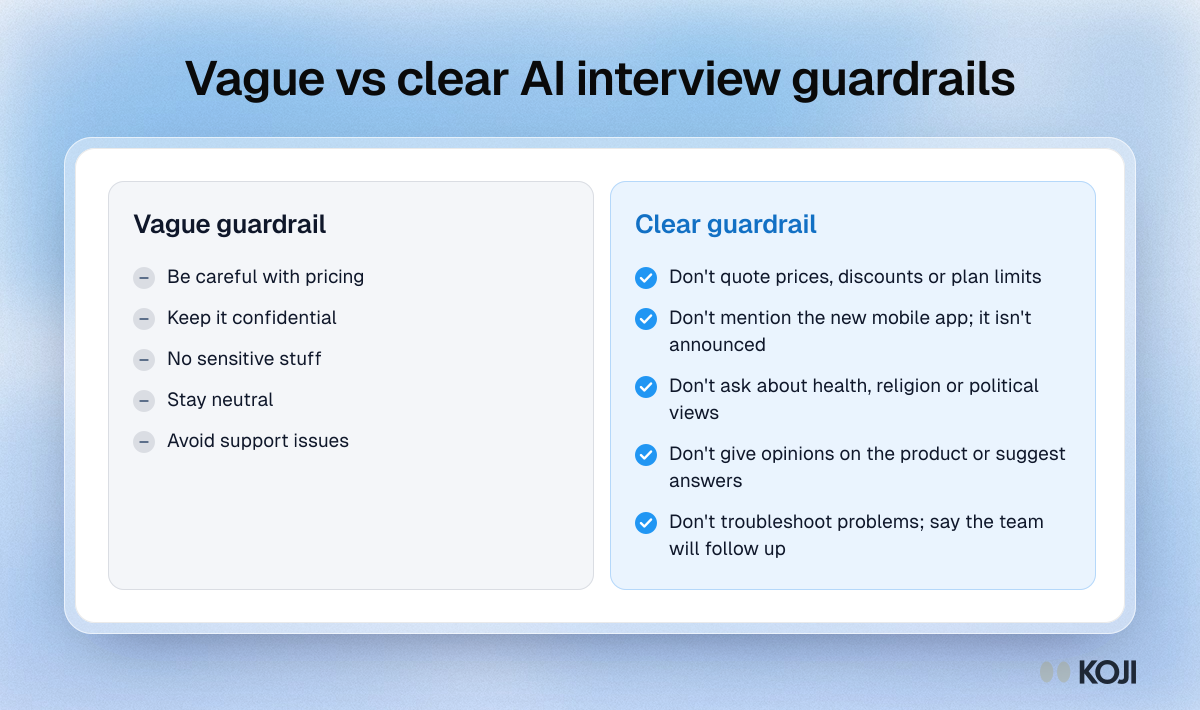
Comparison of vague and clear AI interviewer guardrails, from pricing and confidentiality to sensitive topics and neutrality.

Comparison

Vague vs clear AI interview guardrails
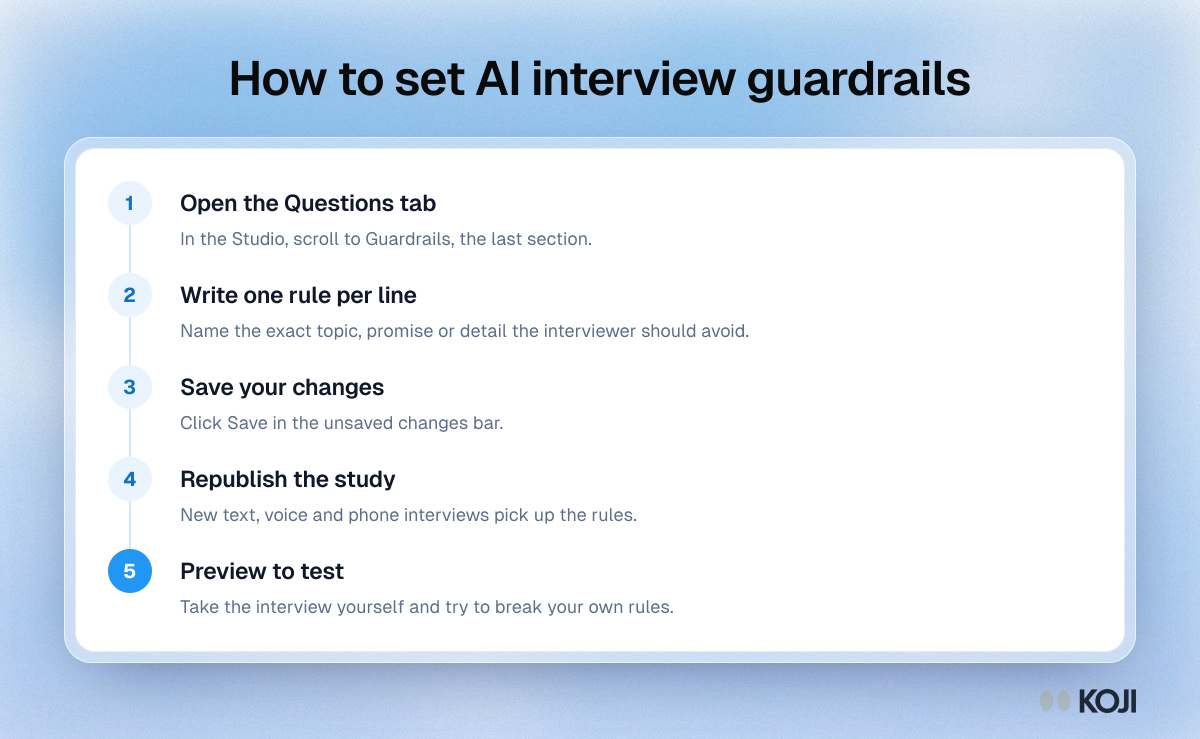
Process for setting interview guardrails in Koji: open the Questions tab, write one rule per line, save, republish, then preview to test.

Process

How to set AI interview guardrails
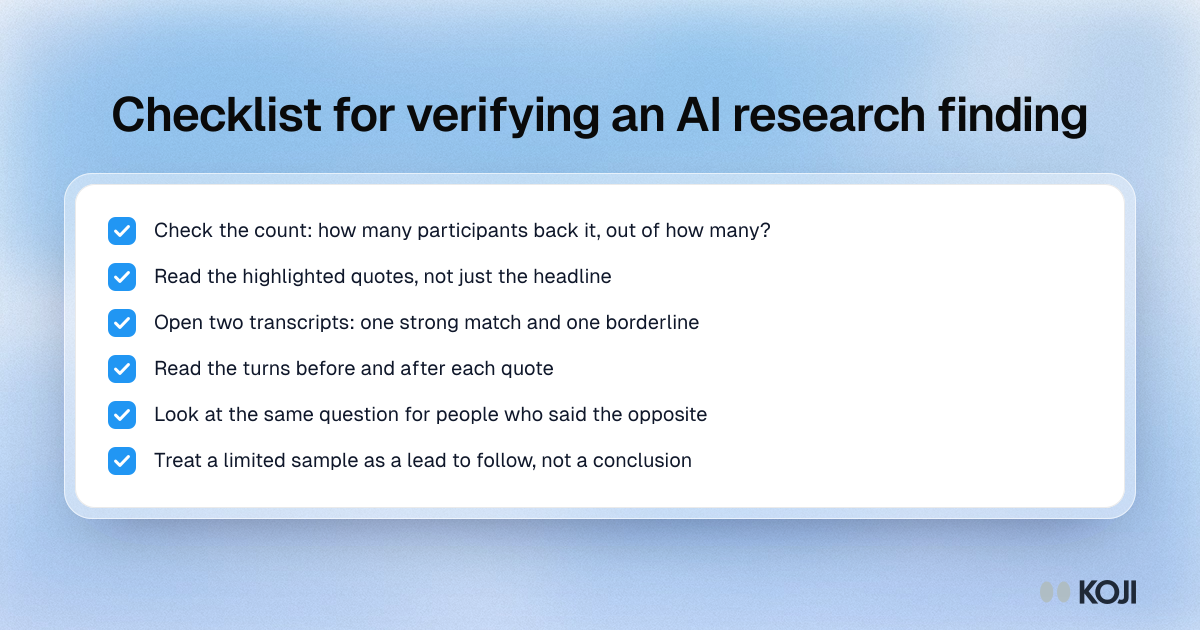
Checklist for verifying an AI research finding: check the count, read the quotes, open two transcripts, look for the counter-signal and mind the sample size.

Checklist

Checklist for verifying an AI research finding
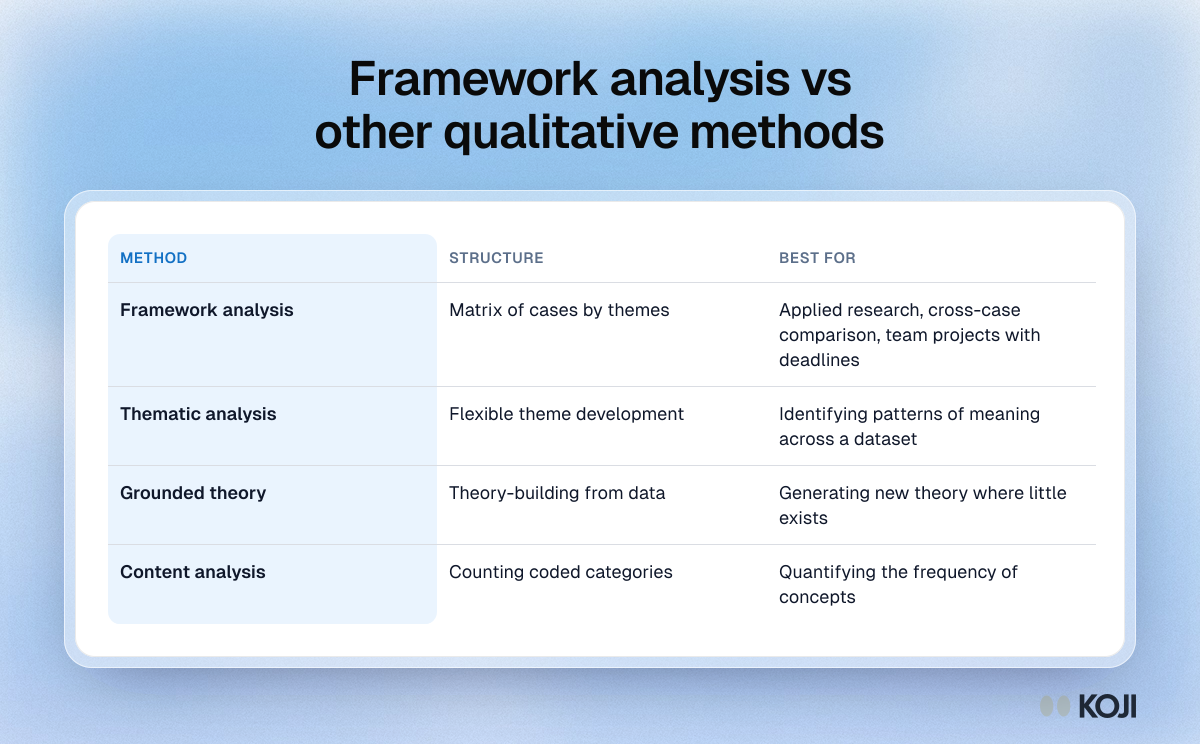
Table comparing framework analysis, thematic analysis, grounded theory and content analysis by structure and by what each method is best for.

Reference table

Framework analysis vs other qualitative methods
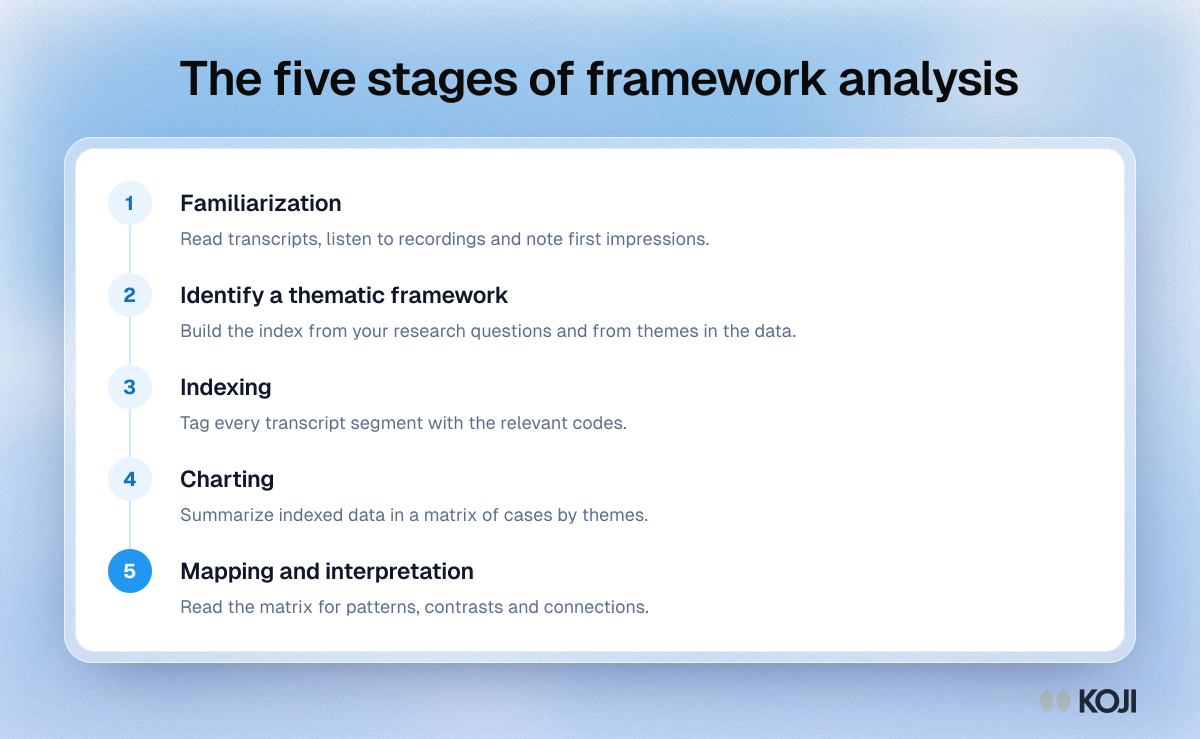
Process showing the five stages of framework analysis: familiarization, identifying a thematic framework, indexing, charting, and mapping and interpretation.

Process

The five stages of framework analysis
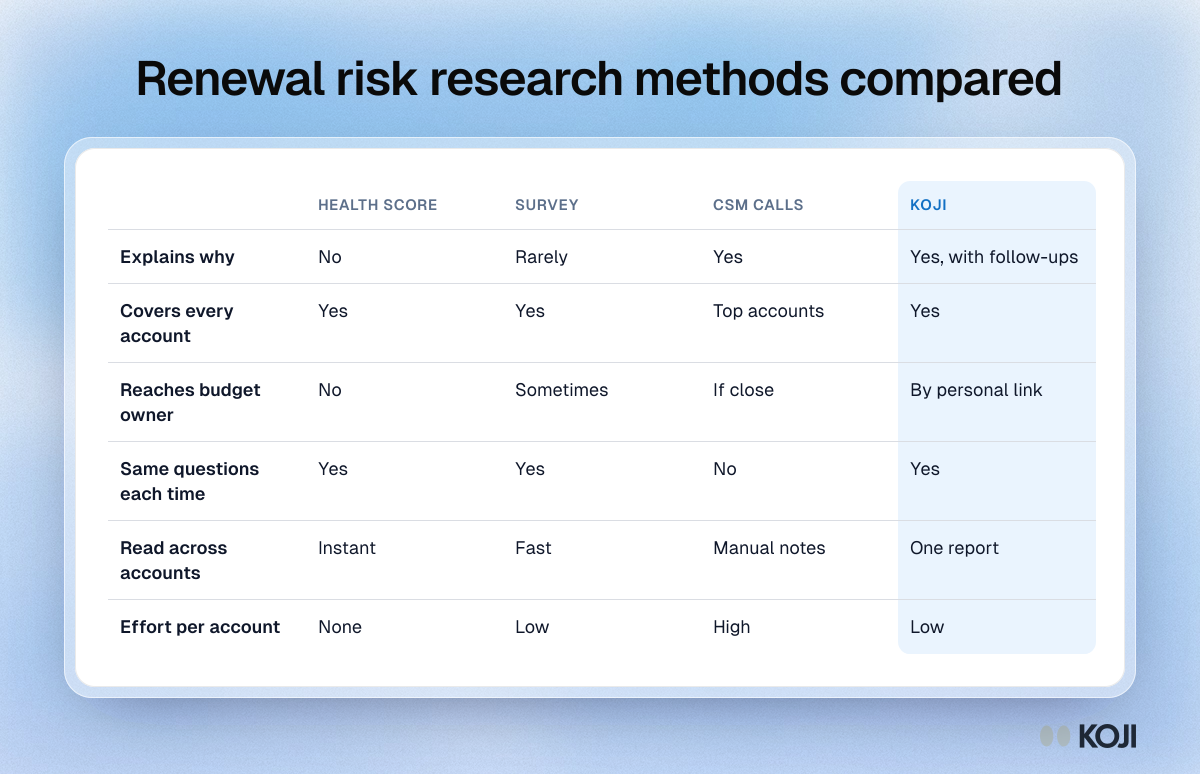
Table comparing health scores, surveys, CSM calls and Koji AI interviews for renewal risk research on explanation, coverage, consistency and effort.

Reference table

Renewal risk research methods compared
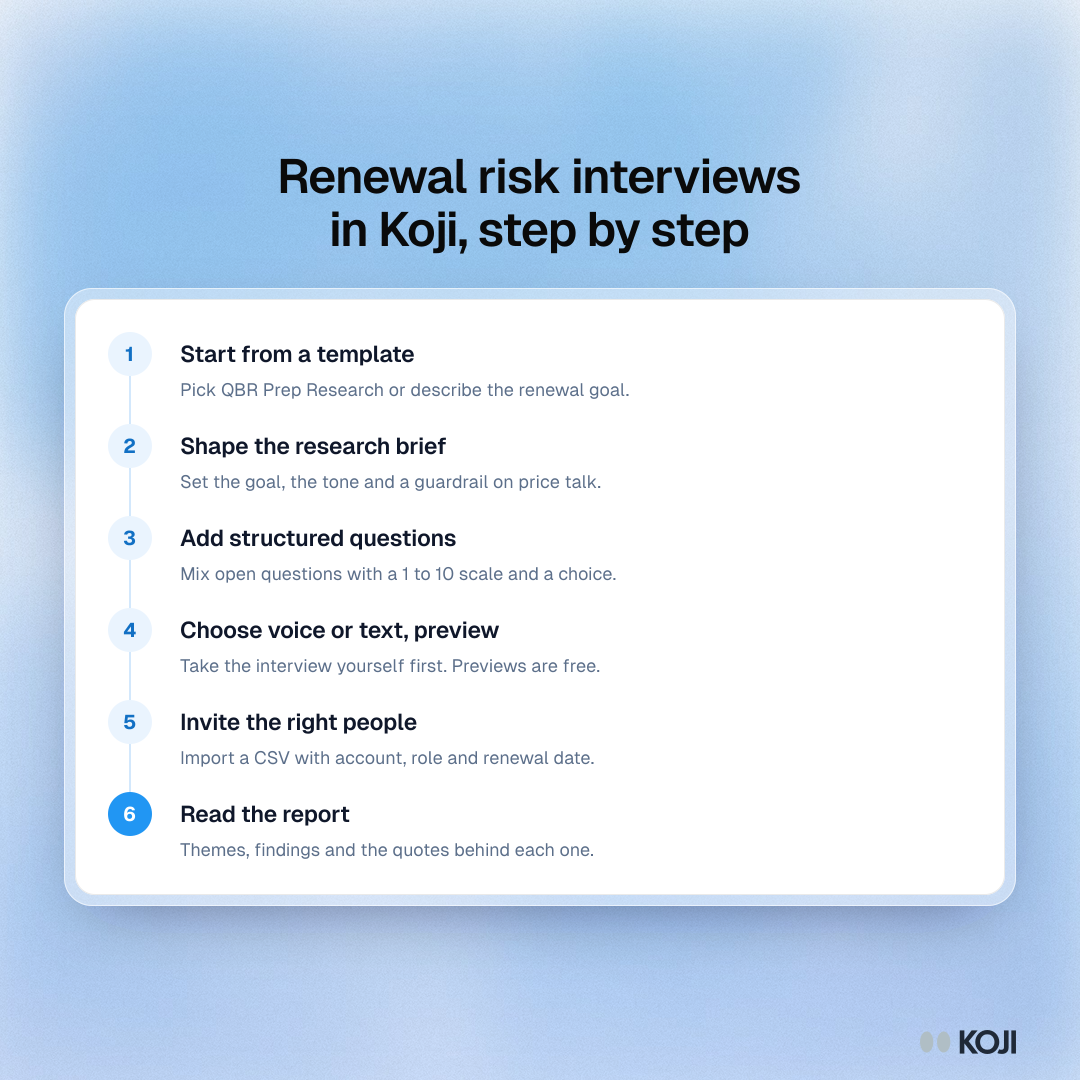
Process showing six steps to set up renewal risk interviews in Koji: template, research brief, structured questions, preview, CSV invites and report.

Process

Renewal risk interviews in Koji, step by step
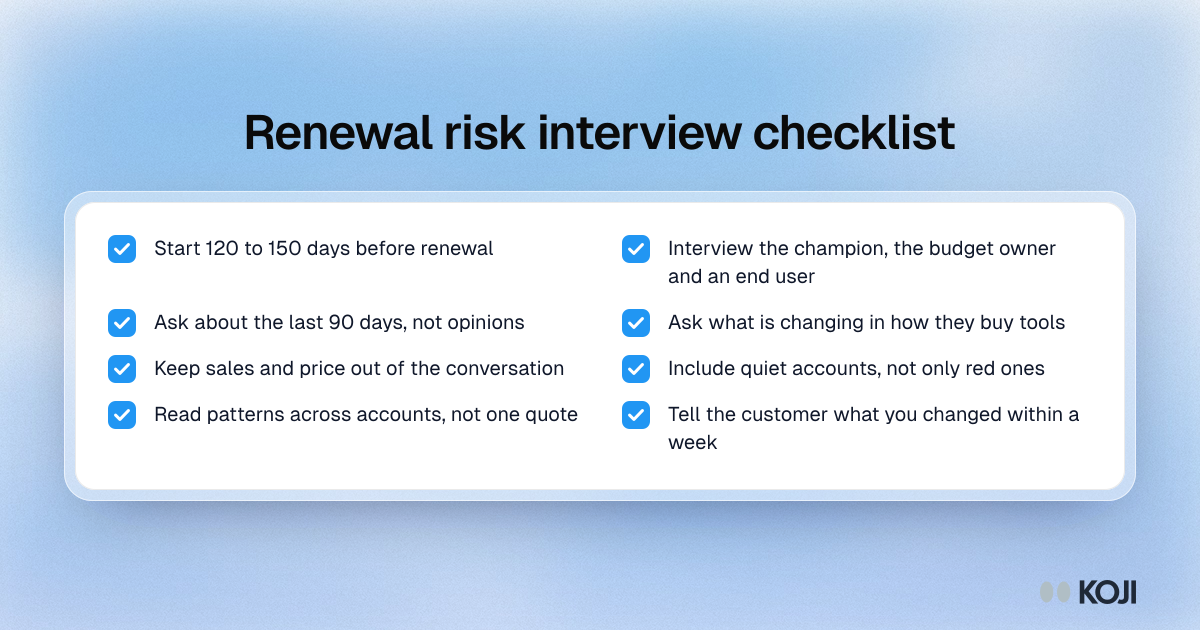
Checklist for running renewal risk interviews: when to start, who to interview, what to ask and how to close the loop with the customer.

Checklist

Renewal risk interview checklist
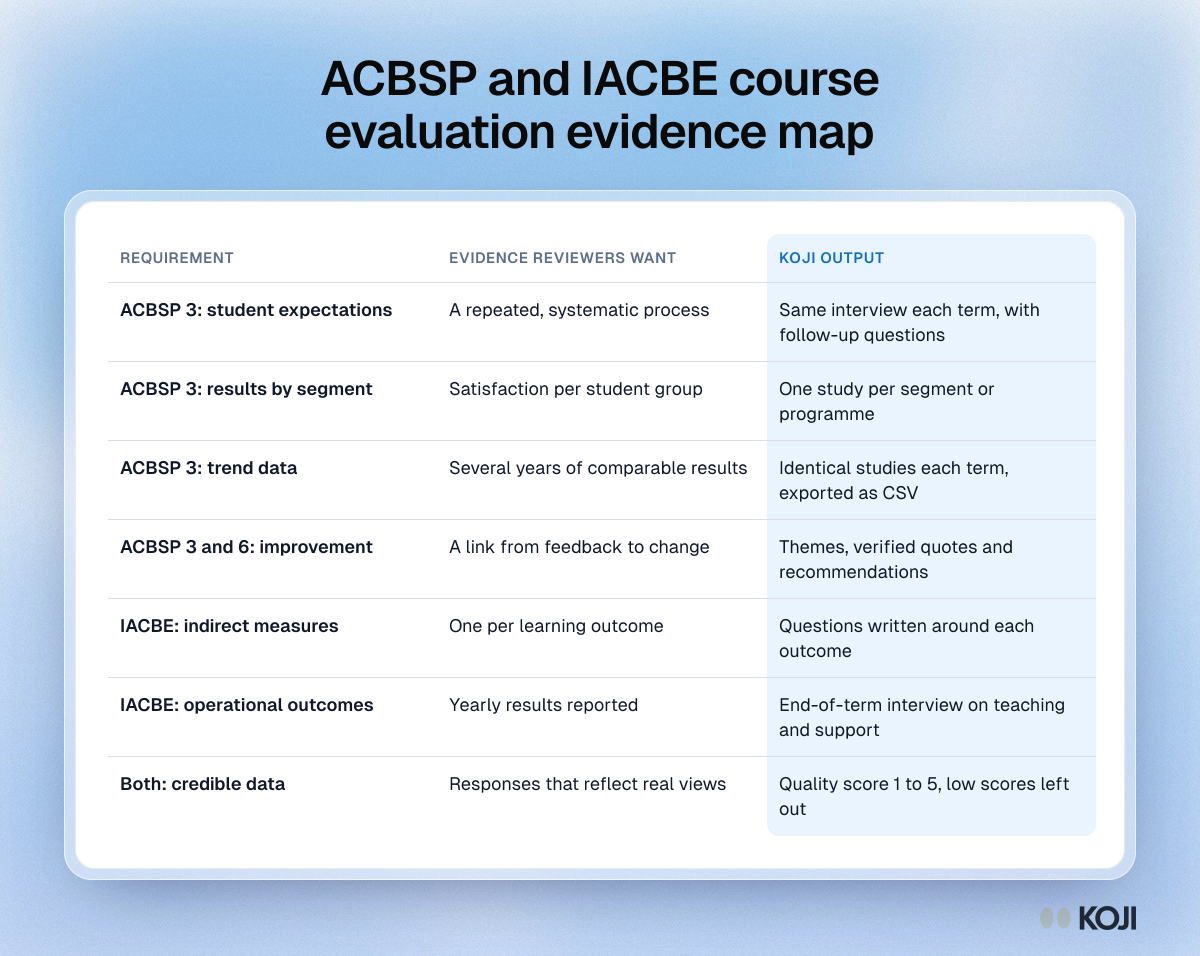
Table mapping ACBSP Standard 3 and IACBE outcomes assessment requirements to course evaluation outputs, from segment results to indirect measures.

Reference table

ACBSP and IACBE course evaluation evidence map
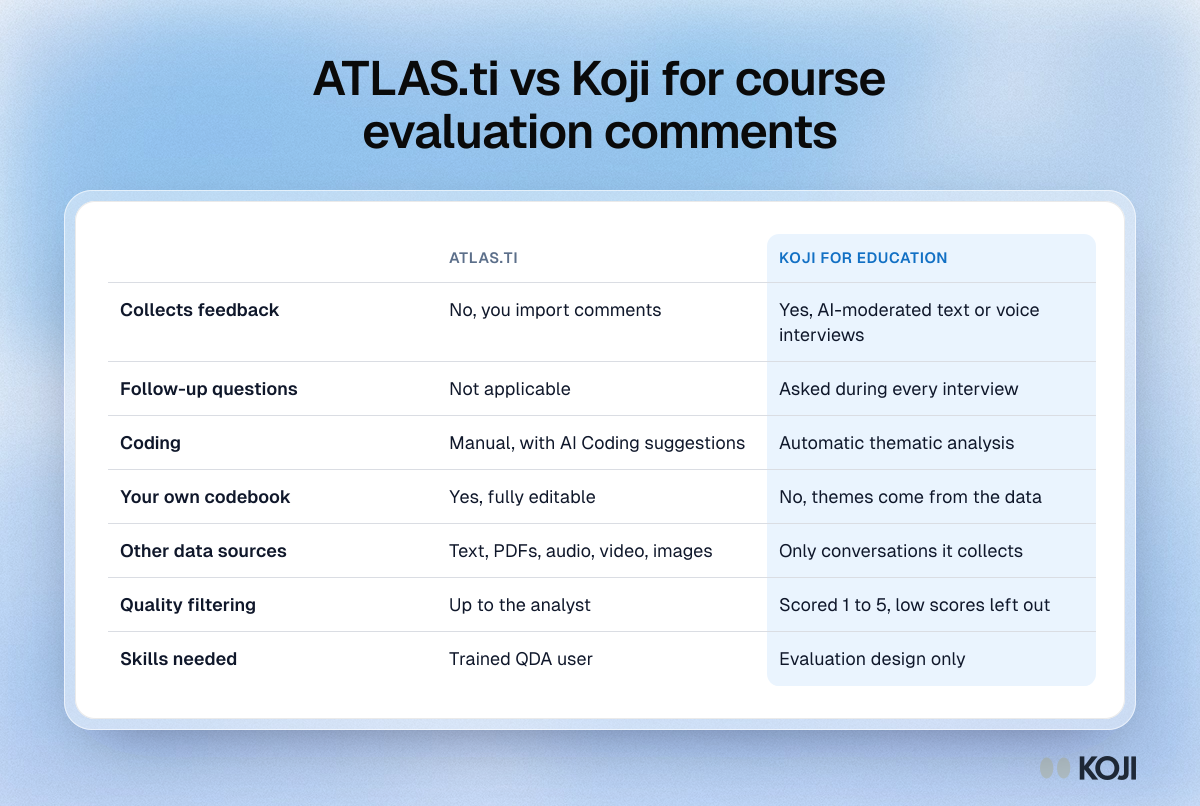
Comparison table of ATLAS.ti and Koji for course evaluation comments: collection, follow-up questions, coding, codebook control and quality filtering.

Reference table

ATLAS.ti vs Koji for course evaluation comments
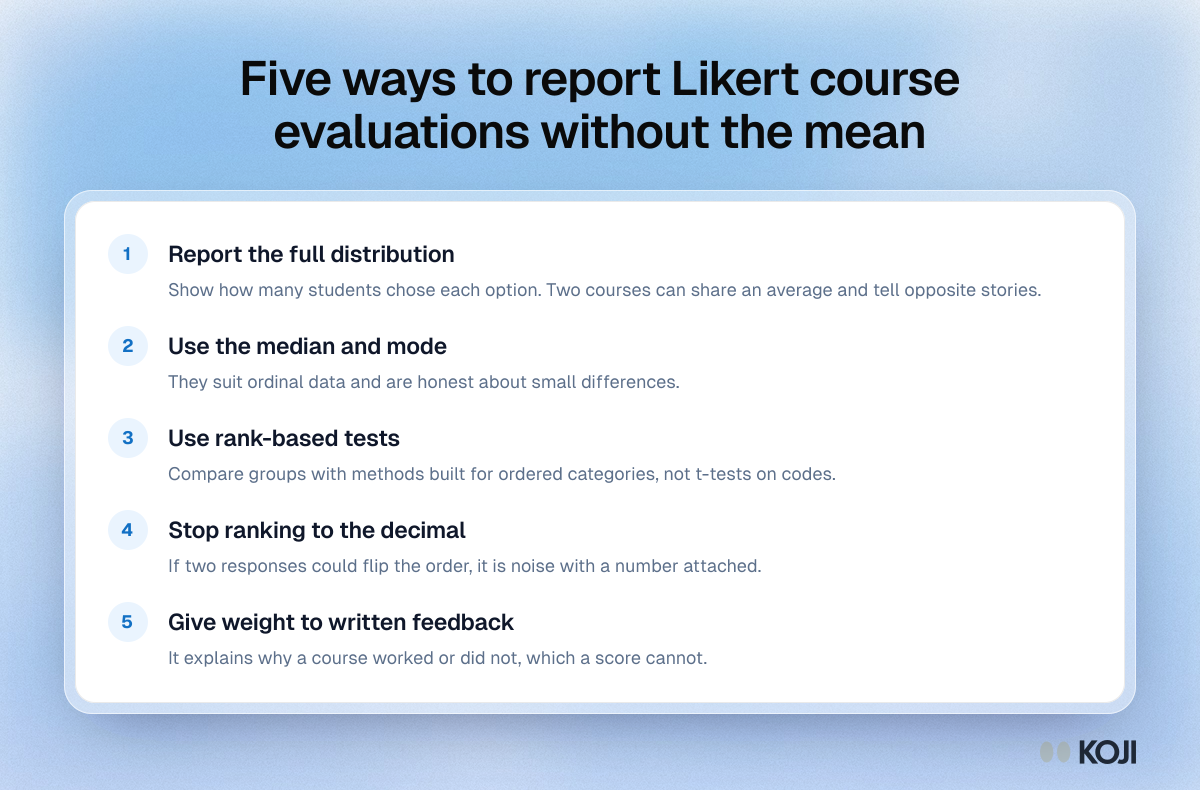
List of five ways to report Likert course evaluation data without averaging, from showing distributions and medians to giving comments more weight.

Guide

Five ways to report Likert course evaluations without the mean
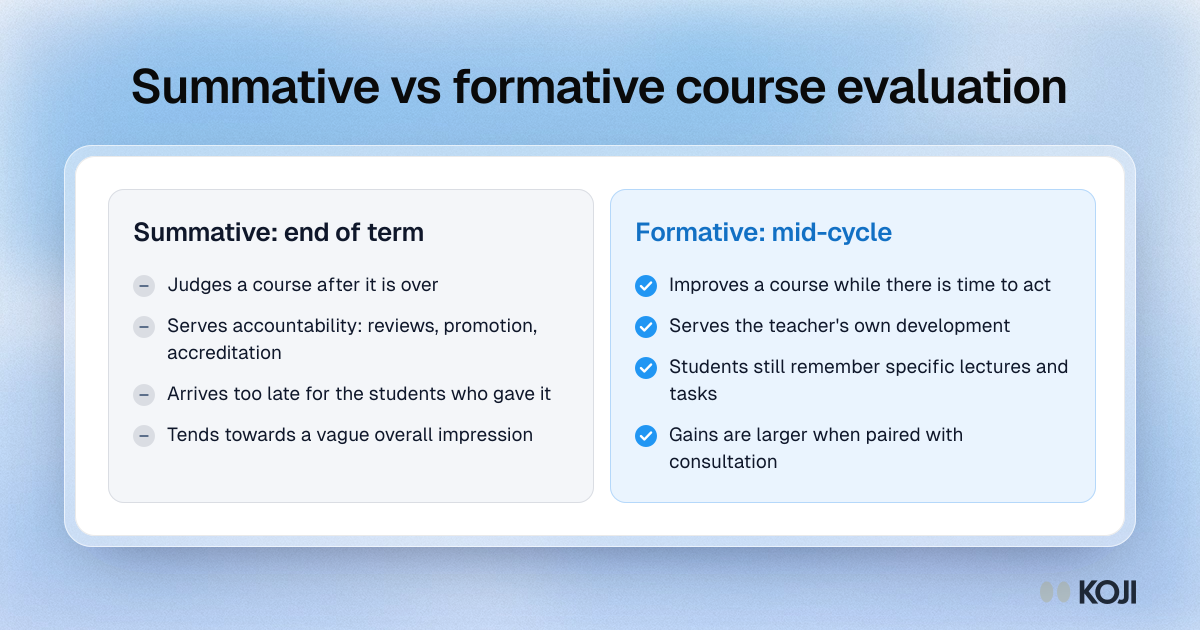
Comparison of summative end-of-term course evaluation and formative mid-cycle feedback: purpose, timing, who benefits and the quality of what students recall.

Comparison

Summative vs formative course evaluation
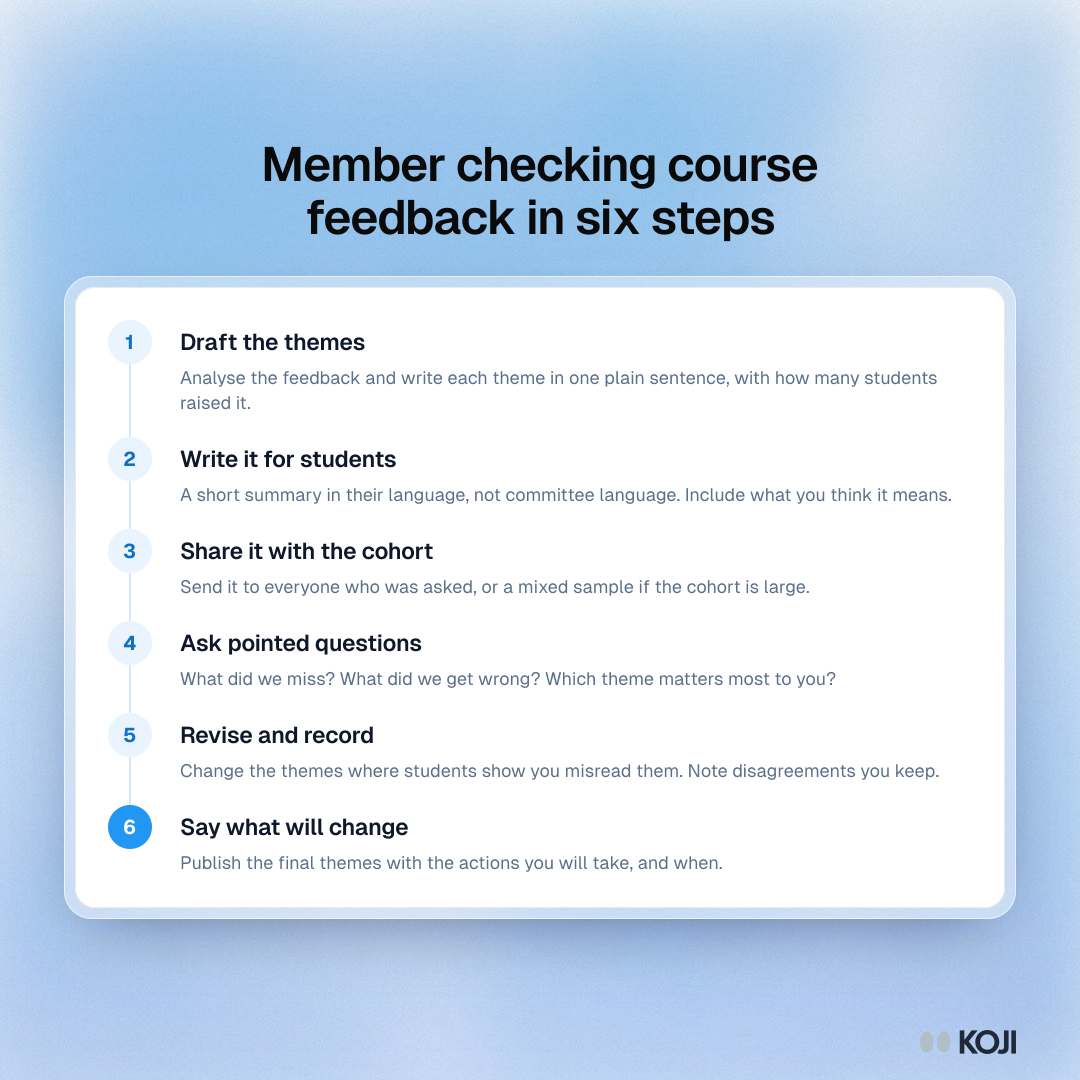
Process diagram for member checking course feedback: draft themes, share them with students, ask what was missed, revise, and say what will change.

Process

Member checking course feedback in six steps
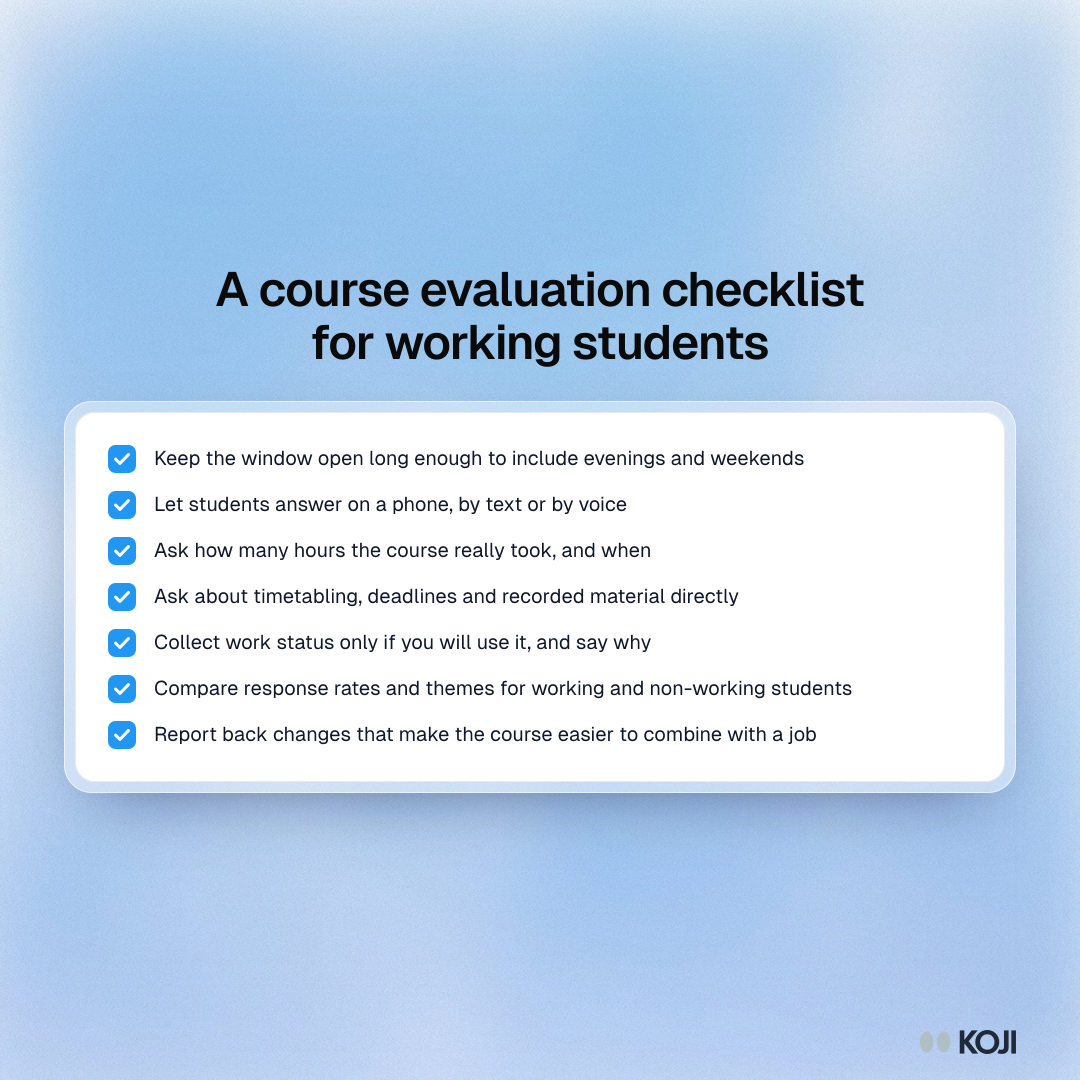
Checklist for making course evaluation work for students with paid jobs, from flexible response windows and voice answers to asking about timetabling.

Checklist

A course evaluation checklist for working students
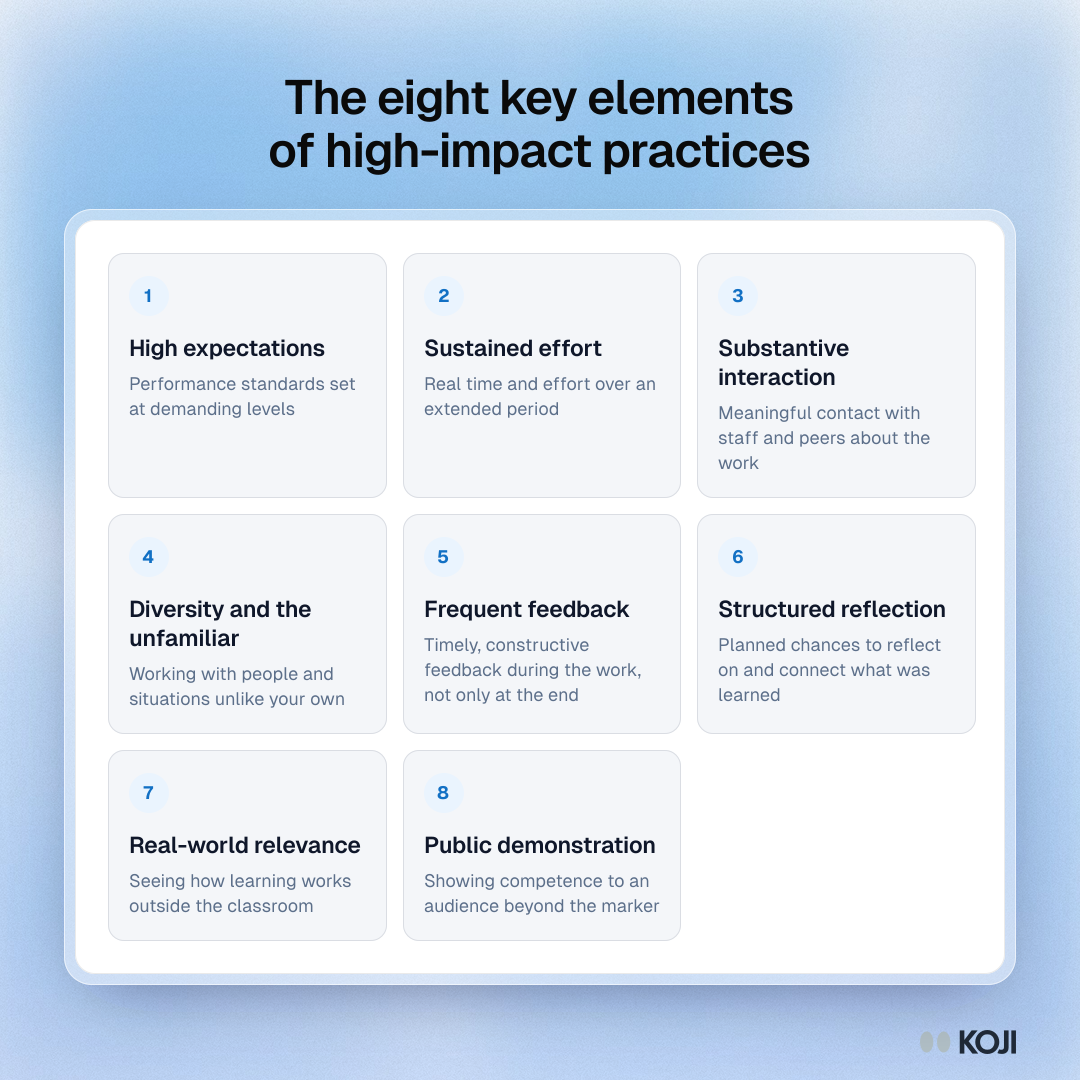
Framework of the eight key elements of high-impact practices, including high expectations, sustained effort, feedback and structured reflection.

Framework

The eight key elements of high-impact practices
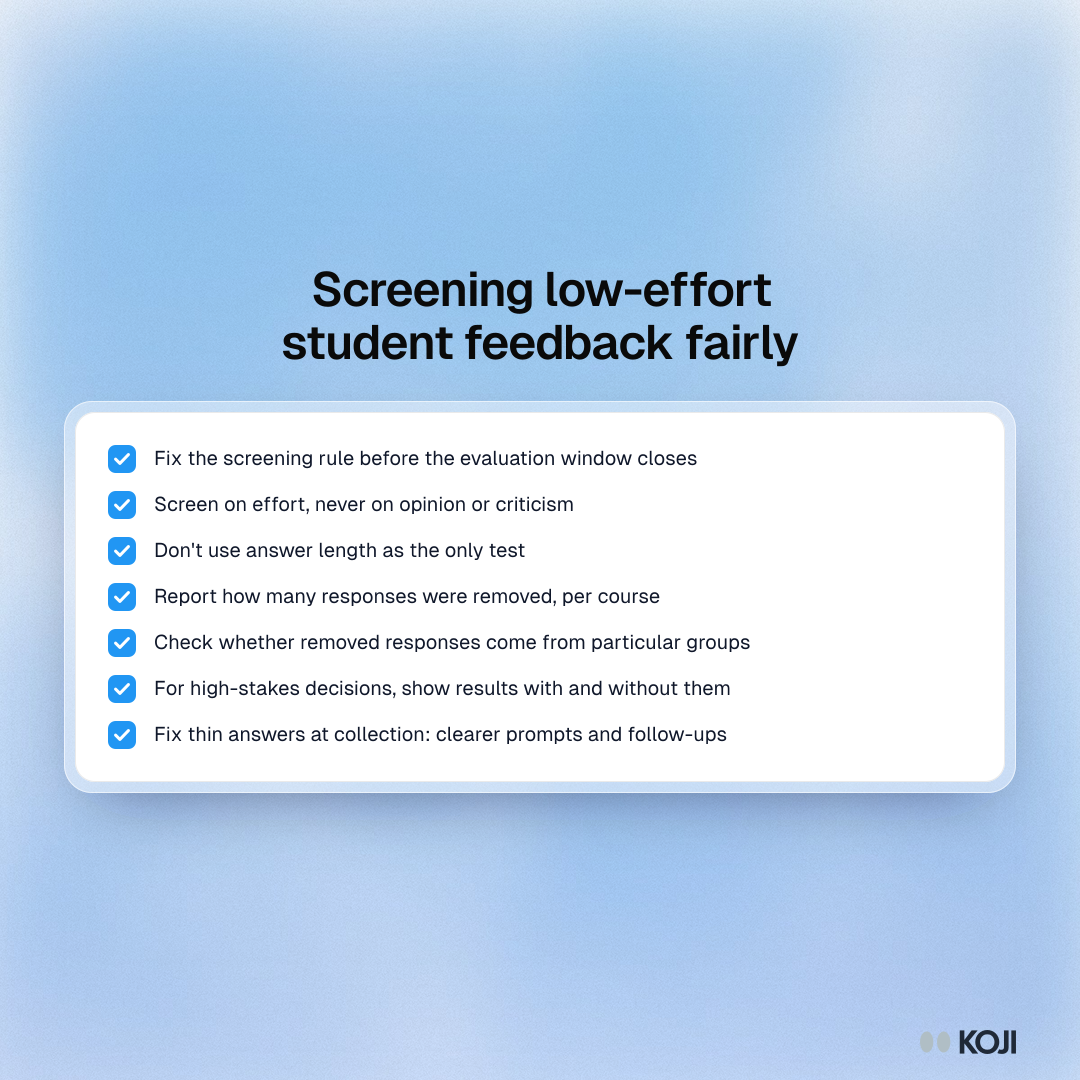
Checklist for screening low-effort student feedback fairly: fix the rule in advance, screen on effort not opinion, report removals and compare groups.

Checklist

Screening low-effort student feedback fairly
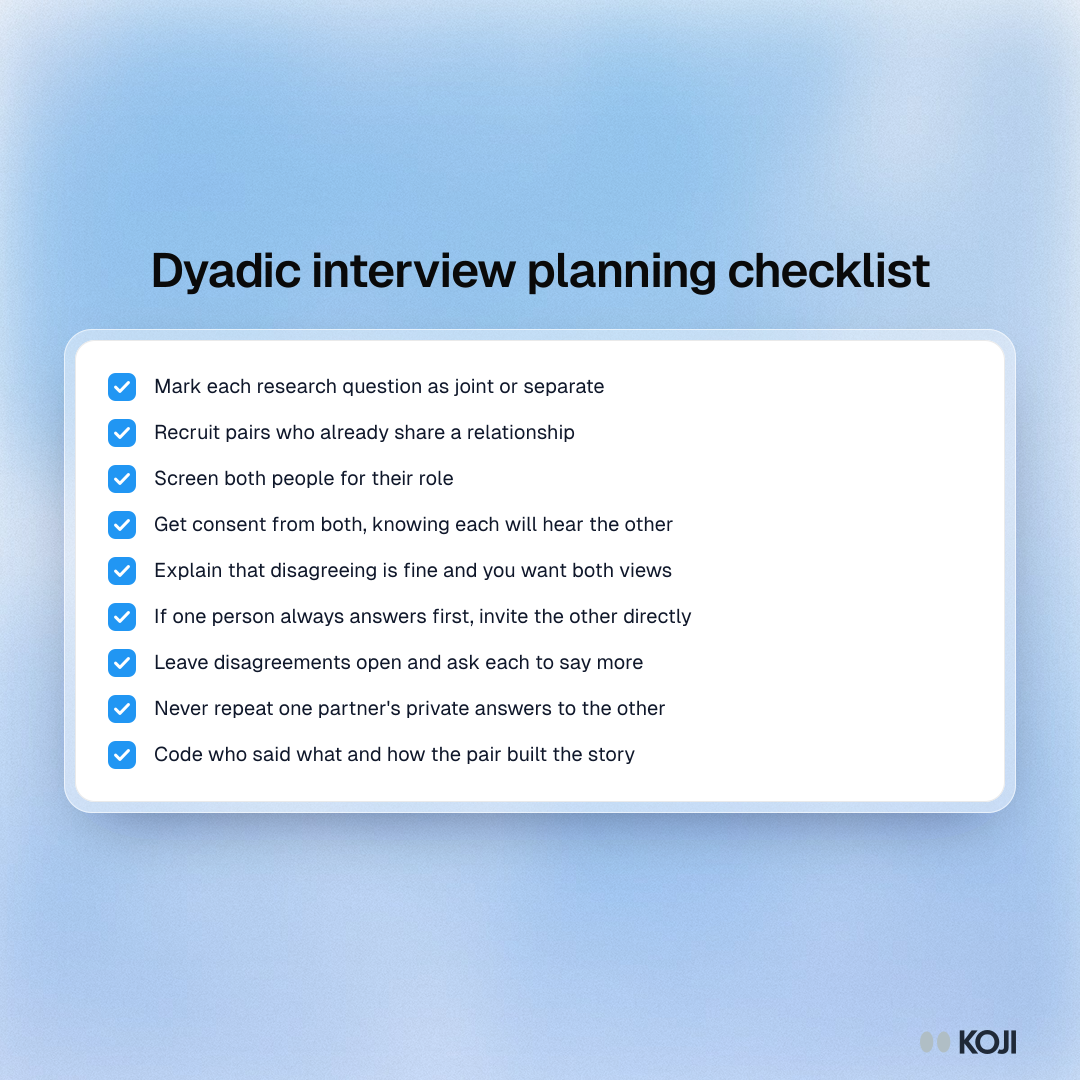
Checklist for planning a dyadic interview, covering format, recruitment, consent, moderation and analysis.

Checklist

Dyadic interview planning checklist
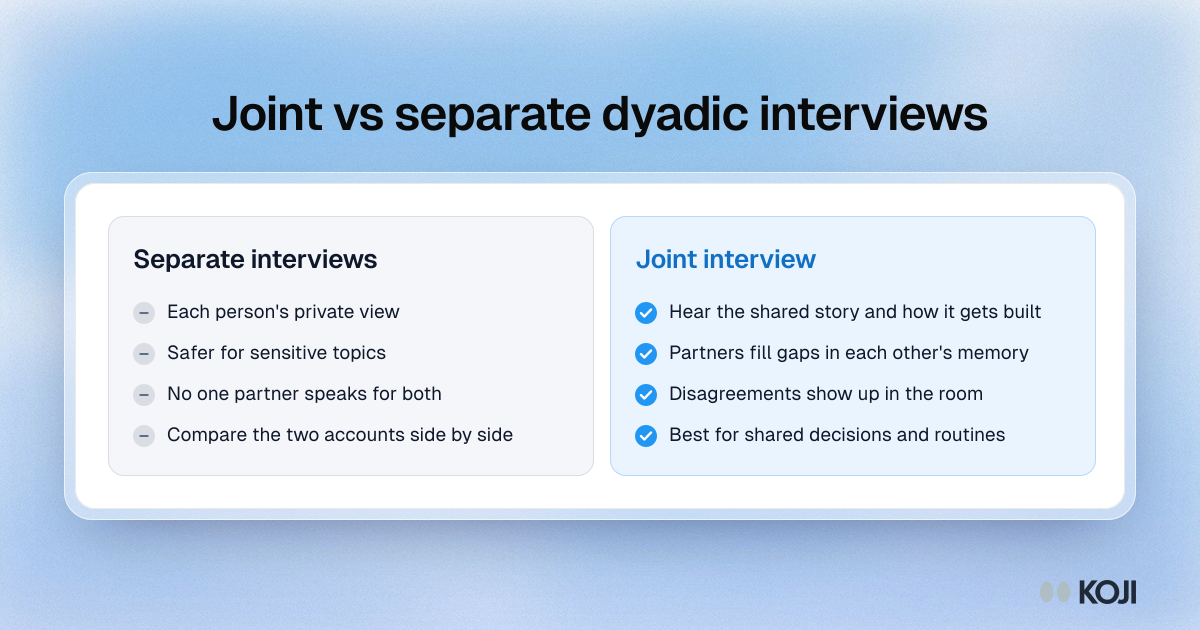
Comparison of joint and separate dyadic interviews, showing what each format is good for and when each one is the better choice.

Comparison

Joint vs separate dyadic interviews
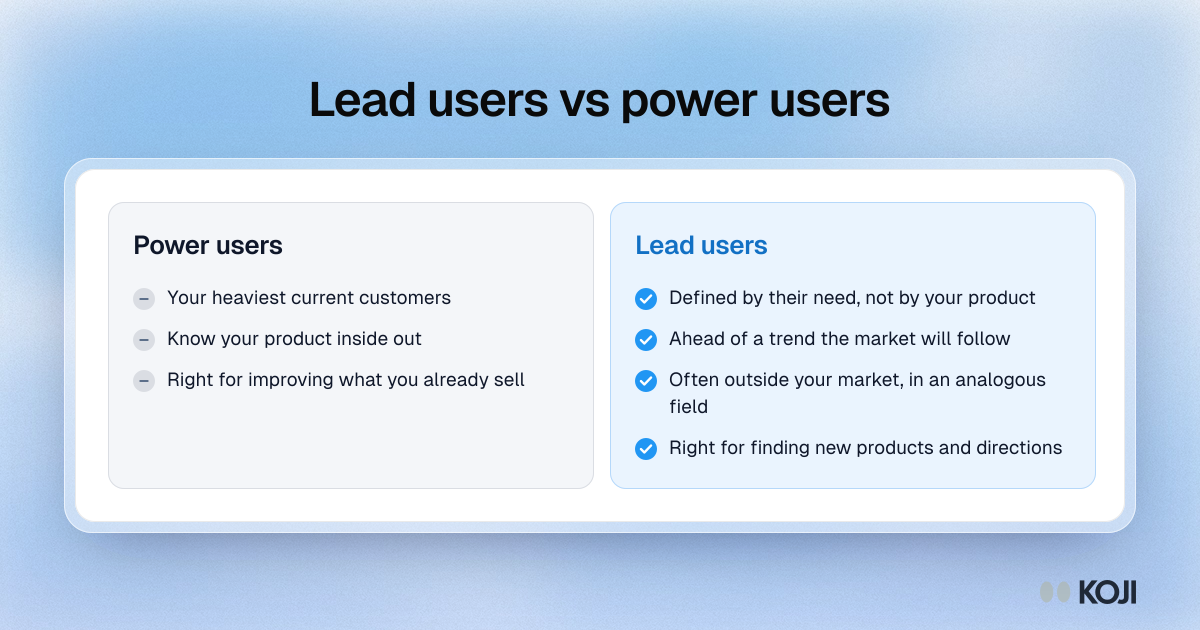
Comparison of lead users and power users, showing how they differ in where they come from, what they know and what research with them is good for.

Comparison

Lead users vs power users

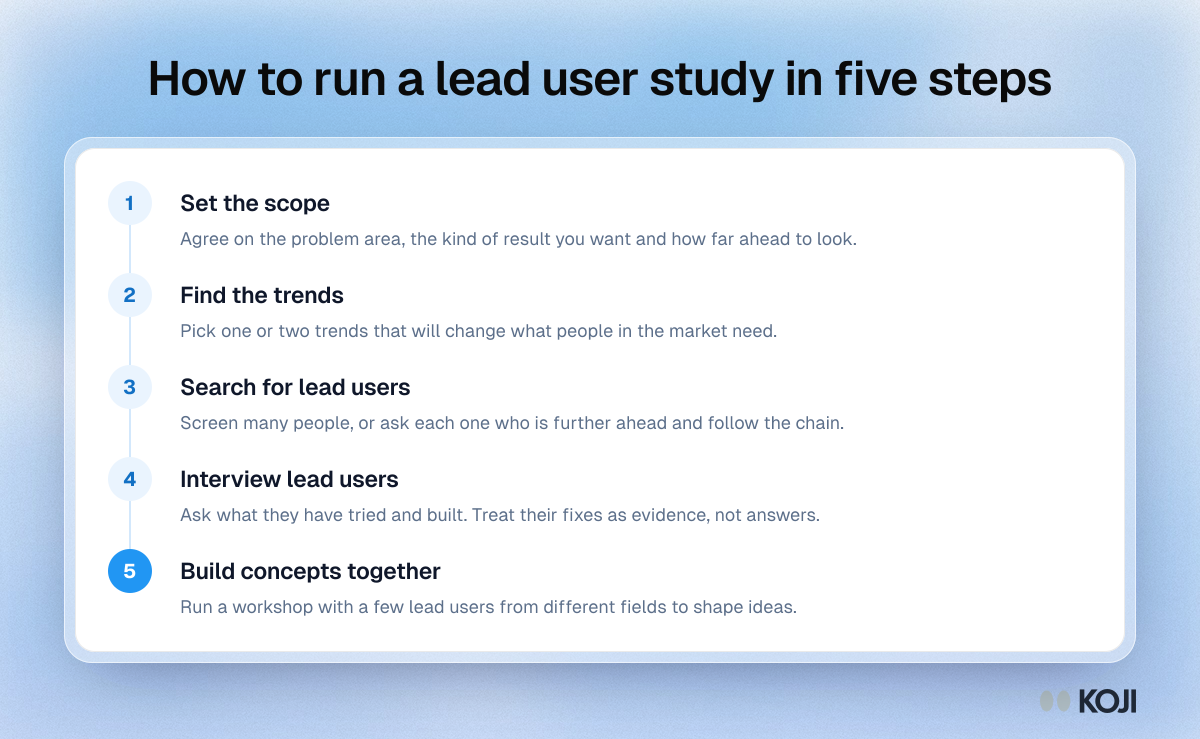
Process showing five steps of a lead user study: set the scope, find the trends, search for lead users, interview them, and build concepts together.

Process

How to run a lead user study in five steps
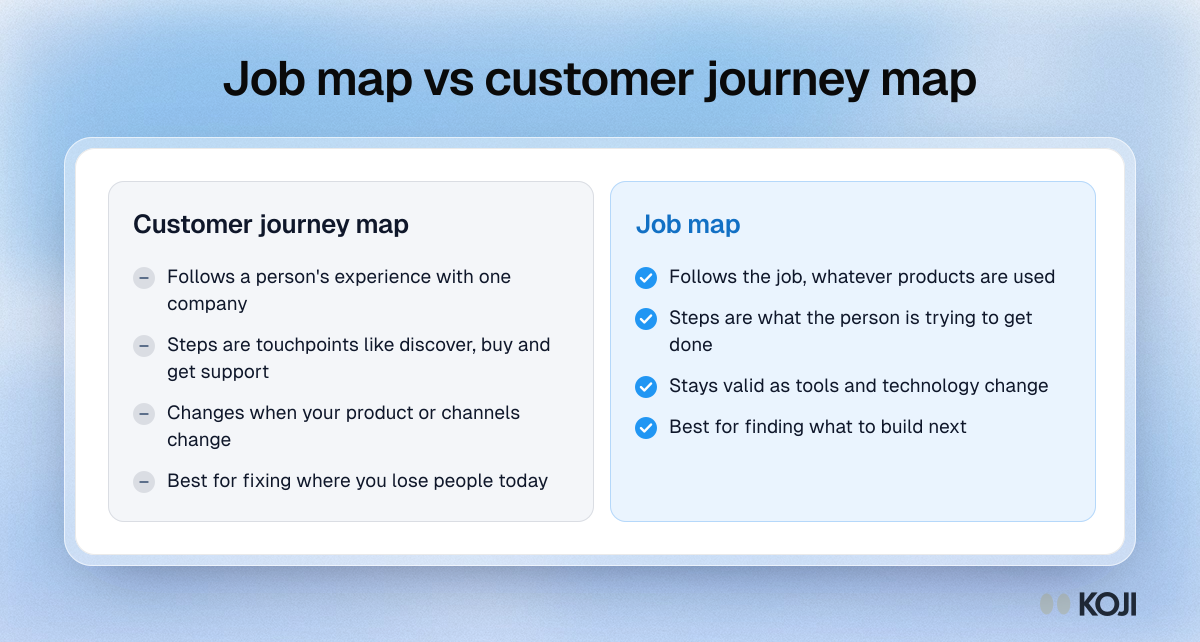
Comparison of a job map and a customer journey map, showing how their focus, steps, stability and main use differ.

Comparison

Job map vs customer journey map
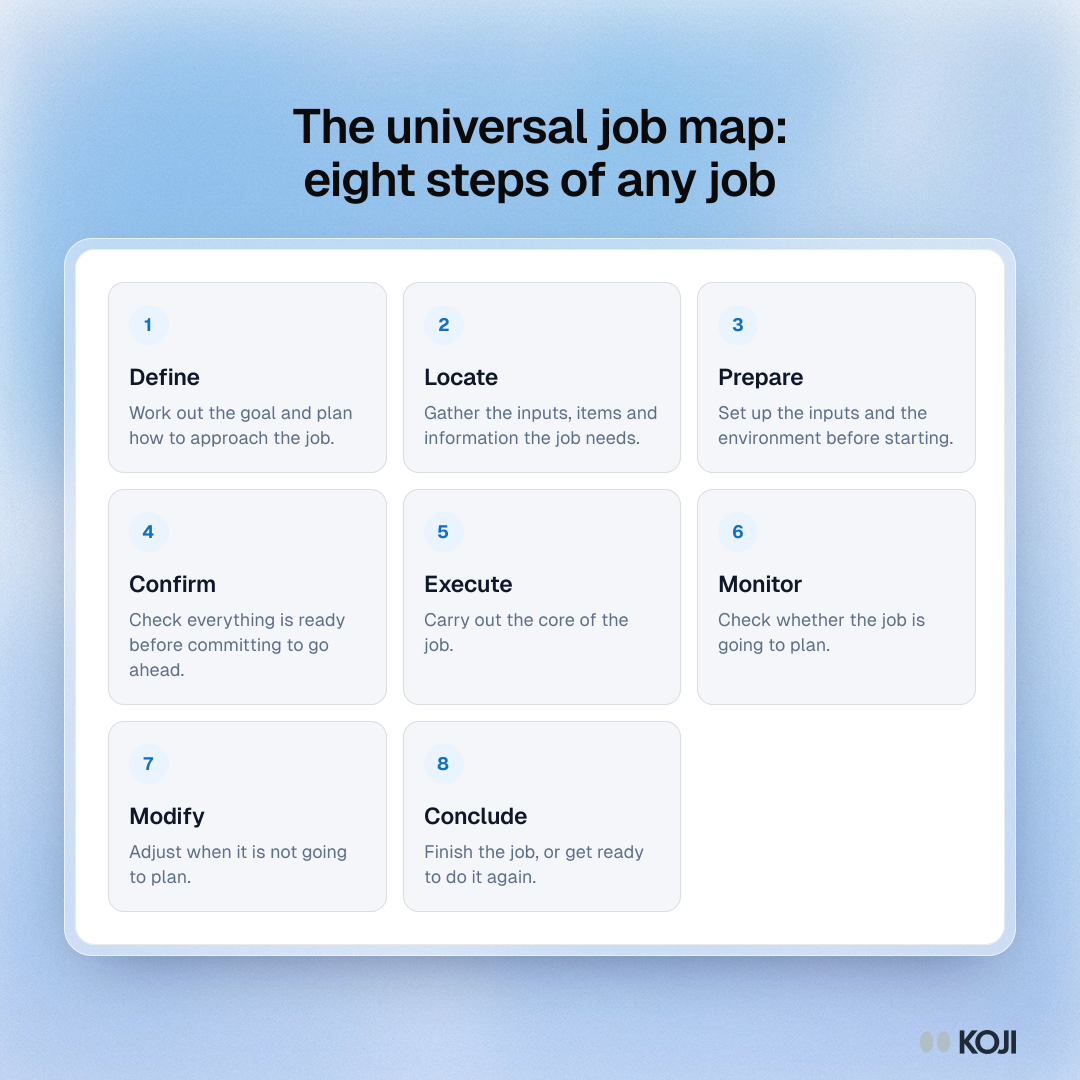
Framework showing the eight steps of the universal job map: define, locate, prepare, confirm, execute, monitor, modify and conclude.

Framework

The universal job map: eight steps of any job
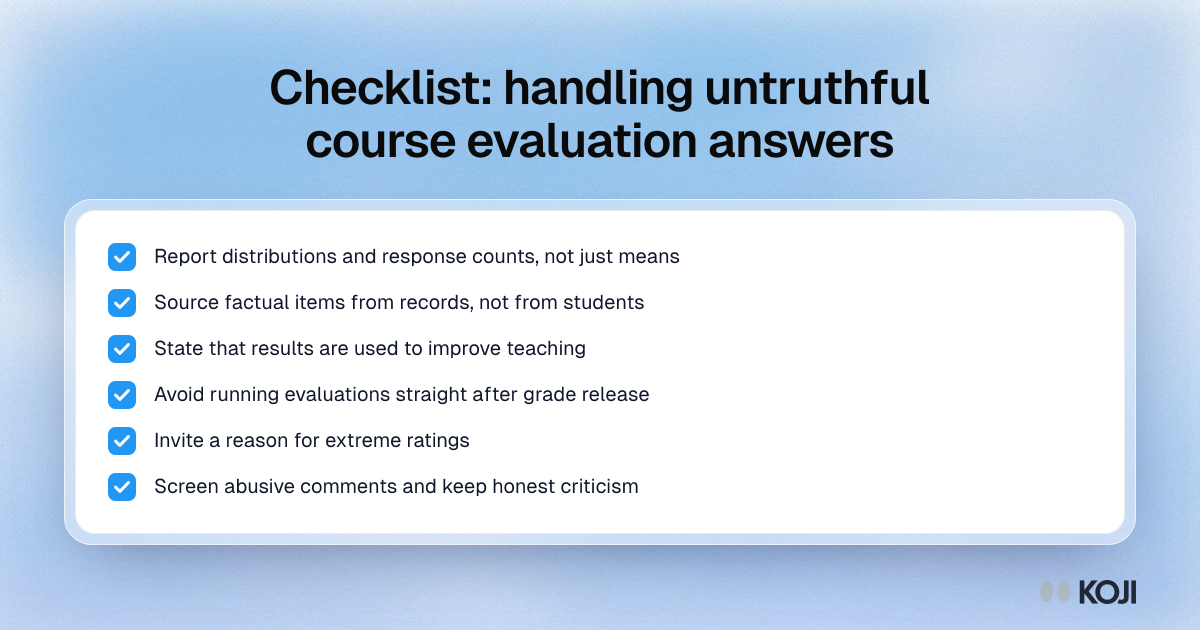
Checklist of six steps for reducing and reading untruthful answers in course evaluations, from reporting distributions to asking for reasons.

Checklist

Checklist: handling untruthful course evaluation answers
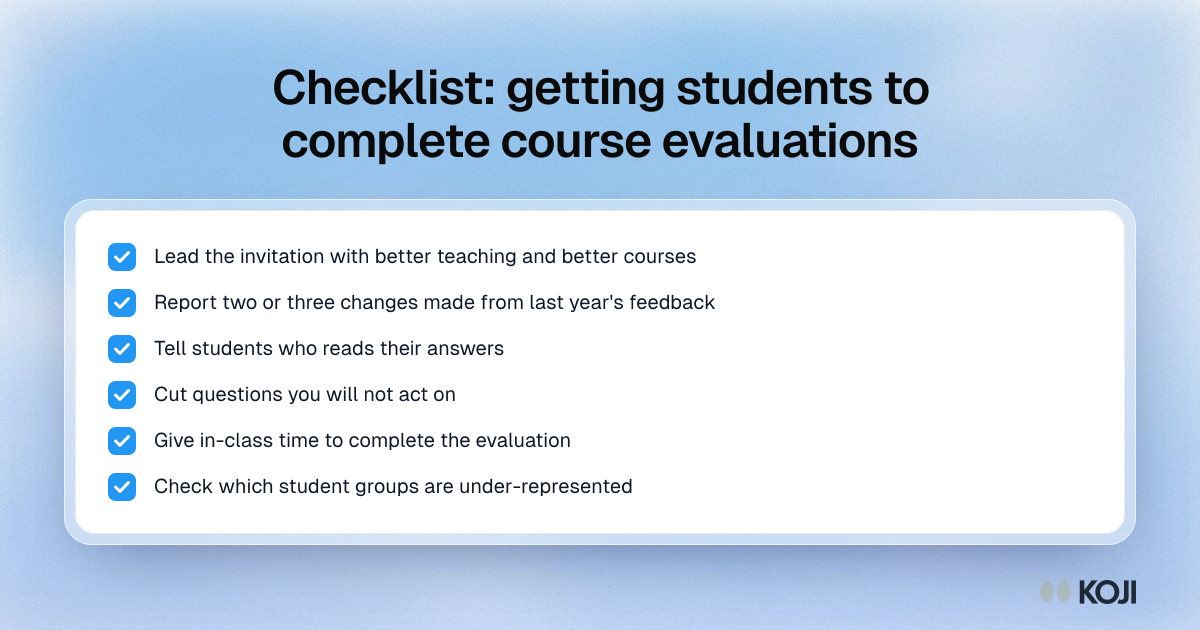
Checklist of six steps that raise students' reasons to complete course evaluations, from invitation wording to showing what changed last year.

Checklist

Checklist: getting students to complete course evaluations
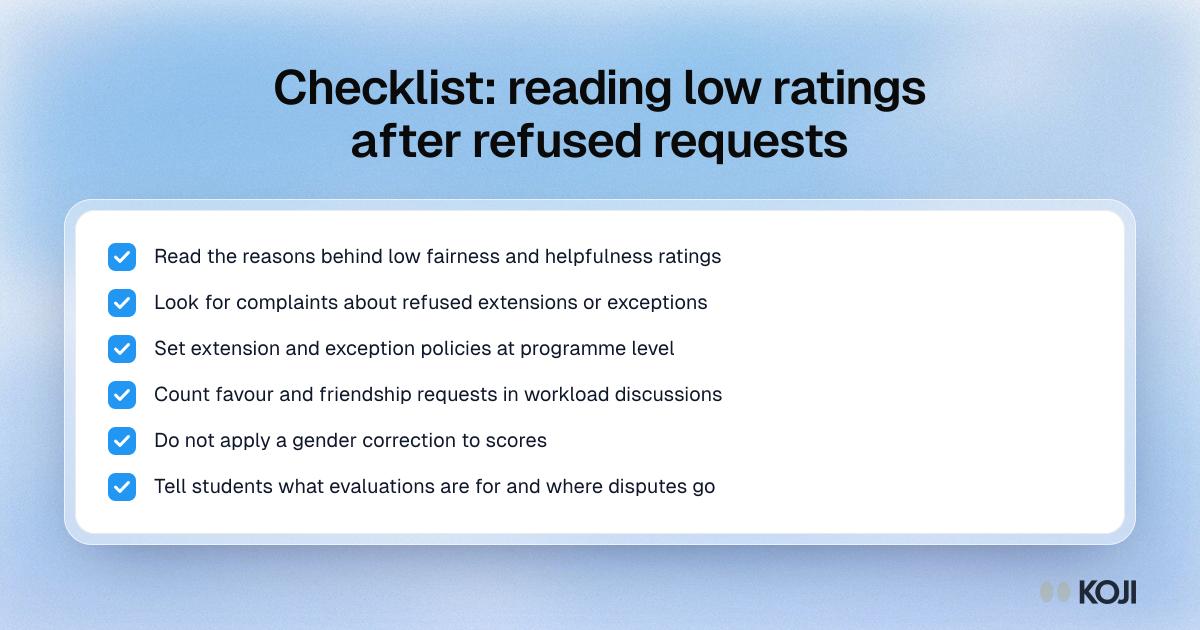
Checklist of six steps for reading low course evaluation ratings that may reflect refused student requests rather than teaching quality.

Checklist

Checklist: reading low ratings after refused requests
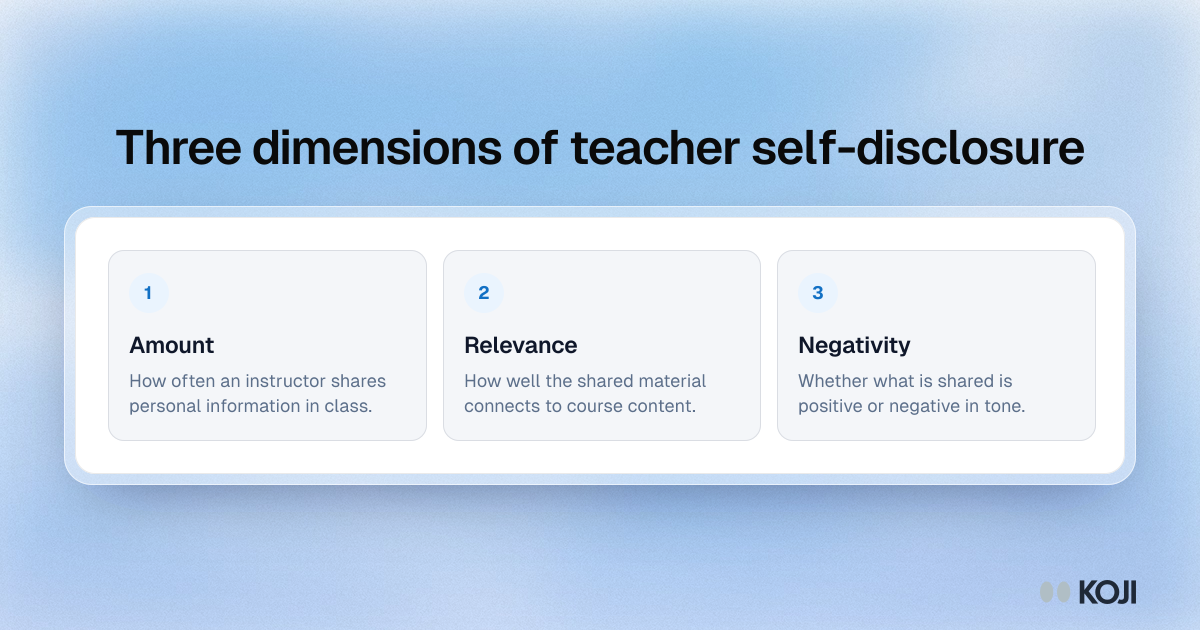
Framework showing three dimensions of teacher self-disclosure: amount, relevance and negativity, as defined by Cayanus and Martin (2008).

Framework

Three dimensions of teacher self-disclosure
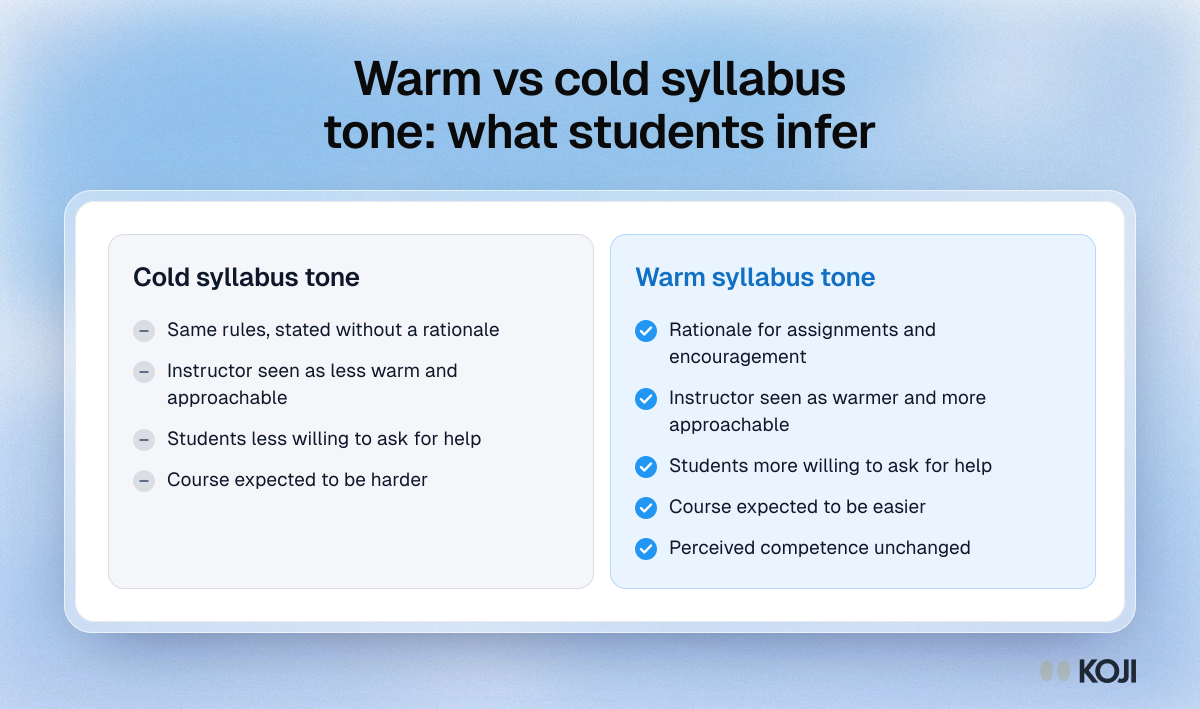
Comparison of a cold and a warm syllabus tone and how each shifts student views of the instructor, help seeking and expected course difficulty.

Comparison

Warm vs cold syllabus tone: what students infer
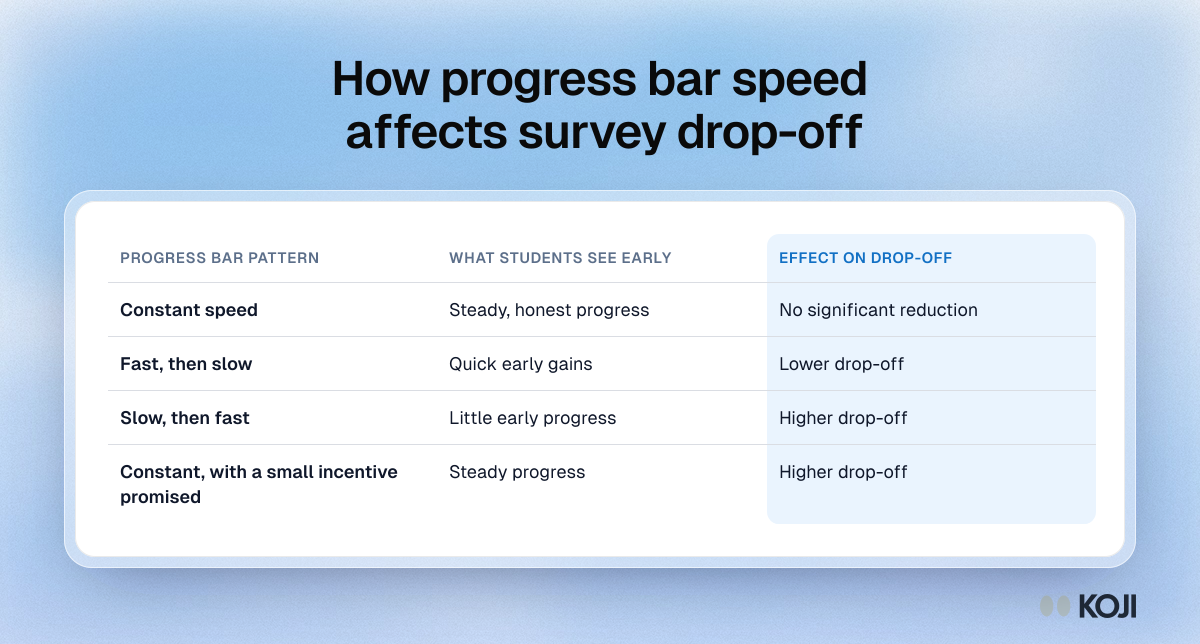
Table comparing four progress bar patterns in web surveys and their effect on drop-off, from a meta-analysis of 32 randomised experiments.

Reference table

How progress bar speed affects survey drop-off
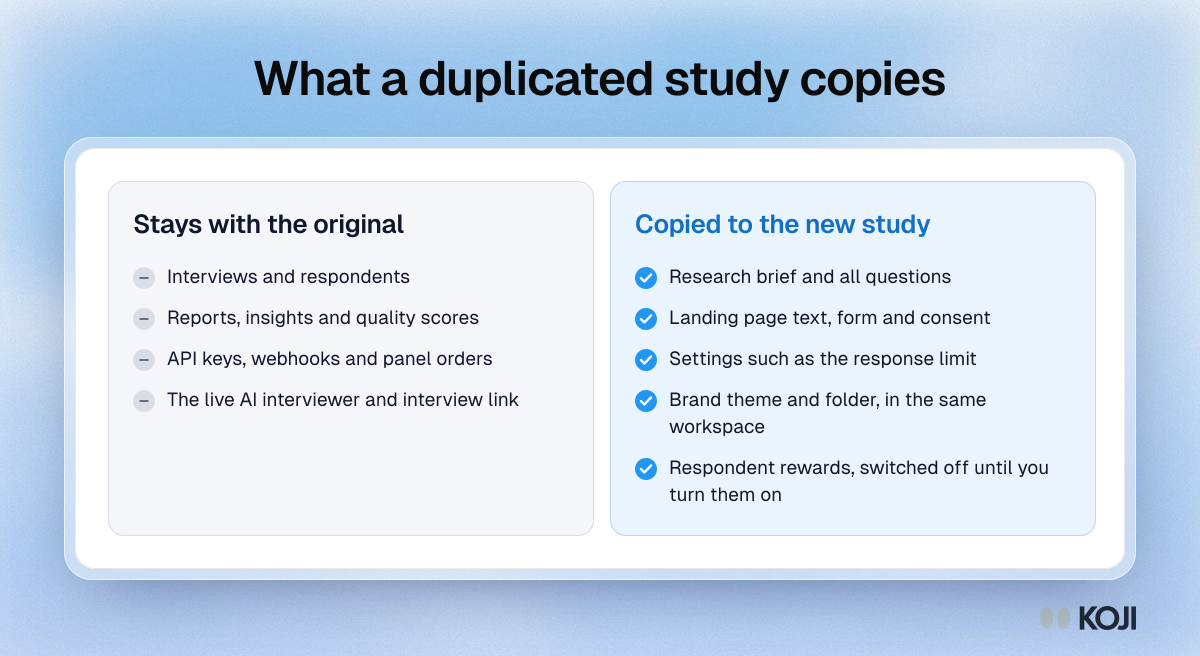
Comparison of what a duplicated Koji study copies, like the brief, questions and landing page, and what stays behind, like interviews and reports.

Comparison

What a duplicated study copies
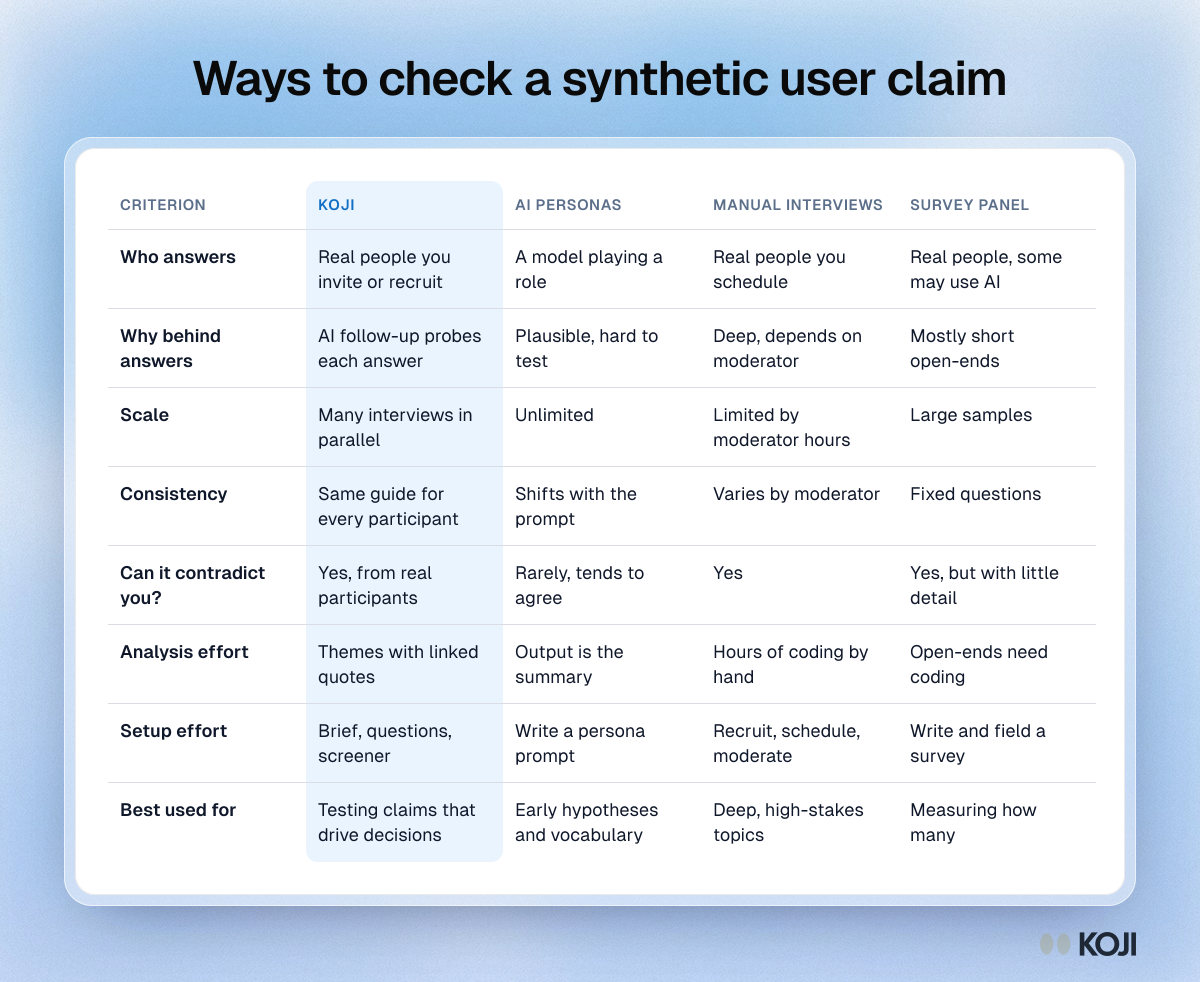
Table comparing Koji, AI personas, manual interviews and survey panels for checking a synthetic user claim, on who answers, depth, scale and analysis effort.

Reference table

Ways to check a synthetic user claim
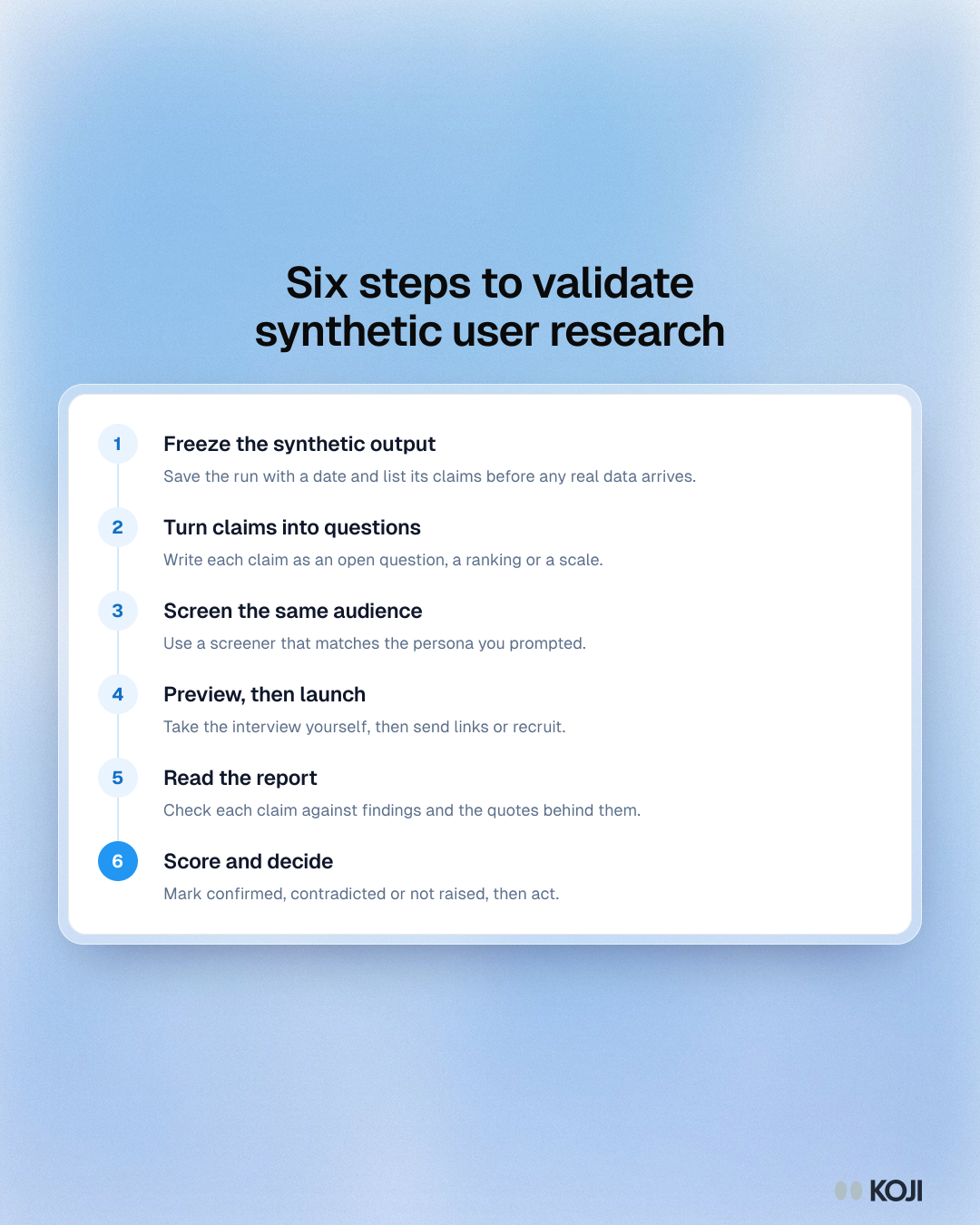
Process showing six steps to validate synthetic user research with real participants: freeze the output, write questions, screen, preview, read and score.
Process

Six steps to validate synthetic user research

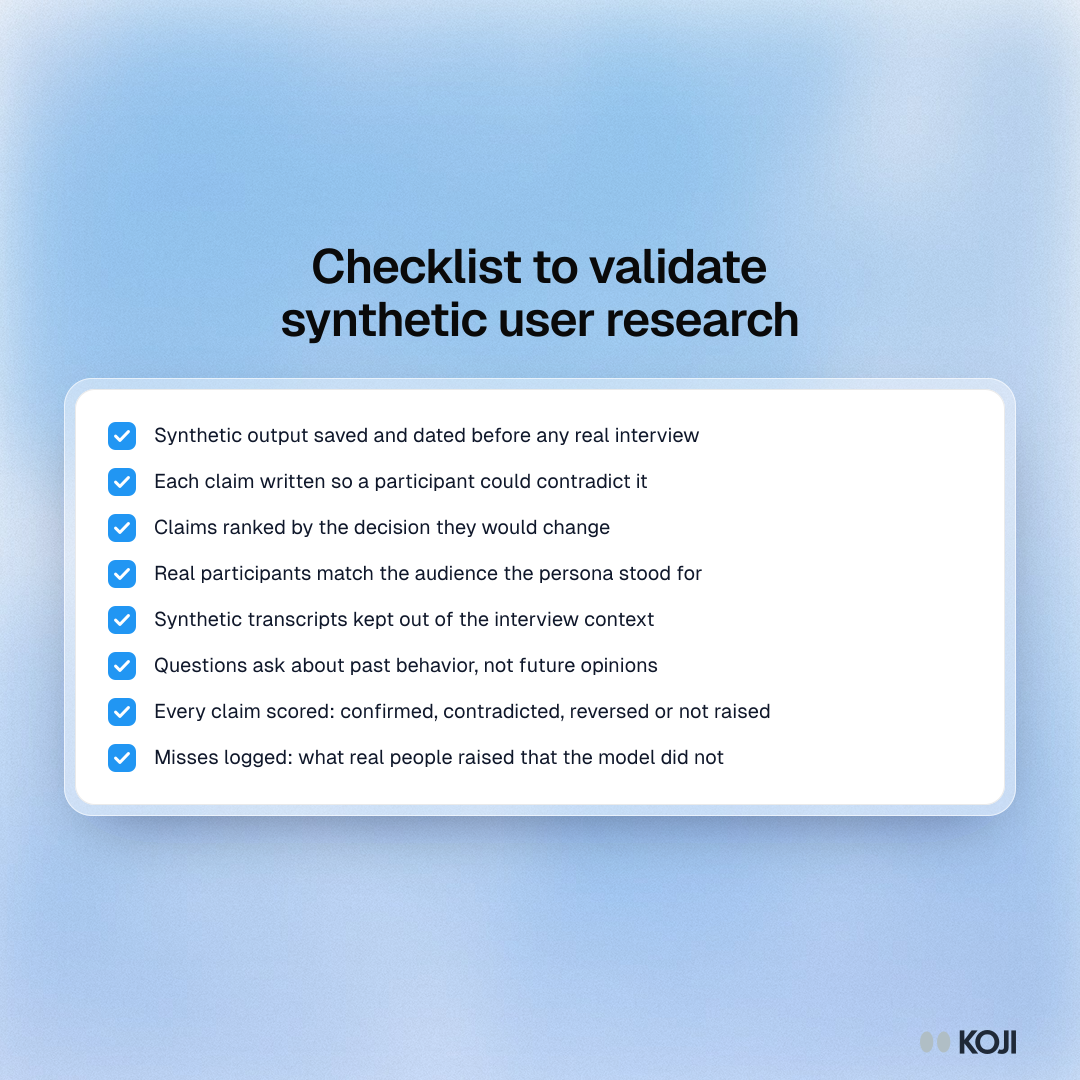
Checklist of eight steps for validating synthetic user research with real participants, from saving the AI output to logging what the model missed.

Checklist

Checklist to validate synthetic user research
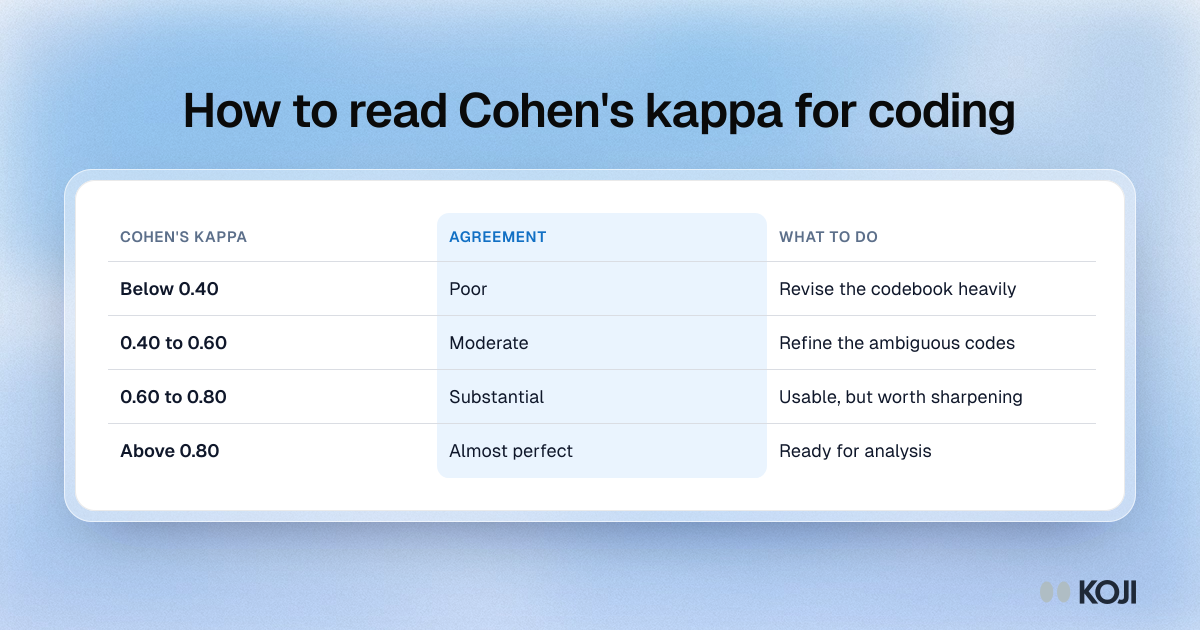
Table of Cohen's kappa thresholds for inter-coder agreement, from poor below 0.40 to almost perfect above 0.80, with what to do at each level.

Reference table

How to read Cohen's kappa for coding
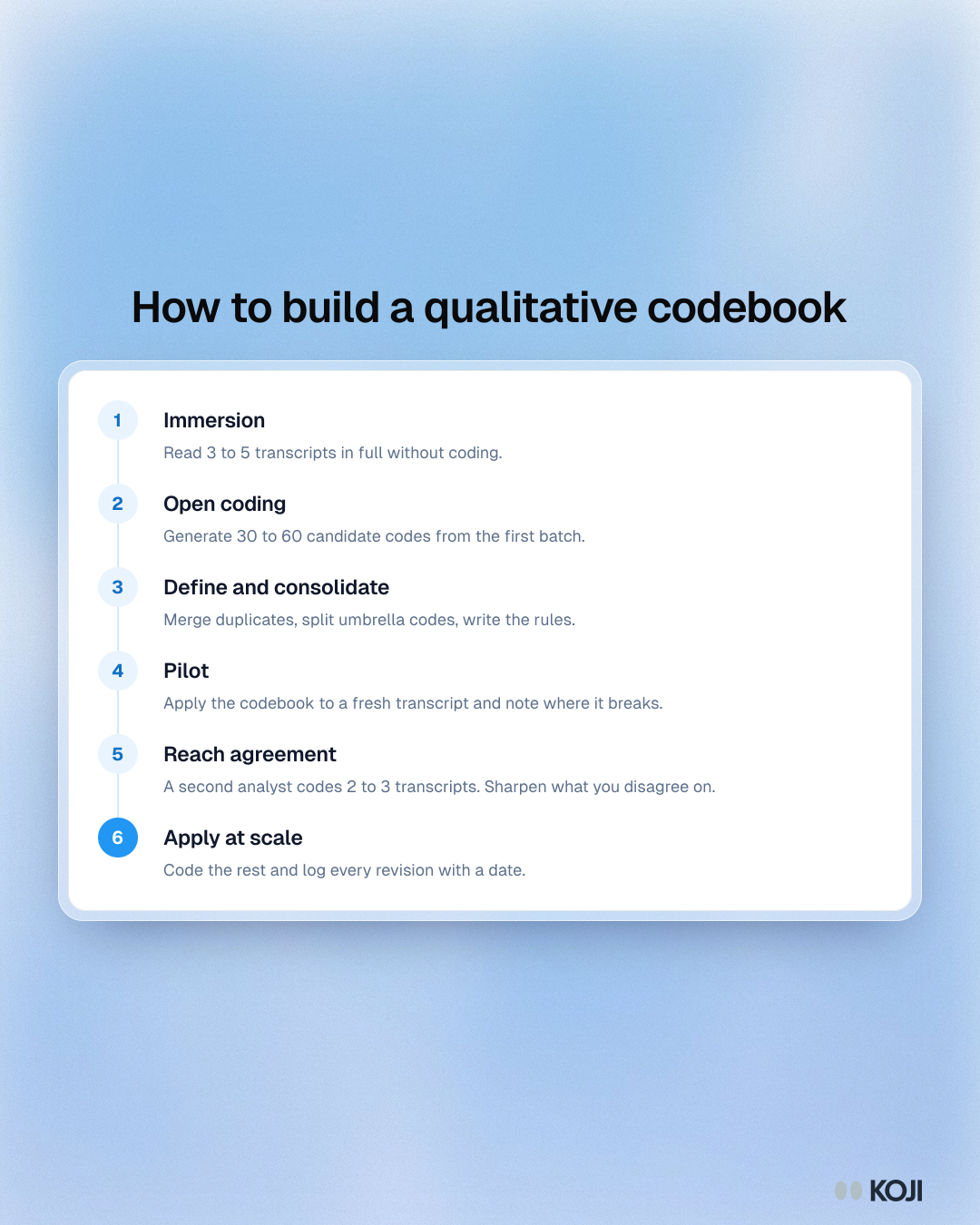
Process showing six phases for building a qualitative codebook: immersion, open coding, define and consolidate, pilot, reach agreement and apply at scale.

Process

How to build a qualitative codebook
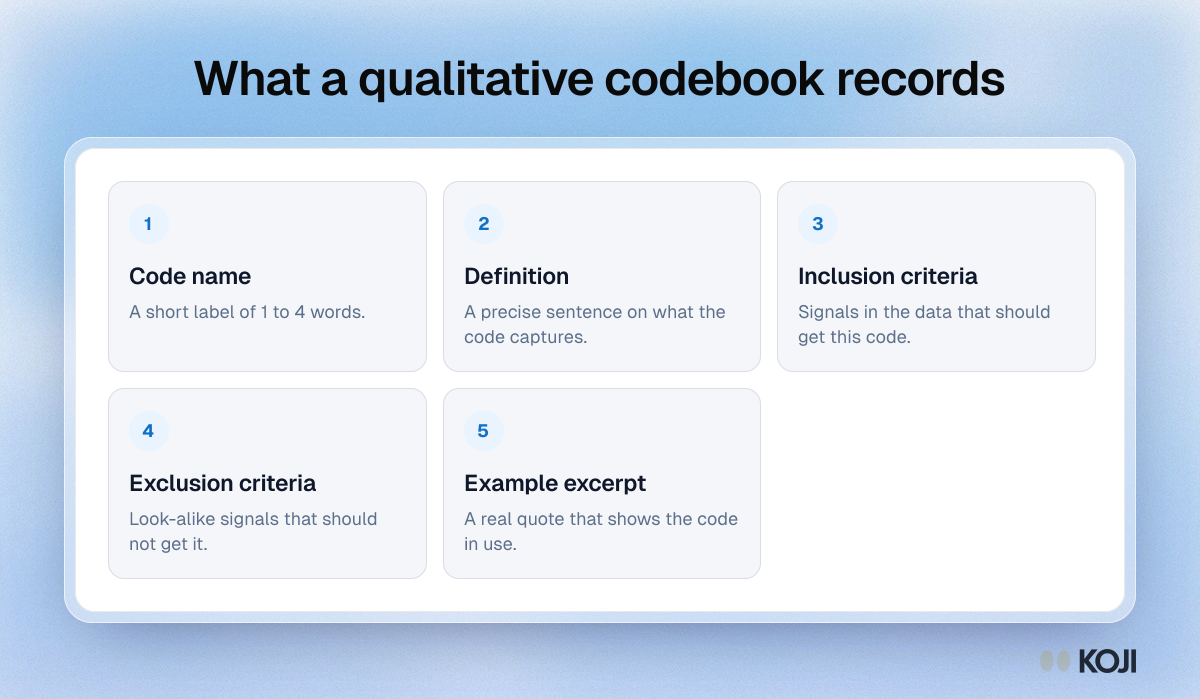
Framework listing the five columns of a qualitative codebook: code name, definition, inclusion criteria, exclusion criteria and an example excerpt.

Framework

What a qualitative codebook records
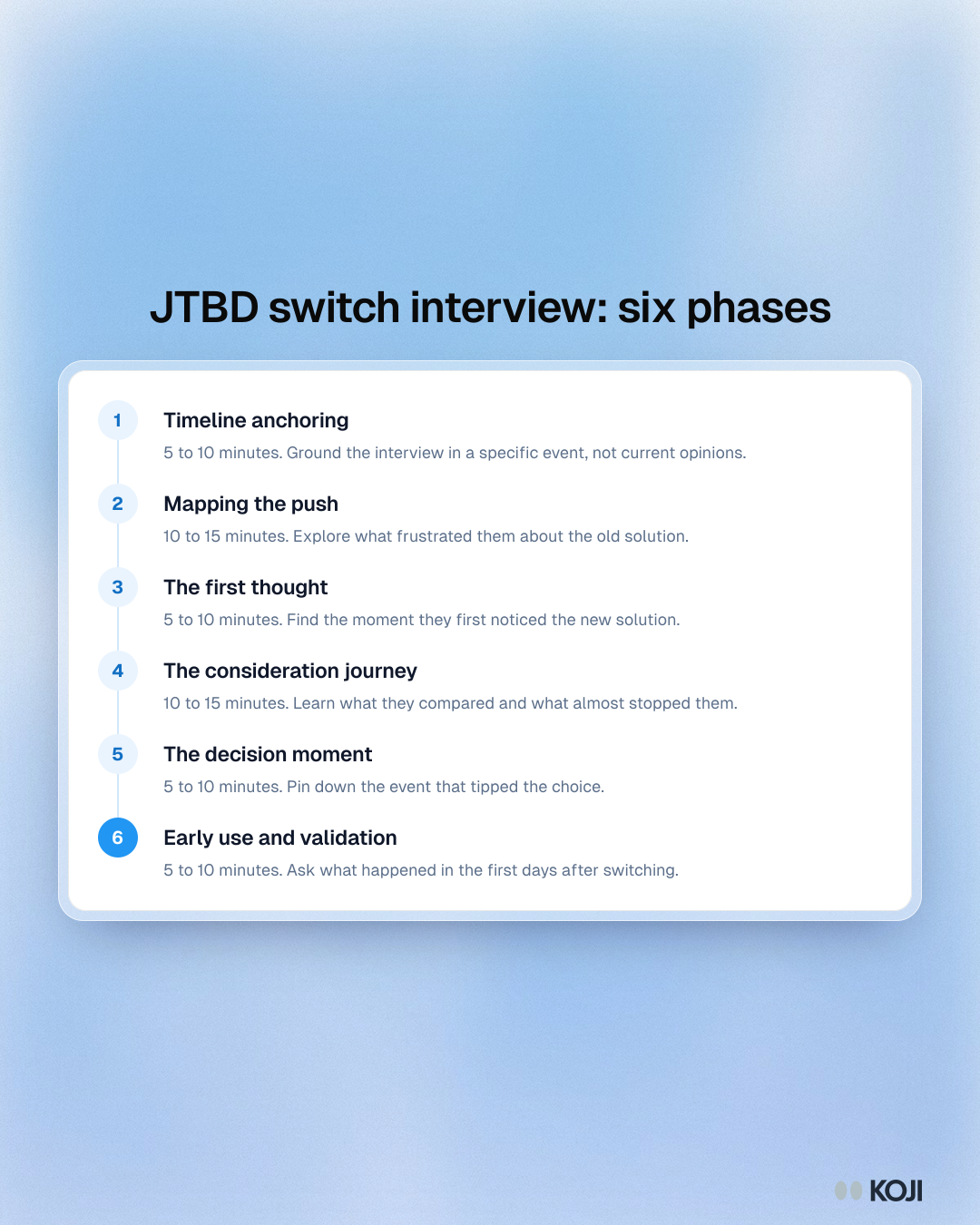
Process showing the six phases of a Jobs to Be Done switch interview, from timeline anchoring to early use, with a time guide for each phase.

Process

JTBD switch interview: six phases
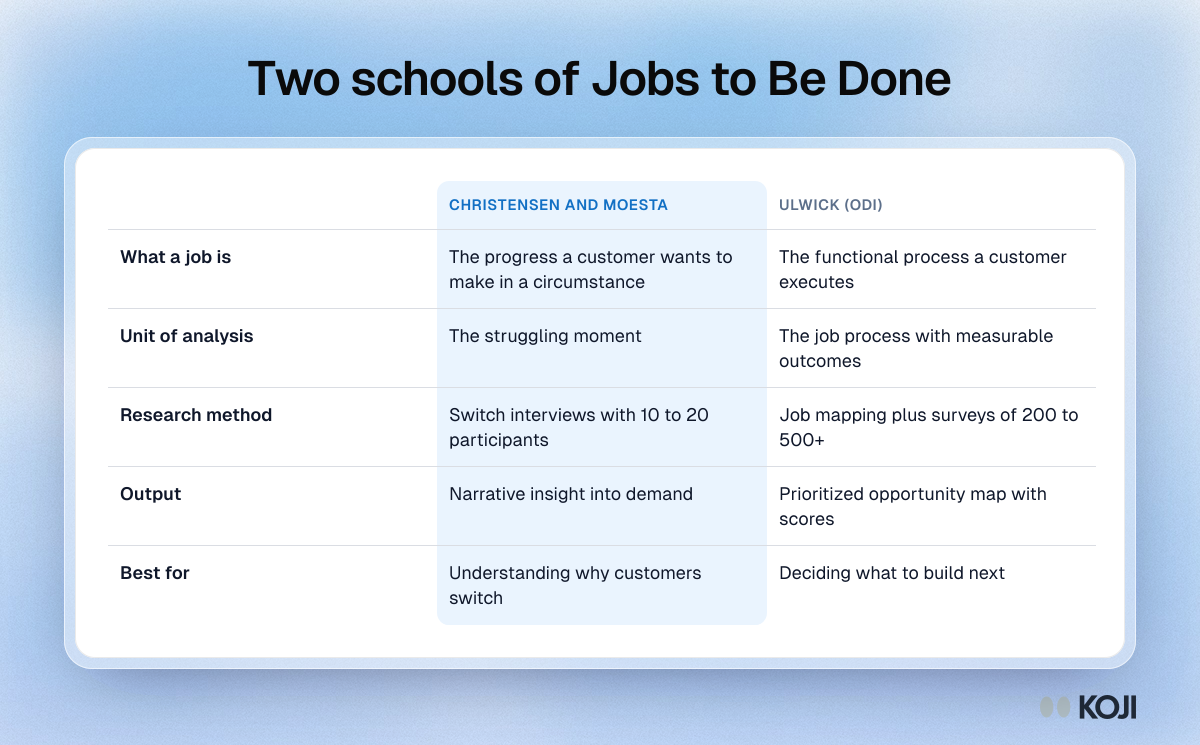
Table comparing the two schools of Jobs to Be Done, Christensen and Moesta against Ulwick's ODI, on definition, method, output and best use.

Reference table

Two schools of Jobs to Be Done
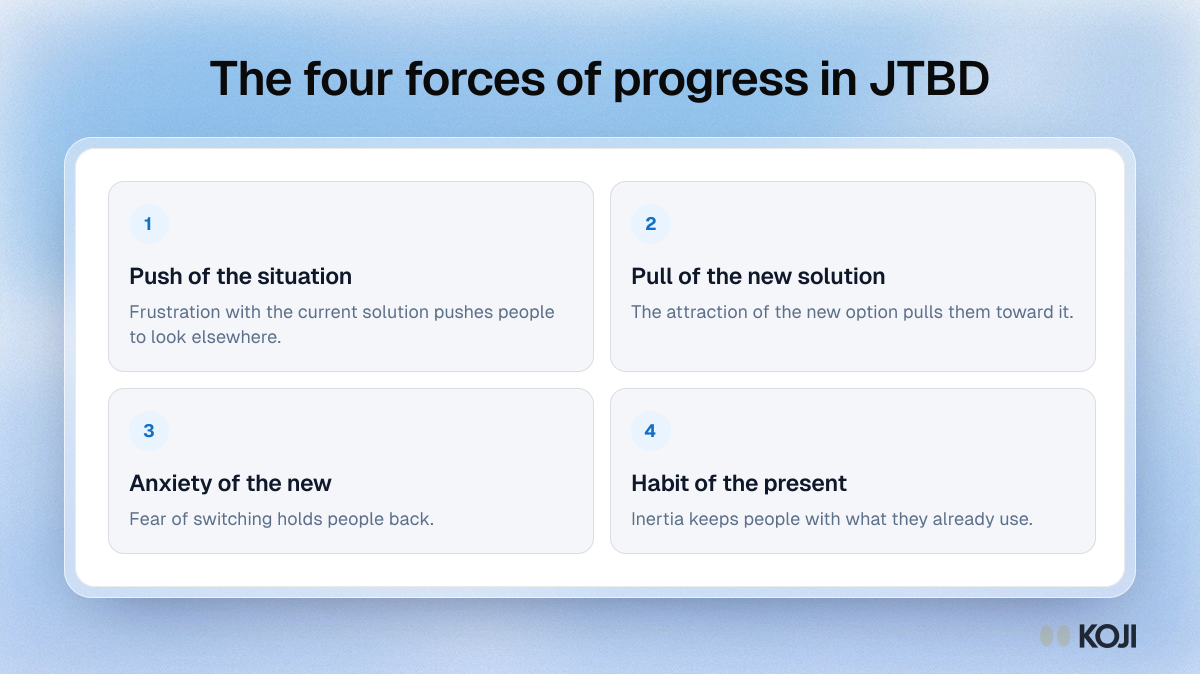
Framework of the four forces of progress in Jobs to Be Done: push of the situation, pull of the new solution, anxiety of the new and habit of the present.

Framework

The four forces of progress in JTBD
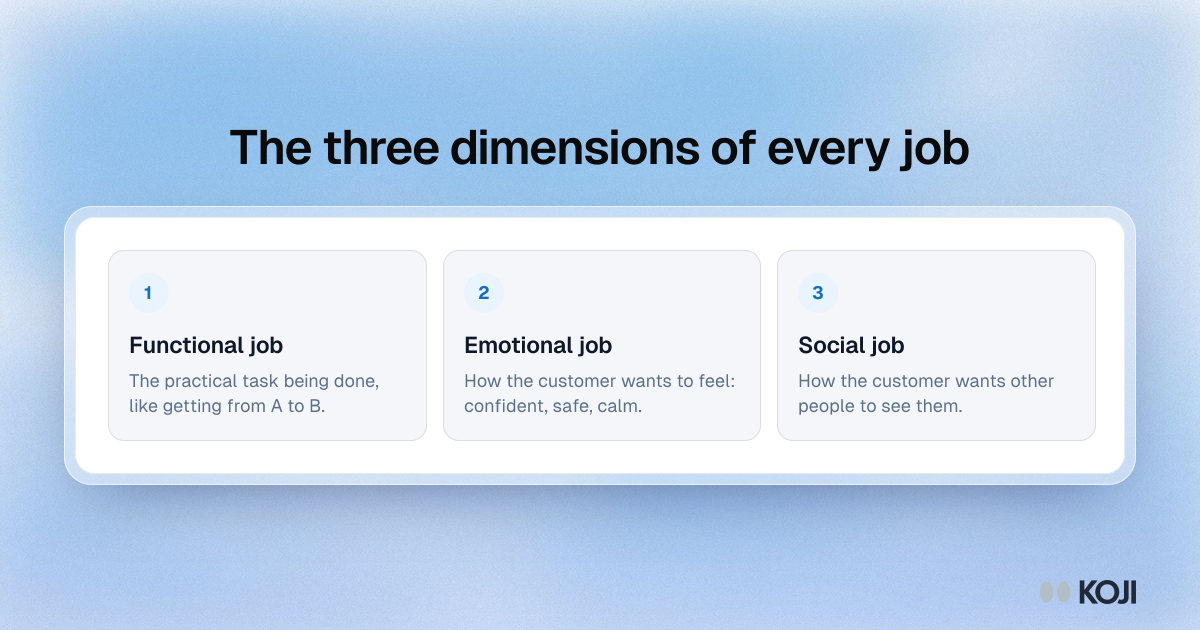
Framework showing the three dimensions of a job in Jobs to Be Done: the functional job, the emotional job and the social job.

Framework

The three dimensions of every job
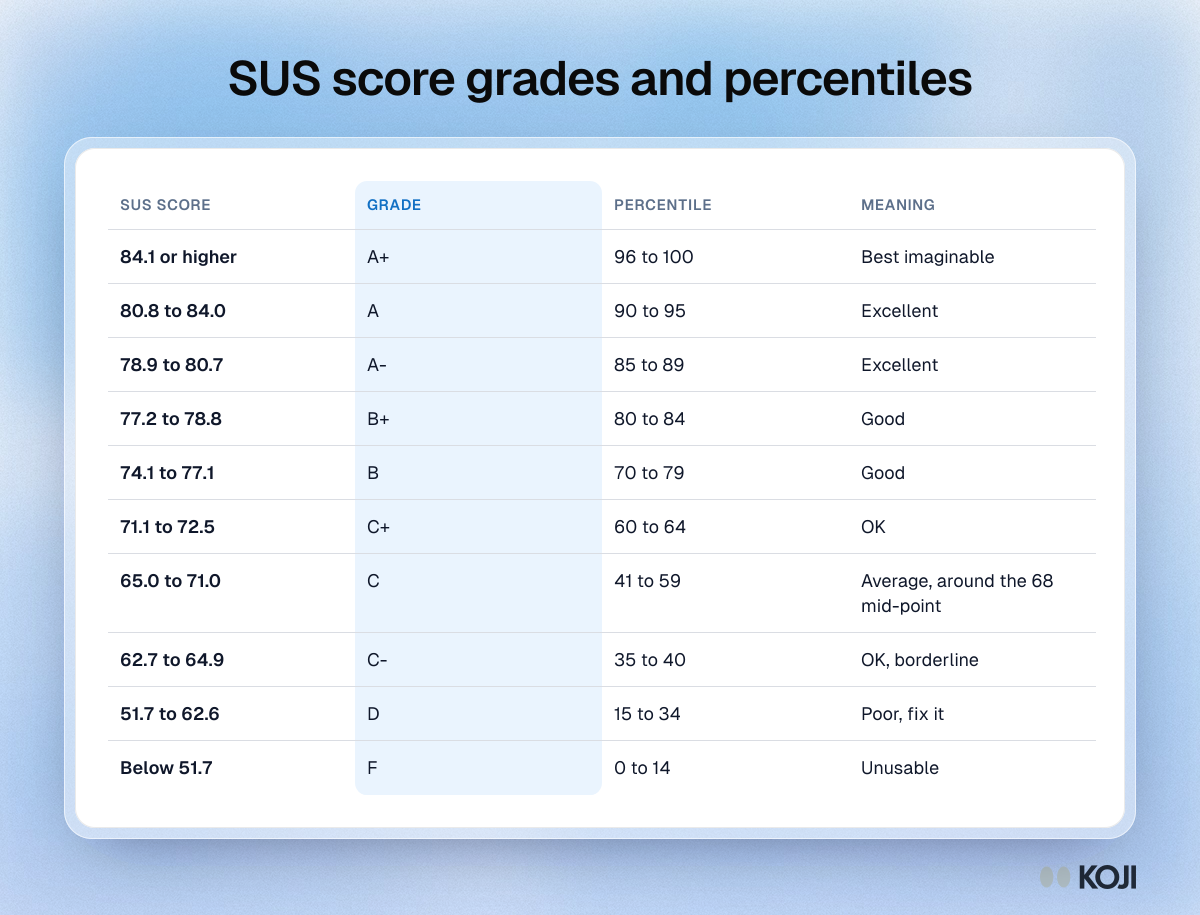
Table of System Usability Scale scores with letter grade, percentile and meaning, from A+ at 84.1 or higher down to F below 51.7, with 68 as the average.

Reference table

SUS score grades and percentiles
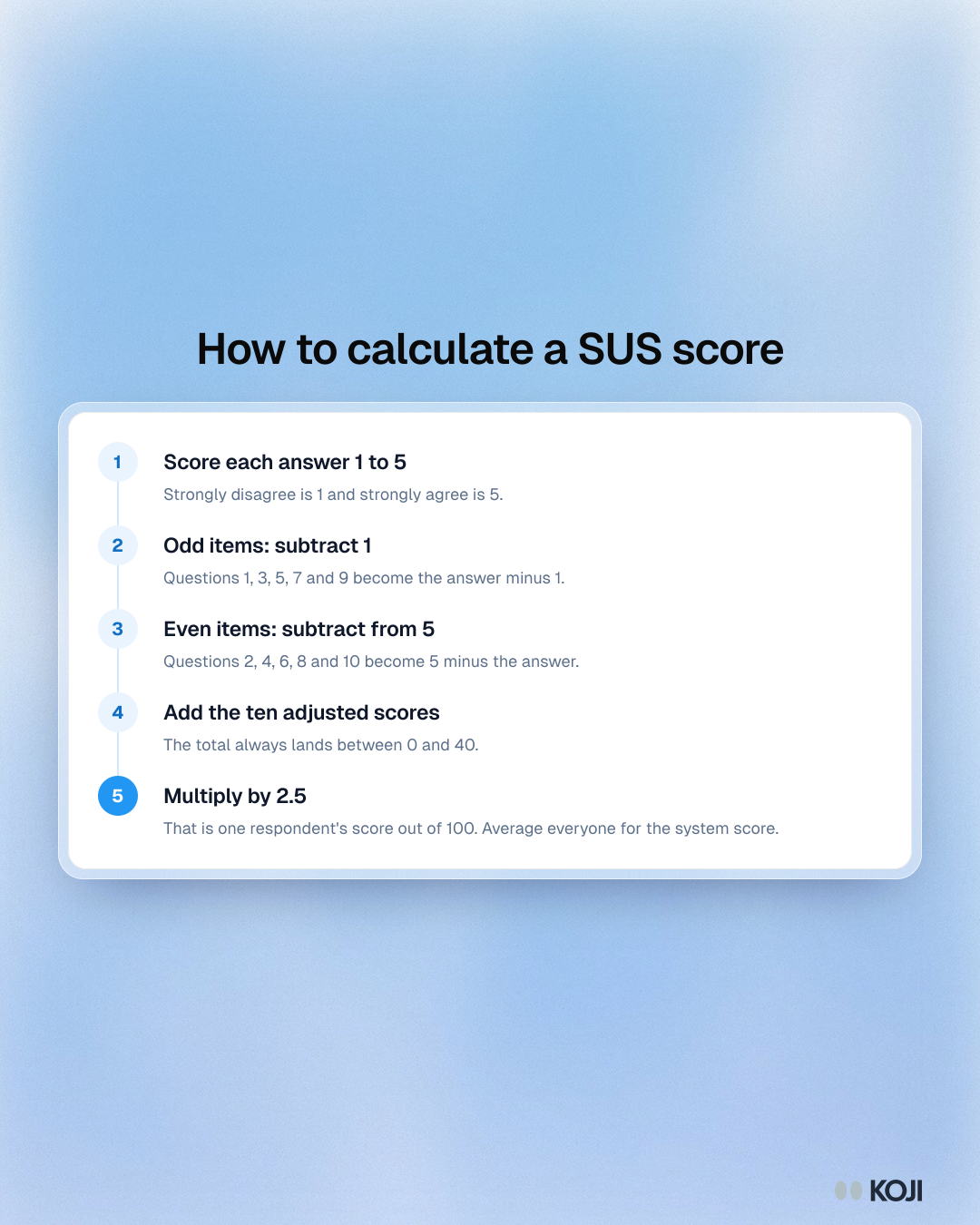
Process showing five steps to calculate a System Usability Scale score: convert answers, adjust odd and even items, add them up and multiply by 2.5.

Process

How to calculate a SUS score