Free to save and share

Frameworks and cheat sheets for customer research

Every framework, checklist and comparison from our guides, as an image you can download, drop into a deck or share with your team.
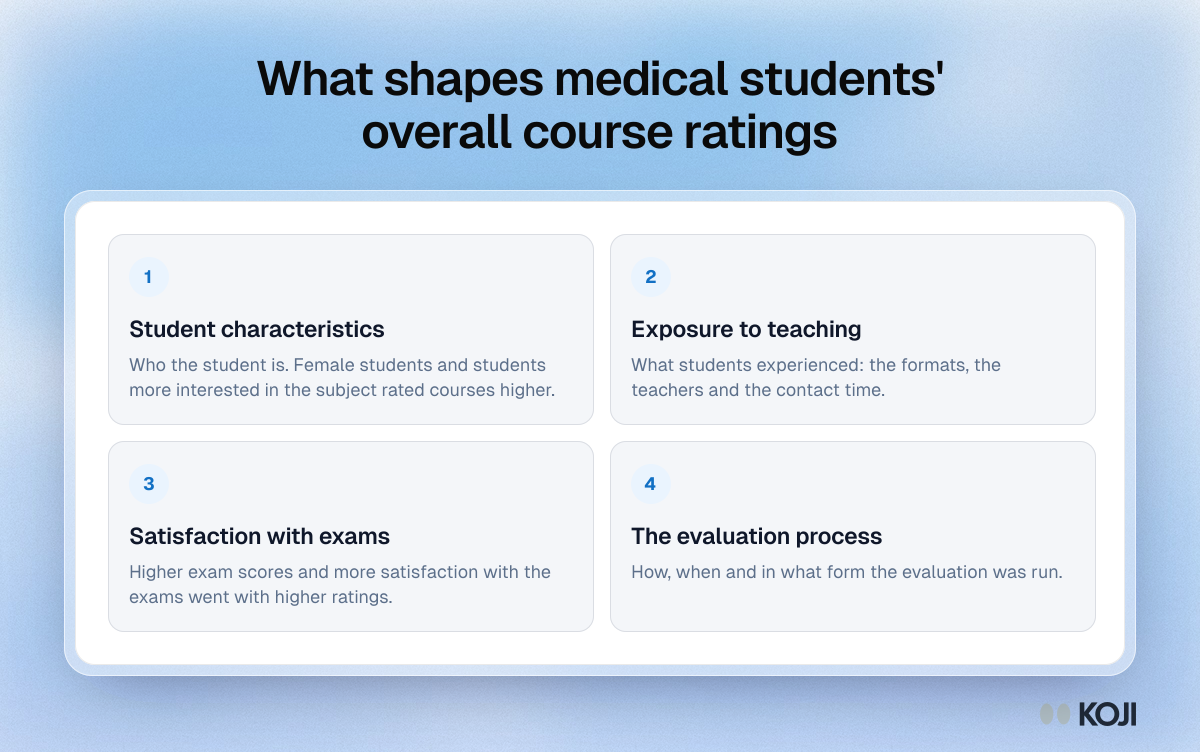
Framework of four factor groups behind medical students' course ratings: student traits, exposure to teaching, exam satisfaction and the evaluation process.

Framework

What shapes medical students' overall course ratings
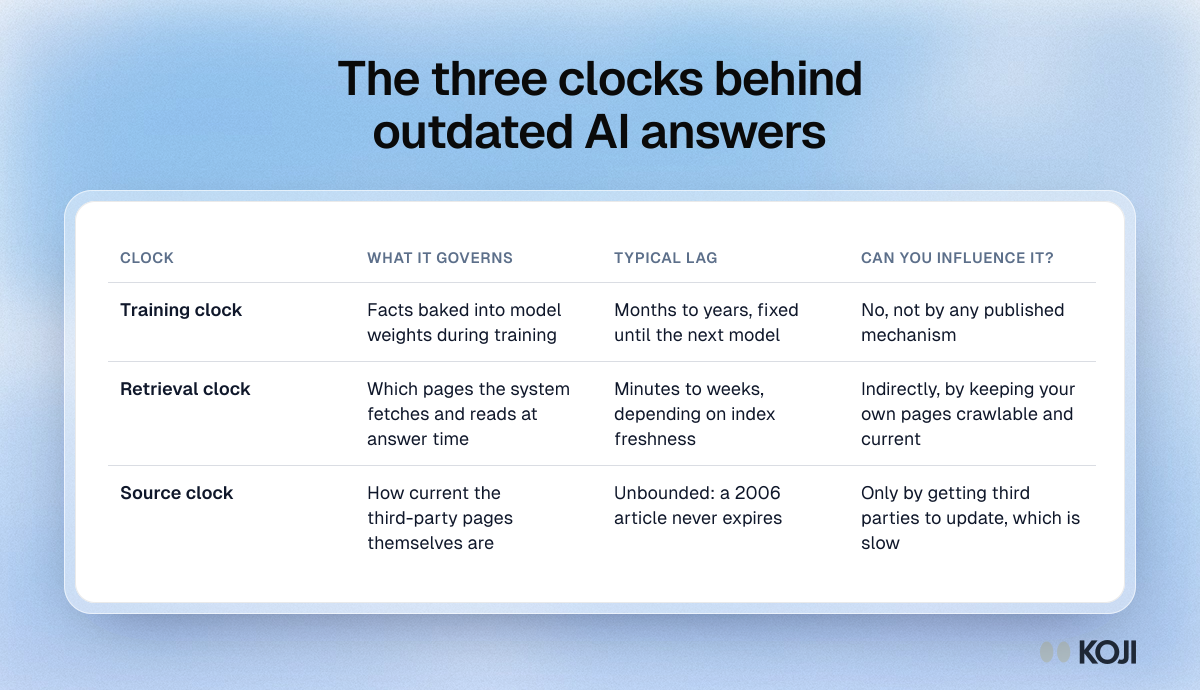
Table of the three clocks behind outdated AI answers: training, retrieval and source, with what each governs, its lag and your influence.

Reference table

The three clocks behind outdated AI answers
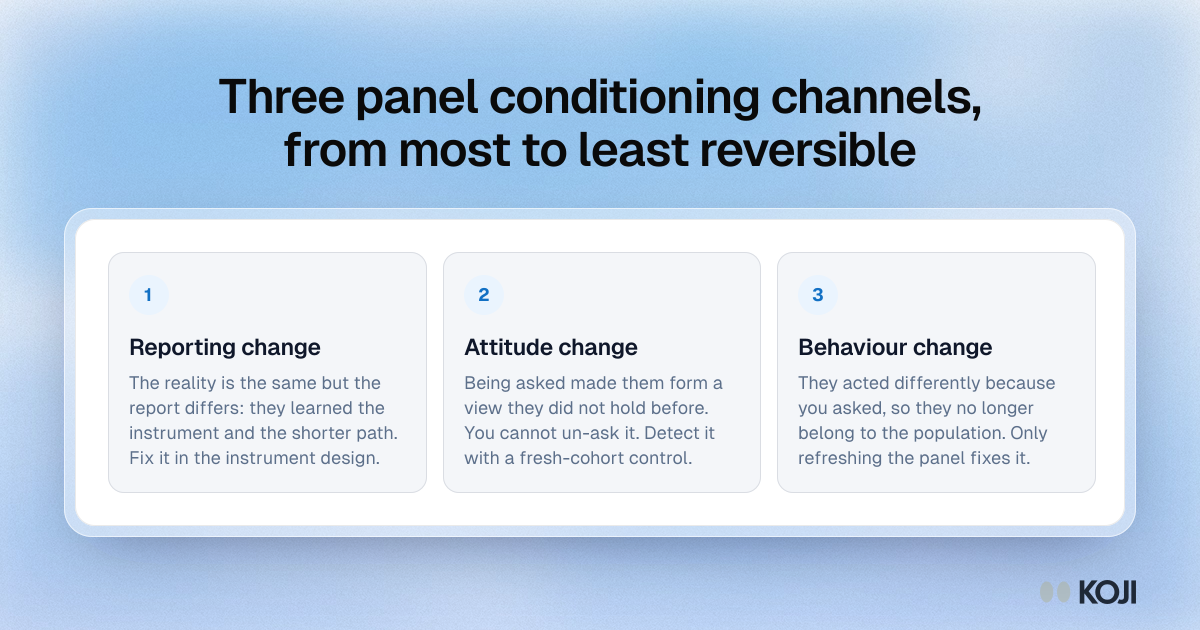
Framework of three panel conditioning channels: reporting change, attitude change and behaviour change, ranked by how far each can be undone.

Framework

Three panel conditioning channels, from most to least reversible
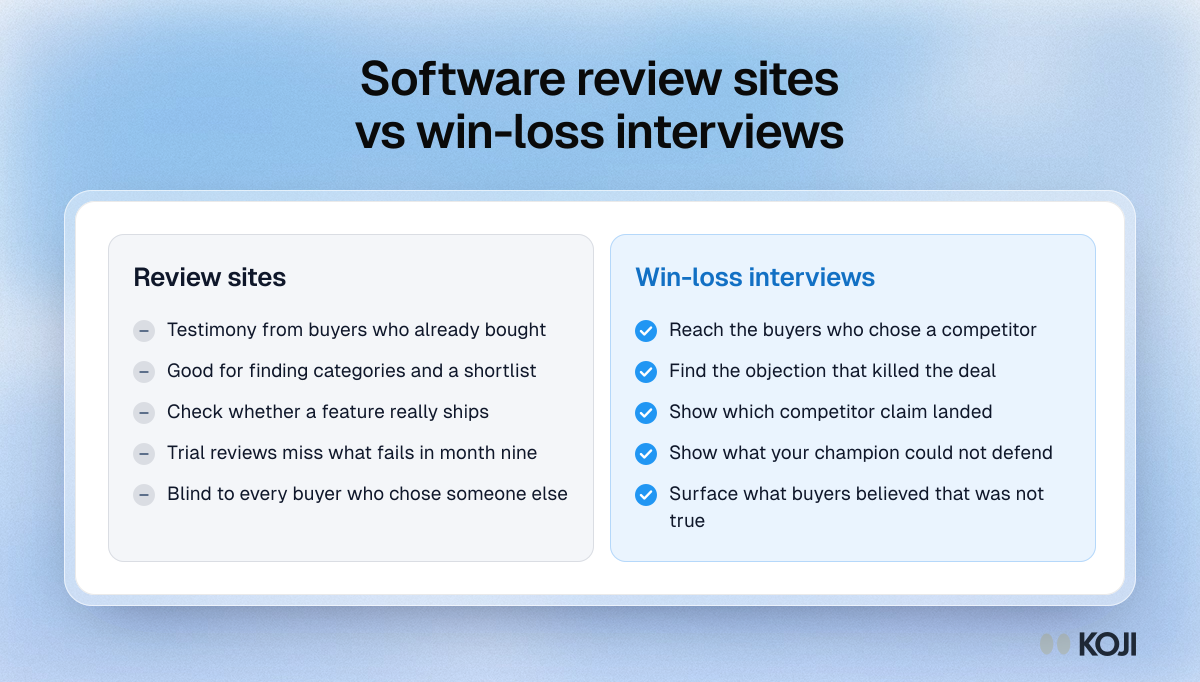
Comparison of software review sites and win-loss interviews: testimony from past buyers against conversations that reach lost deals.

Comparison

Software review sites vs win-loss interviews
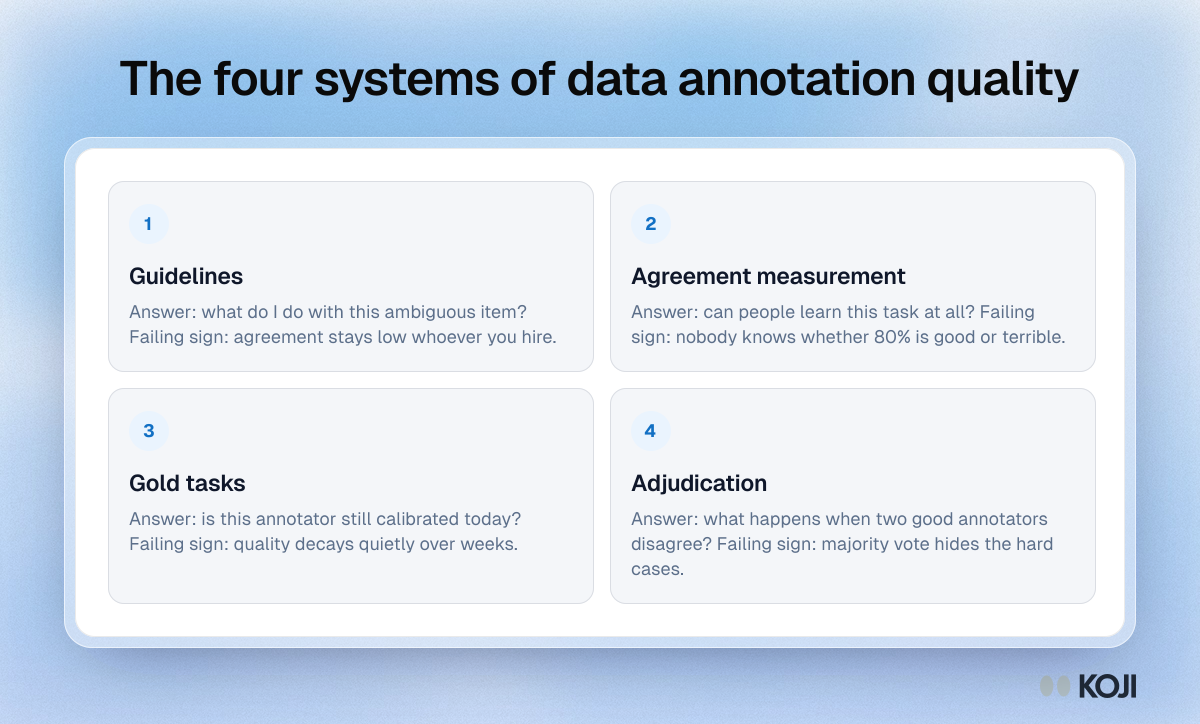
Framework of the four systems behind annotation quality: guidelines, agreement measurement, gold tasks and adjudication, each with its failing sign.

Framework

The four systems of data annotation quality
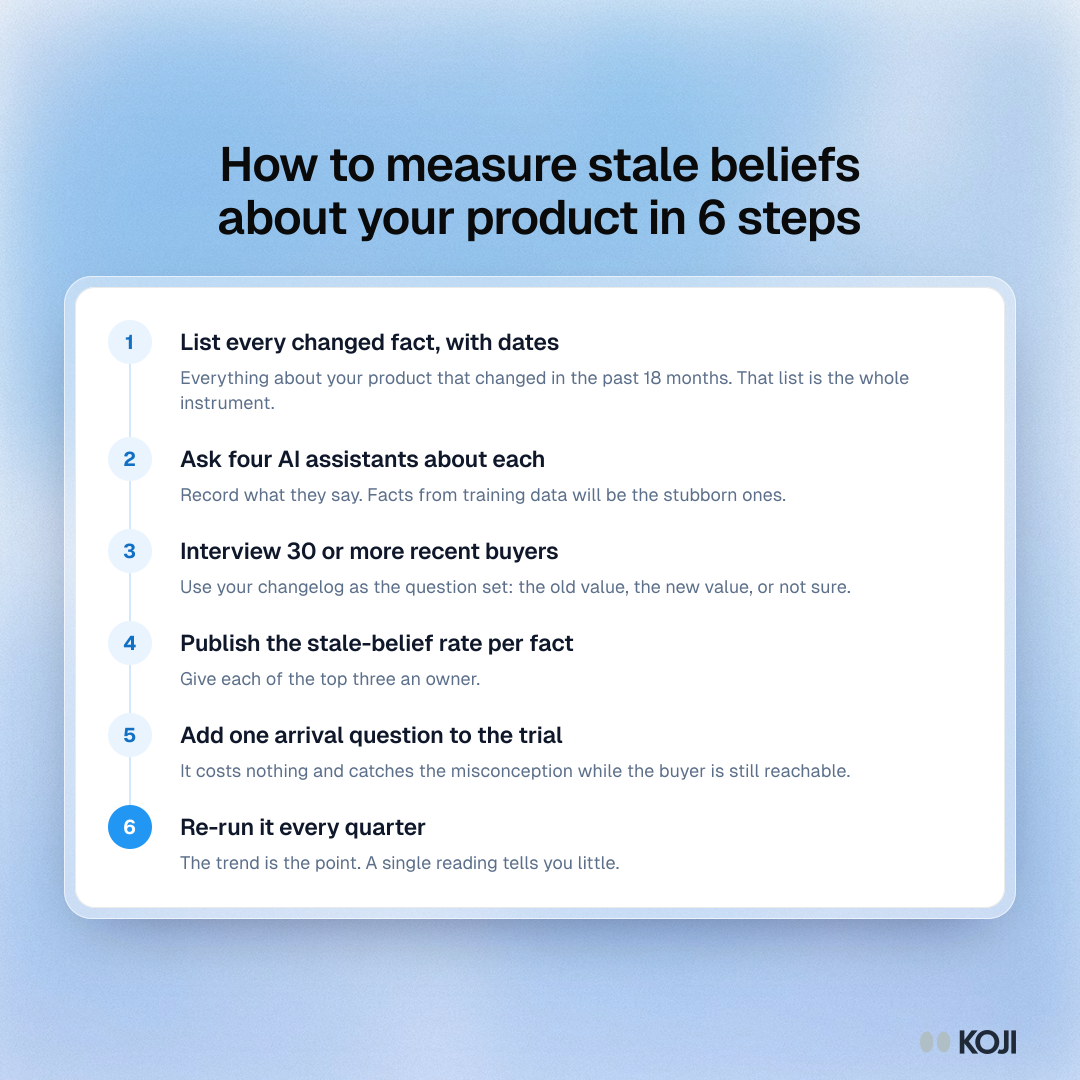
Process showing six steps to measure stale beliefs: list changed facts, query AI assistants, interview buyers, publish rates, ask in trials, repeat.

Process

How to measure stale beliefs about your product in 6 steps
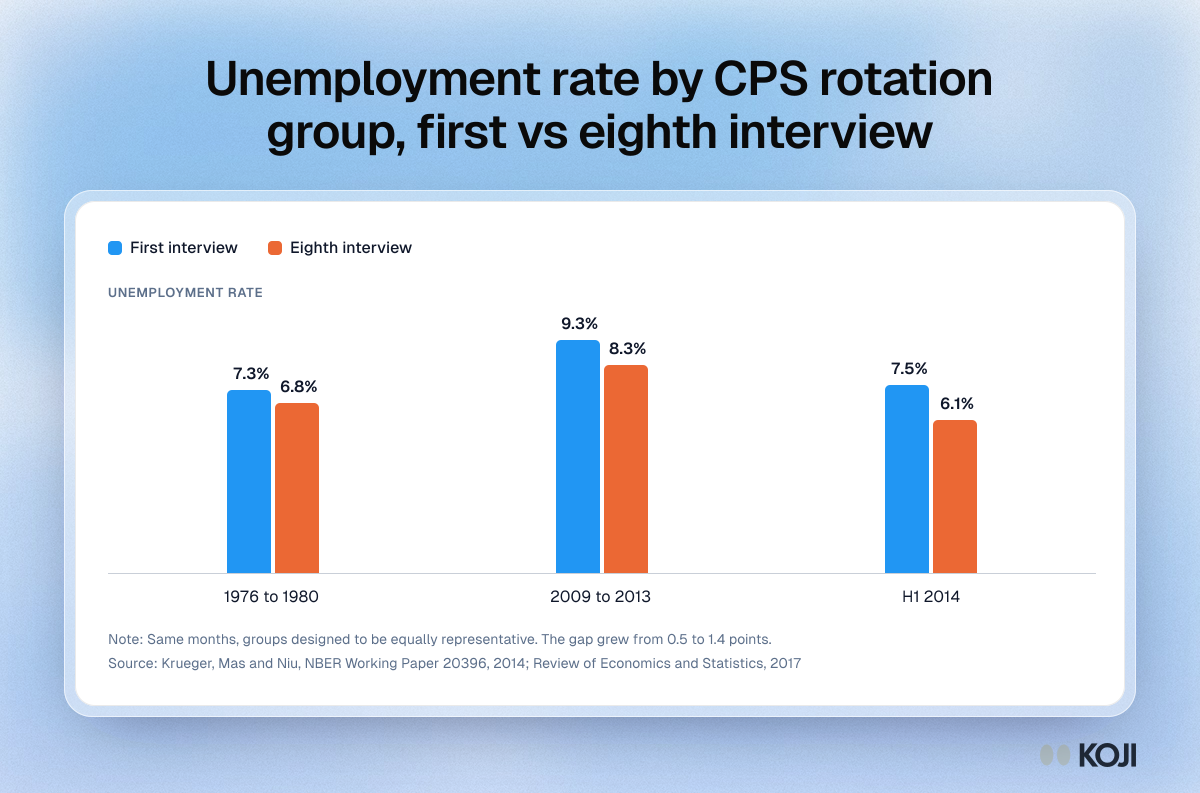
Column chart of the US unemployment rate reported by first-time and eighth-time CPS households: 7.3% vs 6.8%, 9.3% vs 8.3%, 7.5% vs 6.1%.

Column chart

Unemployment rate by CPS rotation group, first vs eighth interview
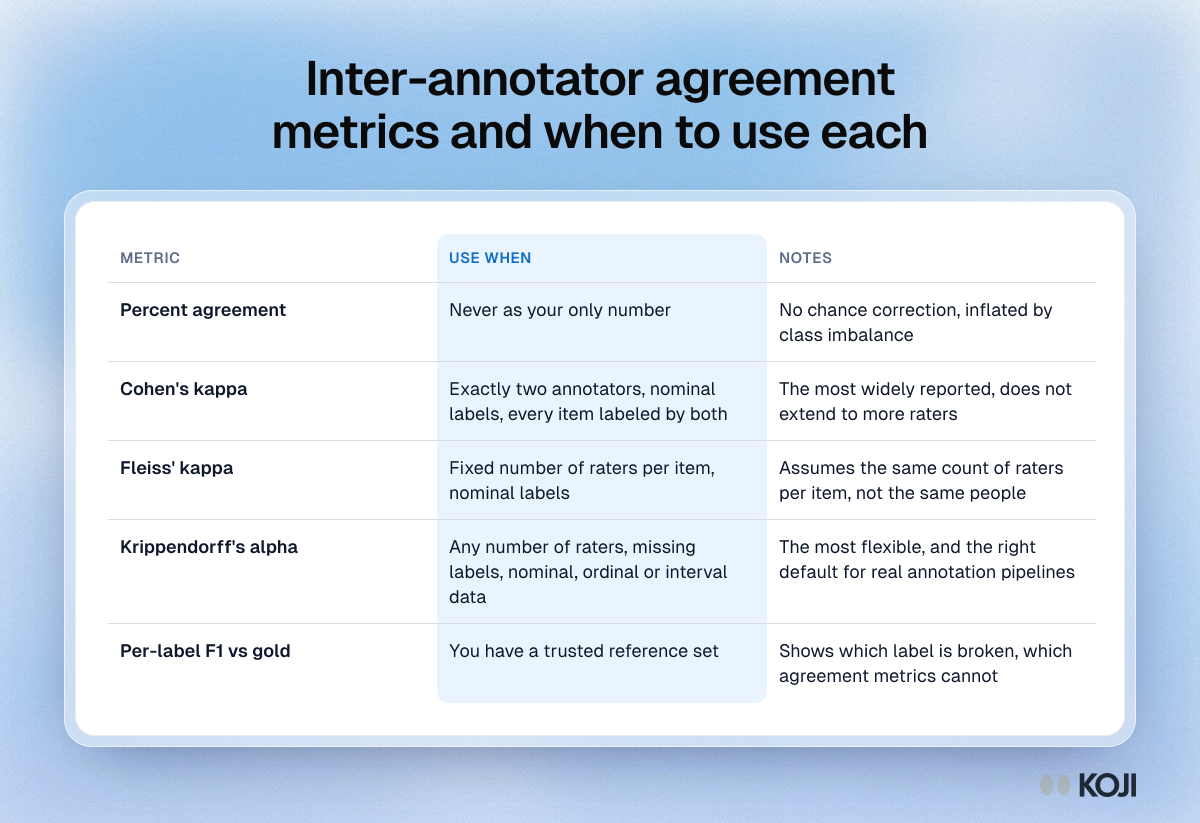
Table comparing percent agreement, Cohen's kappa, Fleiss' kappa, Krippendorff's alpha and per-label F1 by when to use each.

Reference table

Inter-annotator agreement metrics and when to use each
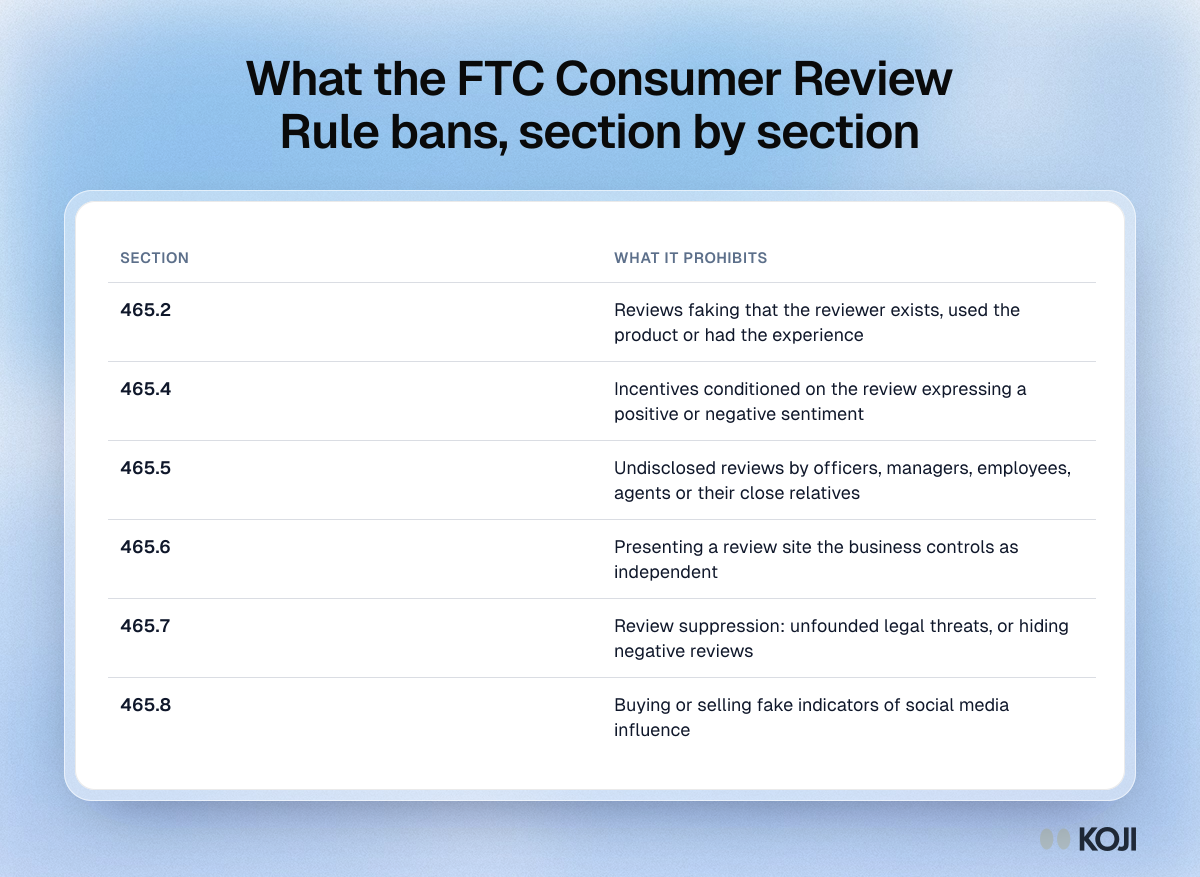
Table of the FTC Consumer Review Rule, 16 CFR Part 465, listing what sections 465.2, 465.4, 465.5, 465.6, 465.7 and 465.8 prohibit.

Reference table

What the FTC Consumer Review Rule bans, section by section
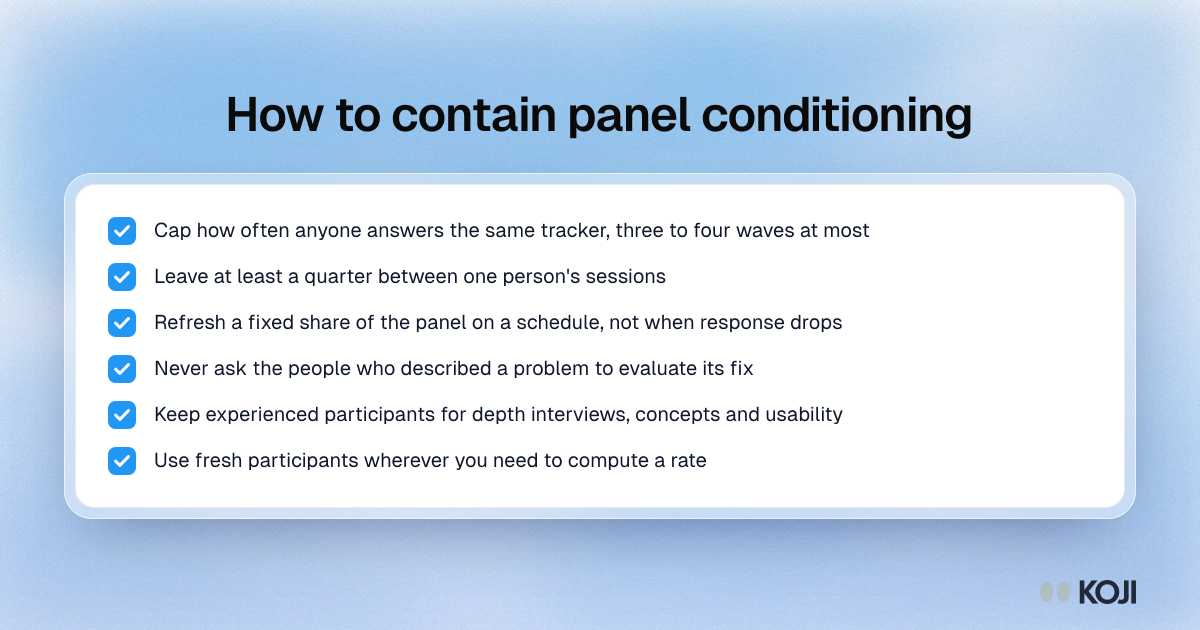
Checklist of six design controls for panel conditioning, from capping waves per person and rest intervals to scheduled refreshment.

Checklist

How to contain panel conditioning
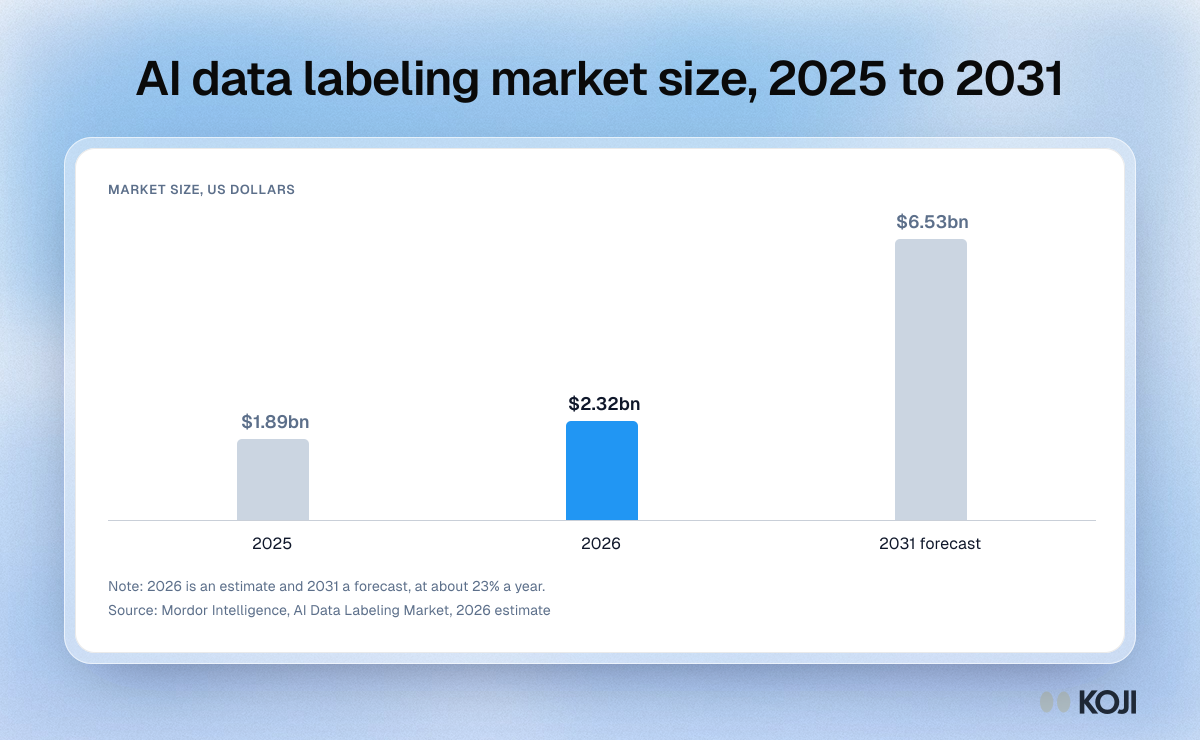
Column chart of the AI data labeling market: $1.89 billion in 2025, about $2.32 billion in 2026 and a forecast $6.53 billion by 2031.

Column chart

AI data labeling market size, 2025 to 2031
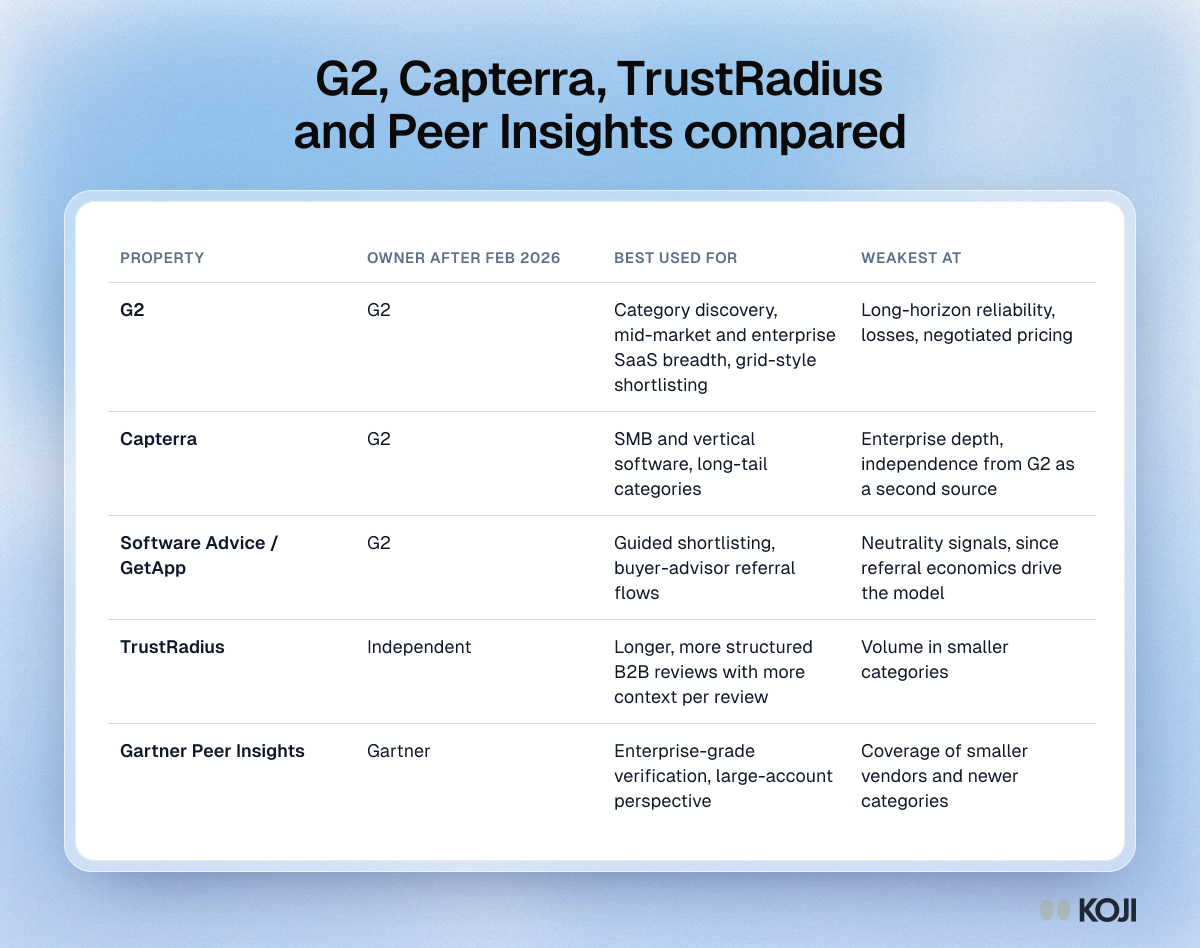
Table comparing G2, Capterra, Software Advice and GetApp, TrustRadius and Gartner Peer Insights by owner, best use and weakest point.

Reference table

G2, Capterra, TrustRadius and Peer Insights compared
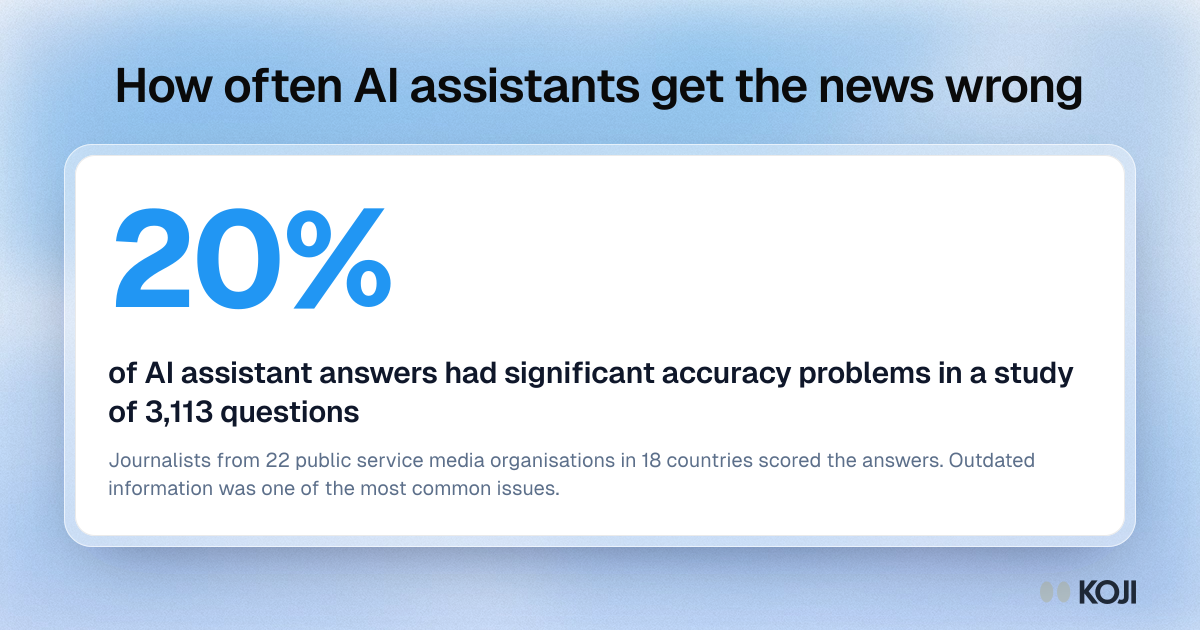
Stat card: 20% of AI assistant answers had significant accuracy problems across 3,113 questions in the EBU and BBC study.

Key figure

How often AI assistants get the news wrong
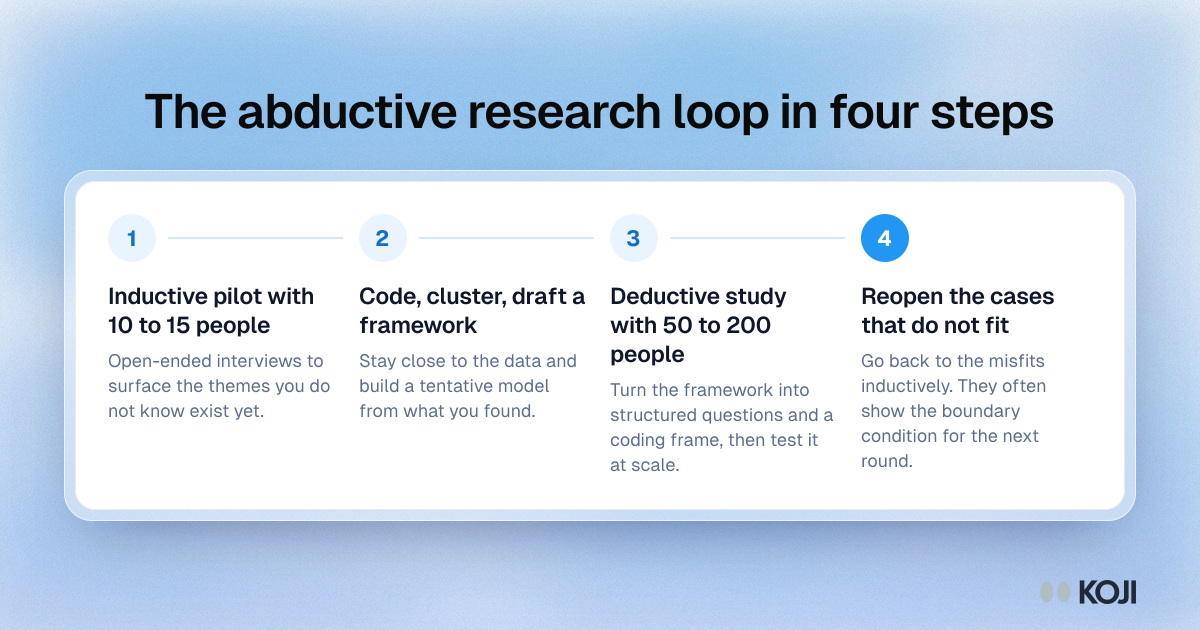
Process showing the abductive research loop: an inductive pilot of 10 to 15, a draft framework, a deductive study of 50 to 200, then the misfits.

Process

The abductive research loop in four steps
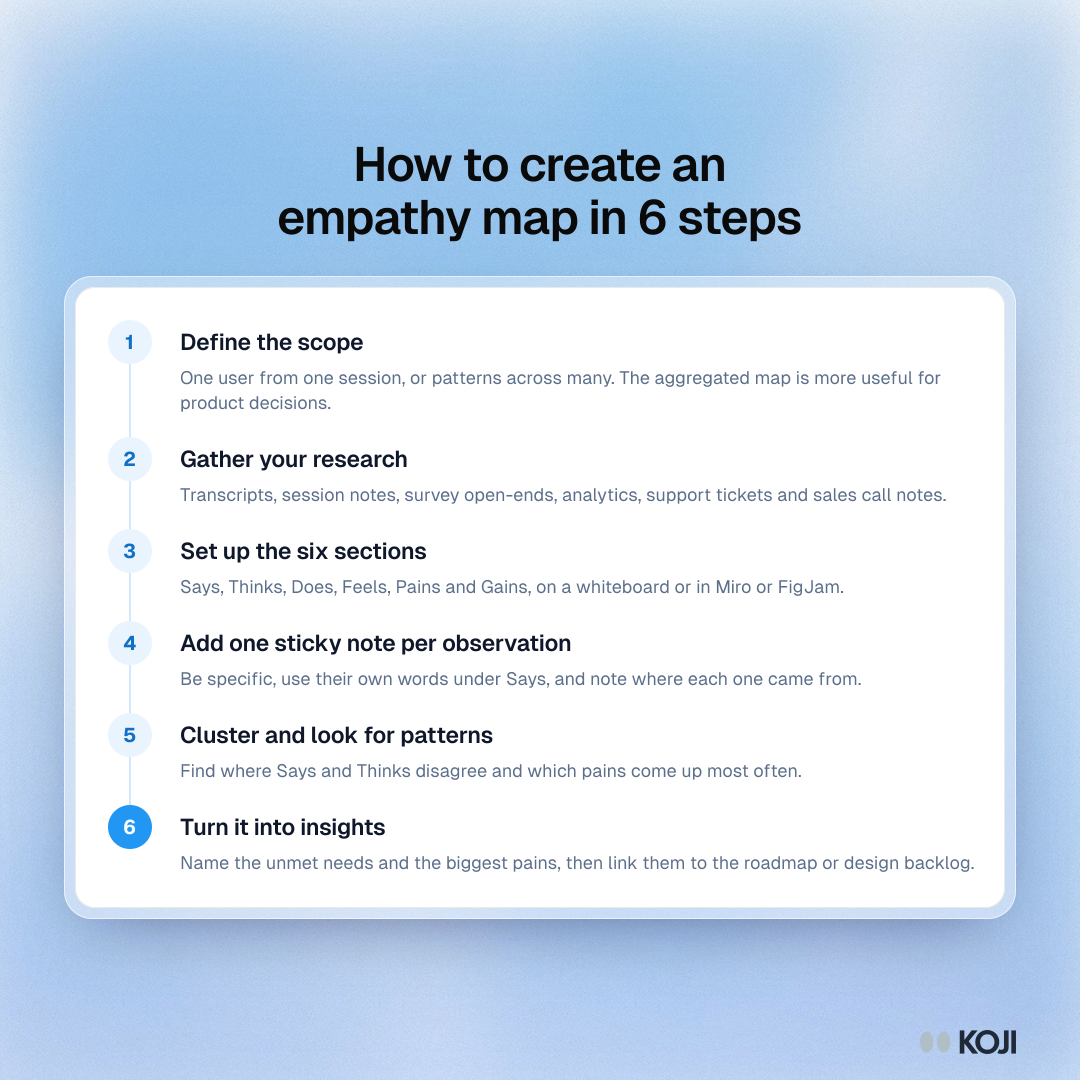
Process showing six steps to create an empathy map: define scope, gather research, set up sections, add notes, cluster, then draw insights.

Process

How to create an empathy map in 6 steps
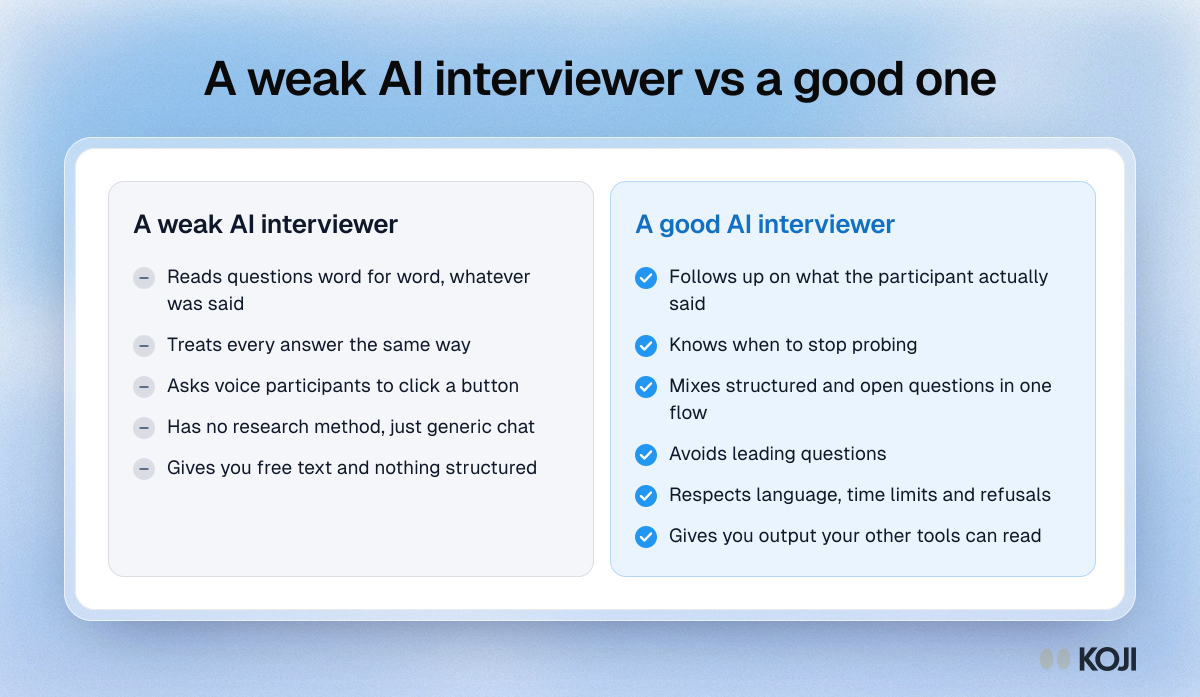
Comparison of a weak and a good AI interviewer: scripted questions and free text only, against real follow-ups and structured output.

Comparison

A weak AI interviewer vs a good one
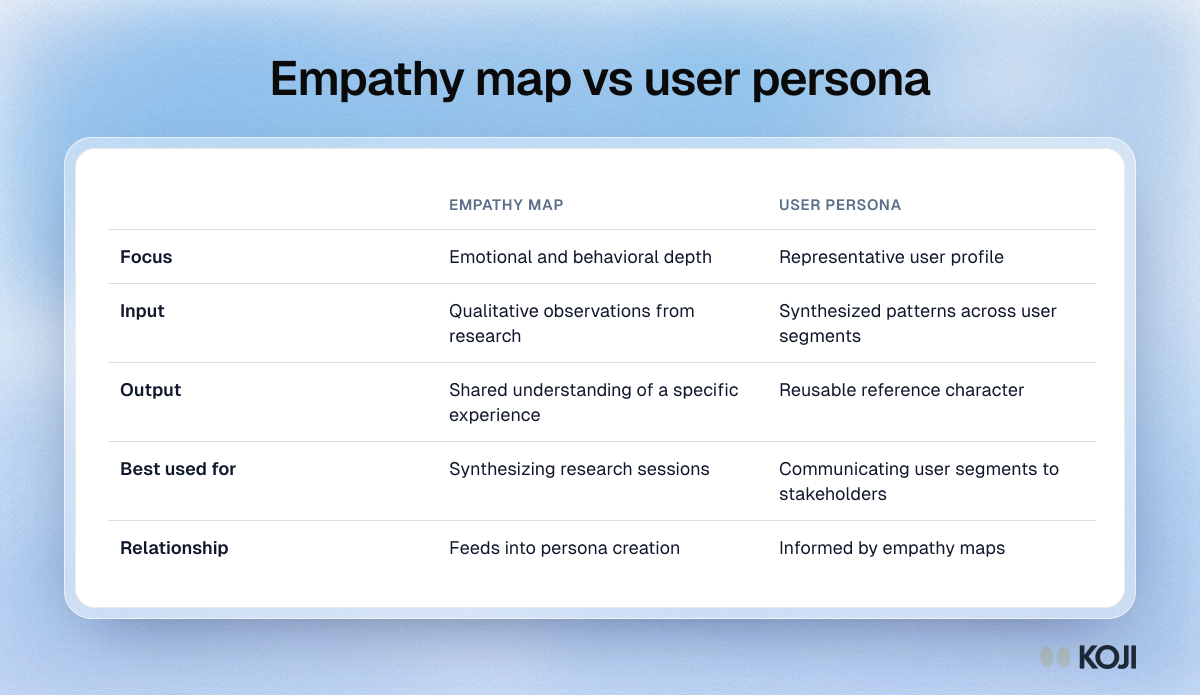
Table comparing empathy maps and user personas by focus, input, output, best use and how the two feed each other.

Reference table

Empathy map vs user persona
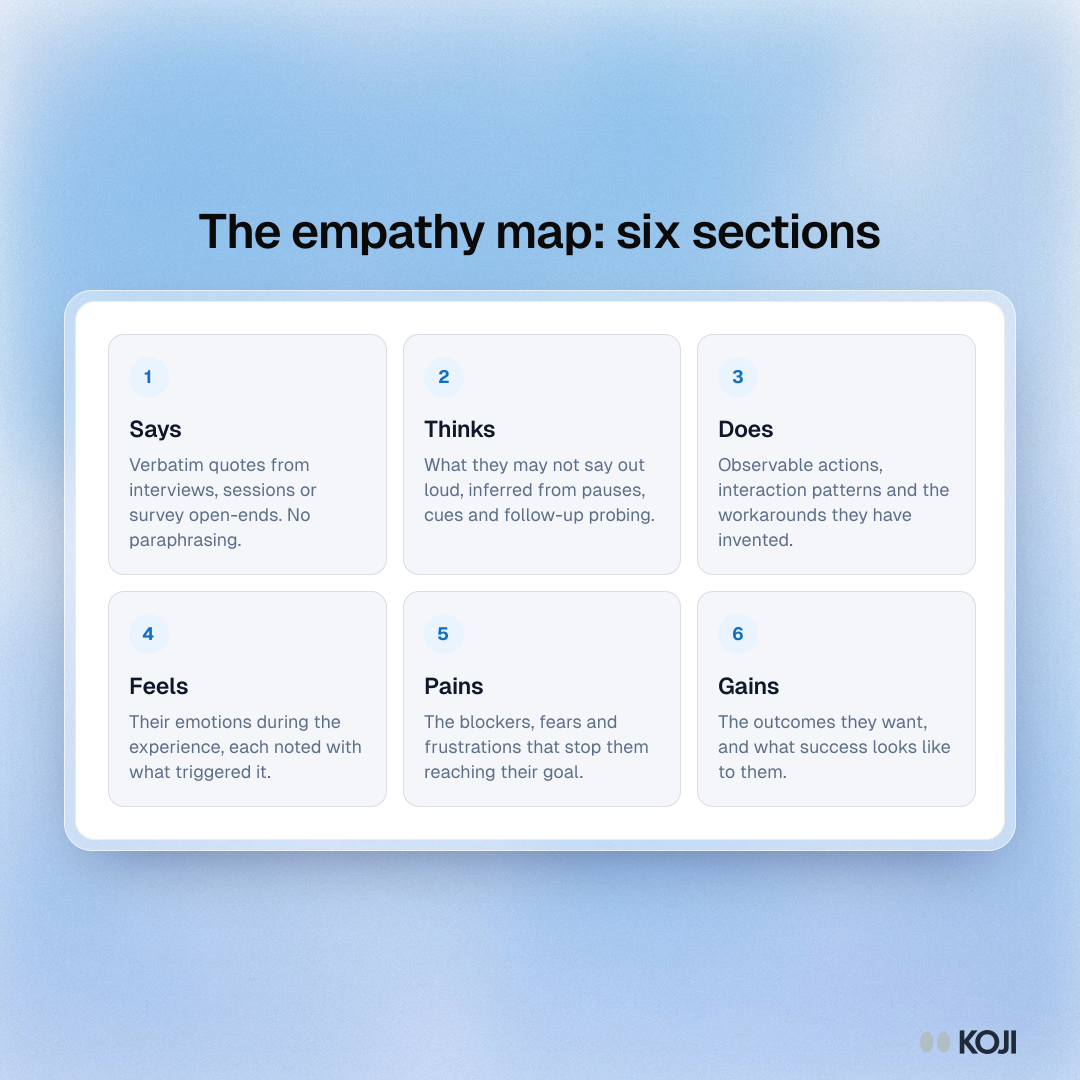
Framework showing the six sections of an empathy map: says, thinks, does and feels around the user, plus pains and gains.

Framework

The empathy map: six sections
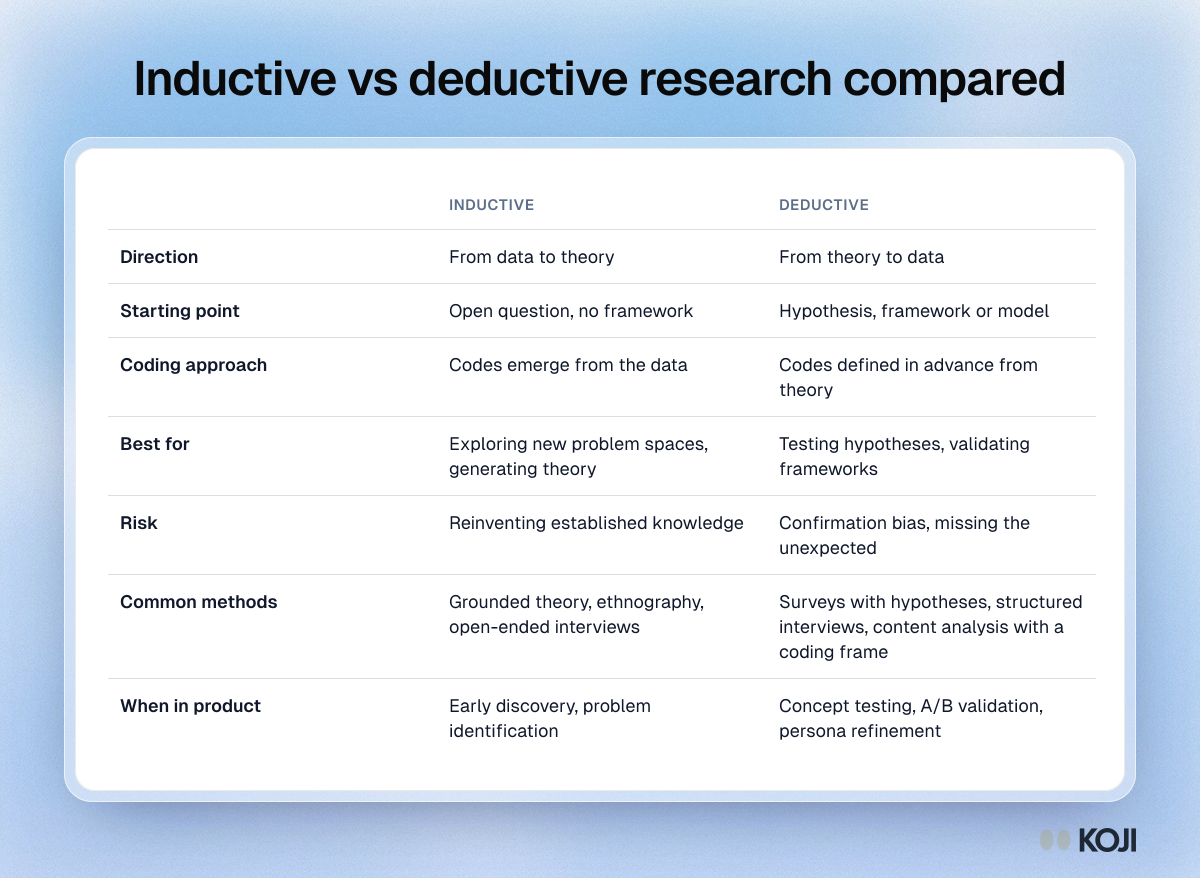
Table comparing inductive and deductive research by direction, starting point, coding, best use, risk, common methods and timing in product work.

Reference table

Inductive vs deductive research compared
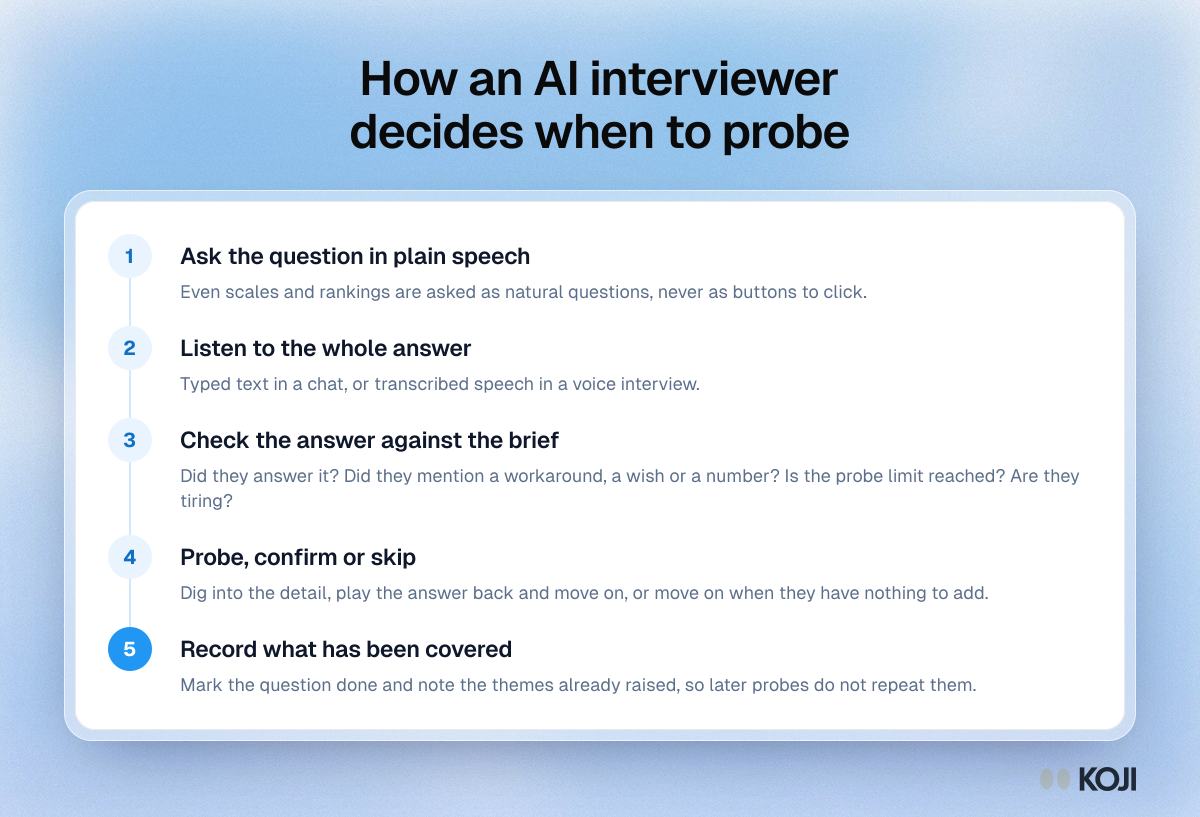
Process showing the five steps an AI interviewer repeats for each question: ask, listen, check the answer, probe or move on, then record it.

Process

How an AI interviewer decides when to probe
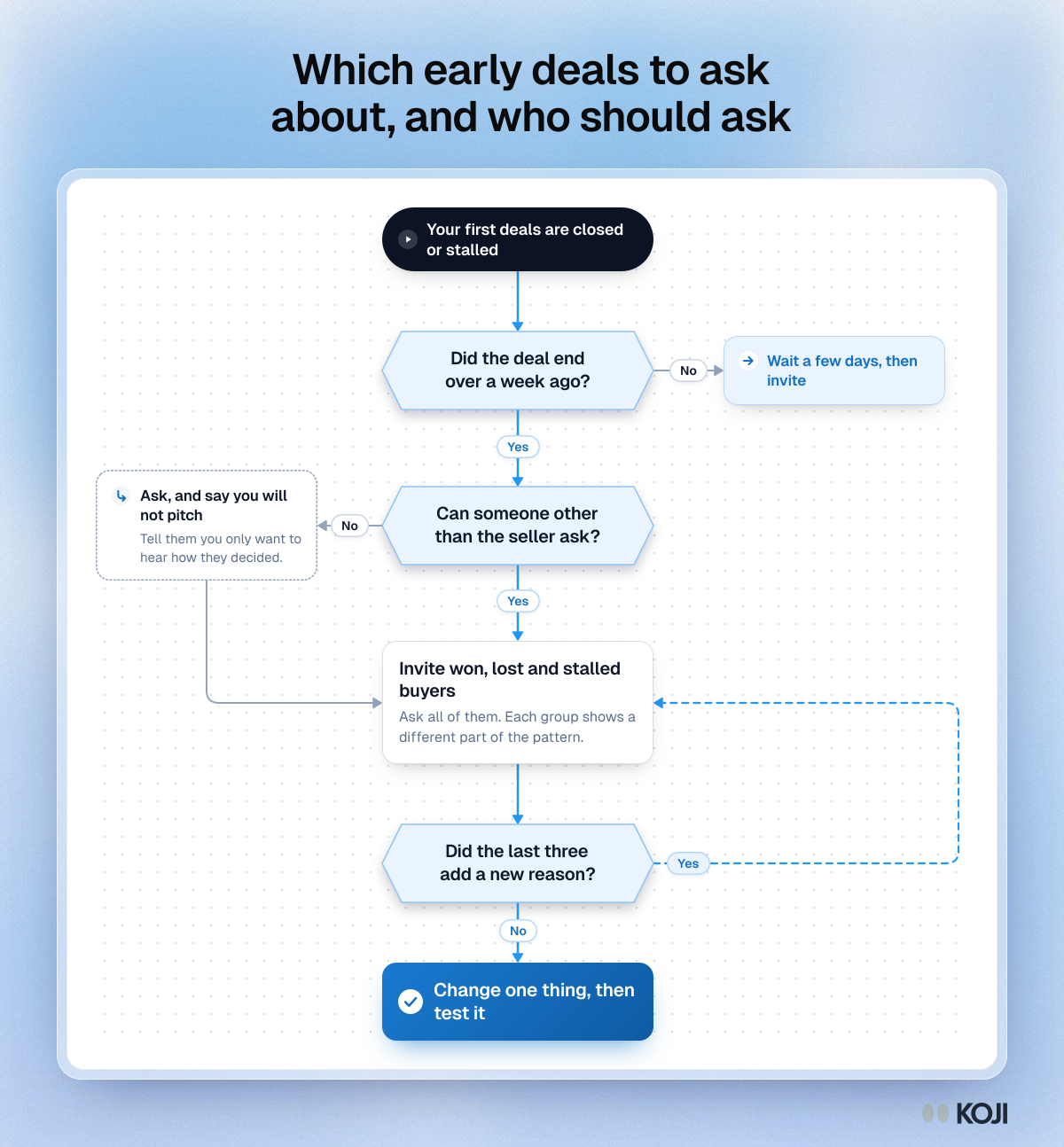
Flowchart for choosing early deals to interview: wait a week, have someone else ask, invite won, lost and stalled buyers, stop when nothing new appears.

Flowchart

Which early deals to ask about, and who should ask
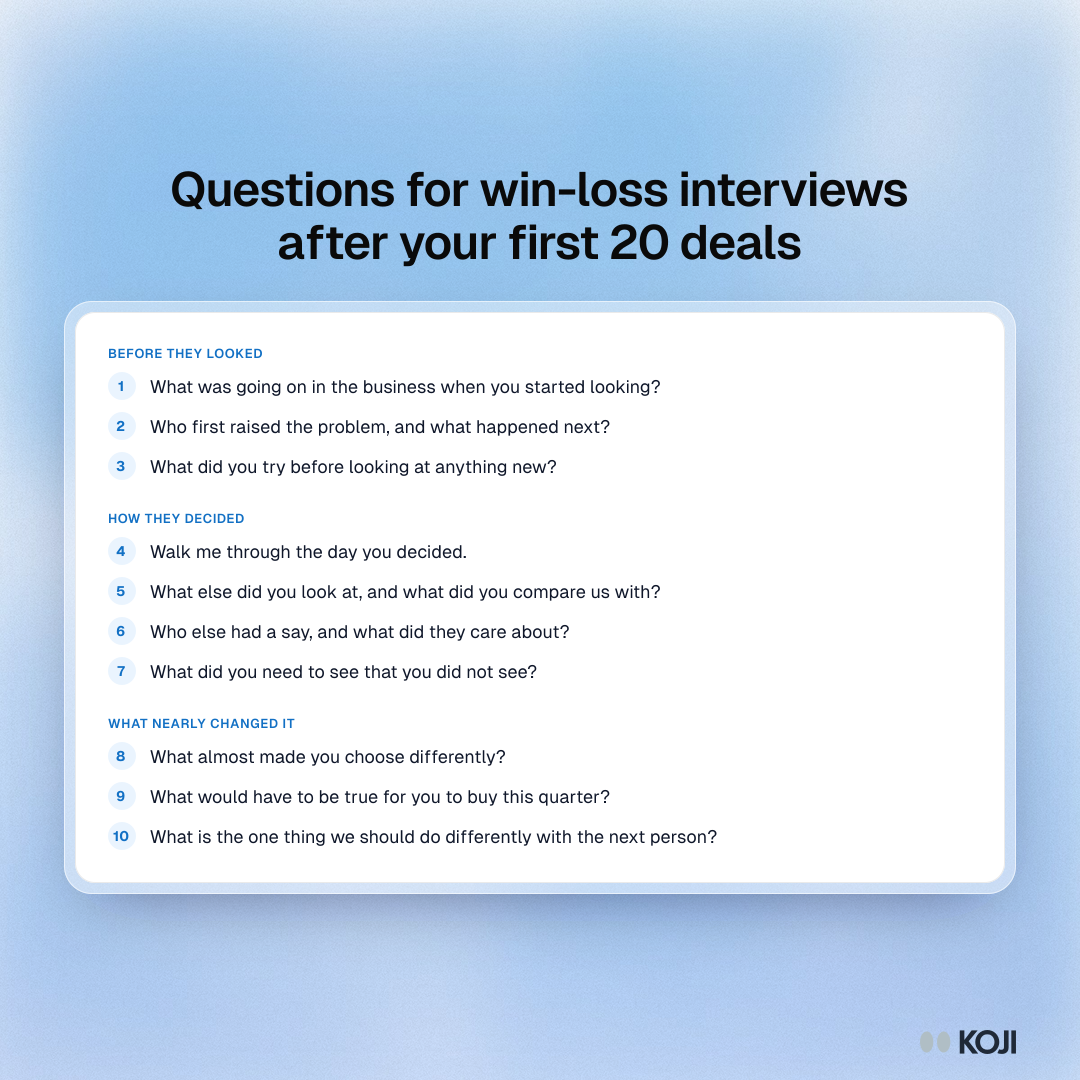
Question bank for interviewing buyers from your first 20 deals: before they looked, how they decided, and what nearly changed the outcome.

Question bank

Questions for win-loss interviews after your first 20 deals
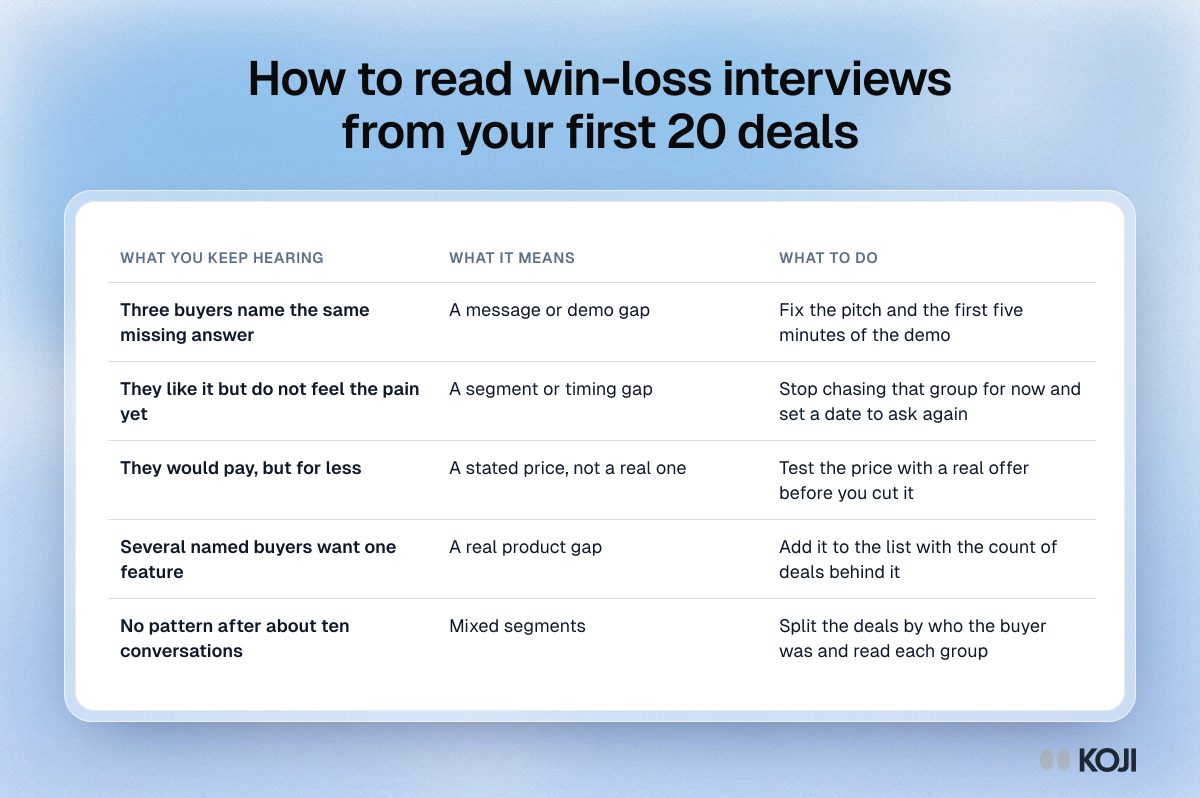
Table matching what founders hear in win-loss interviews, such as a missing answer, no felt pain or a lower price, to what it means and the one change to make.

Reference table

How to read win-loss interviews from your first 20 deals
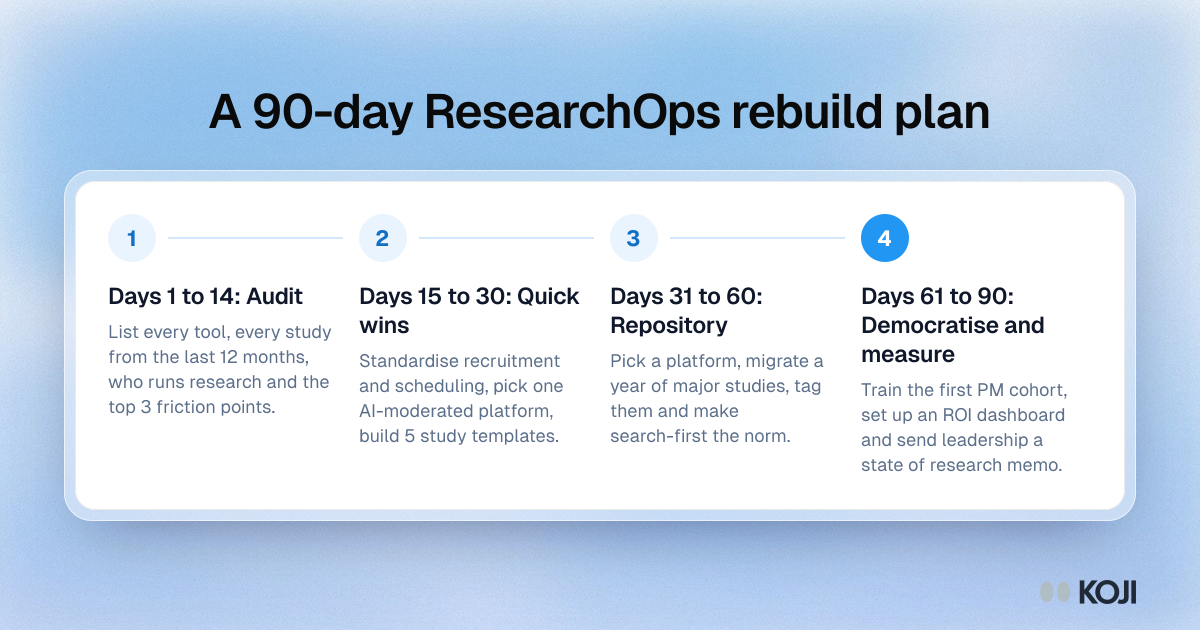
Process of a 90-day plan to set up or rebuild ResearchOps in four phases: audit, quick wins, a research repository, then democratisation and measurement.

Process

A 90-day ResearchOps rebuild plan
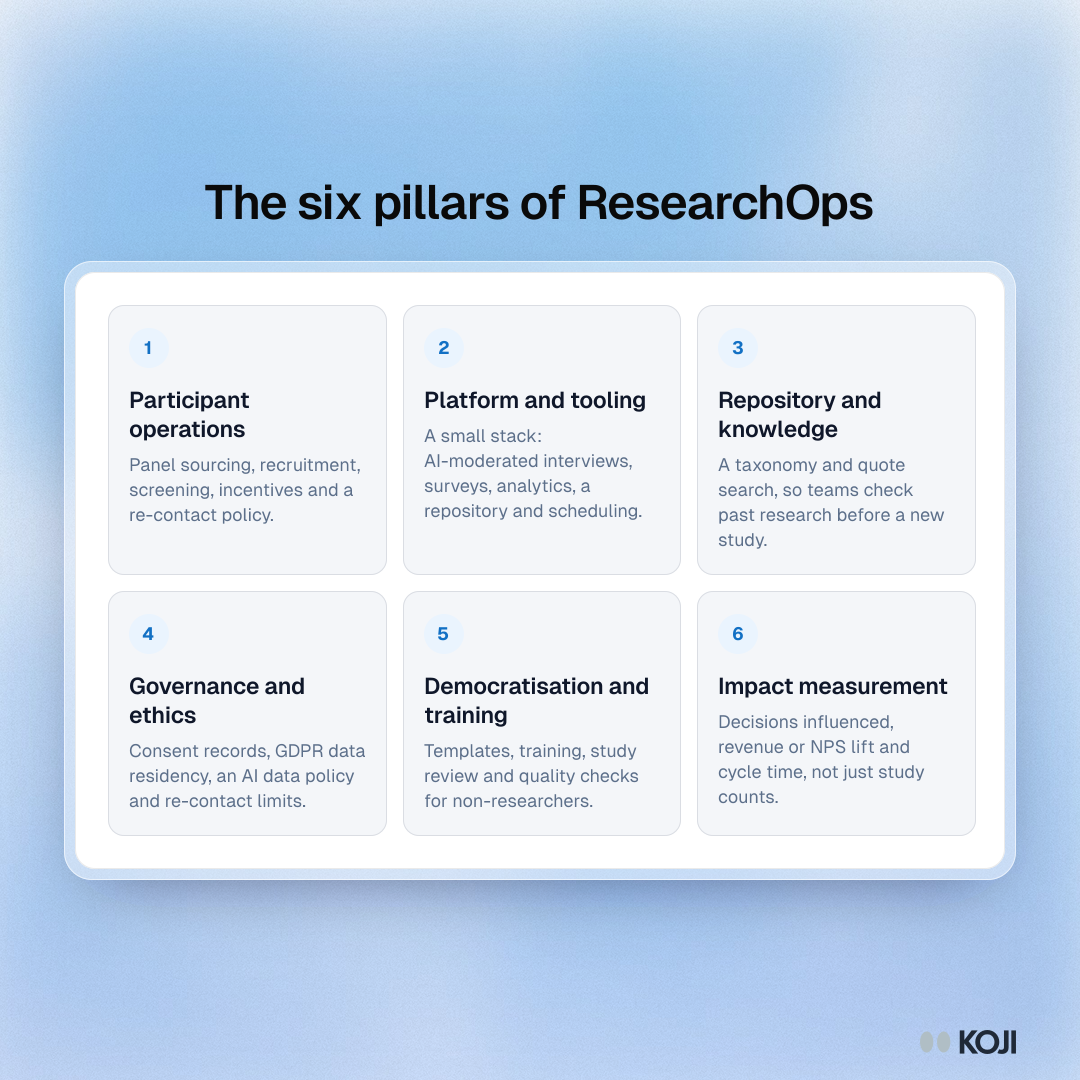
Framework of the six pillars of research operations: participants, platform and tools, repository, governance, democratisation and impact measurement.

Framework

The six pillars of ResearchOps
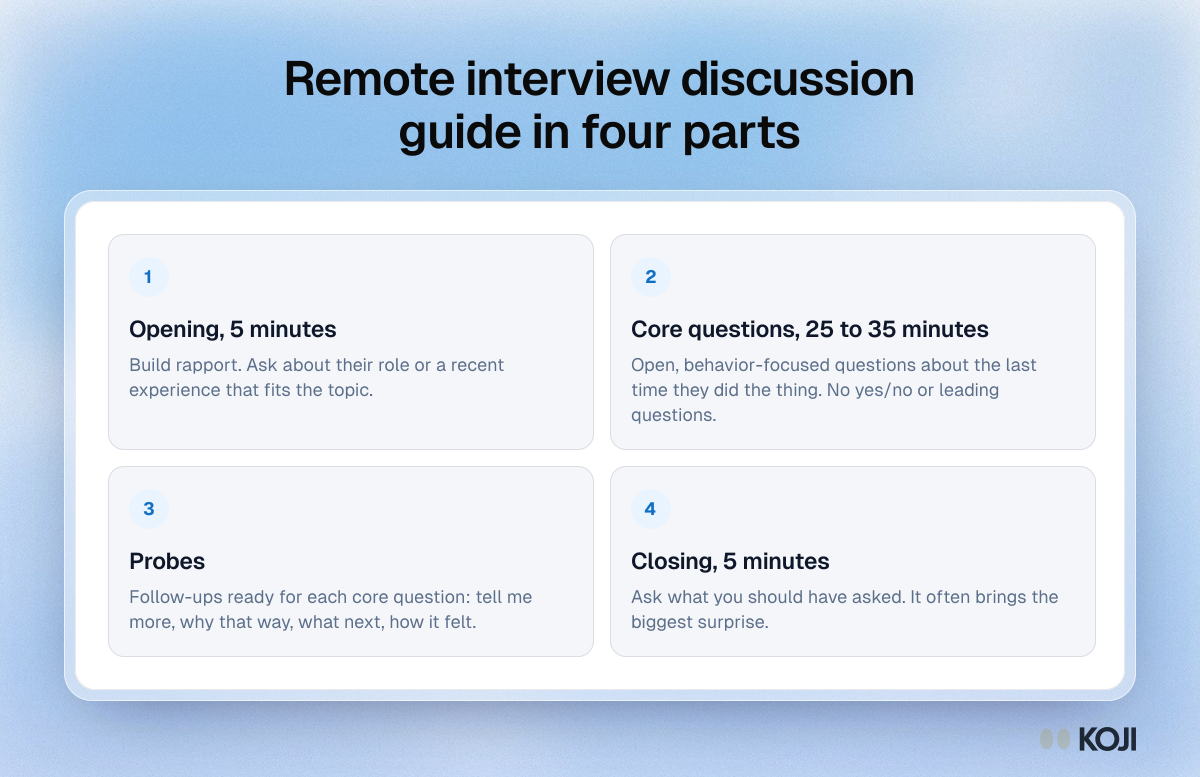
Framework of a remote interview discussion guide in four parts: a 5-minute opening, 25 to 35 minutes of core questions, prepared probes and a 5-minute close.

Framework

Remote interview discussion guide in four parts
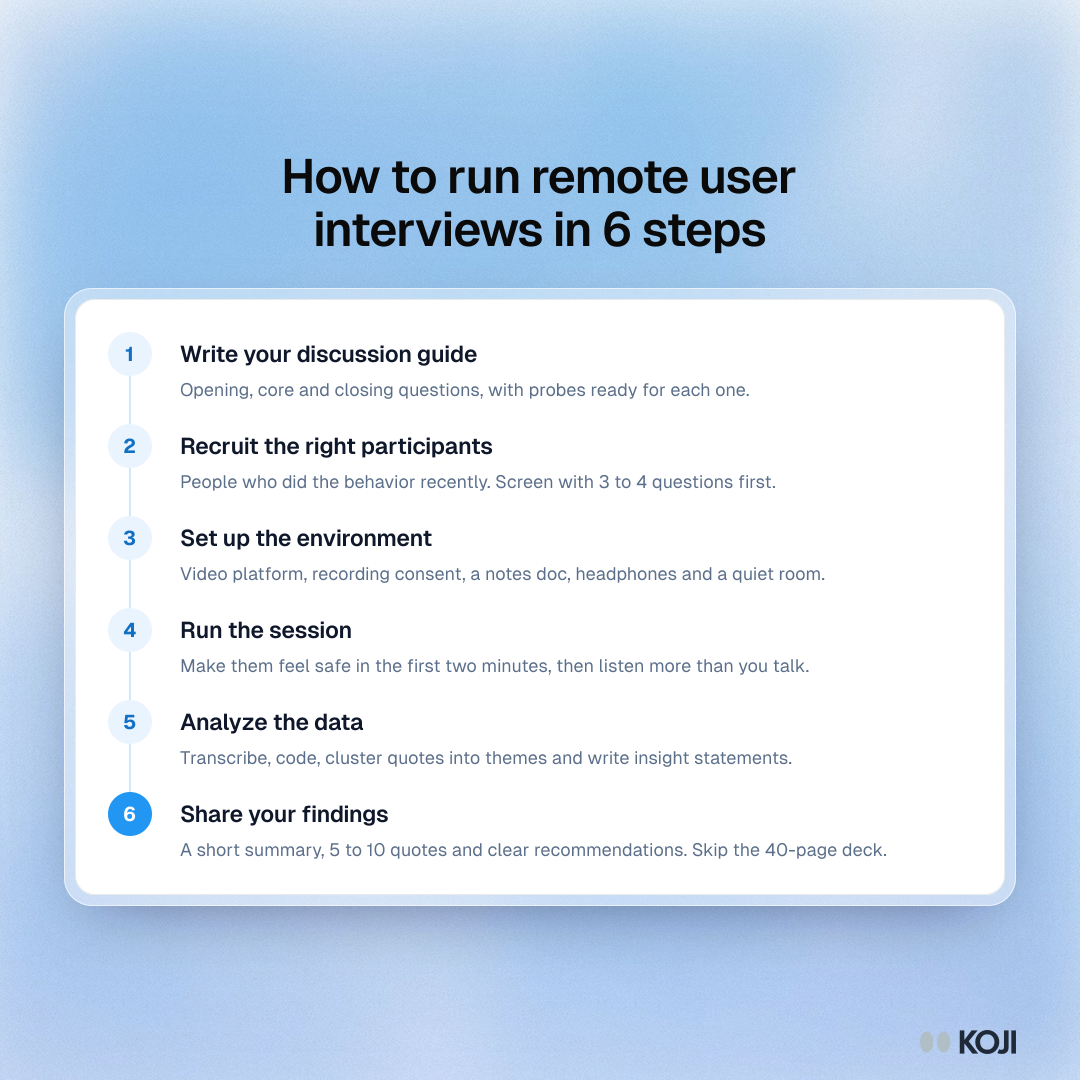
Process of six steps to run remote user interviews: write the discussion guide, recruit, set up the call, run the session, analyze and share findings.

Process

How to run remote user interviews in 6 steps
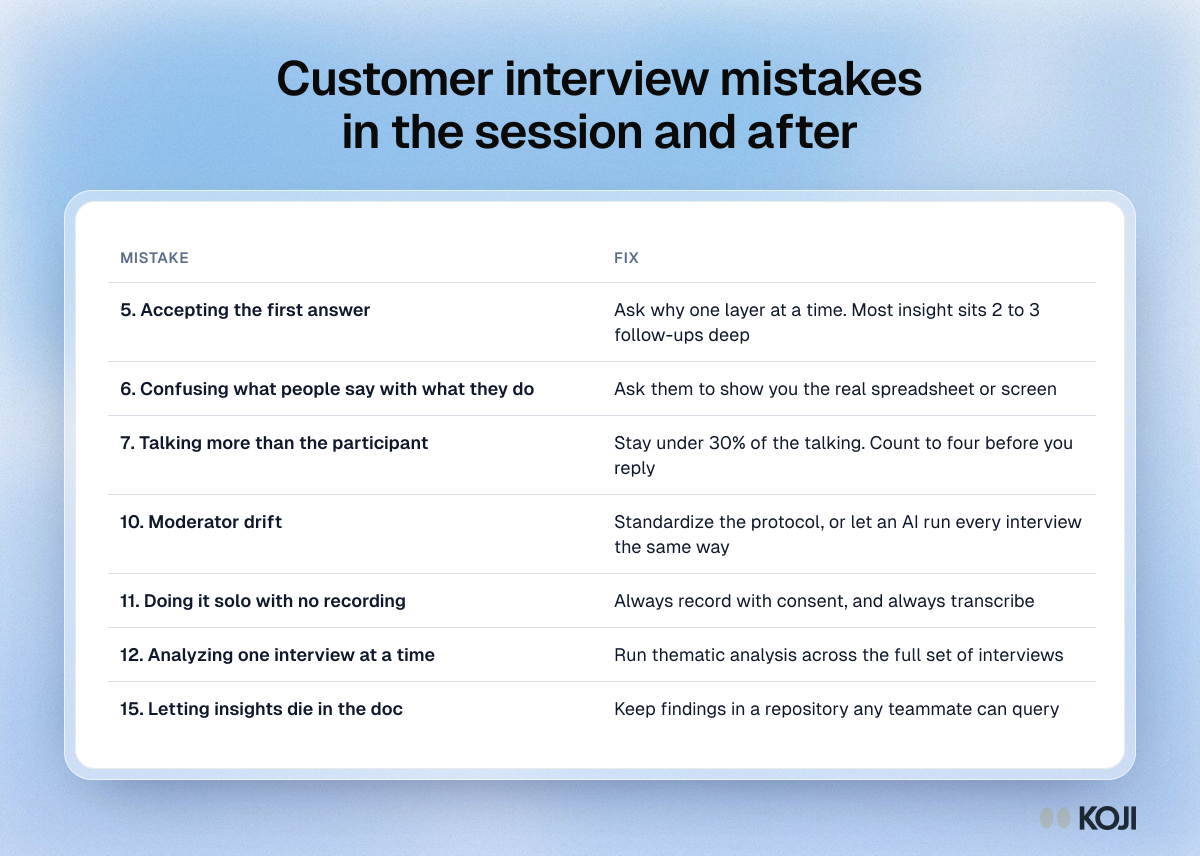
Table of seven customer interview mistakes made during and after the session, from accepting the first answer to letting insights die in a doc, with fixes.

Reference table

Customer interview mistakes in the session and after
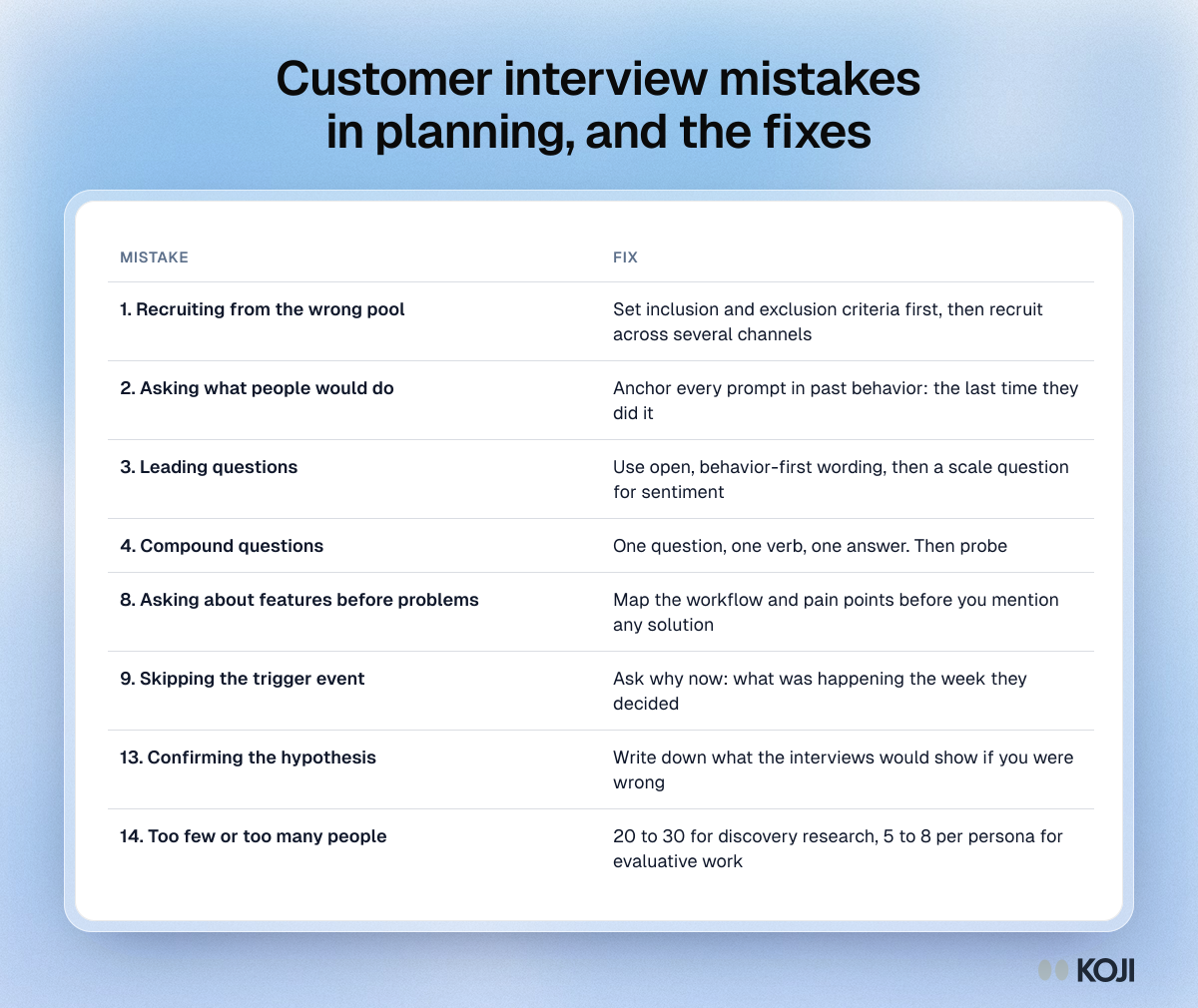
Table of eight customer interview mistakes made before the session, from recruiting the wrong pool to the wrong sample size, each with its fix.

Reference table

Customer interview mistakes in planning, and the fixes
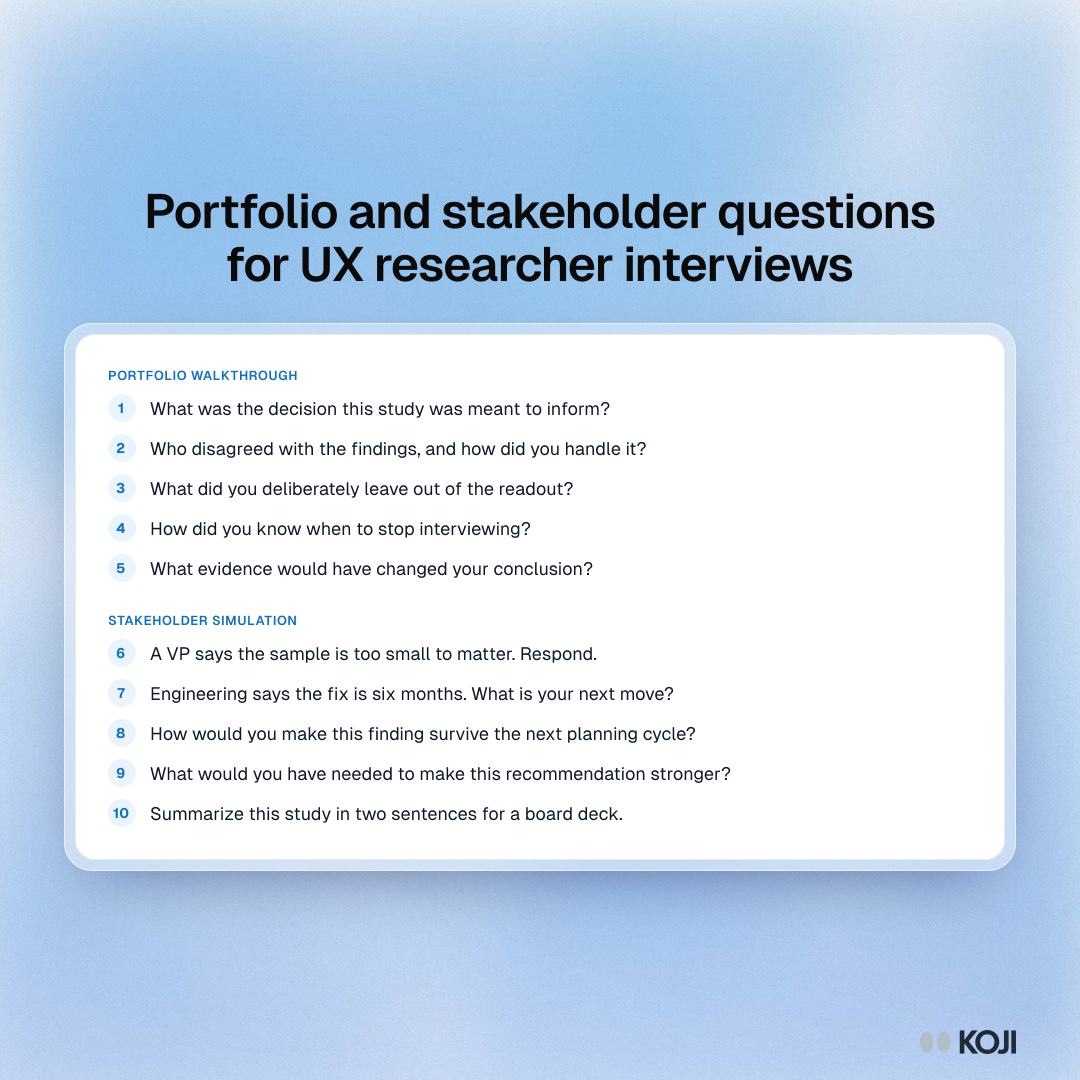
Question bank of ten interview questions for hiring a UX researcher, five for the portfolio walkthrough and five for a stakeholder simulation.

Question bank

Portfolio and stakeholder questions for UX researcher interviews
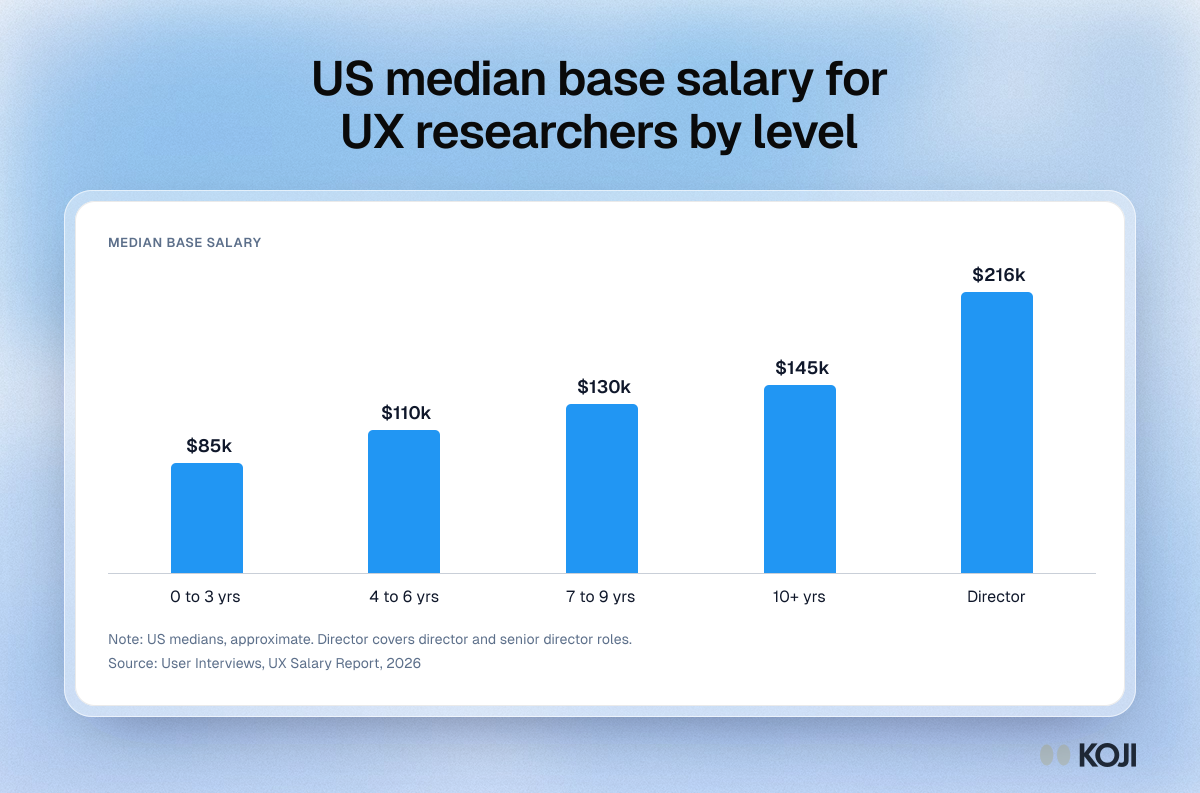
Column chart of 2026 US median base salary for UX researchers: about $85k entry level, $110k mid, $130k senior, $145k at 10+ years and $216k for directors.

Column chart

US median base salary for UX researchers by level
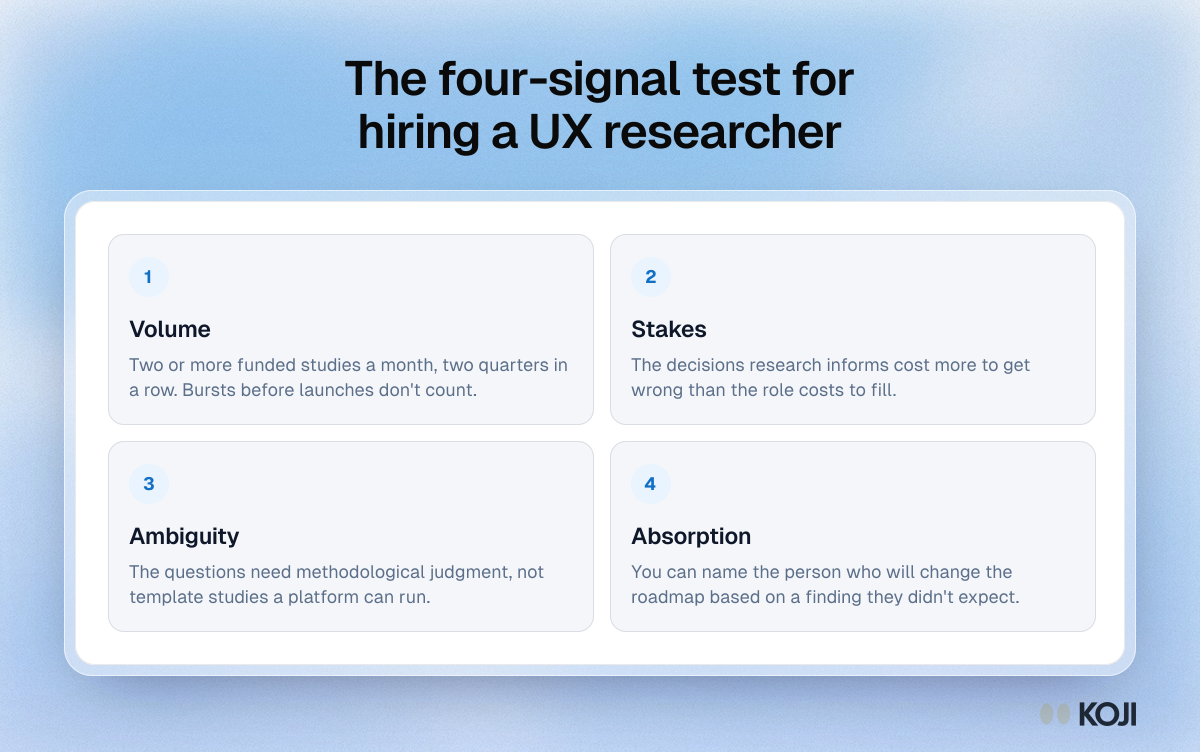
Framework of four signals that show when to hire a UX researcher: continuous volume, high stakes, ambiguous questions and someone who will act on findings.

Framework

The four-signal test for hiring a UX researcher
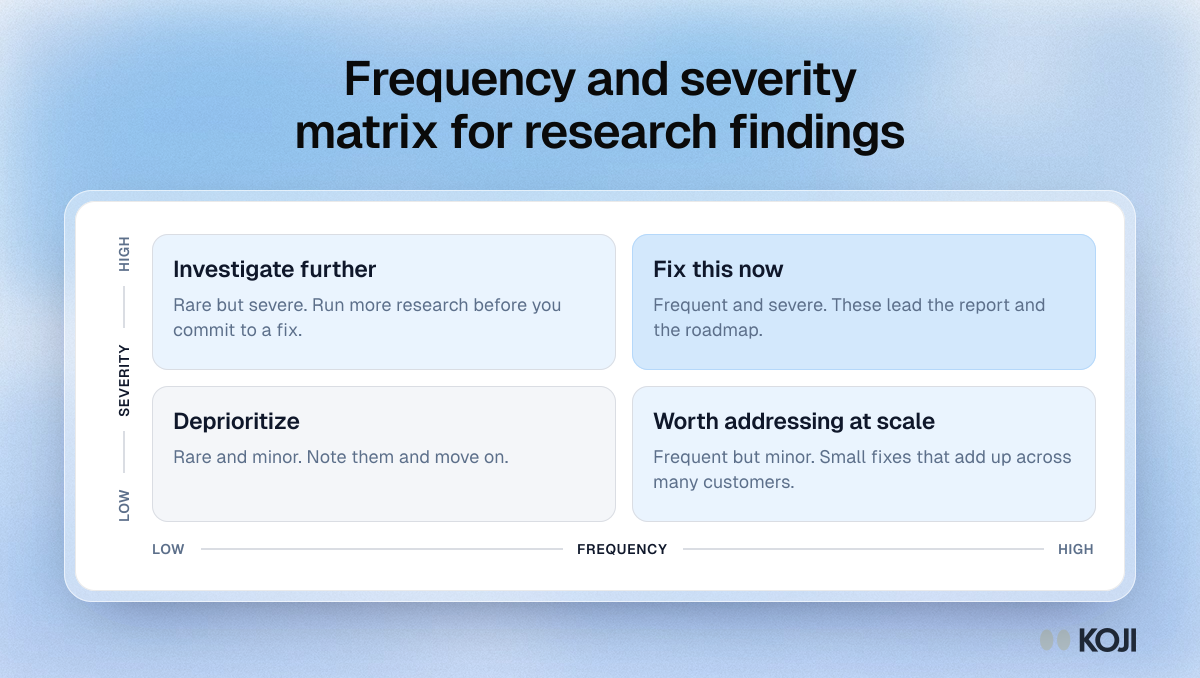
Matrix that sorts research findings by frequency and severity into four actions: fix now, worth addressing at scale, investigate further and deprioritize.

Matrix

Frequency and severity matrix for research findings
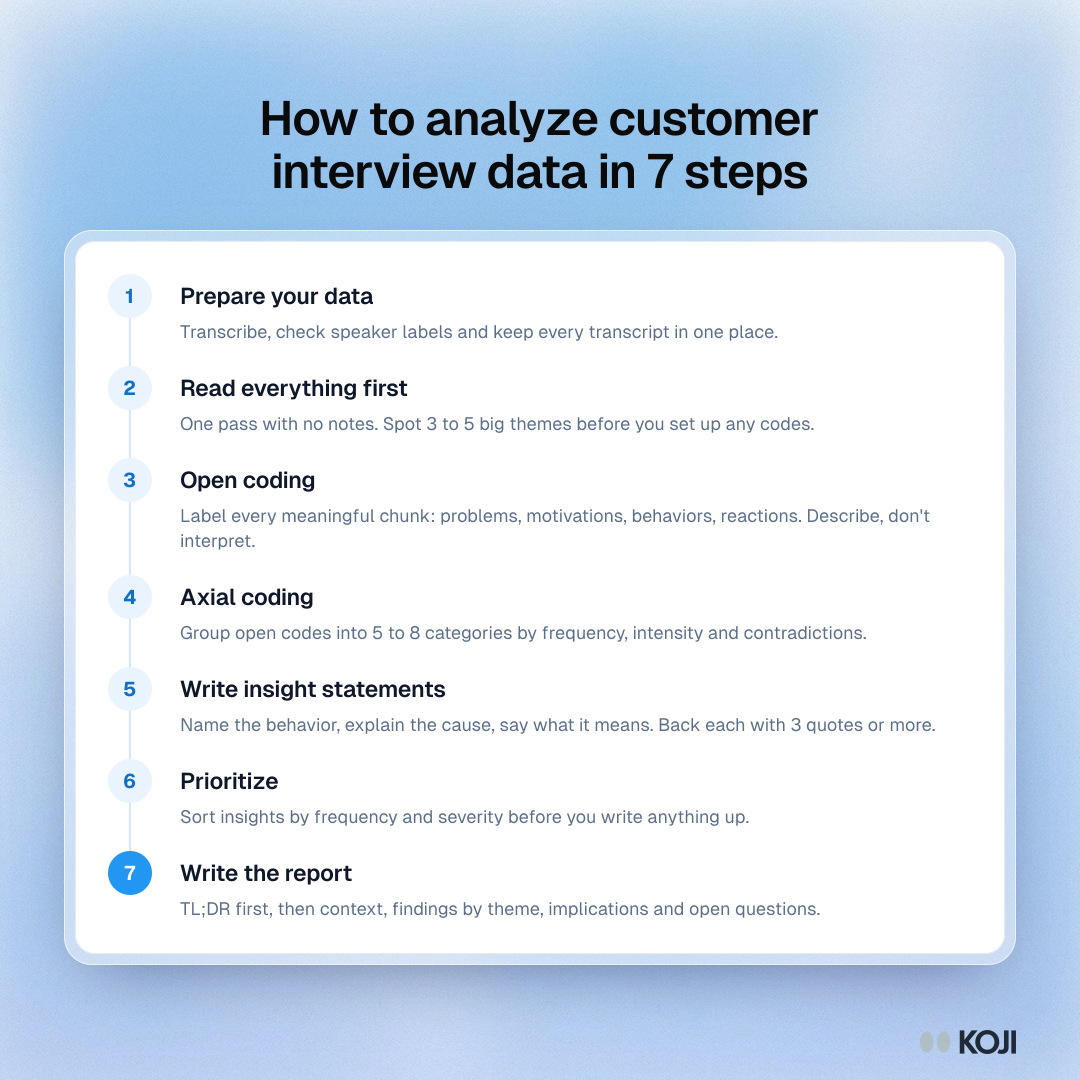
Process of seven steps to analyze customer interview data, from preparing transcripts and open and axial coding to insight statements, priorities and a report.

Process

How to analyze customer interview data in 7 steps
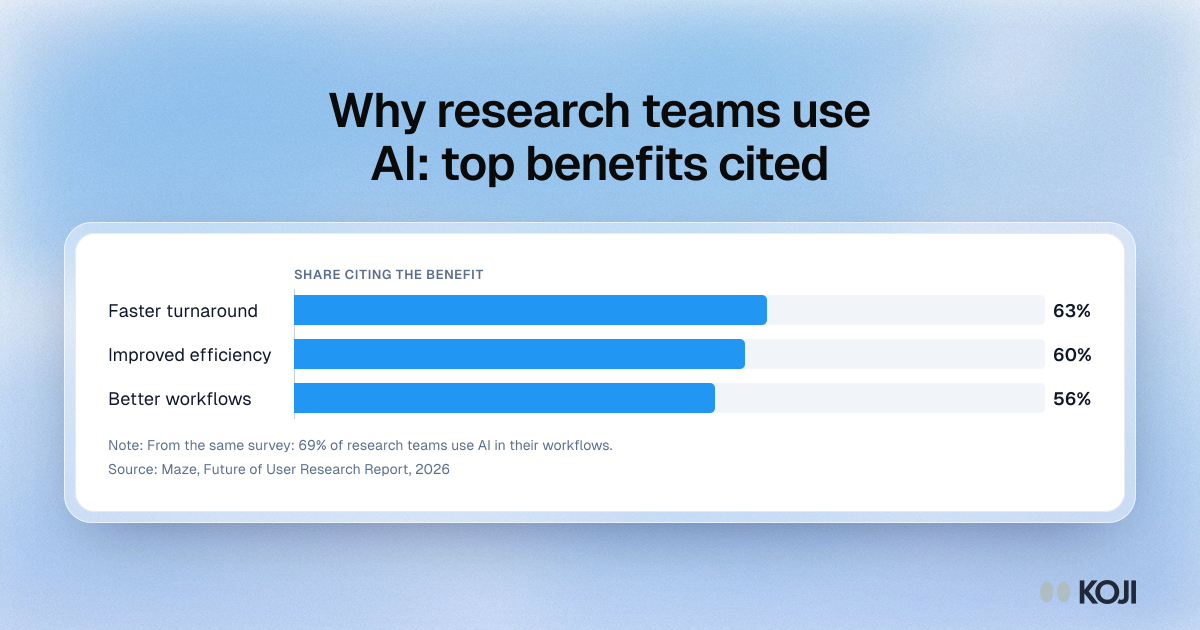
Bar chart of the top benefits research teams cite for using AI, from the Maze 2026 report: faster turnaround 63%, improved efficiency 60%, better workflows 56%.

Bar chart

Why research teams use AI: top benefits cited
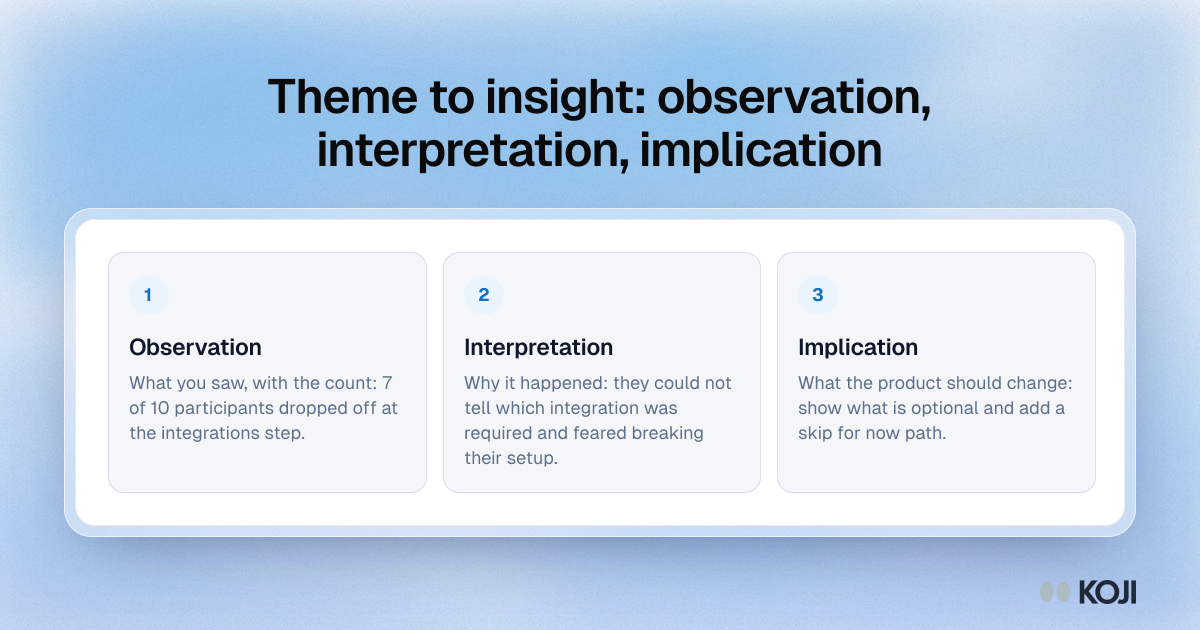
Framework showing how an interview theme becomes an insight in three parts: the observation with its count, the interpretation of why, and the implication.

Framework

Theme to insight: observation, interpretation, implication
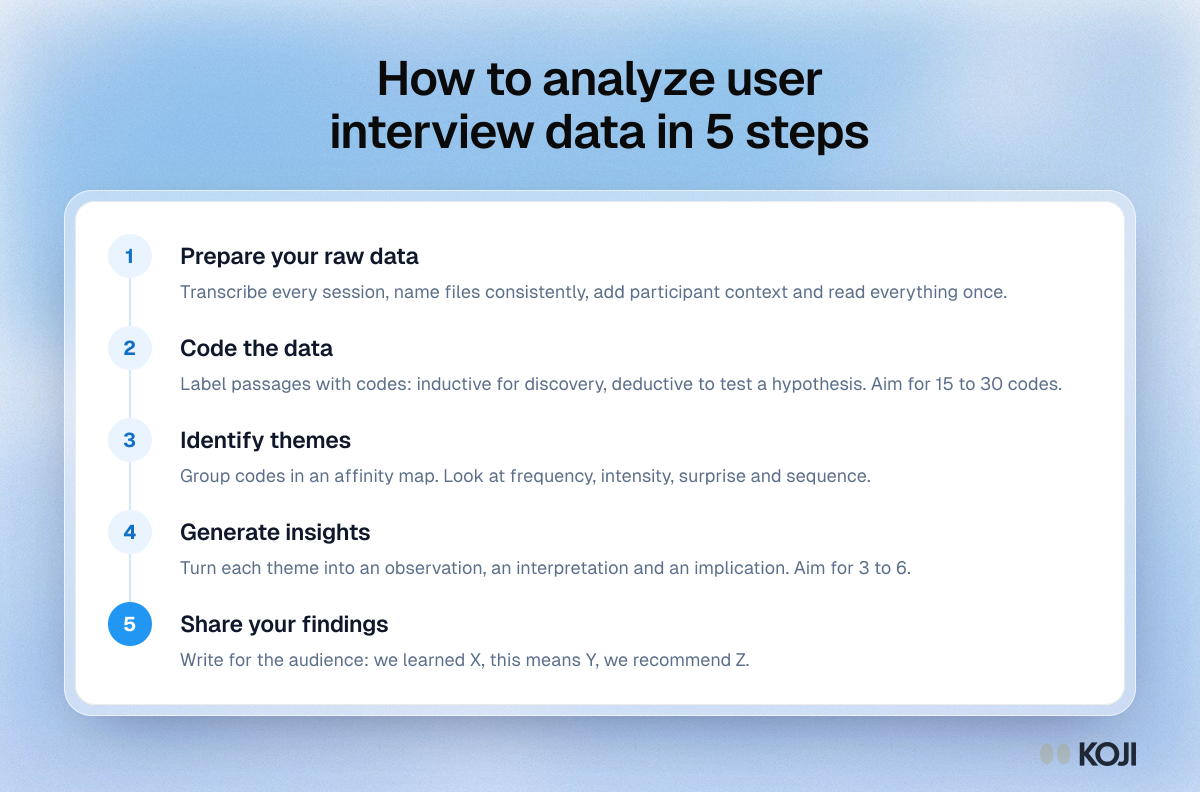
Process of five steps to analyze user interview data: prepare transcripts, code passages, group codes into themes, write insights and share findings.

Process

How to analyze user interview data in 5 steps
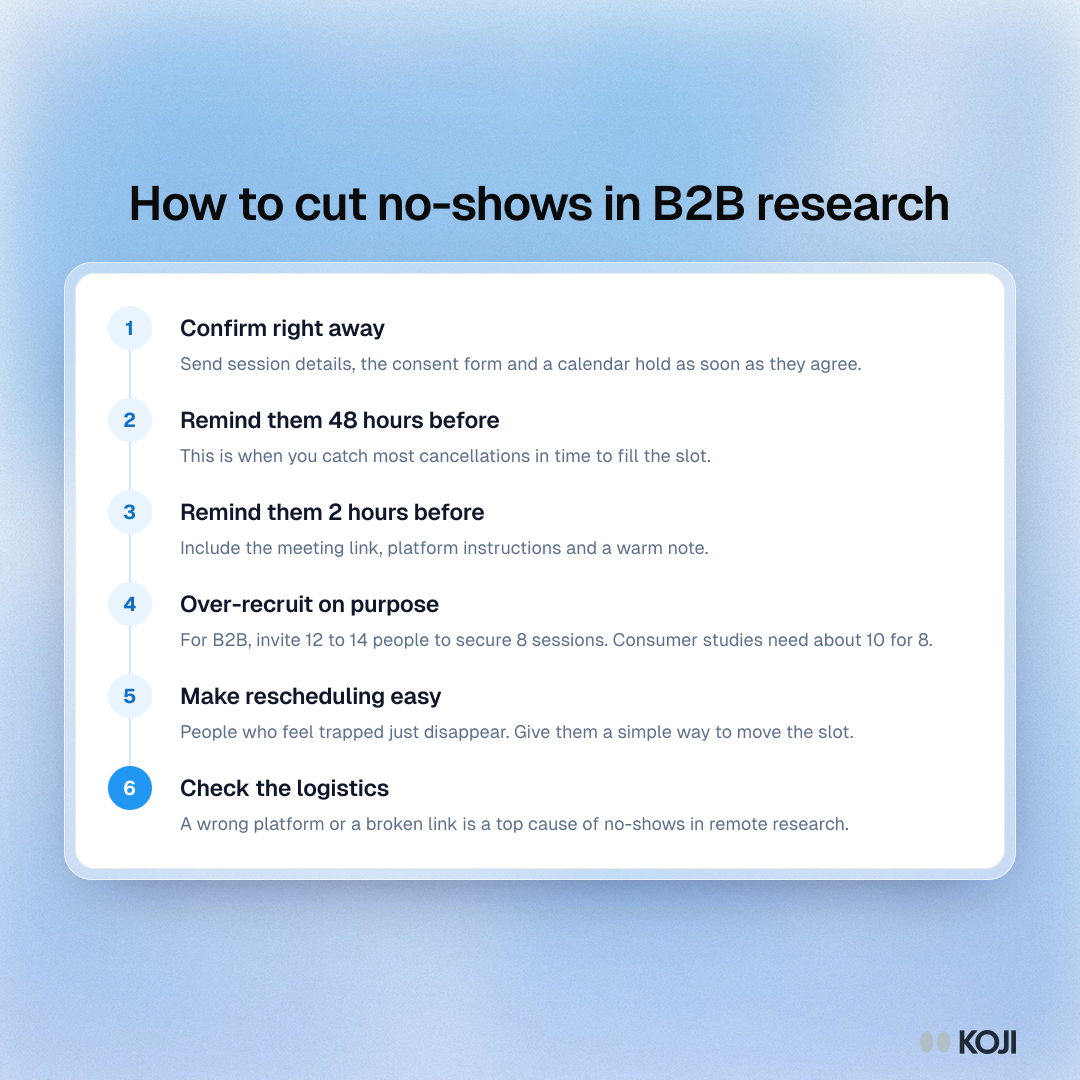
Process of six steps to reduce no-shows in B2B user research, from an instant confirmation and two reminders to over-recruiting 12 to 14 people for 8 sessions.

Process

How to cut no-shows in B2B research
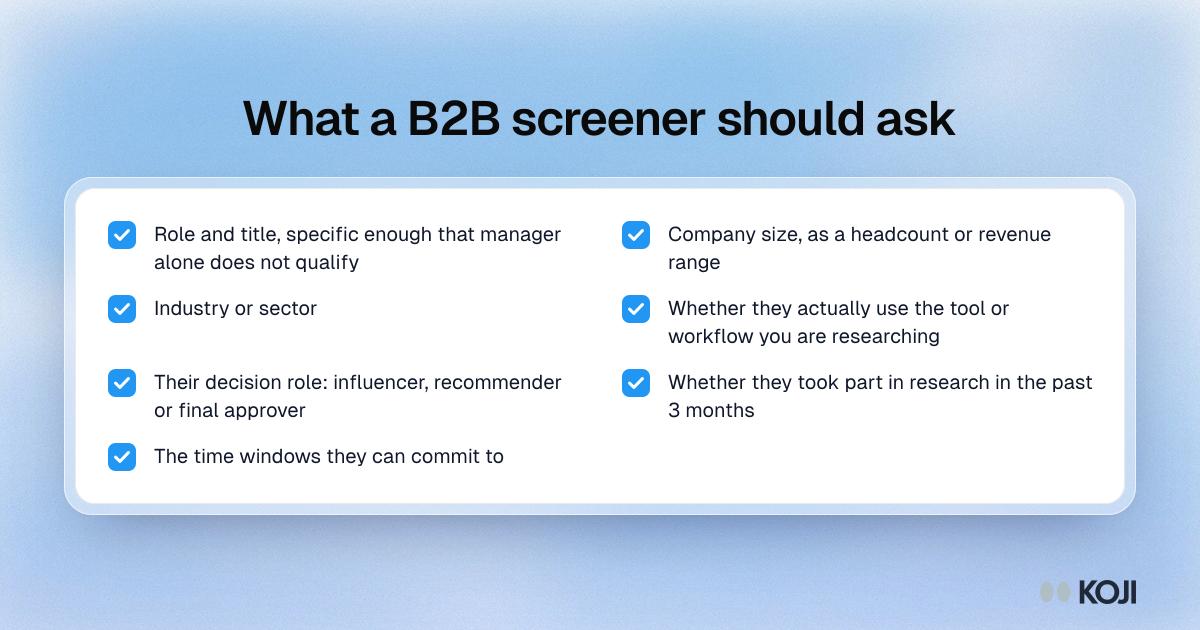
Checklist of seven things a B2B research screener should ask, from role and company size to decision role, research recency and availability.

Checklist

What a B2B screener should ask
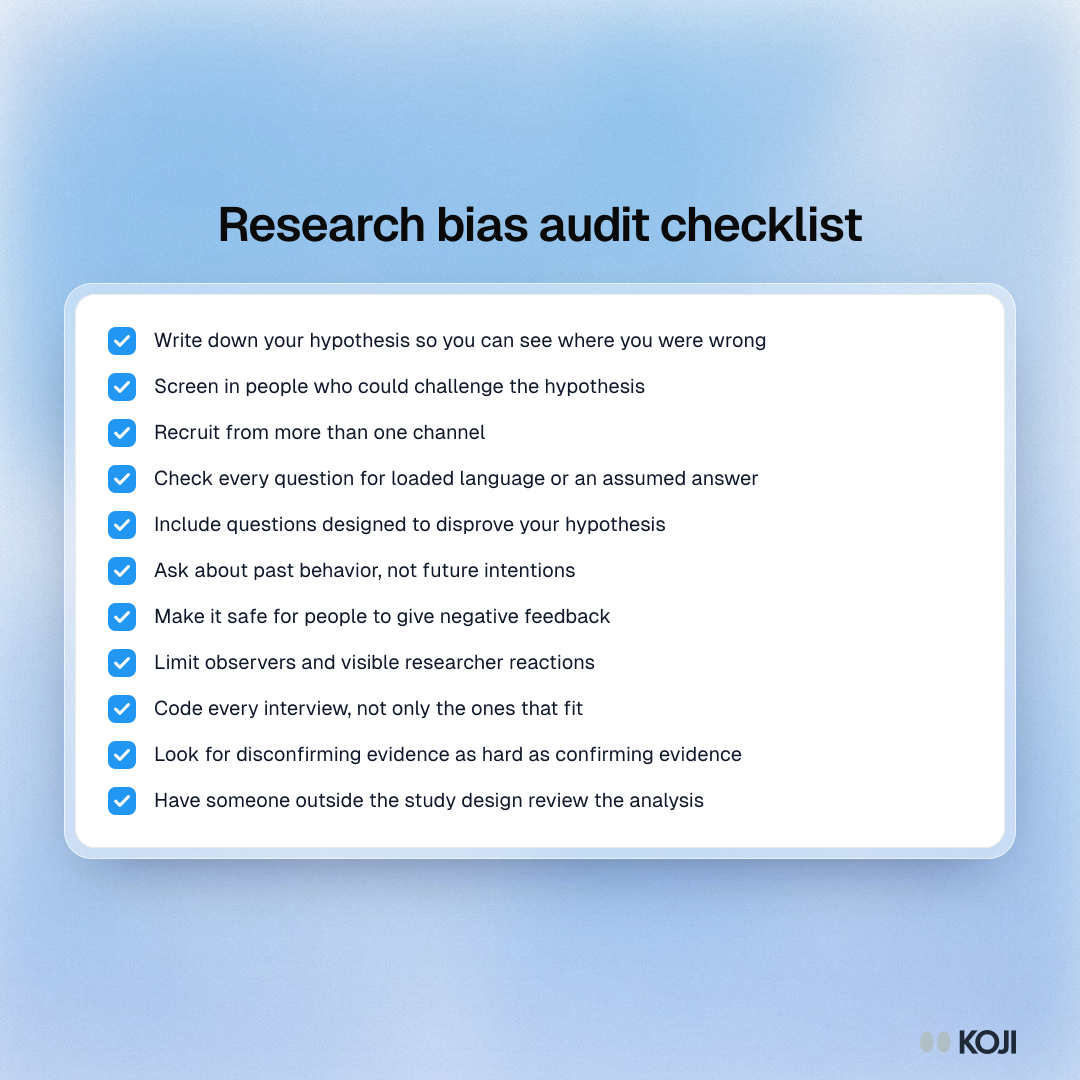
Checklist of eleven checks to run before a study, covering the hypothesis, recruitment, question wording, data collection and analysis.

Checklist

Research bias audit checklist
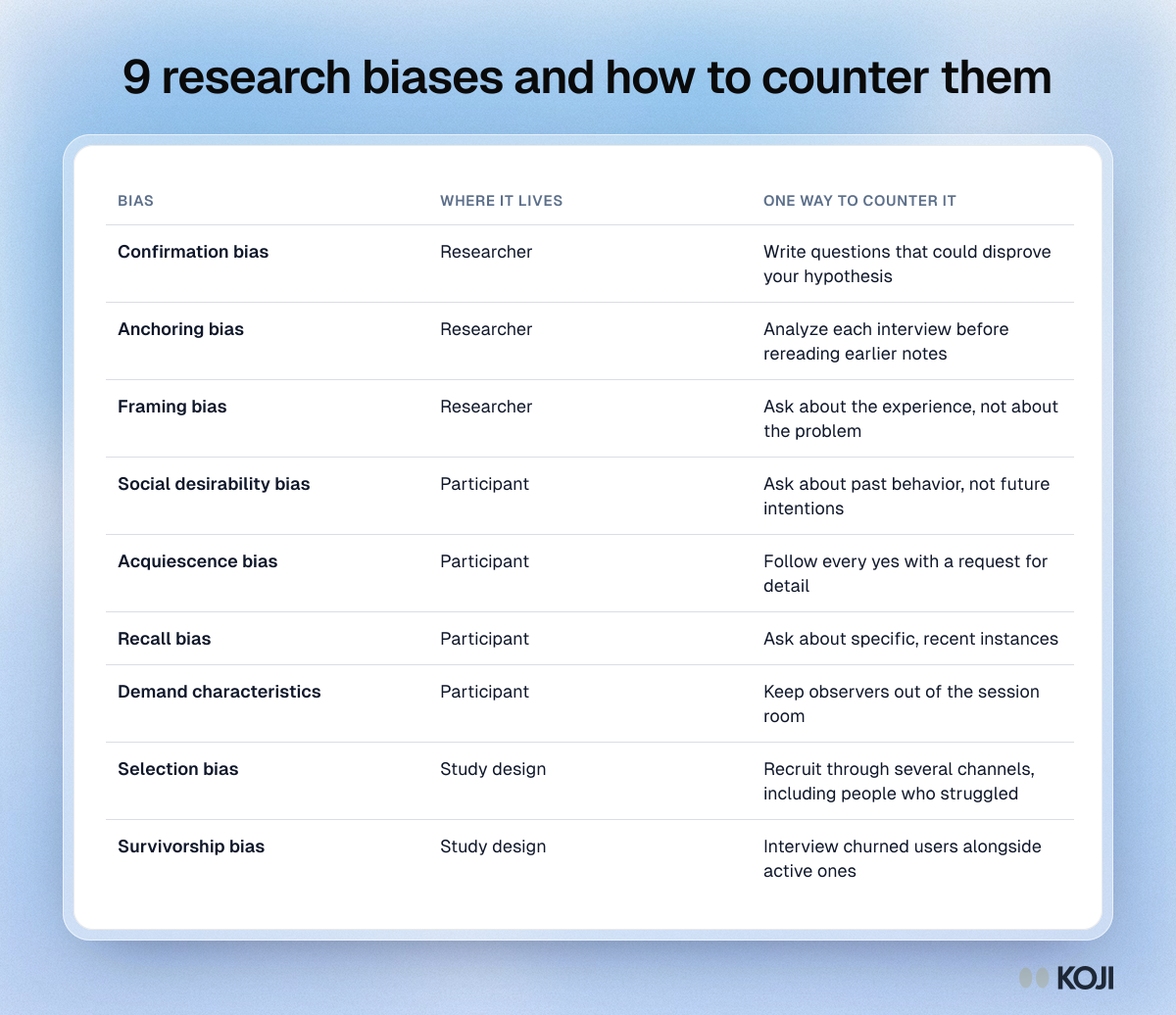
Table of nine research biases, grouped by researcher, participant and study design, with one way to counter each in user research.

Reference table

9 research biases and how to counter them
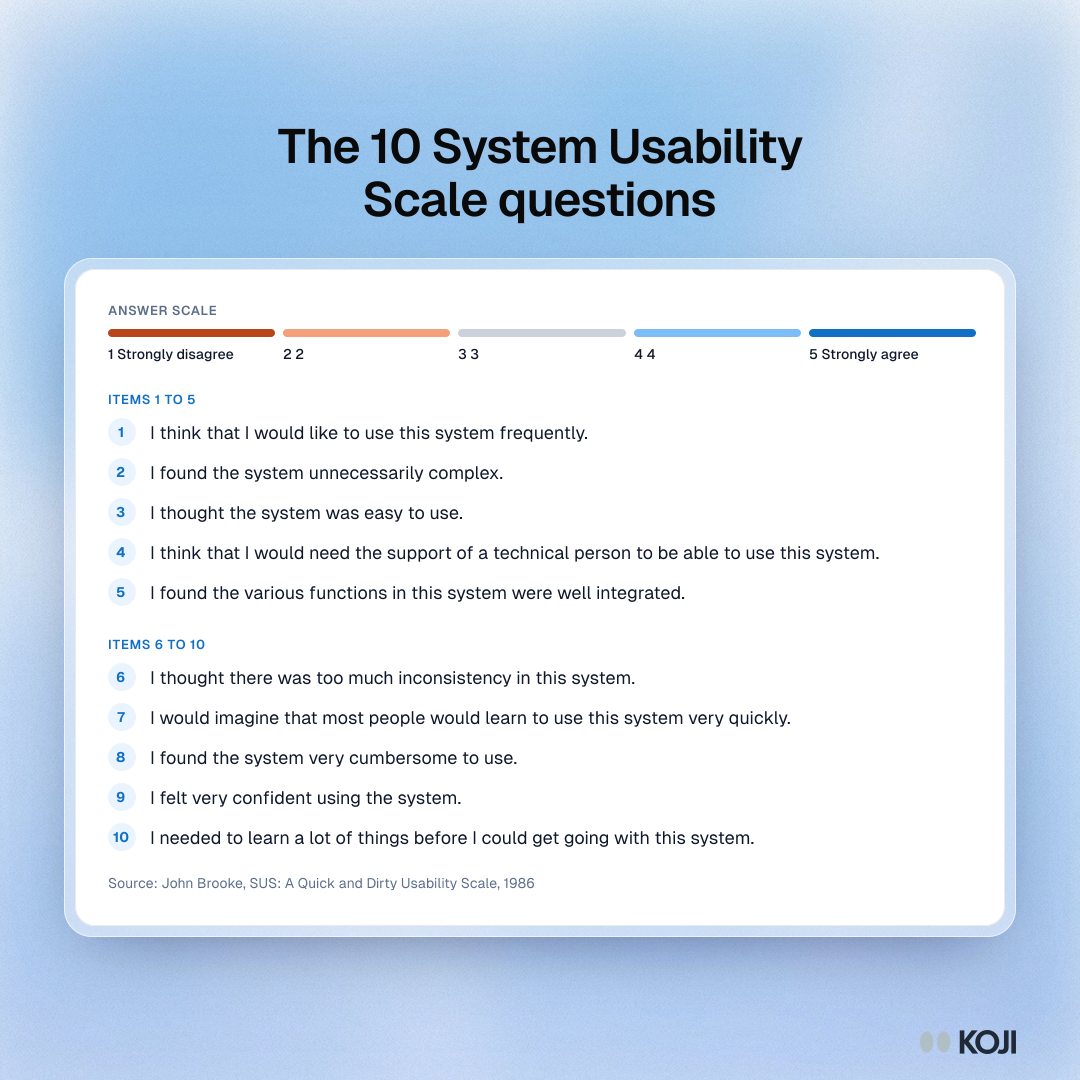
Question bank listing the ten System Usability Scale statements, each rated on a five-point scale from strongly disagree to strongly agree.

Question bank

The 10 System Usability Scale questions
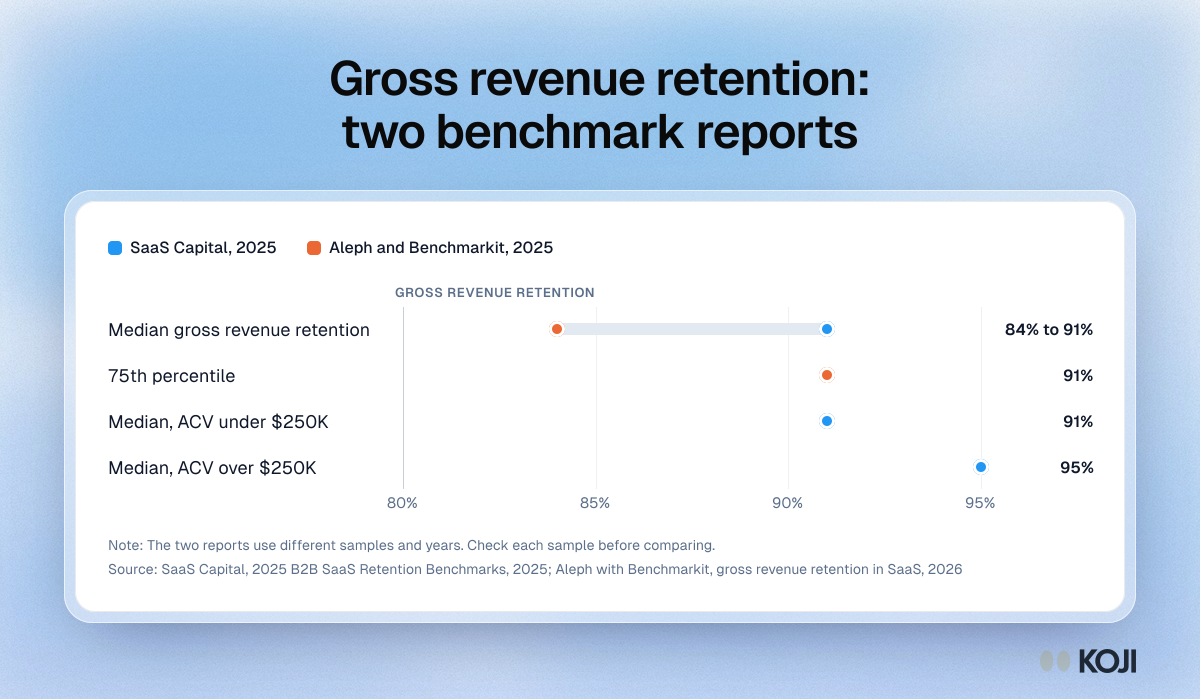
Range chart of B2B SaaS gross revenue retention from two reports: a median of 91% and 84%, and 91% below and 95% above a 250,000 dollar contract value.

Benchmark range

Gross revenue retention: two benchmark reports
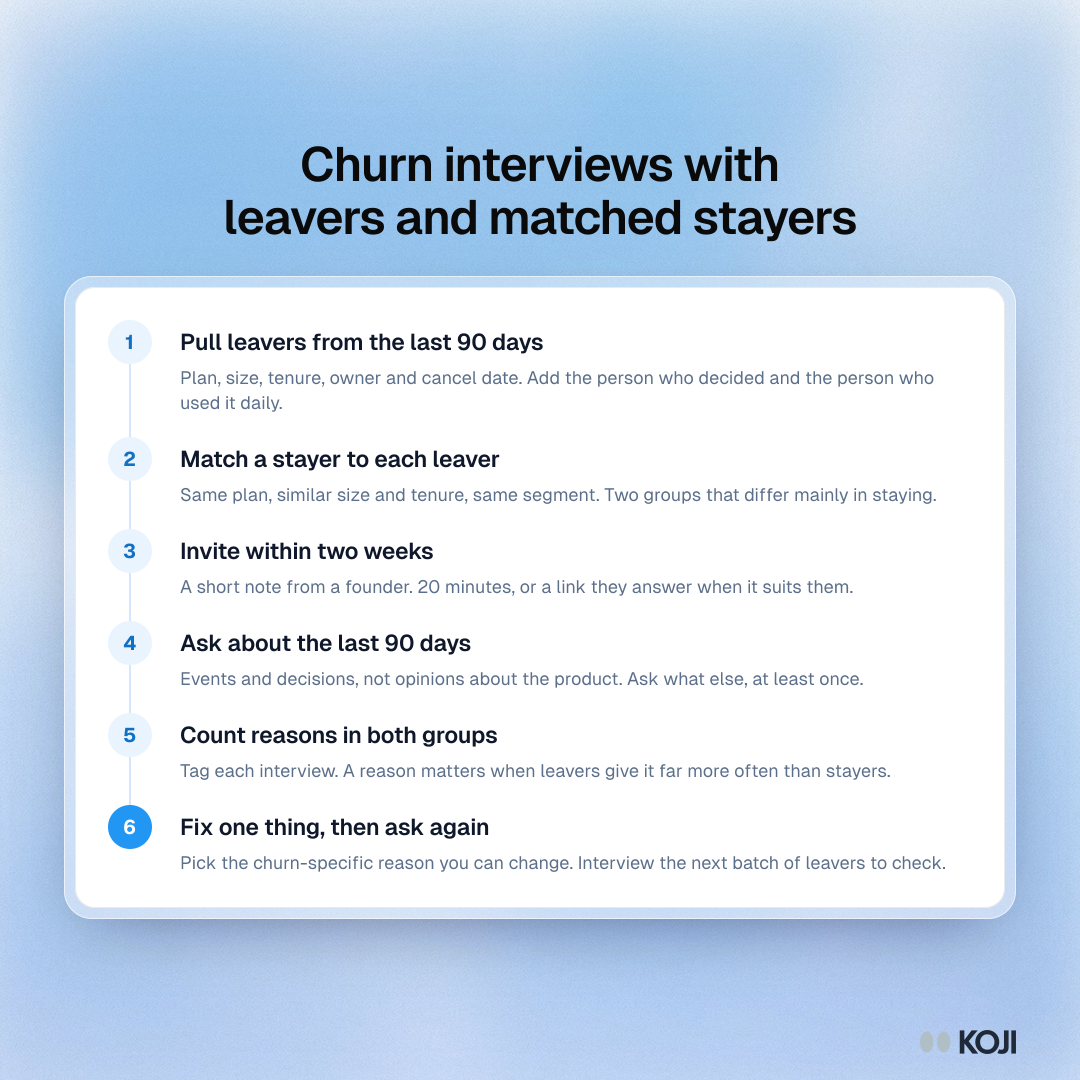
Process in six steps for churn interviews: pull leavers, match stayers, invite, ask about the last 90 days, count reasons in both groups, fix one thing.

Process

Churn interviews with leavers and matched stayers
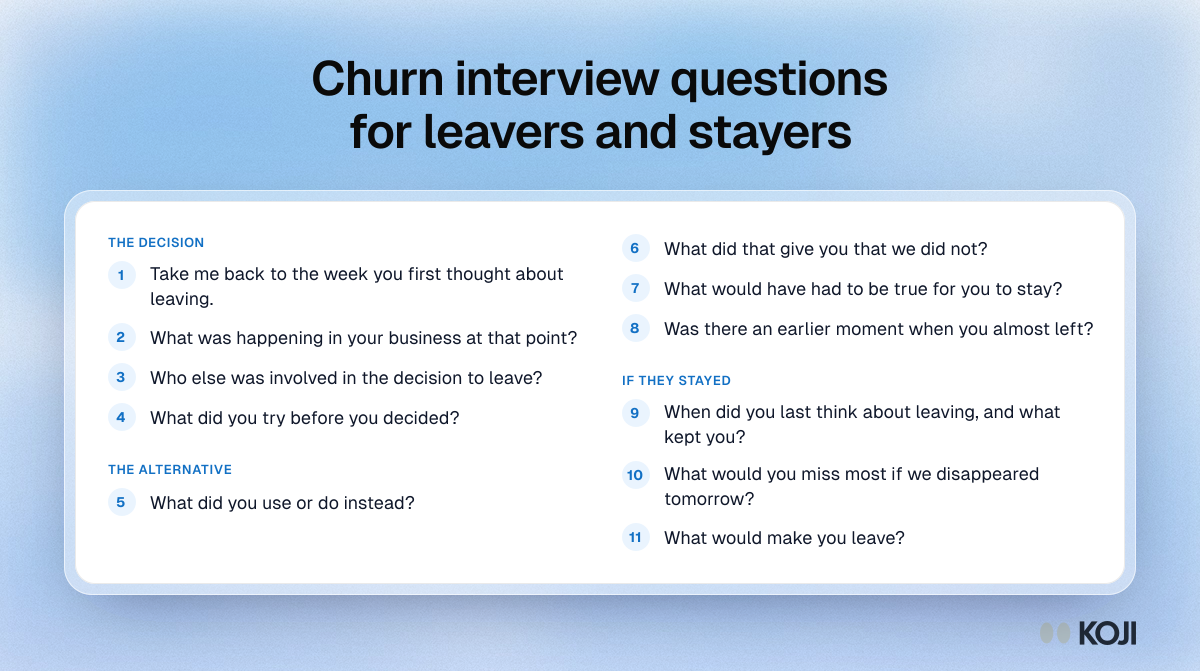
Question bank of eleven churn interview questions in three groups: the decision to leave, the alternative, and a version for customers who stayed.

Question bank

Churn interview questions for leavers and stayers
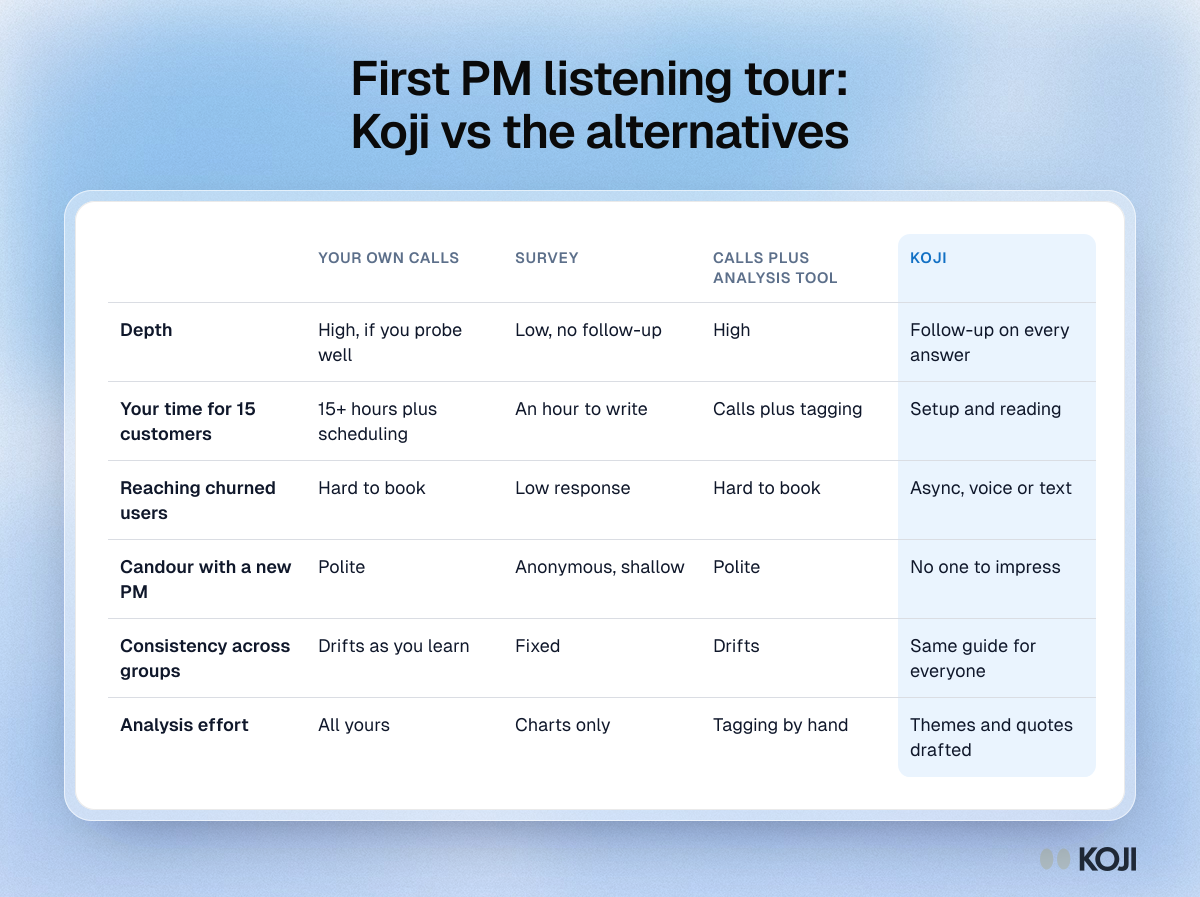
Comparison table of a first PM's listening tour options: own calls, survey, own calls plus an analysis tool, and Koji, on depth, time, reach and analysis

Reference table

First PM listening tour: Koji vs the alternatives
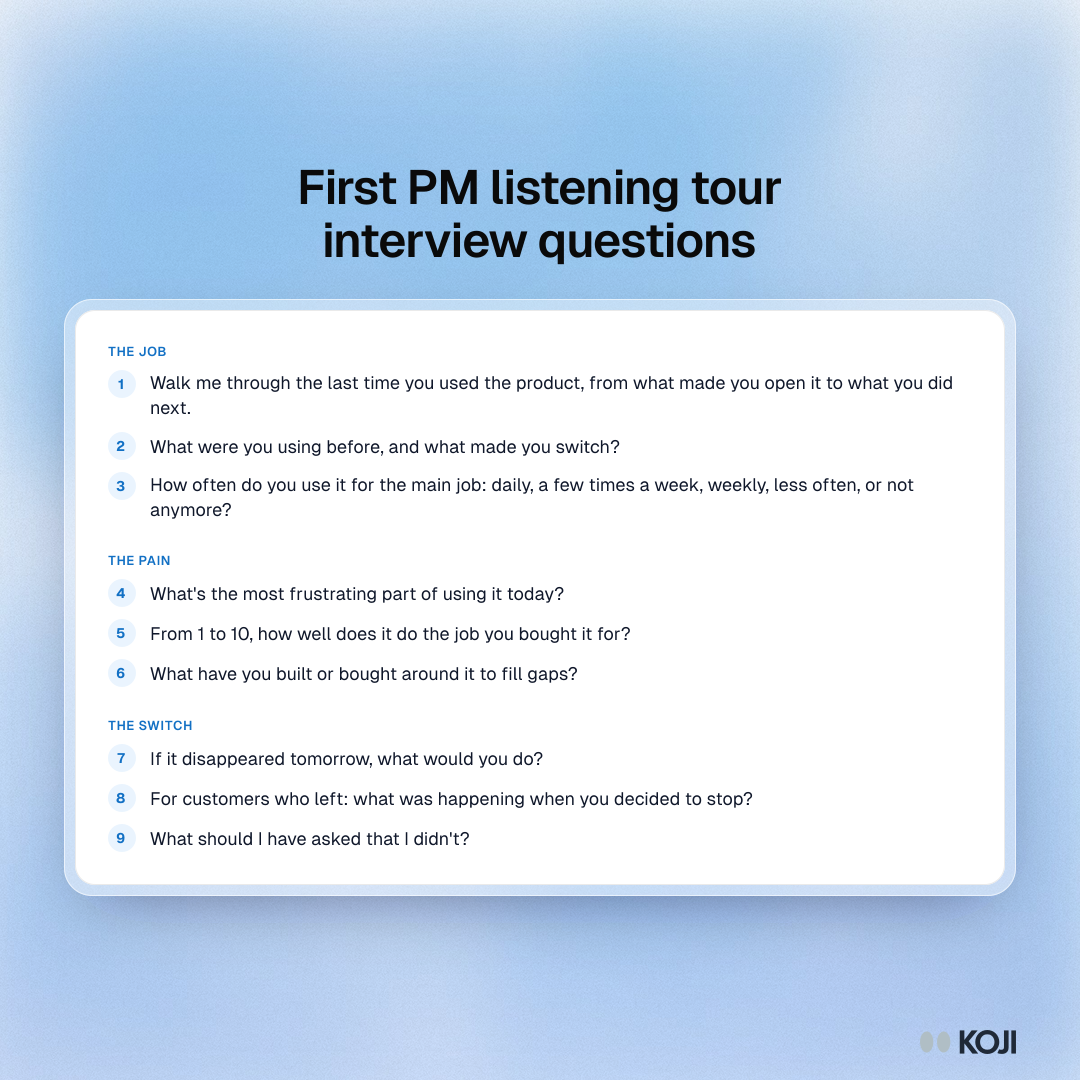
Question bank for a first product manager's customer listening tour, in three sections: the job, the pain and the switch

Question bank

First PM listening tour interview questions
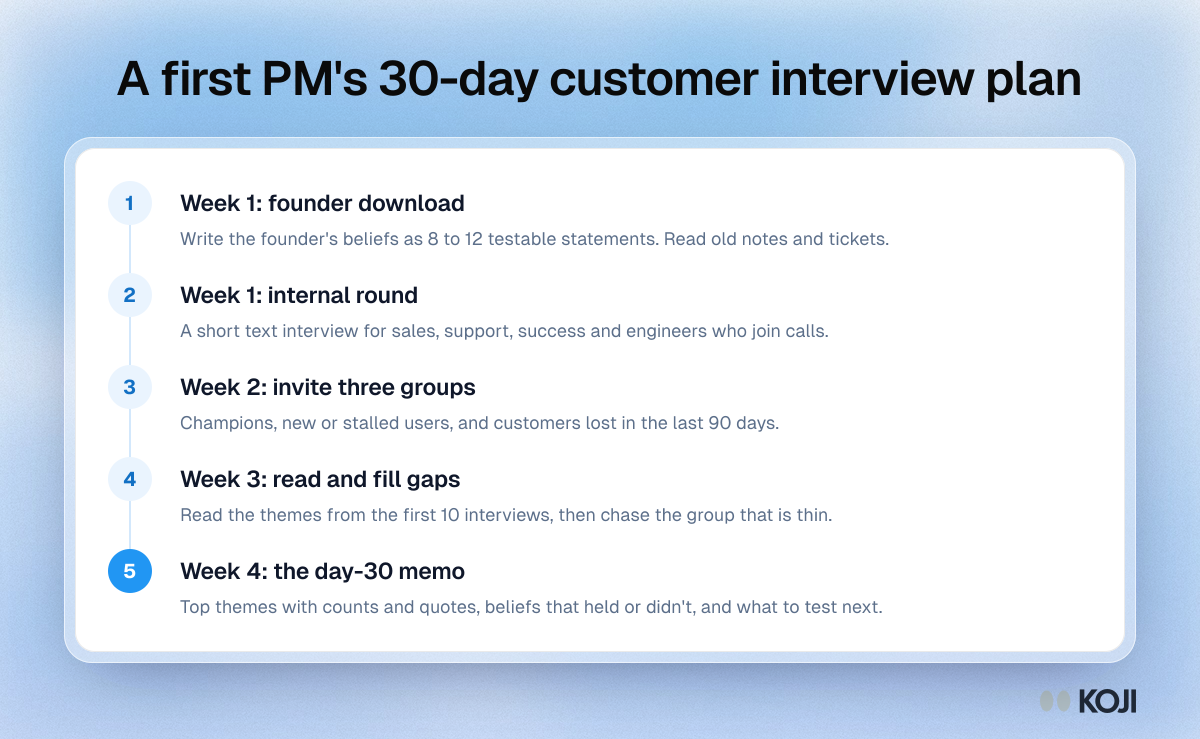
Process for a first product manager's 30-day customer interview plan in four weeks, from founder download to day-30 memo

Process

A first PM's 30-day customer interview plan
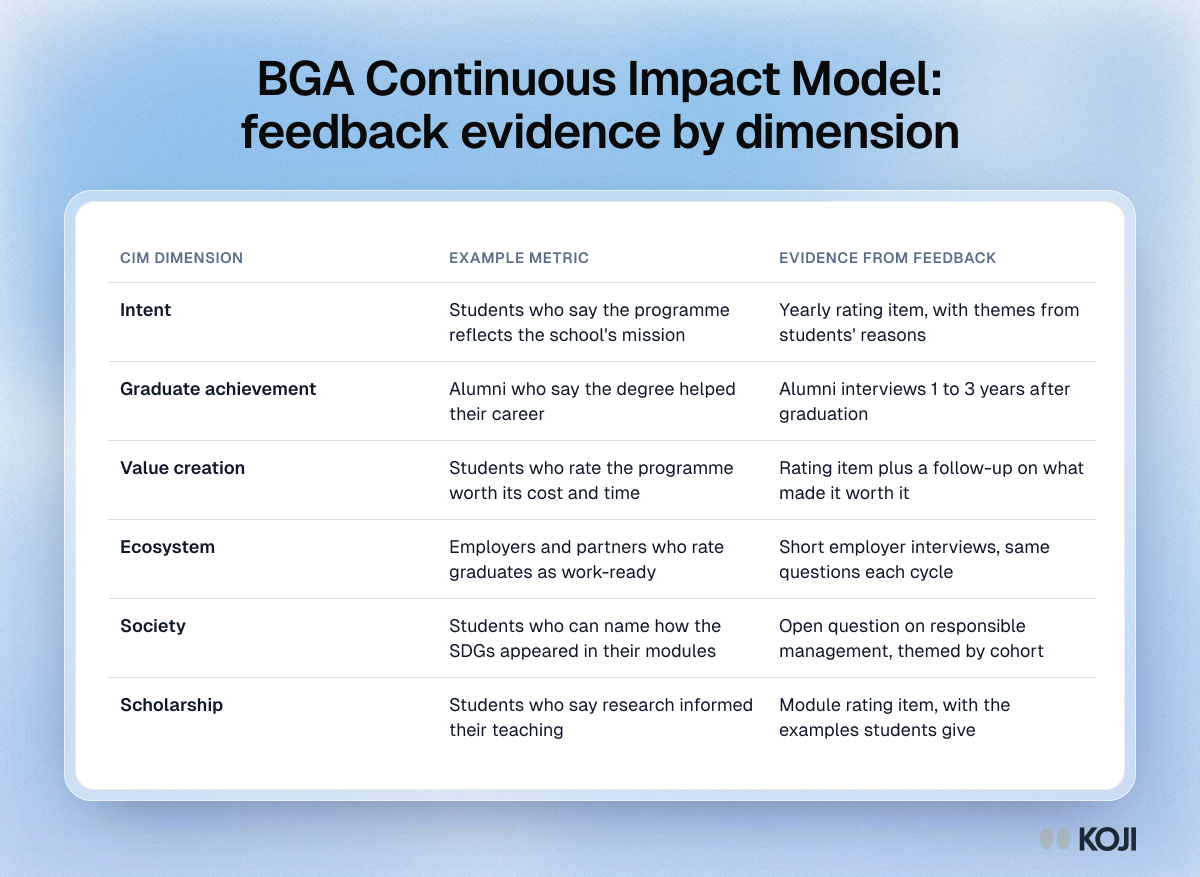
Table mapping the six BGA Continuous Impact Model dimensions to an example metric and the feedback evidence that supports each

Reference table

BGA Continuous Impact Model: feedback evidence by dimension
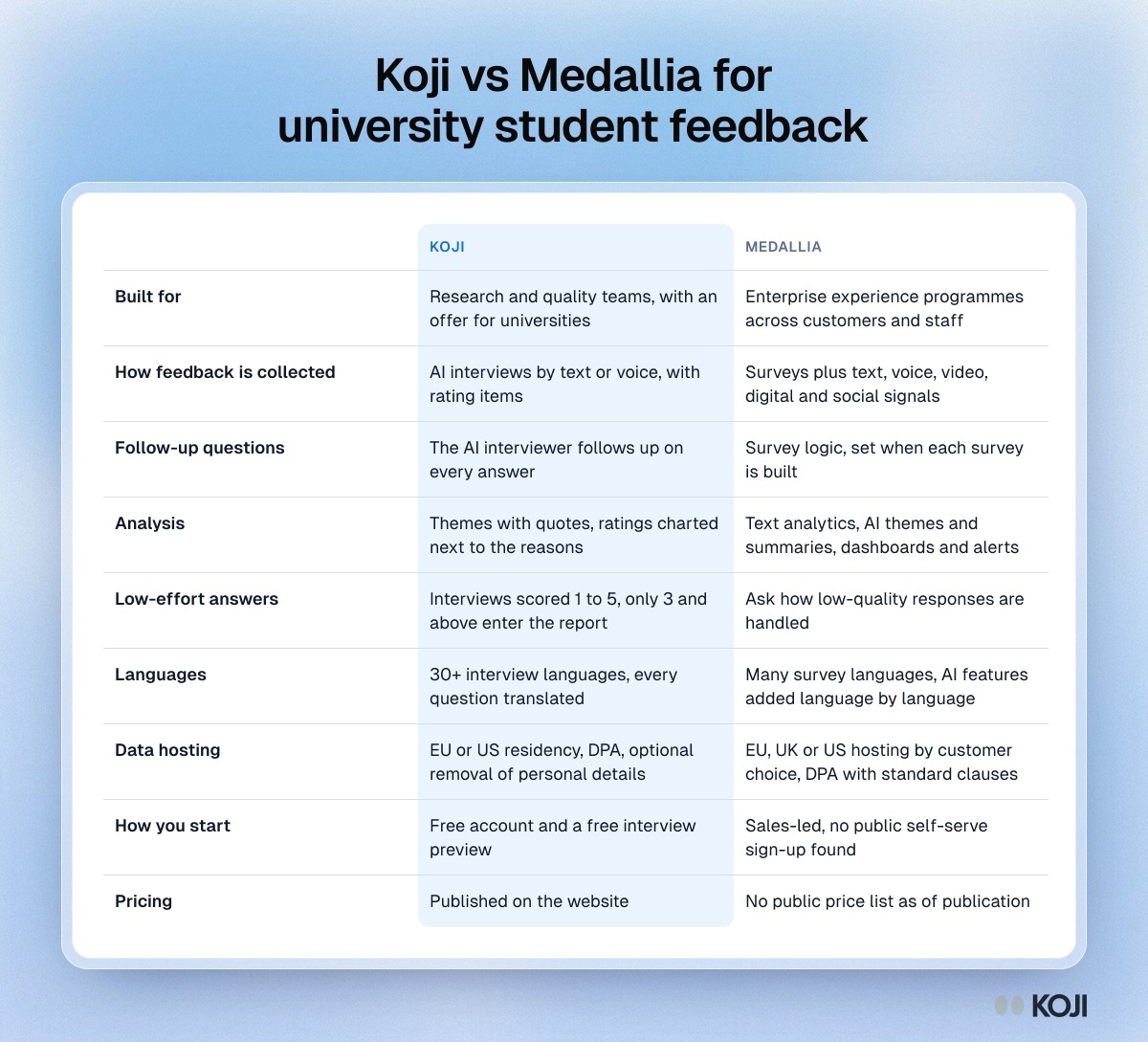
Table comparing Koji and Medallia for university feedback: collection, follow-up questions, analysis, data hosting, how you start and pricing

Reference table

Koji vs Medallia for university student feedback
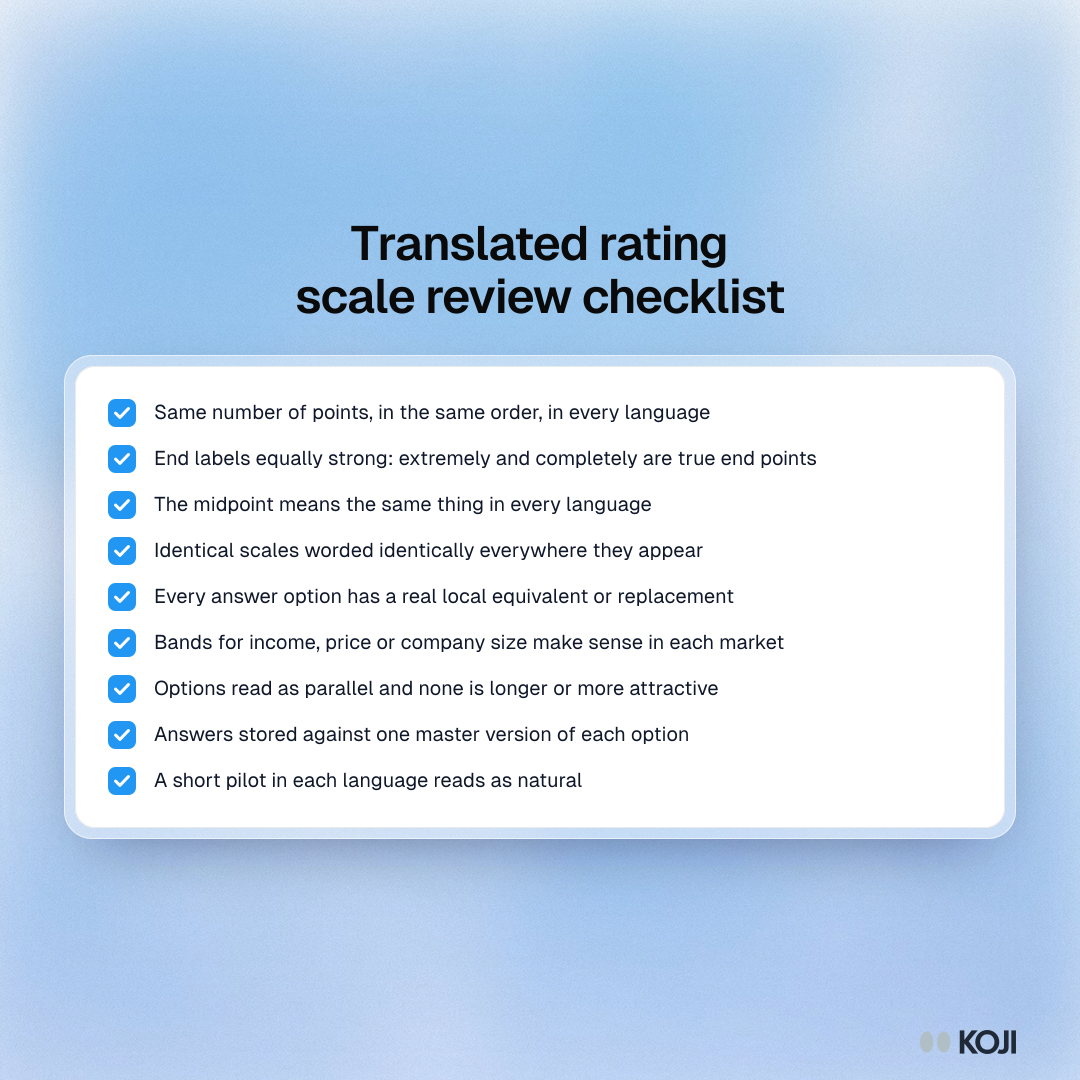
Checklist for reviewing a translated rating scale or answer option set before launch, from point count and order to a pilot in each language.

Checklist

Translated rating scale review checklist
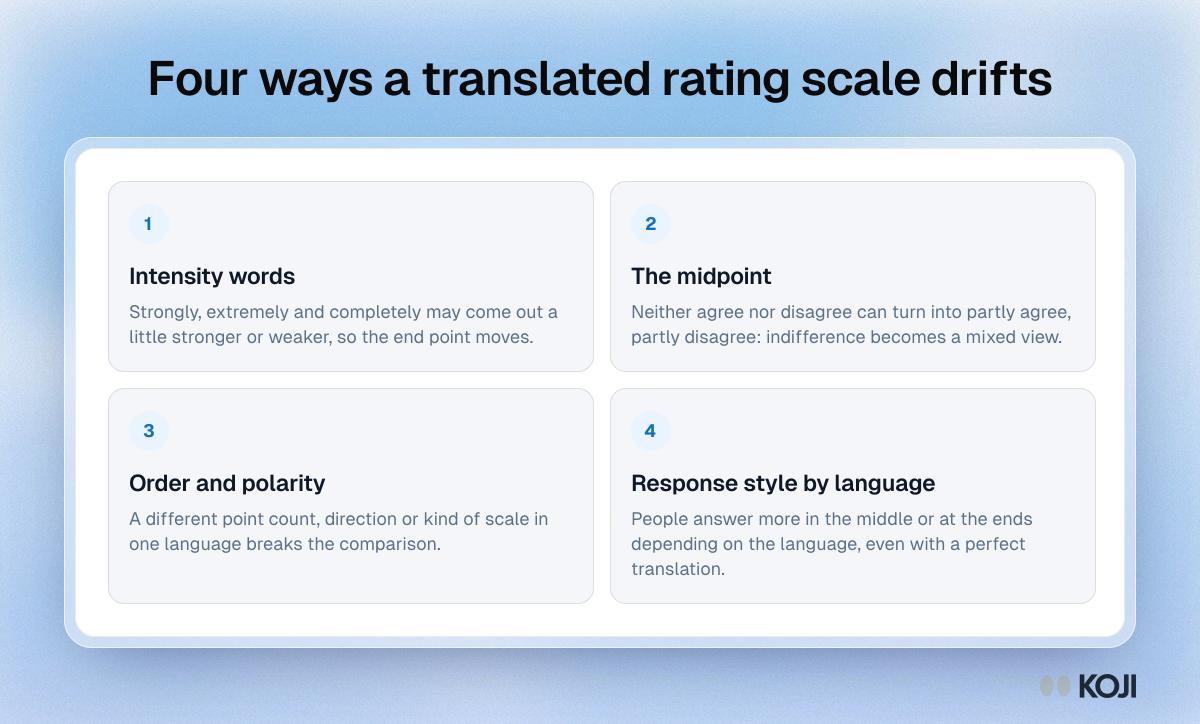
Framework of four ways a translated rating scale drifts: intensity words, the midpoint, order and polarity, and response style by language.

Framework

Four ways a translated rating scale drifts
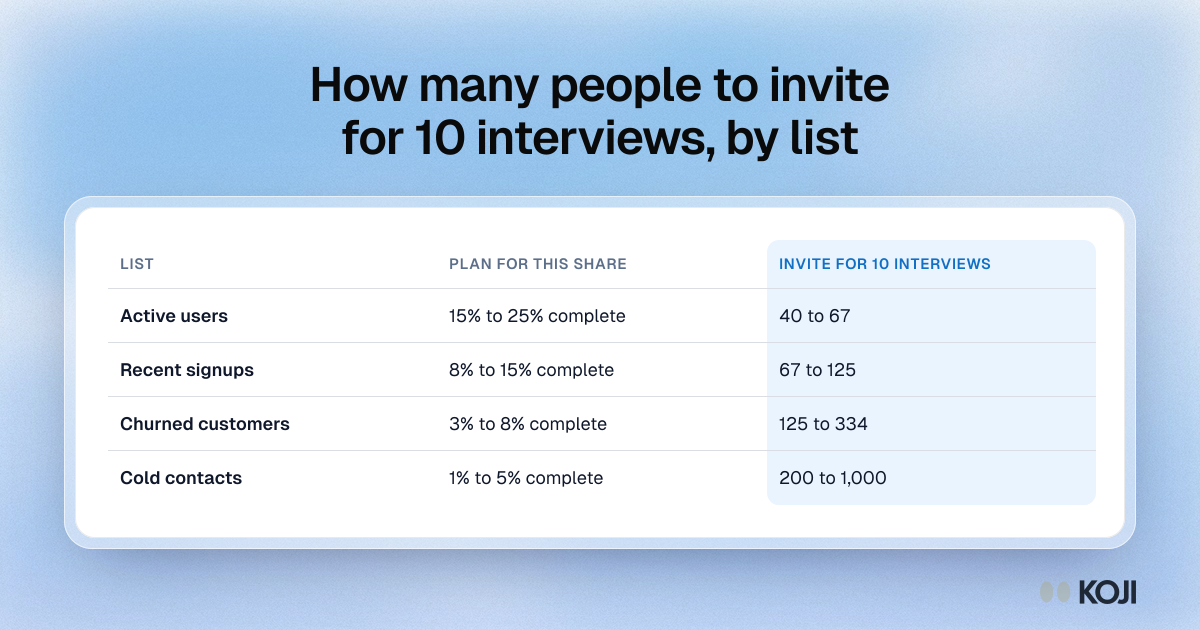
Table of invitations needed for 10 interviews by list: active users 40 to 67, recent signups 67 to 125, churned 125 to 334, cold 200 to 1,000.

Reference table

How many people to invite for 10 interviews, by list
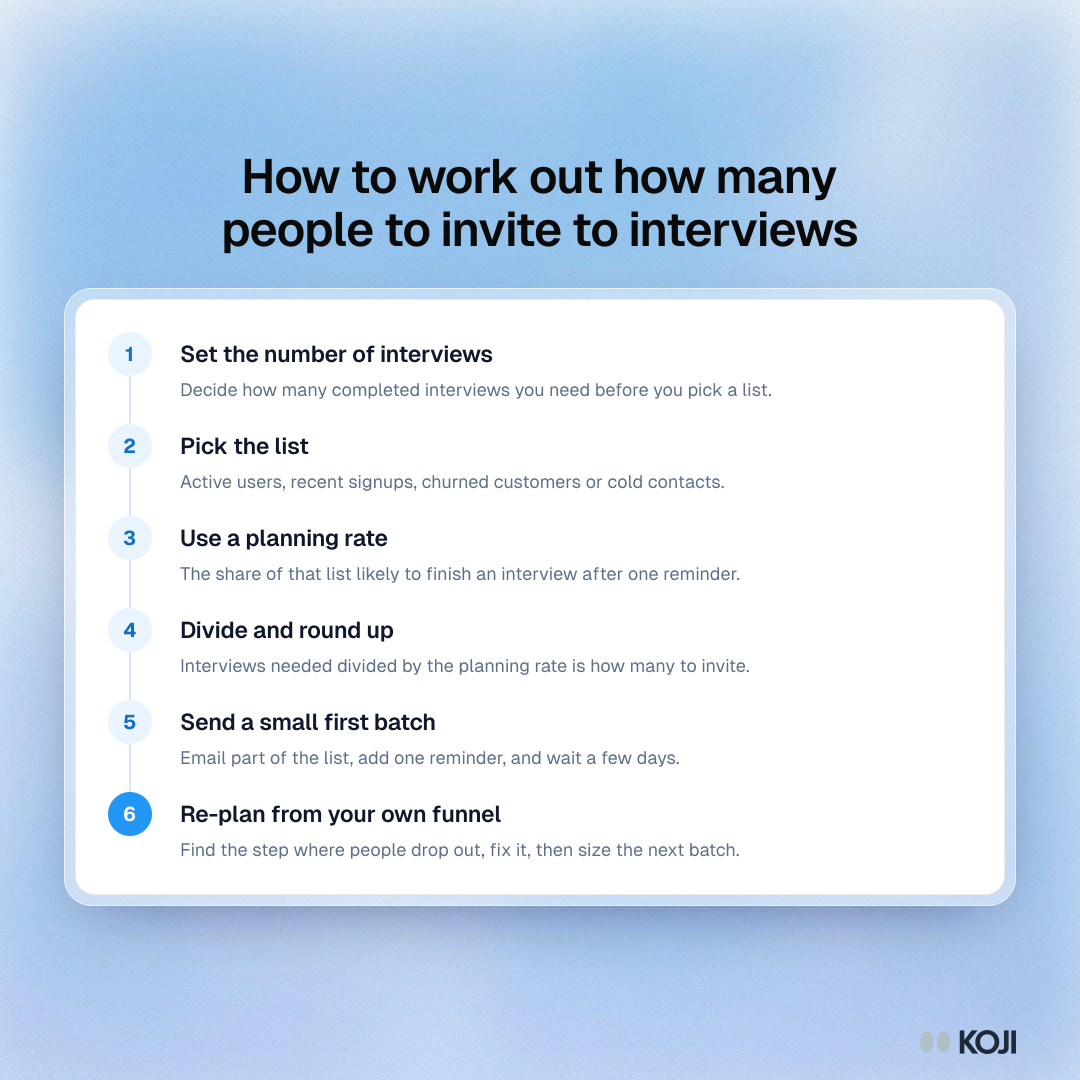
Process for sizing an interview invite: set the target, pick the list, use a planning rate, divide, send a small batch, re-plan.

Process

How to work out how many people to invite to interviews
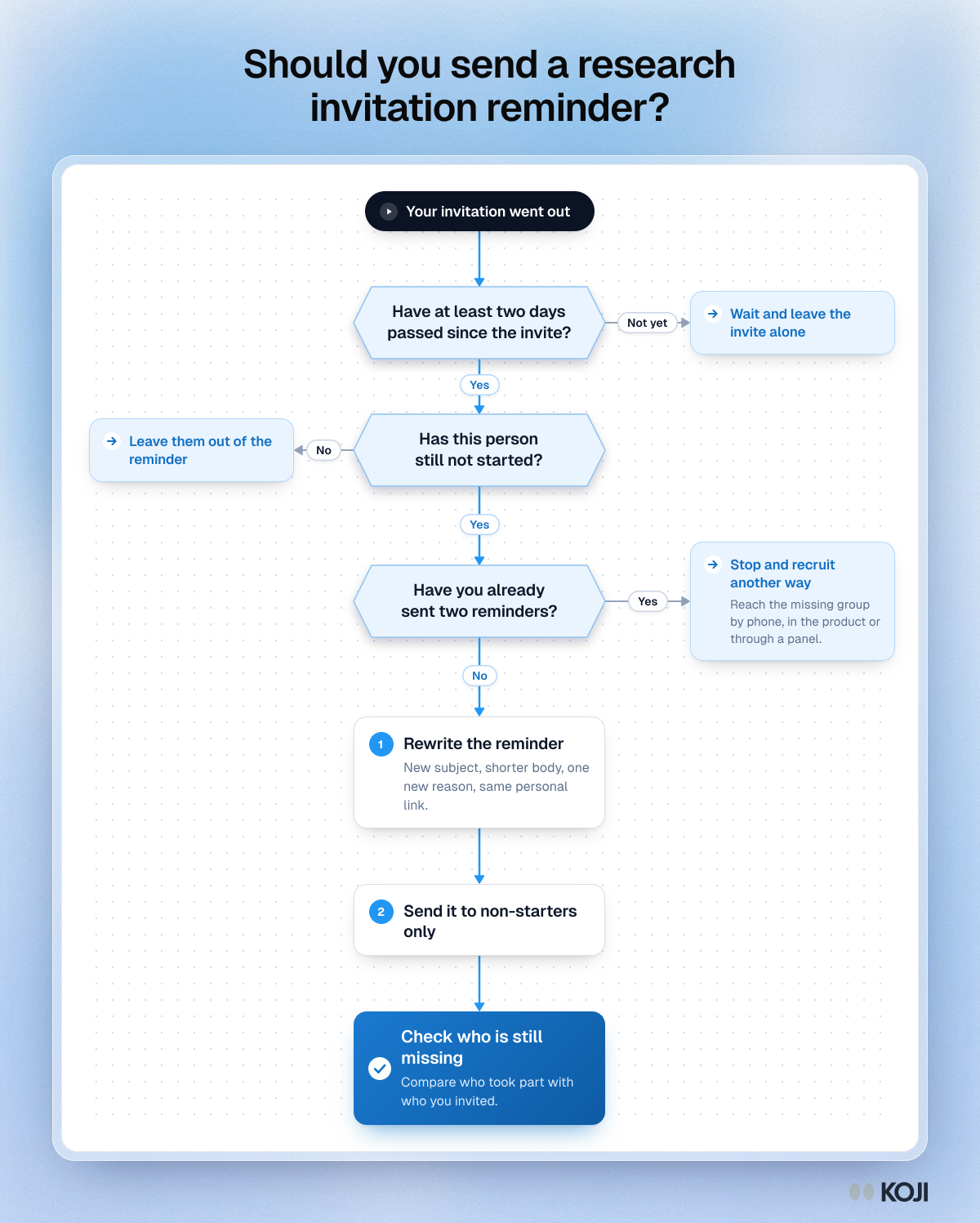
Flowchart for deciding whether to send a research reminder: wait two days, remind only non-starters, rewrite the email, stop after two.

Flowchart

Should you send a research invitation reminder?
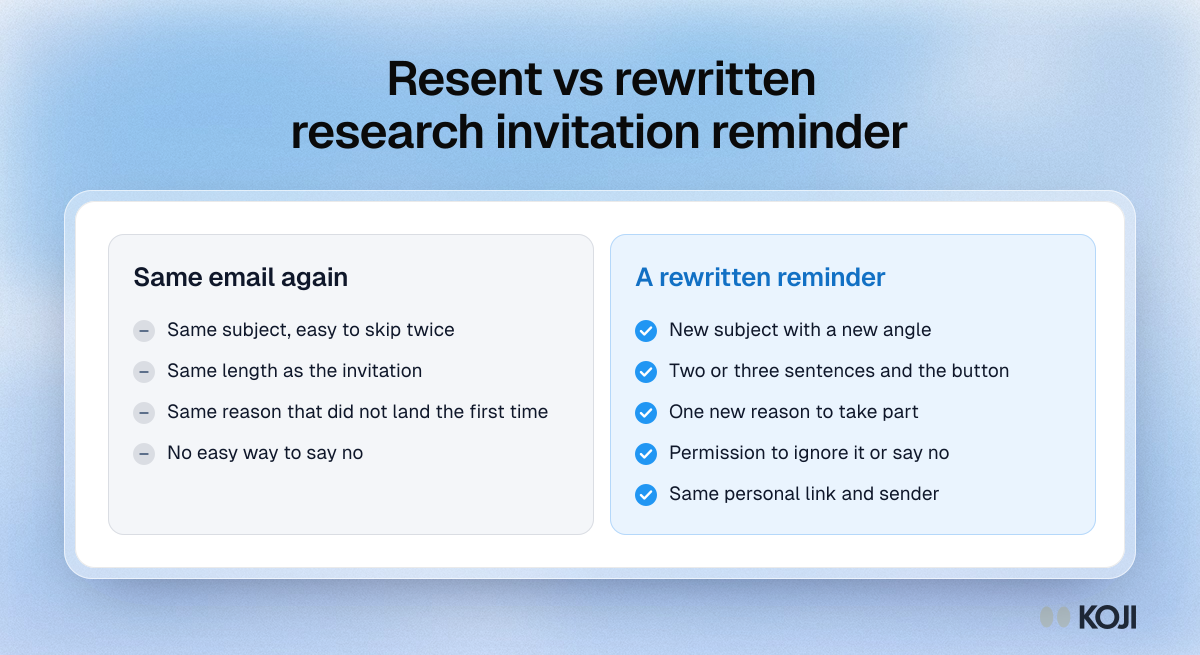
A comparison of a resent reminder and a rewritten one: the rewritten reminder has a new subject, a shorter body, a new reason and an easy way to say no.

Comparison

Resent vs rewritten research invitation reminder
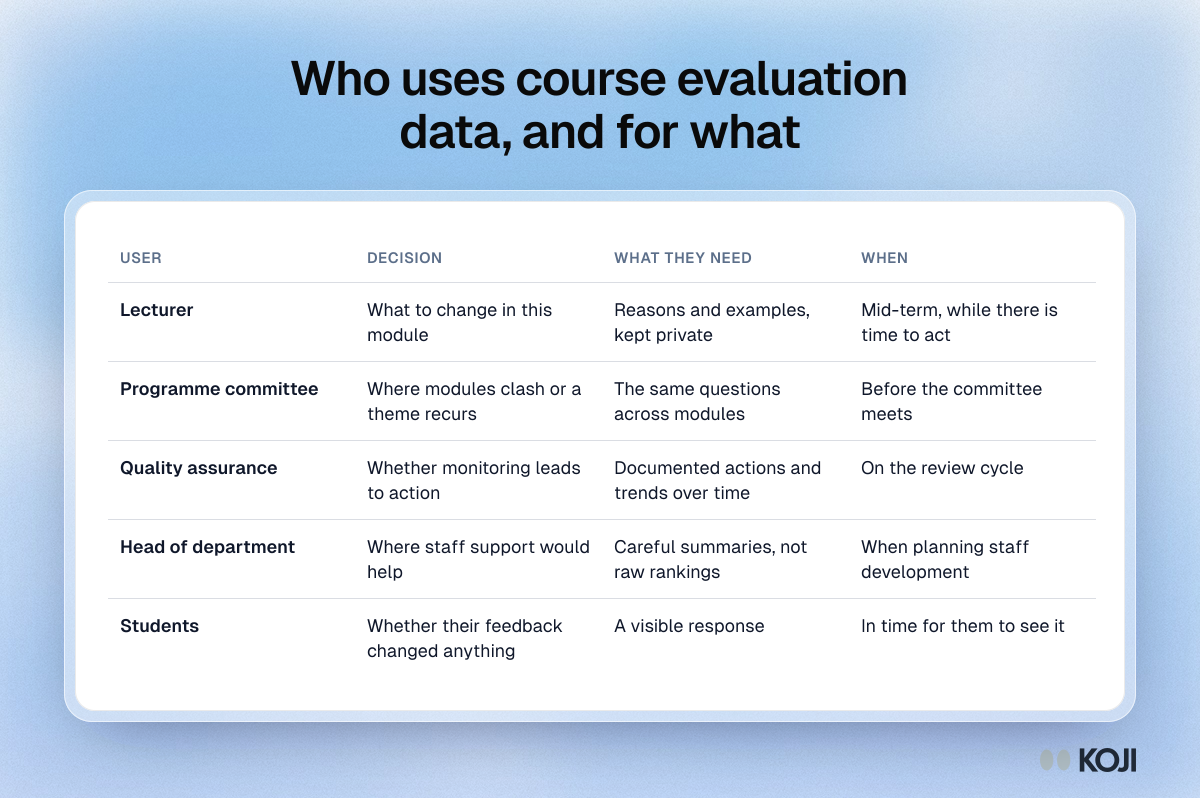
Table of five users of course evaluation data, from lecturers to students, with the decision each makes, what they need and when.

Reference table

Who uses course evaluation data, and for what
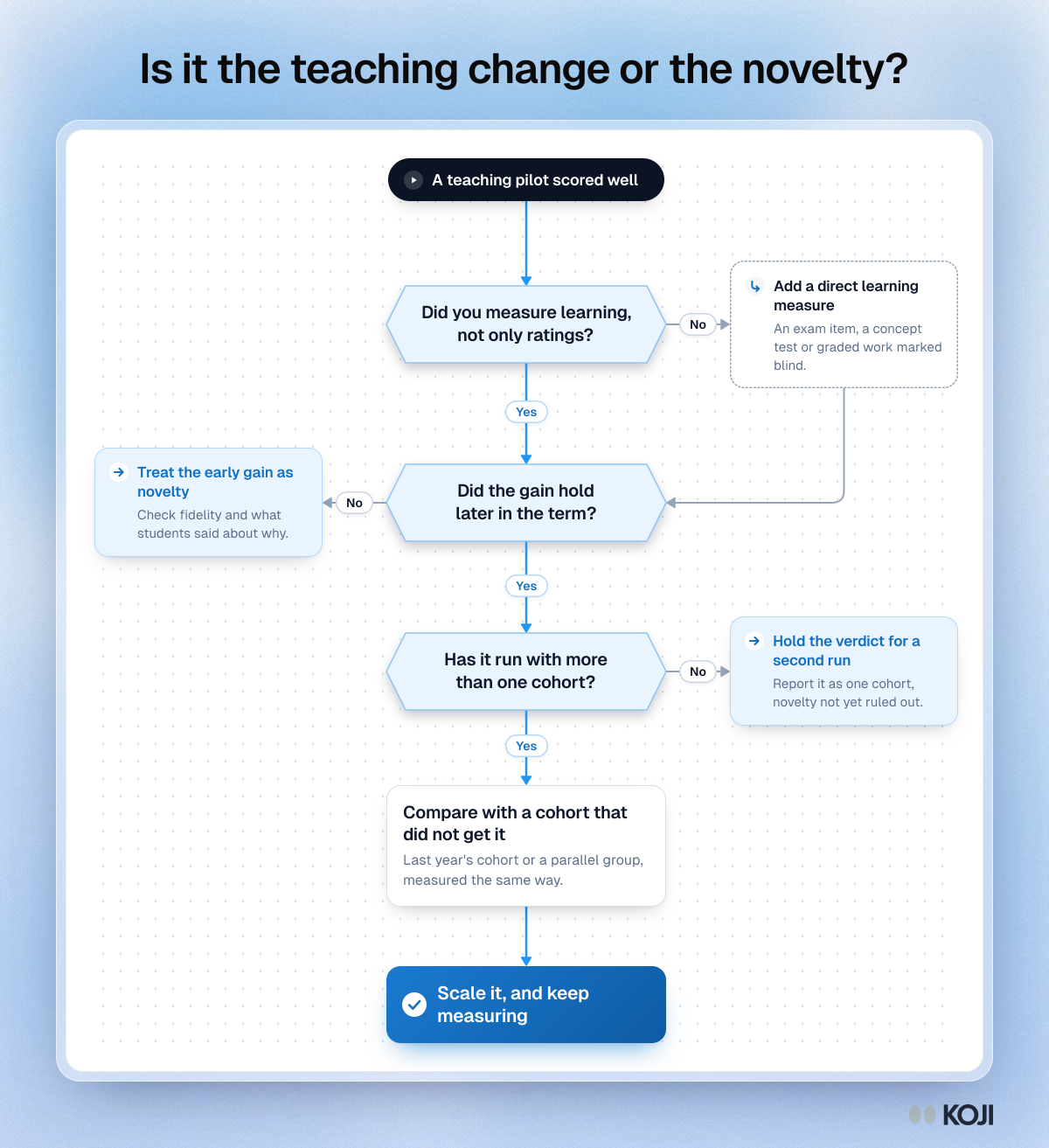
Flowchart for judging a teaching pilot: three questions on learning measures, cohorts and late-term gains, ending in a scale-up with continued measurement.

Flowchart

Is it the teaching change or the novelty?
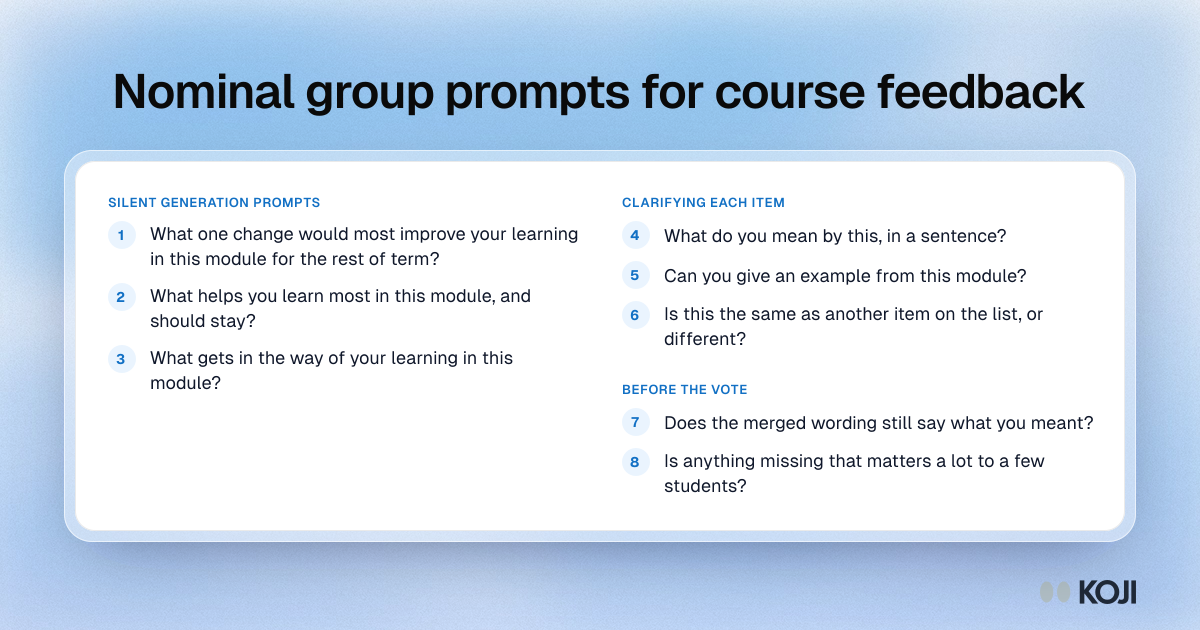
Question bank for running a nominal group session on a module: prompts for silent generation and for clarifying and voting on items.

Question bank

Nominal group prompts for course feedback
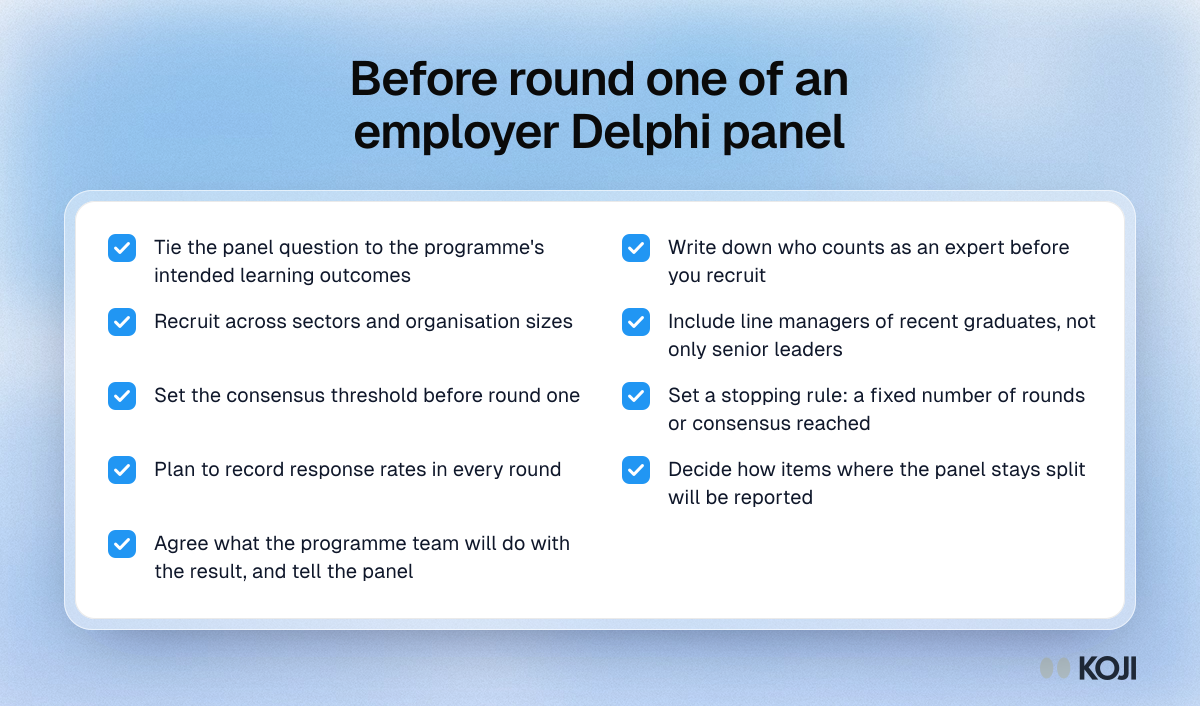
Checklist of nine decisions to make before round one of an employer Delphi panel, from the question and consensus rule to dissent and follow-up.

Checklist

Before round one of an employer Delphi panel